For decades, the Super Bowl has been the gold standard for sports-driven economic impact. One game, one weekend, hundreds of millions of dollars flowing into a host city.
But a deep dive into the data shows that major city marathons are no longer trailing behind. In cities like New York, Boston, and London, marathon weekend now delivers economic returns on par with, and in some cases greater than, the biggest game in American sports.
And it does so in a very different way.

The Super Bowl’s Short, Powerful Surge
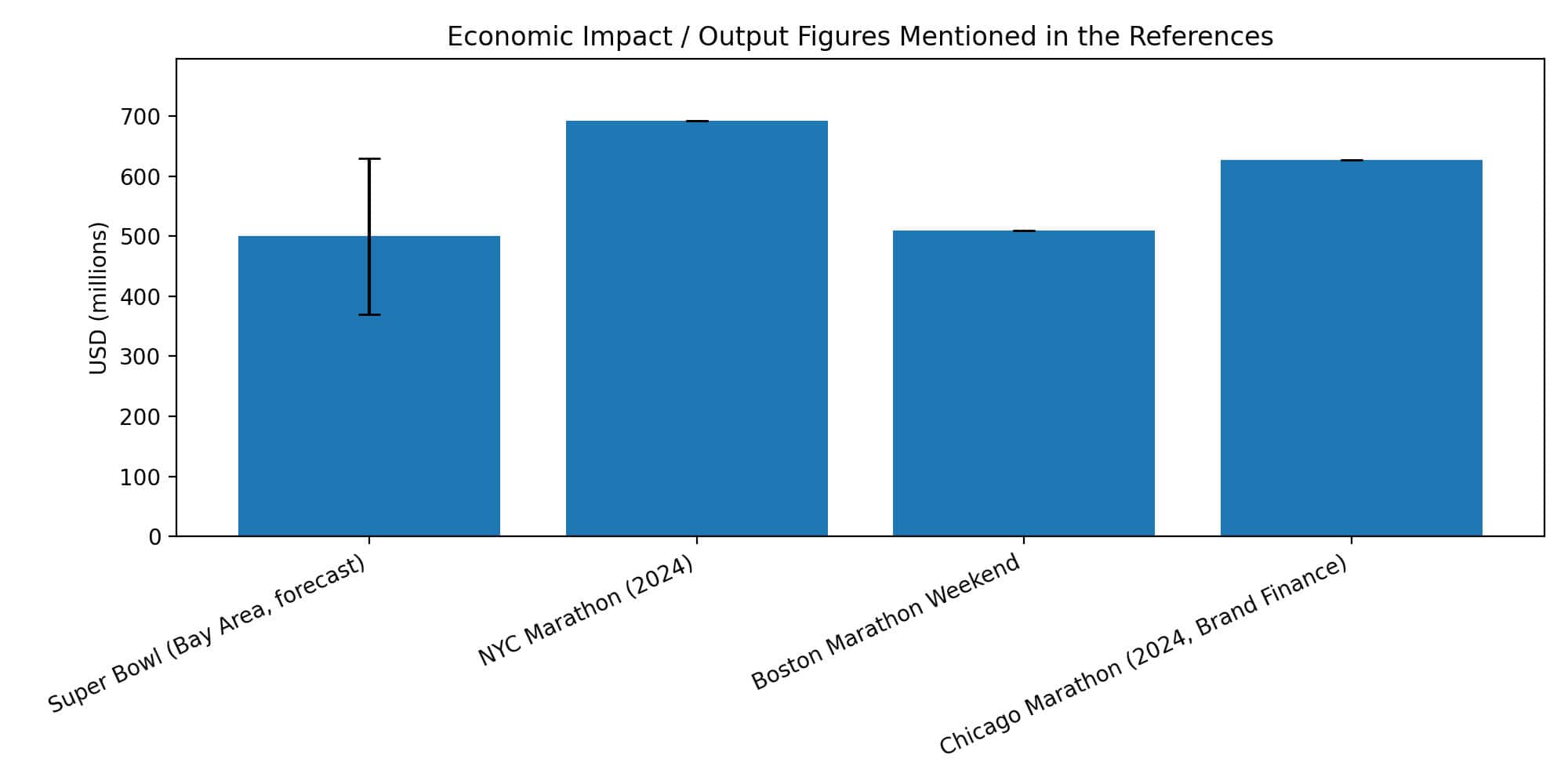
This year’s Super Bowl, played at Levi’s Stadium in Santa Clara, California, is expected to generate between $370 million and $630 million in economic output for the Bay Area, according to a report commissioned by the Bay Area Host Committee.
Last year’s game in New Orleans drew about 115,000 visitors and produced $658 million in local spending. State officials reported more than $80 million in tax revenue tied to the event.
Spending spikes sharply around the stadium. Bank of America estimates a 77 percent jump in consumer spending in nearby areas on game day, driven largely by food, drinks, and parking.
Still, hosting the game is expensive. Santa Clara expects to spend about $6.3 million on security and logistics. Other cities have paid far more. Atlanta’s Super Bowl in 2019 cost local governments an estimated $46 million.
“The economic benefits are relatively short-term, not just in duration, but also in scope,” said Michael Edwards, a professor of sport management at North Carolina State University. “They’re limited to certain industries and specific locations.”

New York’s Marathon Brings Bigger Numbers
By contrast, the TCS New York City Marathon now delivers economic impact on a similar scale, spread across more neighborhoods and over more days.
According to New York Road Runners, the 2024 New York City Marathon generated $692 million for the city’s economy. That figure matches or exceeds the economic impact of recent Super Bowls.
The race drew more than 55,000 finishers and over one million visitors. About $425 million came from visitor spending, including $178 million on hotels, $109 million on dining, and $51 million on shopping. Nearly two million spectators lined the course across all five boroughs.
Mayor Eric Adams compared the marathon’s impact directly to the Super Bowl, saying the race now sits alongside the city’s largest single-sport events.

Boston’s Long Weekend Effect
Boston offers a similar picture, scaled to a smaller city but with deep regional reach.
The Boston Marathon generates more than $509 million in state and local economic activity during marathon weekend, according to data from the Boston Athletic Association and regional tourism groups. The event supports roughly 2,900 jobs and produces more than $206 million in labor income.
More than two-thirds of participants travel from outside New England, and the median stay is three nights. Nearly 87 percent of visitors go out for food and drinks during their stay. EconomicImpact
Unlike the Super Bowl, which is concentrated in and around one stadium, Boston’s race spreads spending along the entire course, from Hopkinton to downtown Boston.

London and the Global Marathon Boom
This shift is not limited to the United States.
A 2025 report from Brand Finance found that the world’s 50 largest marathons generated $5.2 billion in economic impact in 2024, with more than half of that coming from the Abbott World Marathon Majors.
The report ranked the London Marathon as the strongest marathon brand globally and found that the New York City Marathon is the most valuable marathon brand, with an estimated value of $292 million.
Marathons also have a major charitable footprint: across the world’s top events, runners and organizers raised an estimated $425 million for charity in 2024.
The London Marathon in particular has become a fundraising phenomenon: the 2025 race set a new world record for the largest annual one-day fundraising event, generating £87.3 million for charity and bringing its cumulative total over its history to about £1.4 billion for charitable causes.
“Marathons are simultaneously elite athletic competitions and public mass participation events,” said Hugo Hensley, valuation director at Brand Finance. “That unique position is evident in the economic impact they have on the cities where they run.”
Different Models, Different Tradeoffs
The Super Bowl remains unmatched in global television reach and cultural attention.
But when it comes to sustained, citywide economic impact, major marathons are no longer playing second fiddle. In New York, Boston, London, and beyond, marathon weekend has become one of the most reliable economic drivers in sports.
For host cities, that makes marathons less of a spectacle and more of a long-term strategy.