


Most common cardio exercise types, such as running, walking, cycling, the elliptical machine, stair climbing, jump roping, and even rowing, require you to use your legs.
However, if you have a knee, hip, ankle, foot, or another leg injury, or you have a physical impairment or disability that prohibits the use of your legs during exercise, coming up with a good cardio workout without using your legs can be challenging.
However, although your doctor may advise you to take a certain amount of time off from exercising completely if you have the go-ahead to try and train, there are a few options for upper-body cardio workouts that don’t use your legs.
This article will discuss how to work your cardio without legs and examples of upper-body cardio without using legs.
We will cover:
- How to Do a Cardio Workout Without Using Your Legs
- The Best Upper-Body Cardio Workouts That Don’t Involve Your Legs
Let’s jump in!
The Honest Truth About Cardio Without Legs
The popular framing of “leg-free cardio” collapses two distinct physiological questions into one: how much running fitness can you preserve while a leg injury keeps you off your feet, and which modalities will actually deliver an aerobic stimulus that matters? The literature on cross-training and detraining gives reasonably clear answers, and they’re not always intuitive — some “upper body cardio” options barely move the needle for trained runners, while others approach the stimulus of running itself.
The specificity problem: heart-only vs muscle-specific adaptations
Cardiovascular fitness has a central component (heart, lungs, blood) and a peripheral component (mitochondria, capillaries, oxidative enzymes in the working muscle). The central component is largely transferable across modalities; the peripheral component is mode-specific 1Coyle EF, Martin WH, Bloomfield SA, Lowry OH, Holloszy JO. Effects of detraining on responses to submaximal exercise. J Appl Physiol. 1985;59(3):853-9.. This is why an injured runner can swim or row for 8 weeks and return with a cardiac platform that’s mostly intact, but the running-specific economy and capillary density will be partially lost. Holloszy and Coyle’s foundational work on muscle adaptations to endurance training documented that mitochondrial enzyme activity is largest in the muscles you train and decays in the muscles you don’t 2Holloszy JO, Coyle EF. Adaptations of skeletal muscle to endurance exercise and their metabolic consequences. J Appl Physiol. 1984;56(4):831-8.. The Mujika and Padilla detraining series found that VO2max declines by approximately 6–10 percent in 3–4 weeks of complete inactivity in trained athletes, but maintenance is largely preserved with cross-training that keeps stroke volume and central cardiovascular work intact 3Mujika I, Padilla S. Detraining: loss of training-induced physiological and performance adaptations. Part I. Sports Med. 2000;30(2):79-87..
Modalities that actually deliver a runner-equivalent stimulus
The cross-training options vary substantially in how much aerobic load they can produce, especially in someone who can’t use their legs. Arm-crank ergometry — the closest analogue to running for upper-body-only training — can elicit roughly 60–75 percent of the runner’s leg-cycling VO2max in trained subjects, because the smaller muscle mass caps the cardiac output that can be sustained 4Sawka MN, Foley ME, Pimental NA, Toner MM, Pandolf KB. Determination of maximal aerobic power during upper-body exercise. J Appl Physiol. 1983;54(1):113-7.. Rowing (when the leg drive can be replaced with arms-only or fixed-seat technique) and combined arm-leg ergometry get higher in absolute VO2 cost because they recruit more muscle, but in pure leg-out scenarios the upper-body ceiling is the binding constraint 5Sawka MN. Physiology of upper body exercise. Exerc Sport Sci Rev. 1986;14(1):175-211.. Deep-water running with a flotation belt is the highest-fidelity injury substitute for runners and can preserve VO2max within 2–4 percent of running for 4–6 weeks of injury layoff, because gait patterns and central cardiovascular load are similar to overground running while the impact is removed 6Wilber RL, Moffatt RJ, Scott BE, Lee DT, Cucuzzo NA. Influence of water run training on the maintenance of aerobic performance. Med Sci Sports Exerc. 1996;28(8):1056-62..
Heart-rate targets and intensity calibration
The single most common mistake in upper-body cardio is mis-calibrating intensity from running heart-rate zones. Maximum heart rate during arm-crank or upper-body exercise typically sits 10–15 bpm below leg-cycling or running max, because the smaller working muscle mass produces a lower cardiac demand at peak 7Sawka MN. Physiology of upper body exercise. Exerc Sport Sci Rev. 1986;14(1):175-211.. The implication: a runner who maps zone 4 from running to upper-body exercise by absolute heart rate is actually working in a zone closer to threshold, not the VO2max zone. Re-anchoring intensity to perceived effort, or to a separately-measured arm-ergometry max, is the cleaner approach 8Borg G. Borg’s Perceived Exertion and Pain Scales. Human Kinetics; 1998.. Total session duration also has to be longer in upper-body cardio to deliver equivalent training load: a 60-minute arm-crank session may be needed to match the central load of a 45-minute run because of the lower absolute work rate, and the small-muscle mode tires out localised muscle groups before central cardiovascular fatigue limits the session 9Volianitis S, Krustrup P, Dawson E, Secher NH. Arm blood flow and oxygenation on the transition from arm to combined arm and leg exercise in humans. J Physiol. 2003;547(2):641-8..
Maintenance vs build: how long the substitute window holds
Cross-training is more effective at preserving fitness than at building it for runners. Mujika and Padilla’s detraining work documented that 6–8 weeks of well-executed deep-water running maintains VO2max within 1–3 percent of pre-injury baseline, but does not appreciably build it past that 10Mujika I, Padilla S. Detraining: loss of training-induced physiological and performance adaptations. Part I. Sports Med. 2000;30(2):79-87.. The same is broadly true of cycling, rowing, and arm-crank ergometry — they preserve, but slowly. The corollary is that long injury layoffs (more than approximately 8–12 weeks) start to lose meaningful running-specific adaptation regardless of cross-training quality, particularly the bone-loading and tendon-stiffness adaptations that are mode-specific 11Arampatzis A, Karamanidis K, Albracht K. Adaptational responses of the human Achilles tendon by modulation of the applied cyclic strain magnitude. J Exp Biol. 2007;210(Pt 15):2743-53.. Returning runners should expect a gradual ramp back rather than a clean continuation; sudden volume jumps after a layoff are the dominant predictor of recurrent injury 12Nielsen RO, Buist I, Sorensen H, et al. Training errors and running related injuries: a systematic review. Int J Sports Phys Ther. 2012;7(1):58-75..
When the substitute is more burden than benefit
Two situations make cross-training a worse choice than rest. First, when the cross-training modality involves the same tissue as the injury — aggressive arm work after a chest injury, deep-water running with an unstable foot fracture, cycling with a hip stress reaction. Loading the injured tissue indirectly slows healing and the “low-impact” framing can be misleading. Second, when the cross-training drives systemic fatigue that competes with healing — the energy-availability literature shows that high-volume training, even non-impact, raises overall energy demand and can divert resources from tissue repair if calorie intake doesn’t scale up 13Mountjoy M, Sundgot-Borgen JK, Burke LM, et al. IOC consensus statement on relative energy deficiency in sport (RED-S): 2018 update. Br J Sports Med. 2018;52(11):687-97.. The honest reading: cross-training is the right tool for short-duration leg injuries (1–6 weeks) where preserving fitness pays back faster than rest costs, and the wrong tool for severe acute injuries where systemic recovery should be the priority. The choice of modality matters less than choosing the right intensity, duration, and total weekly load to avoid converting an injury layoff into an injury recurrence.
How to Do a Cardio Workout Without Using Your Legs
The overarching purpose of a cardio workout also called an aerobic workout, is to increase your heart rate so that you challenge and strengthen your cardiovascular system.
According to the American College of Sports Medicine, to qualify as a moderate-intensity “cardio” workout, your heart rate should be in the range of 64-76% of your maximum heart rate, while vigorous-intensity cardio is associated with a heart rate of 77-95% of your max.
To meet the guidelines for physical activity for adults set forth by the Centers for Disease Control and Prevention and the British Heart Foundation, you should aim to accumulate either 150 minutes of moderate-intensity aerobic exercise or 75 minutes of vigorous-intensity cardio exercise per week.
For this reason, it can be helpful to wear a heart rate monitor during your cardio workouts to get a sense of your true effort level and the physiological impact of your workouts.
The Best Upper-Body Cardio Workouts That Don’t Involve Your Legs
Here are some ideas for cardio without using legs but with your upper body instead:

#1: Arm Ergometer
One of the best types of cardio that doesn’t require legs is the upper-body ergometer, or arm ergometer.
This is essentially a stationary arm bike or exercise bike for the arms.
These types of exercise bikes are typically found in physical therapy settings, but certain commercial and community gyms, such as YMCAs, also tend to have one or two on hand as well.
To use an arm ergometer, sit upright in the seat and then hold onto handles that you can then pedal with your arms.
Like a regular exercise bike, you can adjust the resistance and pedal at a faster cadence to increase the intensity.
You can also do intervals to give you more of a cardio workout without legs.
If you want to create an arm bike on a budget, you can buy a small under-desk cycle and place it on top of a desk or table.
These inexpensive units don’t usually have as many resistance levels, and the ergonomics aren’t usually optimized for long, vigorous arm cardio workouts in the way that upright arm ergometer bikes are, but they can be a good budget-friendly option if you have a leg injury and want to do upper-body cardio workouts at home.

#2: Pull Buoy Swimming
Swimming can be a great upper-body workout.
To focus on your arms to do cardio without legs, you can allow your legs to simply rest in the water while you vigorously perform free stroke with your arms.
If you need to do a cardio workout without using your legs at all, you can use a swimming tool known as a pull buoy.
This is essentially the opposite of a kickboard, in which you are resting your arms and working your legs.
Instead, you place a small piece of foam between your legs, which gives them buoyancy and requires you to keep them stationary to hold the pull buoy in place.
Then, you can focus on just using your upper body and core to swim, keeping your legs entirely uninvolved during the upper-body cardio workout.
#3: Chair Cardio Workout
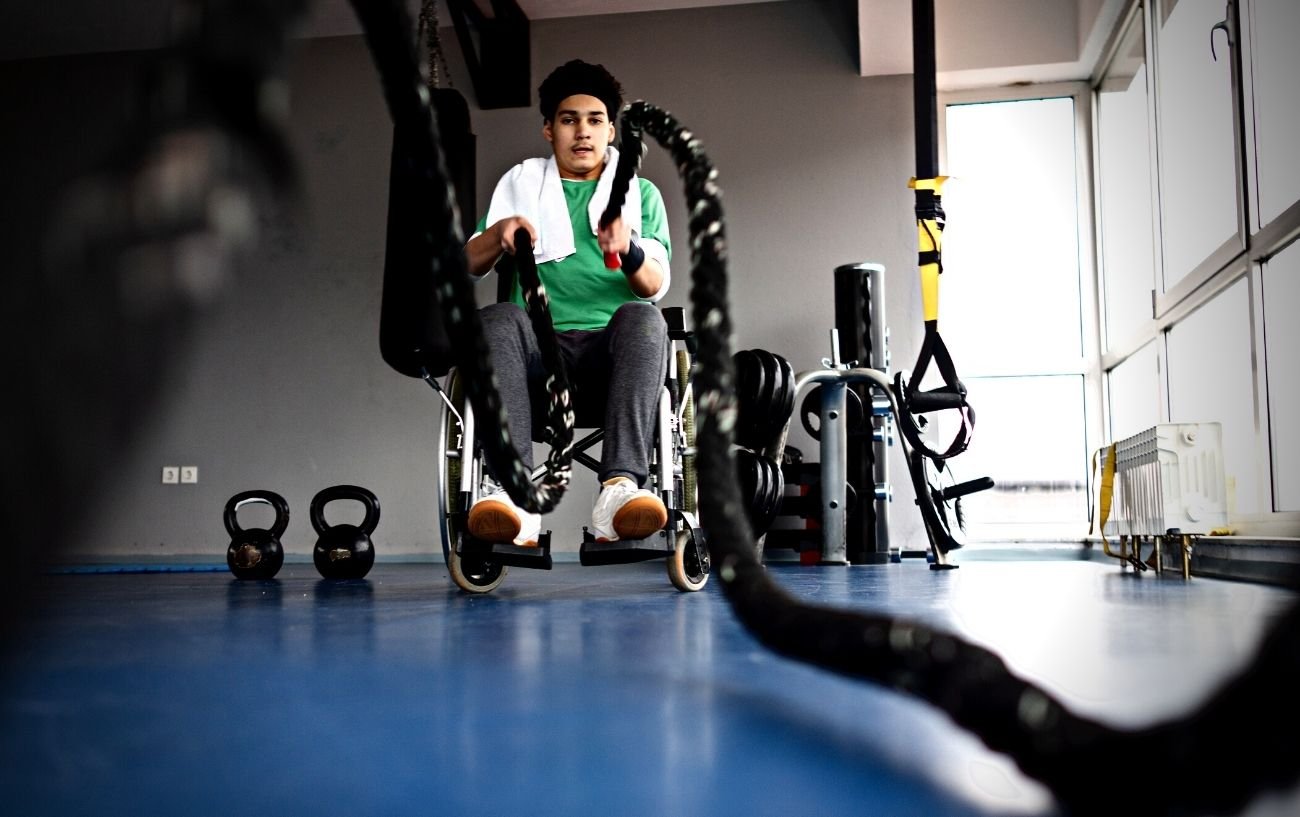
If you are in a wheelchair, have mobility impairments, or have a musculoskeletal injury that requires you to be entirely non-weight-bearing, you can also do a seated cardio workout without legs.
There are many free chair cardio workouts on YouTube, or you can create your own.
Put on some upbeat music, and then perform different intervals of cardio exercises for the arms.
For example, you can grab a pair of light dumbbells and do rapid punches forward for 60 seconds, alternating to each side for 60 seconds and then overhead for 60 seconds. Then, do running arms with the dumbbells, pumping vigorously alongside your body.
Complete five rounds for a 20-minute cardio workout without legs.

#4: Upper-Body Rowing
Rowing is a total-body workout, even though we often consider it an upper-body cardio exercise.
With that said, you can modify a rowing machine to do cardio that doesn’t require legs.
If you can’t use either leg, place your feet down on the floor on either side of the rail rather than strapped into the footplates. Then, pull the handlebar with your arms.
You won’t row as fast or far with each stroke, but it’s a good way to get your heart rate up without using your legs.
If you have an injury in one foot or leg but have use of the other, you can strap your good foot into the rower as usual, and then you can place your injured foot on a skateboard and roll it back and forth on the ground as you row.
This will give you more of a total-body cardio workout.

#5: Kayaking
Kayaking or canoeing only involves the upper body. If you paddle vigorously, you can keep your heart rate elevated and get a good cardio workout without using the lower body.
#6: Stand-Up Paddleboarding
If you can stand, stand-up paddleboarding can be an excellent cardio and strengthening workout when you can’t use your legs. You can also kneel or sit on the board and paddle if you are unable to stand.
Stand-up paddleboarding is also a great core workout because you have to balance and stabilize your body against the moving water, and when you are pushing against water resistance on only one side of your body at a time.
#7: Arm Aqua Jogging
Aqua jogging with a flotation belt can be a good upper-body cardio workout without using your legs.
Pump your arms vigorously to stay afloat and raise your heart rate. Keep your legs still if you’re unable to use them. The flotation belt will help keep you buoyant.

#8: Boxing
If you can stand up, you can hit a punching bag or speed bag with boxing gloves or do shadow boxing for a high-intensity cardio arm workout. You can also sit in a chair if you’re unable to stand up or be weight-bearing.
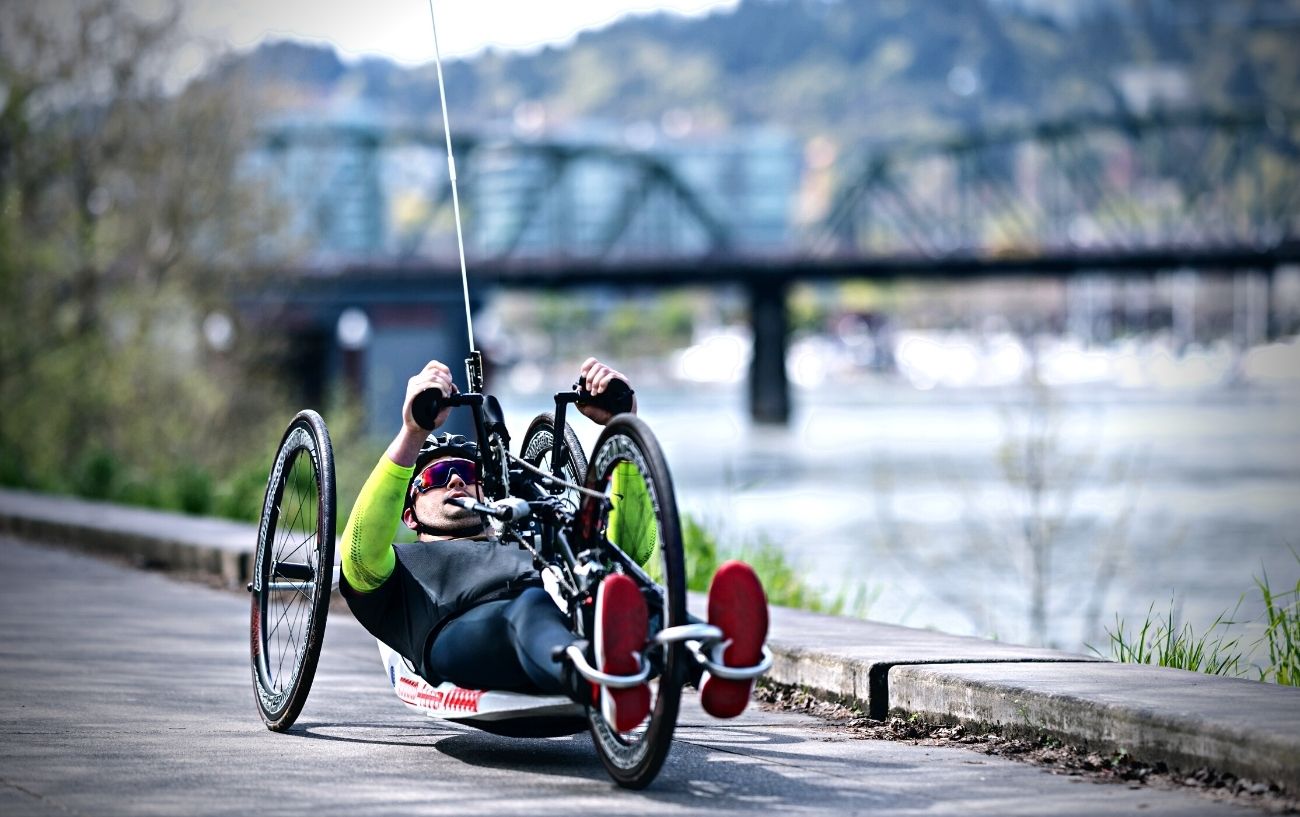
#9: Handcycling
Like using an arm ergometer or upper-body stationary arm bike, hand cycling is biking outdoors but using a specialized cycle that uses an arm crank instead of leg pedals. This enables you to get a challenging cardio workout without using your legs.
Plus, you get to exercise outdoors, which can help the time pass more quickly and enable a far more enjoyable workout than when using an arm bike indoors.
#10: Rope Climbing
Pulling your body up a rope is an extremely challenging workout from a cardiovascular and strength perspective.
There are also rope climbing machines, which are essentially an endless rope like a stair climber machine, but it is quite difficult to find these in most gym facilities.

#11: Upper-Body Circuit Training
One way to get a cardio workout without legs is to perform upper-body circuit training.
You can use lighter weights and higher repetitions and eliminate the rest between exercises. This will help keep your heart rate elevated throughout the duration of the workout. Lift vigorously and rapidly, focusing on using good form.
For example, you might do 60 seconds of bicep curls, 60 seconds of chest press, 60 seconds of chest fly, 60 seconds of dips, 60 seconds of weighted punches, 60 seconds of forward raises, 60 seconds of lateral raises, 60 seconds of overhead presses, 60 seconds of overhead punches, and 60 seconds of reverse fly.
Complete three rounds and you have a good 30-minute upper-body cardio workout that also strengthens your muscles.
Overall, it is more challenging to get an intense cardio workout without your legs because most of your muscle mass is found in your lower body, and most of the common cardio exercises involve your legs in one way or another. However, it is possible to do cardio without legs with a little creativity.
If you have a specific injury, it can also be helpful to consult a physical therapist for individualized advice, so they can prescribe you exercises that are safe to perform while you are recovering.
For some rowing intervals, you can check out our rowing machine workouts; just don’t use your legs!

References
RunClub — Free
Join 300,000+ runners in RunClub
Free training plans for every distance, a daily running game, exclusive coaching content, and a real community of runners. Create your free account in 20 seconds — no card.
Already a member? Log in →








Join the conversation
Thanks! I'm going to have a meniscus repair soon. I need ways to stay "active" without putting any weight on my leg (for 8 weeks)! I have been doing pretty good at the gym, so I don't want to lose it all sitting at home on the couch for 8 weeks after this surgery! Hopefully I can get back to 10K a day quickly!
Hii there Amber, thanks a lot for this guide, I think I will do a combination of the 11 with the 8!
I am going through some problems with my knees and I wanted to look for other ways to do "cardio".