


If you’ve ever finished a run with tight, aching legs — or cut a workout short because something pulled in the back of your thigh — your hamstrings are probably trying to tell you something.
Hamstring injuries are among the most common in running, and they’re also among the most stubborn to recover from.
Yet despite this, most runners pour their energy into quad strength, calf work, and hip mobility while their hamstrings get almost no dedicated attention. It’s one of the most consistent gaps we see in runner training — and one of the most costly.
Your hamstrings aren’t just along for the ride. They’re active in every stride, responsible for both driving your leg back during the power phase and controlling your knee as your foot swings forward.
They absorb impact, support your pelvis, and work in close coordination with your glutes to keep your running mechanics efficient. When they’re tight, weak, or underrecovered, everything from your pace to your posture pays the price.
The good news: a few targeted stretches done consistently — especially after runs and long workouts — can make a significant difference in flexibility, recovery, and injury resilience.
This guide covers the eight best hamstring stretches for runners, along with what the hamstrings actually do, how they contribute to your performance, and how to stretch them properly so the work sticks.

What Exactly are the hamstring muscles?
The three main muscles in our hamstrings are the biceps femoris, semimembranosus, and semitendinosus. They are used primarily to bend the knees and extend and rotate the hips.1Rodgers, C. D., & Raja, A. (2023, April 1). Anatomy, Bony Pelvis and Lower Limb, Hamstring Muscle. PubMed; StatPearls Publishing. https://www.ncbi.nlm.nih.gov/books/NBK546688/ These muscles begin at the pelvis and run along the femur. Let’s quickly break down these three separate muscles and see what each does:
The biceps femoris is the outer part of the thigh. It allows knee flexion, hip extension, and the lateral rotation of the tibia.
The semimembranosus is the back part of the thigh. It allows knee flexion, hip extension, and rotation of the tibia while the knee is bent.
The semitendinosus is also located at the back of the thigh, between the other two hamstring muscles. It allows knee flexion, hip extension, and rotation of the tibia with a bent knee, just as the semimembranosus does.
Now that we’ve got the anatomy figured out, let’s see why our hamstrings are so important to our running.

How Do My Hamstrings Help Me Run?
The hamstrings play a central role in running mechanics — far more than most runners appreciate.
Working alongside the glutes, the hamstrings are primary drivers during the push-off phase of each stride, generating force against the ground to propel you forward. The stronger your hamstrings, the more power you can produce with each stride — which means greater speed and better running economy over time.
But their job doesn’t stop at push-off. During the “swing-through” phase2Roland, Jens, & Jesper Bencke. (2017). COMPARISON OF HAMSTRING MUSCLE ACTIVATION DURING HIGH-SPEED RUNNING AND VARIOUS HAMSTRING STRENGTHENING EXERCISES. International Journal of Sports Physical Therapy, 12(5), 718. https://pmc.ncbi.nlm.nih.gov/articles/PMC5685404/ — the moment before your foot returns to the ground — the hamstrings act as a brake, decelerating the lower leg and preventing the knee from hyperextending.
The hamstrings also help stabilize the knee throughout the entire gait cycle, absorbing the impact forces that travel up through the leg with every foot strike.
Over the course of a long run, that adds up to thousands of repetitions, which is exactly why hamstring strength and flexibility aren’t optional extras. They’re foundational to running faster, staying efficient, and staying healthy.
Here are some of the exercises you can incorporate into your strength training program to build stronger, more resilient hamstrings
- Single-Leg Romanian Deadlifts
- Nordic Hamstring Curls
- Stability Ball Hamstring Curls (single and double leg)
- Eccentric Bridges
- Hip Thursts
- Bulgarian Split Squats
- Kettlebell Swings

In addition to strengthening your hamstrings, warming them up correctly is another piece of the training puzzle.
You can do so by adding dynamic stretching before each run.
The Frankenstein and Scoops are excellent dynamic hamstring stretches for runners that you can add to your pre-workout routine:
Frankenstein

- Stand tall with your back straight, core tight, and your arms extended out in front of you.
- Lift your right leg as close to your extended right or left arm as possible, keeping your knee extended and your back straight. Do not bend over to reach for your foot. Bring your foot up as close as possible to your hand with the eventual goal of tapping it.
- Alternate legs. You can do this exercise in place or by walking forward.
Scoops

- Stand with your feet hip-width apart.
- Step your right foot forward slightly, placing your right heel on the ground and flexing your foot.
- Bend your left knee slightly.
- Bend at the waist and bring your arms in a fluid scooping motion toward your right foot and follow through, bringing them back to the initial position.
- Repeat for 30 seconds on one side, and then repeat on the other.
Along with strengthening your hamstrings, stretching them out after your runs can also improve your performance and lower your risk of injury.
Before we jump into the specific hamstring stretches, let’s look at the general rules for stretching your muscles out after a workout or run.
Tips For Static Stretching
- Hold each stretch for between 30 and 45 seconds to reap optimal benefits.
- Try to relax your muscles while holding each stretch.
- Breath deeply while you stretch. With each exhale, you can gently stretch the muscle a bit more.
- Stretch your muscles gently. You should feel mild tension but not pain. If you feel pain, let up on the stretch or stop altogether.
The Best 8 Hamstring Stretches For Runners
#1: Standing Toe Touch Hamstring Stretch

The standing toe touch is most likely the most straightforward hamstring stretch:
- Stand tall with your feet hip-width apart.
- Bend at the hips and reach for your toes while keeping your legs and back straight.
- Hold for 45-60 seconds.
#2: Cross Over Hamstring Stretch

This one is a slight variation on the previous stretch, crossing one foot over the other.
- Stand tall and cross your right foot over your left, lining up your feet close together.
- Lower your upper body toward your feet, slowly bending your knees ever so slightly.
- Reach toward your toes, or if you are more flexible, you may need to place your palms flat on the floor.
- Hold for 45-60 seconds.
- Repeat on the other side.
#3: Single Leg Forward Fold Hamstring Stretch

- Stand with your feet hip-width apart.
- Step your right foot forward slightly, placing your right heel on the ground and flexing your foot.
- Bend your left knee slightly.
- Bend at the waist and bring your torso toward your extended legs until you feel a stretch, keeping your back completely straight.
- Hold for 45-60 seconds.
- Repeat on the other side.
#4: Triangle Forward Fold Hamstring Stretch

- Stand tall with your feet slightly wider than shoulder-width apart.
- Reach first toward your right toes, or if you are more flexible, you may need to place your palms flat on the floor.
- Hold for 45-60 seconds.
- Slowly bring yourself back up to the starting position.
- Now reach for your left toes and repeat.
- Hold for 45-60 seconds.
#5: Half Split Hamstring Stretch

- Start in a lunge position with your left leg in front of you at 90 degrees and your right knee on the ground directly underneath your body.
- Extend your left leg in front of you gently, and place your heel on the ground.
- Keep your back straight, bend forward at the hips, and reach toward your left foot.
- Hold for 45-60 seconds.
- Repeat on the other side.
#6: Seated Forward Fold Hamstring Stretch

- Sit on the floor with your legs extended straight out in front of you and your feet pointed up.
- Reach toward your toes, grabbing on to them if you can. If not, you can hold onto your ankles or shins to maintain the position.
- Hold for 45-60 seconds.
#7: The Hurdler Hamstring Stretch

- Sit on the floor with your left leg extended straight out in front of you.
- Bend your right leg at the knee and place the sole of your right foot on your left inner thigh.
- Bend at the waist and reach both arms toward your extended left foot, grabbing on to them if you can. If not, you can hold onto your ankle or shin to maintain the position.
- Hold for 45-60 seconds.
- Repeat on the other side.
#8: Lying Hamstring Stretch With Resistance Band
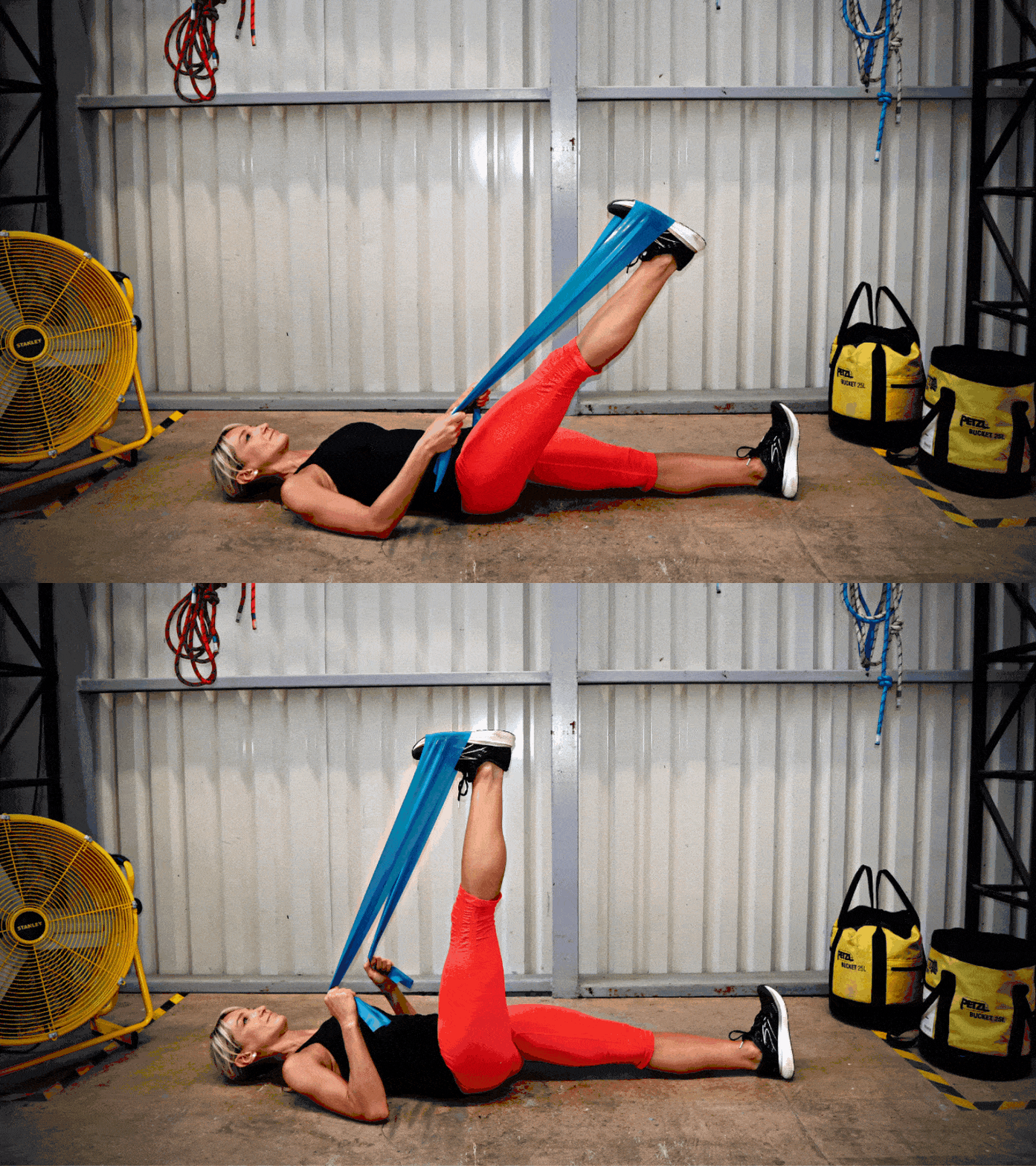
- Lie on your back with your legs extended out in front of you.
- Loop a resistance band around the sole of your right foot and hold each side of the resistance band in either hand.
- Lift your right leg towards you until it is perpendicular to your body.
- Using the resistance band, gently pull your leg toward your body until you feel a stretch, keeping your knee extended.
- Keep your back and other leg flat on the floor at all times.
- Hold for 45-60 seconds.
- Repeat on the other side.
Remember, your hamstrings aren’t the only muscles you need to stretch out after a run or workout. Include your calves, quads, glutes, and any other muscles you used in your stretching routine for a complete cooldown.
To continue adding to your stretching exercise library, here are our check out this next guide:
References
RunClub — Free
Join 300,000+ runners in RunClub
Free training plans for every distance, a daily running game, exclusive coaching content, and a real community of runners. Create your free account in 20 seconds — no card.
Already a member? Log in →


Join the conversation
Very useful