


Life is always a balancing act, with shifting priorities and responsibilities, and we sometimes eliminate activities we deem nonessential in order to focus on more important tasks. Running, for example, may fall by the wayside once children come along.
While everything seems to change when you become a parent, with a bit of imagination and planning, running can remain a part of your life even when your children are very young.
Today, I’m sharing some ways I managed to keep covering the miles when my children were young.
Everyone has their own particular circumstances, of course, so every suggestion will not work for every person, but if you have decided running is important to you, these ideas may help you discover ways to fit running into your life.
When Running Suddenly Got Complicated
I’ve always enjoyed running, and even when going to school or working, I found it relatively easy to find time for a daily run.
While pregnant with my first child, I continued to run and, somewhat inexplicably, did not give much thought to how I would keep running once I gave birth.
Once my son was born, however, I quickly discovered that my days of simply grabbing my shoes and heading out the door for a run whenever I wanted had come to an end.
I was initially somewhat overwhelmed by my new responsibilities and lack of sleep, but with what I now see as unfounded optimism, I figured things would soon smooth out and I would resume running.
When my son was three months old, however, I returned to my full-time job and had not even gone for a run.
Moreover, my husband became the stay-at-home parent, and it did not seem fair for me to arrive home after being gone for nine or ten hours and expect him to remain in charge while I went out for a run.
He clearly needed a break and time to take care of his own work projects, and I, of course, wanted to spend time with my child, whom I had not seen all day.
Faced with this situation, I feared my running days might be over, at least for a while.
Knowing that running was key to maintaining my sanity, however, I decided it was a priority, and with a bit of creativity, planning, and flexibility, I was able to run as many miles when my children were small (a second son came along three years later) as I was before we had children.
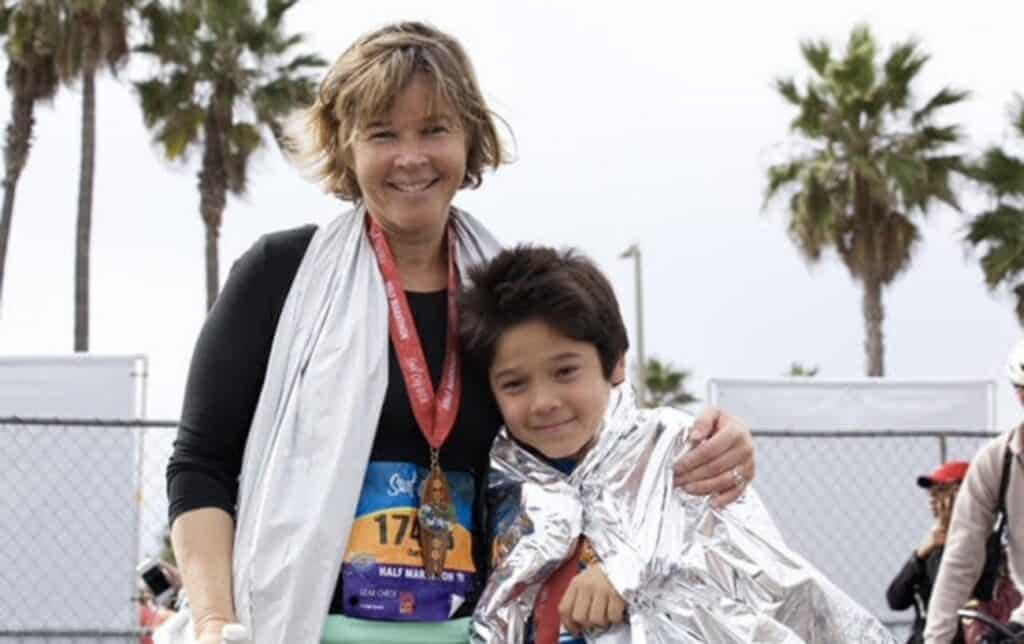
How Running Makes Me a Better Parent
If you’ve ever been a new parent, you know that between sleepless nights, feedings, and endless responsibilities, even finding time to shower or eat can feel like an accomplishment.
In that whirlwind, running might seem impossible—or even indulgent. But for me, getting back to it was what kept me grounded.
Running boosted my energy, cleared my head, and helped me show up as a better parent and partner.
It became precious time to reset—sometimes with a podcast, sometimes just with the sound of my footsteps—and those miles made all the difference in my patience and perspective.
More than that, I realized that taking care of my body wasn’t selfish; it was an investment in my family’s well-being and a way to model healthy habits for my kids.
The Cardinal Rule: Learn When To Say No
When I first tried to squeeze running back into my routine after having kids, I quickly realized that the most challenging part wasn’t lacing up—it was saying no. No to extra commitments, no to overfilling my schedule, and sometimes, no to things that seemed important but weren’t essential.
I had to make peace with the fact that running was a priority—not the priority—but one that mattered enough to protect. Once I acknowledged that, it became easier to structure my days around it. I learned to leave space for runs by being more selective about what I said yes to.
Time and energy are finite, especially when parenting drains most of both. But by setting boundaries and learning to let go of the “shoulds,” I created room for what fueled me, including running. And in doing so, I became more present not only on the road but also at home.
Related: 8 Best Running Games for Kids
Look For Opportunities To Scale Back Your Commitments
There are many areas of life where it’s perfectly reasonable to scale back, especially during those early years when your children are small and your time feels stretched thin.
If you’re the type of person who naturally says yes to volunteering, helping with projects, or taking on extra commitments, it may be time to practice saying no, at least for now.
School Volunteer Commitments
This skill becomes especially valuable once your child starts school, when opportunities to “get involved” seem endless. You’ll be asked to chaperone field trips, organize classroom parties, join committees, sew costumes, and bake cookies for fundraisers.
If those things genuinely bring you joy, by all means, say yes. But it’s also okay, healthy, even, to recognize your limits. In my experience, these well-intentioned commitments often took far more time and energy than I expected.
And the truth is, my child’s school experience wasn’t any better or worse because I didn’t volunteer for every activity. Once I realized that, I felt comfortable saying no to some of the requests and saving that time for other things, like a quiet run or a family dinner.
Re-examine Your Work Obligations
It’s also worth taking a closer look at your work commitments and seeing where you can reasonably scale back.
While I continued to give my best effort during work hours, I made a conscious decision to stop volunteering for extra projects, skip the optional committees and event planning, and avoid staying late unless it was absolutely necessary.
I also made sure to actually use my vacation days instead of letting them pile up.
Of course, everyone’s work situation is different, but it’s worth evaluating your own. You may find there’s room to adjust your schedule, take on fewer additional responsibilities, or even reduce your hours temporarily.
A small shift at work can make a big difference in freeing up time and mental space for running, rest, and family.

How to Fit Your Runs Into Real Life
Finding some free moments in your schedule, however, is only one part of the puzzle, as you still have a child depending on you around the clock. So, the other part of the puzzle is figuring out how to run while still meeting your parenting responsibilities.
The options at this point fall into two categories: running with your child and running on your own.
5 Tips For Running With Your Child
Running with a newborn isn’t recommended, as babies need time to develop proper head and neck control. However, you can absolutely start by walking, either with your baby snuggled close in a carrier or safely tucked into a stroller.
These walks are not only a gentle way to get your blood flowing and ease back into movement, but they also offer a wonderful opportunity to bond with your baby and enjoy some fresh air together.
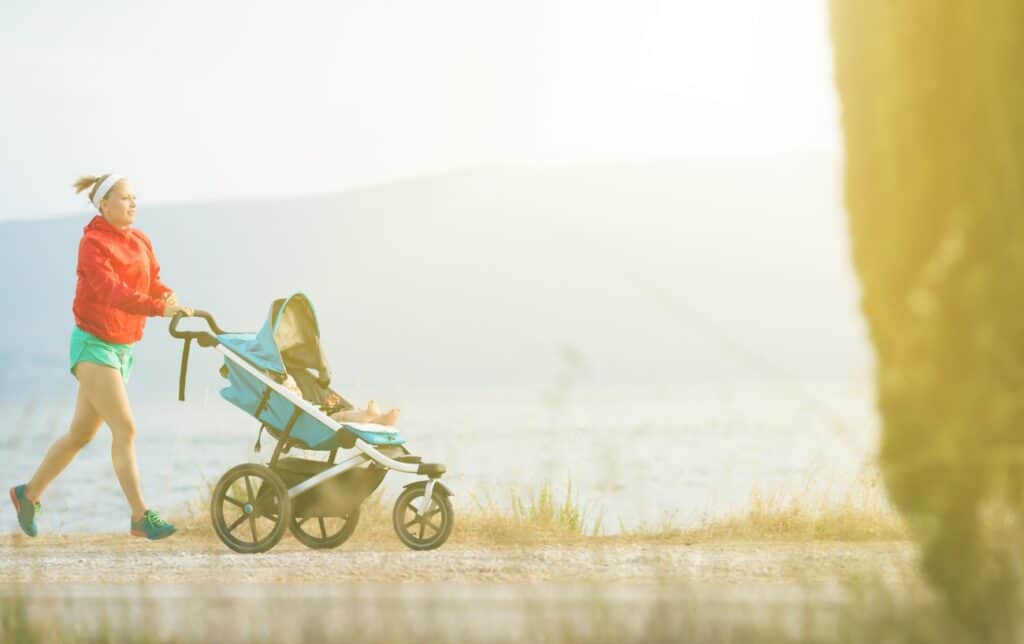
#1: A Running Stroller is Your Best Friend
It is always best to check with your pediatrician, of course, but it is generally said that by six months, most babies have sufficient head and neck strength to tolerate the bumps and speed involved with being a little passenger in a baby jogger or running stroller.
So at this point, you may want to consider investing in one of these joggers, which are typically larger and heavier than regular strollers, but make running much easier, with their three large, air-filled tires and additional features such as handbrakes.
Related: Running With a Stroller: 13 Tips For Parents
With a baby jogger, almost any time is a good time for a run.
If it’s nap time, your baby will likely fall asleep peacefully while you run (and perhaps more easily than he would have otherwise).
If your baby is awake and alert, he will probably enjoy the sights and sounds of your neighborhood, especially if you talk to him while you run.
And if your baby is cranky, a little movement, fresh air, and a breeze may be the perfect calming experience.
I found it surprisingly easy to run during this phase.
My son would fall asleep peacefully in the jogger, usually clutching his favorite blanket, and would not wake up for two or three hours, which allowed me to cover many miles regularly.

#2: Mid-Run Activities
Once babies start walking, however, they are not as content to stay in the jogger for extended periods.
When my son became mobile, I found that having a fun destination for him midway through the run kept us both happy.
If I wanted to run four miles one day, for example, I would pick a park about two miles away and run there with my son in the jogger.
My son would then play at the park for a while (with me doing some stretches on the playground equipment if I was feeling particularly ambitious), and when he tired, I would strap him back in the jogger for the run home.
A stop at a friend’s house for a play date would also work, as would a visit to a shop for a yogurt or other small treat, or a brief excursion to the library for a new book.
Even without a specific destination, I found that just letting my son out of the jogger to run alongside me for a little while would keep him happy.
I also learned that bringing along a book or toy, a snack, and something to drink would help keep him occupied over the miles.
#3: Get A Double Jogger
If you have two little ones, you may want to invest in a double jogger, which has two seats that allow each child to sit up or lie down independently of the other.
I covered many miles with my younger son napping soundly while my older son “read” books to me.
Running with two children does require a little more planning and patience, but my memories of running while pushing both boys around our neighborhood are some of my favorites.

#4: Have Your Child Ride Beside You
Another fun option for fitting in runs with young kids is to have them join you on a bicycle or scooter. This can turn your workout into a shared adventure—one where everyone gets to move, explore, and spend time outdoors together.
Many parents find that this setup works especially well on quiet neighborhood streets, bike paths, or park trails where kids can ride safely alongside you.
It may take a little patience at first as they build confidence and stamina, but over time, it can become a special family routine that keeps everyone active and engaged.
#5: Have Your Child Run With You
When your children are a little older, they may be willing to run with you, at least for short distances.
By nature, children will tend to sprint until they are out of breath and then walk for a while, and as long as you’re willing to go with their flow and not fret that the short sprints don’t fit into your running plan, this situation is at least something.
A track also offers a good opportunity to run with your children, then keep running while keeping an eye on them if they tire before you do.
Most children love running around the track at least a few times, then may have fun kicking a ball or playing another game in the middle of the track while you continue circling.
If your child seems to enjoy running, you may also want to consider signing up for a local fun run, which usually includes a 5K as well as shorter distances for the younger children.
Knowing they are “training” for this race may motivate them to get out there with you more regularly.

7 Tips For Finding Time to Run On Your Own
While running with your youngster can be a great experience for both of you, you shouldn’t feel guilty if you crave a solo run, and there are certainly ways to make this happen.
#1: Run While Your Baby Sleeps
You have probably heard the advice “sleep when your baby sleeps,” and there is certainly wisdom in those words. If you are looking to run some miles on your own, however, don’t overlook the simple idea of running when your baby sleeps.
At a certain point, you learn your baby’s rhythms and sleep habits, so you should be able to anticipate when they will wake in the morning, go to sleep at night, and nap during the day, and, assuming of course that a spouse or other responsible adult is home with the baby, you can use these times to get in at least a short run.
I found it helpful to have my running gear on most of the time, so I could head out the door quickly without wasting time changing when an opportunity arose.
#2: Consider a Treadmill
If you’re alone with your child, running outside, beyond the range of a baby monitor, at least, isn’t really an option.
In these situations, a treadmill can be an invaluable tool, allowing you to fit in a run while keeping your baby safely nearby. It’s also a great backup plan for days when the weather is too cold, hot, or rainy to head outdoors.
If possible, set up your treadmill in a space where your child can safely play, nap, or watch from a nearby seat. That way, you can maintain a sense of togetherness while still carving out time for your own health and routine.
#3: Run Swaps
If your partner also likes to run, you can suggest a child-run swap. One of you watches your youngster while the other goes for a run, and then you switch.
My husband and I used to have fun with this, with the first one to run selecting the route and reporting their time upon return, which the other one would then follow and attempt to beat.
Finding other parents who like to run can also be a way to squeeze in some miles. You may be able to arrange play dates, during which the parents take turns supervising the children and going for short runs.
Once you ask around, in fact, you may be surprised how many other parents are looking for ways to fit in some exercise and appreciate the idea.

#4: Making the Most of Your Lunch Hour at Work
Before having children, you may have used your lunch hour at work to actually go out for lunch, or at least eat a sandwich in the break room and catch up with your co-workers.
Or maybe you just worked through your lunch hour in an effort to be as productive as possible.
Once you have kids and your opportunities to run are limited, however, your lunch hour at work becomes a perfect time for an easy three-miler and then a quick bite back at your desk.
My office did not have a shower, so I initially hesitated to go running, fearing my post-run sweatiness would be off-putting to others. I kept those runs at an easy pace and just splashed some cold water on my face when I returned, and no one seemed to mind.
In fact, once I began running regularly during lunch, I discovered kindred running spirits in the office who would often join me.
#5: Running Once Your Children Are In School
Once your children are in school, your options obviously expand.
If you are not working or are working from home and have some flexibility, you can, of course, run when your child is at school.
When my children were in elementary school, I worked at home two days per week, and on those days, I could fit in an hour-long run between taking them to school and starting work.
You may have more flexibility and can run any time during the school day, or perhaps near the end of the day, before you pick them up.
#6: After School Activities
After-school activities are also perfect opportunities to sneak in a run.
I would often take my older son to taekwondo or my younger son to soccer practice, and after saying a brief hello to the coach and other parents, I would head off for a few miles.
I would also sometimes intentionally plan out my route so I would be far enough away at a certain point that I would have to run an ambitious pace to get back before the class or practice was over.
There is nothing like thinking your child might be alone on a soccer field waiting for you to make you stick to your threshold pace!
#7: Family Outings
Family outings, such as going to a movie, out to eat, or shopping, also offer opportunities to run at least a couple of miles.
Depending on the distance to the destination and the nature of the event, I would either run to the place we were going and meet my family there or run home after the event.
Sometimes I would run the entire distance, and sometimes I would just run partway.
I eventually memorized the routes and distances to many of our typical destinations, and our children got used to my husband pulling the minivan over mid-drive so I could get out and run the last three miles home.
I also learned where clean public restrooms were, so I could change into or out of running clothes if necessary.

#8: Sign Up For Coaching Or a Training Plan
A weird thing happens when you actually hire a coach or commit to a training plan: you’re suddenly more likely to make your running a priority.
At least that’s what happened to our editor and coach, Thomas Watson:
“With a newborn around the house, as well as working from home this past year, I was finding that time to exercise was consistently the last thing on my priority list – and the first thing to get jettisoned.
So when my son was 7 months old, I actually hired a running coach to give me a 4-month training plan.
I wasn’t training for any specific event; I was just looking for a roadmap to make my training more consistent.
I essentially outsourced all the decision-making around daily exercise. Instead of trying to fit a quick workout around life, I was looking at my training plan and then planning the workout alongside my other priorities.
It ended up being one of my most consistent training periods of the past few years!
You Can Make It Happen
The bottom line is that it is entirely possible to keep running even with small children if you make it a priority and stay flexible and open to opportunities.
You may not be able to guarantee you can follow a detailed training plan or training regimen as rigidly as you could before becoming a running parent. Still, you will be able to maintain your running habit and will feel better for doing it, and you will also be setting an excellent example for your children.
Just getting started on your running journey?
Check out our following guides!
Couch To 5k Guide + Training Plan
Couch To 10k Guide + Training Plan
Couch To Half Marathon: Guide + Training Plan
RunClub — Free
Join 300,000+ runners in RunClub
Free training plans for every distance, a daily running game, exclusive coaching content, and a real community of runners. Create your free account in 20 seconds — no card.
Already a member? Log in →








Join the conversation
Great suggestions overall! I would be wary of a mobile baby or toddler in the same room with a treadmill running. Treadmill belts can be very dangerous to little fingers. Be careful with that one.
These are fantastic tips! I definitely echo many of these, ie running is a priority but not THE priority. That’s a hard reminder. Thank you for putting this together. I only disagree with the choice of involvement in school activities. Anywhere my children are I personally must keep active in the environment to know what and who’s in their daily lives and keeping a physical presence is important in discerning the truth and setting the example. It’s not easy at all! But I do understand this is a personal parenting principle we try to abide by. Thank you again for being an encouragement. Run on, friend. ☺️
:) Thanks Alicia!