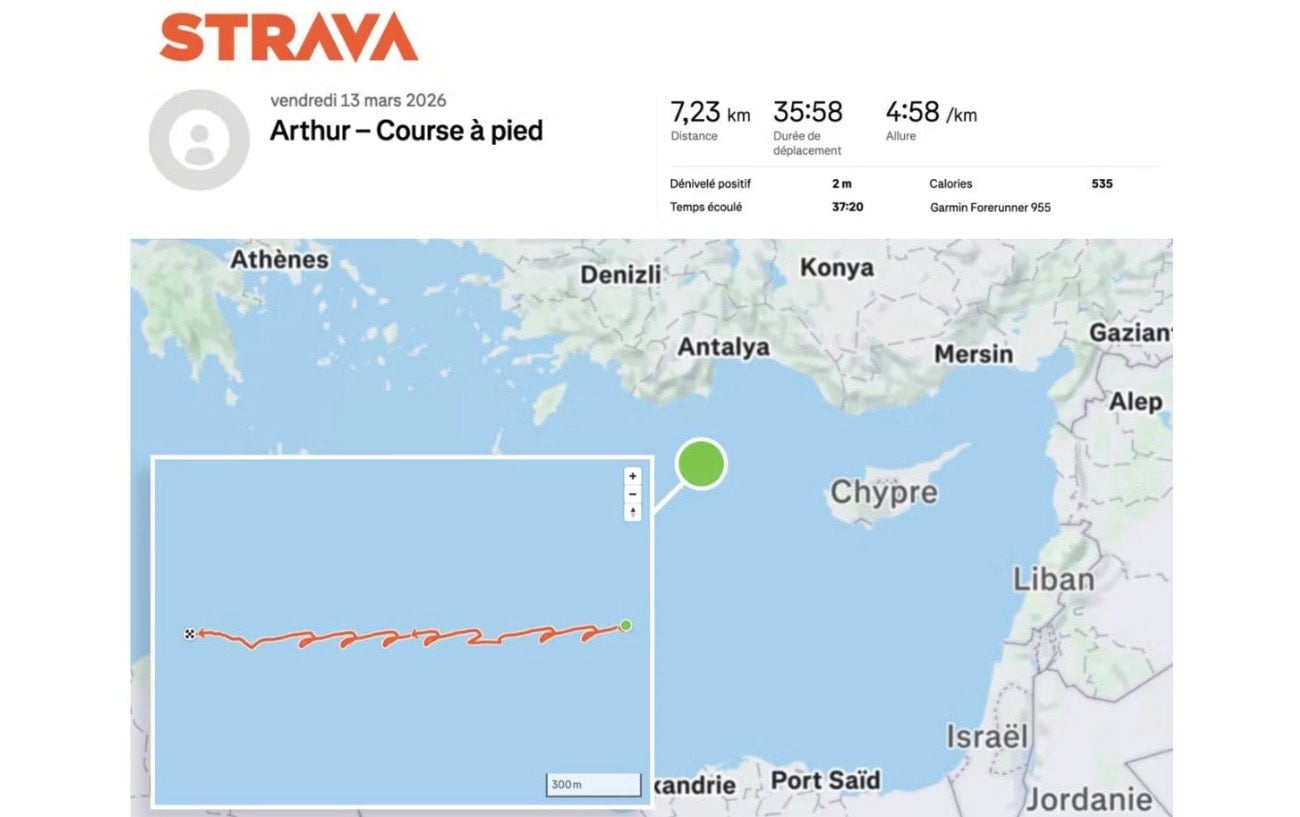
A French sailor named Arthur laced up his shoes on the morning of Friday, March 13, 2026, and went for a run. He covered 7.23 kilometers in just over 35 minutes at a 4:58 per kilometer pace — a genuinely solid effort for a confined deck on a moving warship. His Garmin Forerunner 955 tracked every step. Then he uploaded the workout to Strava, set to public, and inadvertently told the world exactly where France’s flagship nuclear aircraft carrier was parked.
The attached map made it embarrassingly clear: a back-and-forth jogging route, barely 300 meters wide, tracing the flight deck of the FS Charles de Gaulle as it sat in the eastern Mediterranean, south of Cyprus and north of Egypt.
The image, first reported by French newspaper Le Monde and shared widely on social media, spread across the internet within hours. France had not publicly disclosed the carrier’s exact position. “Arthur’s” Strava segment did it for free.
🚨🇫🇷 NEW: The location of the French aircraft carrier, FS Charles de Gaulle, has been given away by a sailor using Strava whilst jogging on the ship deck
— Politics Global (@PolitlcsGlobal) March 19, 2026
[@lemondefr] pic.twitter.com/FuoKMAs06w
The Carrier at the Center of a Crisis
The timing was, to put it gently, not ideal. The Charles de Gaulle — France’s only aircraft carrier and the only nuclear-powered carrier ever built outside the United States — had been rushed to the region just weeks earlier as part of a major French military response to escalating tensions with Iran.
On March 3, President Emmanuel Macron ordered the carrier strike group to redeploy from the Baltic Sea to the Middle East after Iranian-linked drone strikes hit Cyprus, a European Union member and French ally.
By March 9, the carrier had reached Crete, where Macron visited in person and announced that France would lead a coalition naval mission to escort merchant ships through the Strait of Hormuz. The strike group travelling with the Charles de Gaulle includes a nuclear attack submarine, multiple frigates from France, Spain, and the Netherlands, and a fleet oiler — one of the largest French naval deployments in years. Sensitive stuff, in other words. Not the kind of operation where you want your GPS pinging publicly.
The French Ministry of Armed Forces has not commented on the incident.
Strava Has Been Here Before — Many Times
For the running community, Strava needs no introduction. The app — used by more than 100 million athletes worldwide — tracks GPS routes, logs performance data, and connects runners, cyclists, and triathletes through a social feed of shared workouts. The appeal is exactly that visibility. The problem, when military personnel forget to check their privacy settings, is also exactly that visibility.
This is a story we have told before. In January 2018, analyst Nathan Ruser spotted something strange while browsing Strava’s publicly released Global Heatmap — a visualization of billions of GPS points from users worldwide.
The map was glowing brightly in remote parts of Syria, Afghanistan, and Iraq. That glow was coming from American and allied soldiers jogging the perimeters of bases the U.S. government had never publicly acknowledged. Defense departments scrambled. Militaries rewrote their policies. Strava updated its privacy settings. Everyone agreed it would never happen again.
Then, in 2024 and 2025, French newspaper Le Monde launched its #StravaLeaks investigation and found that members of Macron’s own security detail, U.S. Secret Service agents, and soldiers deployed near Gaza were all perfectly traceable through their public Strava accounts. Jogging routes that began and ended at undisclosed addresses. Guard rotation patterns visible to anyone curious enough to look. Individuals who were supposed to be anonymous, mapped out in cheerful orange lines.
Seven years after the first scandal, the lesson apparently hasn’t stuck. We’ve even written about how Strava’s location data could put world leaders at risk — and that was before this latest incident.