


Yoga is often praised as a powerful complement to running, but does it actually qualify as cross-training?
In many ways, yoga can act as the perfect counterbalance to the repetitive, high-impact nature of running. While running places continuous stress on the joints and tightens key muscle groups, yoga offers a low-impact movement practice that promotes flexibility, mobility, and improved range of motion.
Where running challenges the cardiovascular system, yoga typically provides a slower, more controlled stimulus that helps restore and rebalance the body.
Beyond the physical benefits, yoga enhances mind-body connection, posture awareness, and breathing efficiency, which are all crucial elements for efficient, injury-resistant running. It can also reduce stress, support recovery, and improve overall well-being, which directly contributes to better performance.
But does that mean yoga truly counts as cross-training for runners? Can it replace traditional cross-training methods like cycling, swimming, rowing, or strength work? Is yoga enough to fulfill your strength training needs, or should it be viewed as a supportive tool rather than a full substitute?
Yes, there is a way you can work yoga into your training. Let’s explore where it fits in and whether yogis are really onto something.
What Is Cross Training?
In the context of running, cross-training can be thought of as any form of exercise other than running that is often used to improve overall fitness and act as injury prevention. Cross-training for runners is usually categorized as a cardiovascular workout or strength training.
Cardio, or aerobic exercise, is physical activity that conditions the cardiovascular system and increases your heart rate while still being performed “with oxygen.” Your heart rate and respiration rate increase, though not such a high intensity that you can still breathe and carry on a conversation to some degree.
Generally speaking, the aerobic exercise zone is 70-80% of your maximum heart rate. For example, if your maximum heart rate is 180 bpm, a cardiovascular workout would ideally put your heart rate in the range of 126-144 bpm.
Strength training is an important part of any runner’s training plan as it increases muscular strength, size, power, and/or endurance.
Whether doing cardio or strength training, incorporating cross-training into your training program offers many health benefits to runners.1Lavie, C. J., Arena, R., Swift, D. L., Johannsen, N. M., Sui, X., Lee, D., Earnest, C. P., Church, T. S., O’Keefe, J. H., Milani, R. V., & Blair, S. N. (2015). Exercise and the Cardiovascular System. Circulation Research, 117(2), 207–219. https://www.ahajournals.org/doi/10.1161/CIRCRESAHA.117.305205
Cardio strengthens the heart and lungs, improves lung function and tidal volume, reduces blood pressure, reduces the risk of lifestyle diseases (e.g., obesity, diabetes, and atherosclerosis), and improves the elasticity and capacity of blood vessels.
Studies also show that aerobic exercise, like low-impact cross-training activities, reduces blood glucose levels and improves insulin sensitivity, reduces LDL (“bad”) cholesterol levels and increases HDL (“good”) cholesterol levels, and strengthens the immune system.
Finally, it burns calories, helping manage weight.
Strength training builds muscular strength and endurance, helps prevent muscle imbalances, and can reduce the risk of running injuries, especially those nasty overuse injuries.
Weight training increases lean body mass, boosting your metabolic rate and allowing your body to burn more calories throughout the day, even at rest.2Peterson, M. D., Sen, A., & Gordon, P. M. (2011). Influence of resistance exercise on lean body mass in aging adults: a meta-analysis. Medicine and Science in Sports and Exercise, 43(2), 249–258. https://doi.org/10.1249/MSS.0b013e3181eb6265
It also increases bone density, which can reduce your risk of stress and overuse injuries from the high-impact forces of running. Finally, strength training can boost your confidence, self-esteem, and self-efficacy, making it a must in your training routine.3Hong, A. R., & Kim, S. W. (2018). Effects of Resistance Exercise on Bone Health. Endocrinology and Metabolism, 33(4), 435. https://doi.org/10.3803/enm.2018.33.4.435
But which is better for runners: yoga or weight lifting?

Does Yoga Count As Cross Training for Runners?
Can you count your yoga class as the cross-training workout on your training schedule, instead of doing something like the elliptical or swimming?
Similarly, does yoga count as strength training? Can you do yoga instead of weight-based strength training?
The short answer is, it depends.
Unfortunately, not all yoga styles or poses will necessarily count as cross-training for running or help you get stronger.
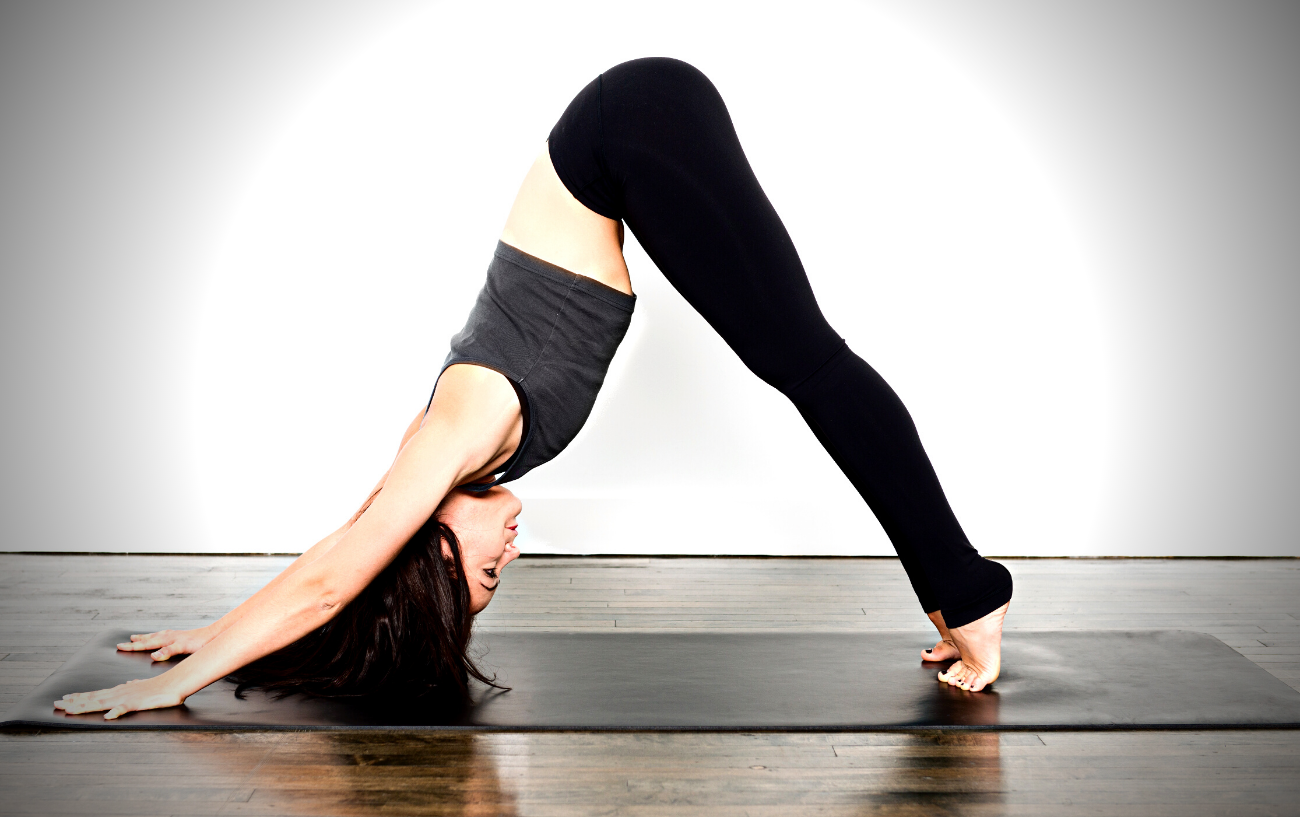
For example, while you might find deep relaxation and mind-body centering benefits, no matter how long you hold the Downward Dog pose, you won’t be increasing your heart rate or muscular strength.
The good news is that while there are plenty of yoga classes and specific yoga poses that will do little to increase your strength or build muscle, there are also some yoga classes that can provide a good workout for runners, and many yoga poses that will help you get stronger.

There are so many different styles, poses, and ways to practice yoga, so it’s possible to get a good strength training workout, but it’s also possible—and frankly more likely—not to.
It’s also even less likely that you’ll get as good a cardio workout with yoga as cross-training activities like rowing, elliptical, or aqua jogging.
While yoga poses where your muscles are under tension, load supporting your body weight, or working against gravity can build muscular strength (and muscular endurance if the poses are held for an extended period of time), using external resistance, like dumbbells, kettlebells, and resistance bands, is more effective at building muscle than working with body weight alone.
To increase muscle mass, also referred to as hypertrophy, your muscles must work against heavier loads. Therefore, when asking about yoga or lifting weights, weights may have their advantage.
With a few exceptions, most yoga classes are also sequenced slowly, so that you’re holding poses for a period of time, keeping your heart rate below the target aerobic zone to count as cardio cross-training.

What Are The Best Types of Yoga for Cross Training?
When it comes to choosing a yoga class to get a hard workout or to have yoga count as cross-training for running, the natural inclination is to assume the primary factor is the class’s level of difficulty.
However, just because a class is rated as “Advanced” rather than “Beginner” or “Intermediate” doesn’t necessarily mean it will be physically challenging enough actually to serve as a strength training workout.
The difficulty levels are usually more an indication of the flow of the class and the lack of pose instructions (and the skill required by the poses, to some degree) than of the muscular strength the poses require.
If you’re looking to build strength with yoga, burn a lot of calories by increasing your heart rate, or have your yoga class serve as your strength training or cross-training workout, it’s more important to consider the style of yoga class over the difficulty level.
Although you might increase your heart rate, use your muscles, and develop some strength through nearly any type of yoga class, the following types of yoga are particularly effective at strengthening your body:

Vinyasa Yoga
Vinyasa yoga can potentially serve as cross training for running as it is active, dynamic, and usually a total-body workout. This style of yoga links poses to your breath, and can leave your muscles quaking by the end.
Poses aren’t held for extended periods, so the constant movement and flow from pose to pose can be a more effective way to increase your heart rate while still building muscular strength.
Ashtanga Yoga
Like Vinyasa, poses in Ashtanga aren’t held very long, but the vigorous pacing and reliance on many upper-body poses make this a great style of yoga for strengthening your core, arms, shoulders, chest, and upper back.
Ashtanga yoga also emphasizes the importance of daily practice, which ultimately can provide the consistency you need to really see improvements in your strength, if you’re looking to have yoga count as strength training.

Power Yoga
Power Yoga can be a challenging total-body workout that increases your cardiovascular fitness, flexibility, and strength.
Power Yoga often includes poses that require a lot of balancing and core control, and inversions, which are also common, increasing upper body strength.
Many of the sequences in a Power Yoga class link poses back-to-back that use similar muscles. This can build muscular endurance and can condition your muscles to develop force and stability when fatigued.
Bikram Yoga
Bikram or hot yoga can increase your heart rate, mainly due to the room’s environmental conditions and the class’s intensity. Be sure to stay plenty hydrated.
Iyengar Yoga
Iyengar is a style of yoga that relies on props to help hold challenging poses for long periods. These long holds can build muscular strength and endurance, so Iyengar yoga can potentially be used as strength training, but not aerobic cross training.

Using Yoga As Strength Training and Cross Training
Even though yoga might not be the most effective form of strength training, it’s possible to get stronger from yoga.
Choose poses that require your legs, arms, or core to hold the position or support your body, such as the Warrior poses, Plank pose, and Dolphin pose.
Increase the duration of the pose or complete numerous reps in a flow of several strengthening poses. For example, flow continuously between the Downward-Facing Dog pose and the Cobra pose for 15 cycles.
If you want to use yoga as your cardio cross-training, it’s important to sequence poses together in a constant flow with little to no rest and minimal static holding. It can be beneficial to wear a heart rate monitor to ensure your heart rate is getting high enough.
With that said, it’s rare to get your heart rate up into the aerobic zone with yoga, so yoga typically isn’t a good substitute for cardio cross training.
However, yoga can potentially count as strength training for runners. Among the vast library of yoga asanas (poses), you can find yoga poses to strengthen nearly every major muscle in the body.
Best Yoga Poses For Runners
Some yoga poses target specific muscles, while others are considered total-body moves. Here are some of the best yoga poses for building strength:
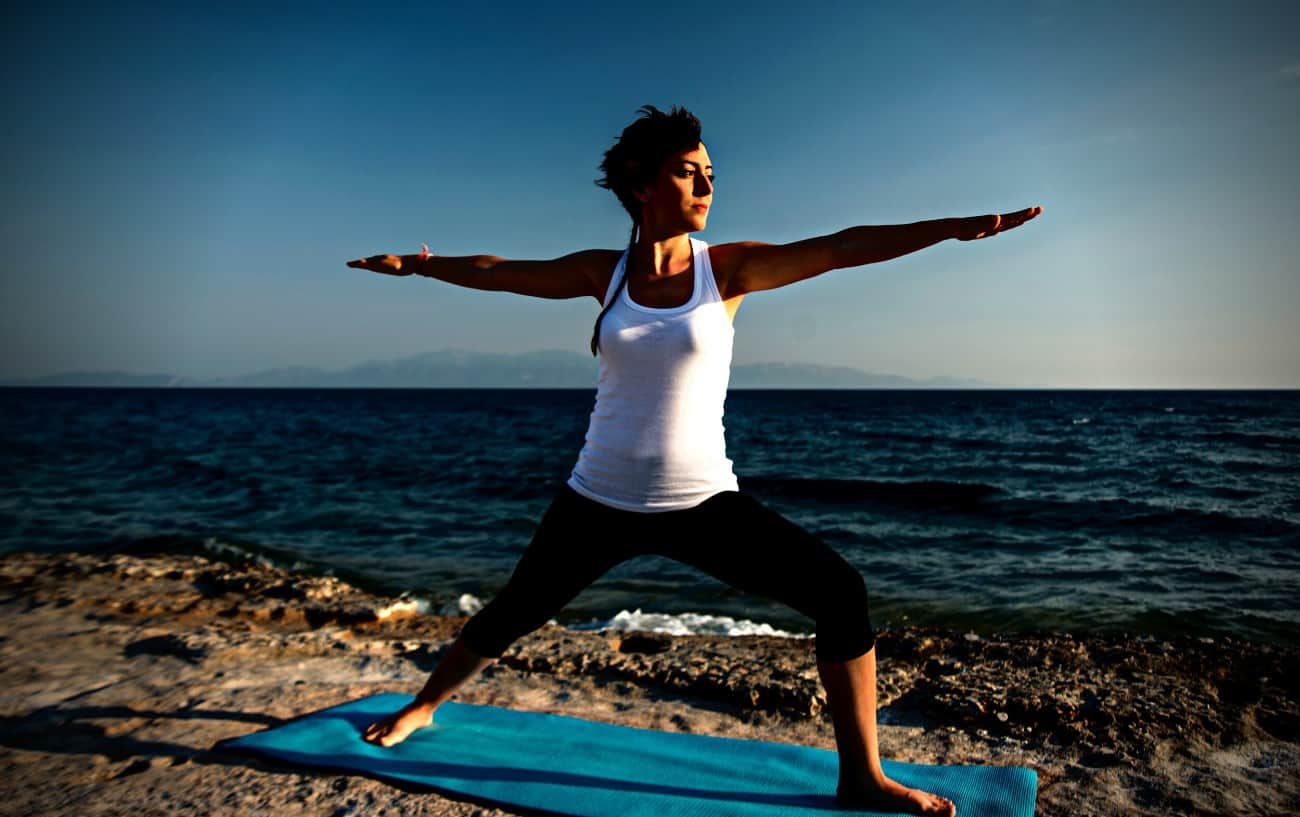
#1: Warrior Poses (Virabhadrasana)
Warrior II and Warrior III poses are great for strengthening your quads, which are one of the largest muscle groups in the body.
With Warrior II, you’ll also strengthen your shoulders and core, and improve your balance.
The Warrior III pose is nearly a full-body pose, strengthening your glutes, quads, arms, and core.
Keeping your core tight will not only help strengthen your abs, but it will also help you balance and maintain the pose.
#2: Four-Limbed Staff Pose (Chaturanga Dandasana)
Plank pose strengthens your core and shoulders. Be sure to squeeze your glutes to relieve strain on your lower back and support optimal form.
#3: Bow Pose (Dhanurasana)
While stretching the chest and hip flexors, the Bow pose strengthens your glutes, upper back, hamstrings, shoulders, and chest. Focus on squeezing your glutes to lift your legs into the pose, rather than passively grabbing them with your hands and pulling them into place.
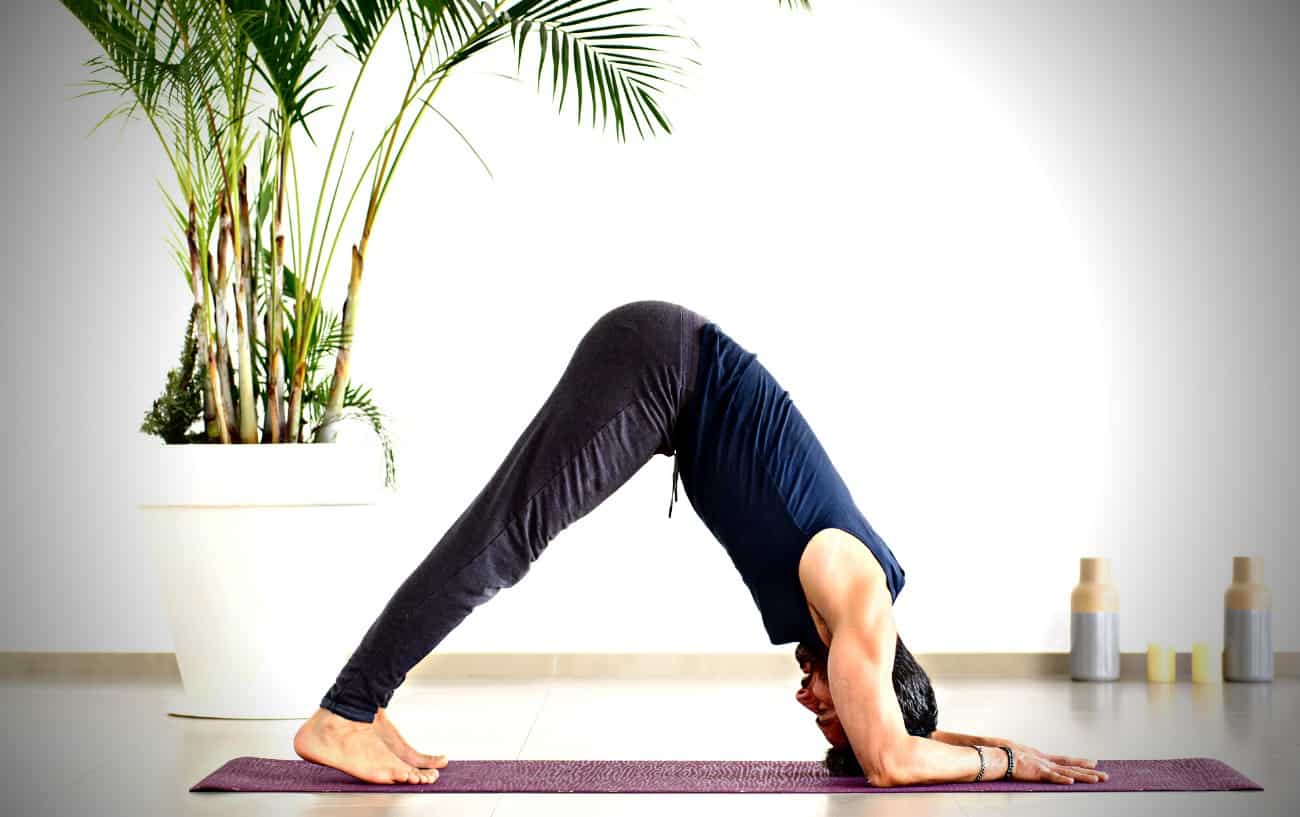
#4: Dolphin Pose (Ardha Pincha Mayurasana)
The dolphin pose will strengthen your shoulders and upper back and is a great preparatory pose for challenging inversions.
#5: Boat Pose (Paripurna Navasana)
The boat pose is a static, isometric hold that requires tremendous core control as it strengthens your abs, quads, hip flexors, and spinal stabilizers.
It’s important to keep your back straight and shoulders back, as this will help build core strength and balance while also encouraging good posture and the synergistic support and control from the lower abs and lower back.

#6: Downward-Facing Dog Pose (Adho Mukha Svanasana)
Downward Facing Dog pose utilizes your shoulders, glutes, calves, core, hamstrings, and back. Squeeze your quads to increase the pose’s intensity.
#7: One-Legged Chair Pose (Eka Pada Utkatasana)
This variation of the Chair pose is basically like holding a single-leg squat. It’s a great yoga pose for strengthening your quads, glutes, hamstrings, and core.
#8: Side Plank Pose (Vasisthasana)
This is one of the best yoga poses for strengthening your obliques (side abdominal muscles), shoulders, and core in general.
Ultimately, adding yoga to your fitness routine is a good way to support your running and target areas that traditional mileage often neglects.
While yoga isn’t an ideal substitute for dedicated cardio-based cross-training, it can play a valuable role in improving strength, mobility, stability, and muscular balance.
Depending on your goals and the style of yoga you practice, it can even function as a form of strength training, especially when it includes controlled holds, functional movements, and core engagement. Beyond the physical benefits, yoga also supports mental clarity, stress reduction, and overall recovery.
For runners who love yoga, the most effective approach is to use it strategically: pair gentle or restorative sessions with hard run days to aid recovery, and schedule more demanding flows on easy run days or as standalone sessions.
This allows yoga to enhance, not compete with, your run training, helping you stay strong, supple, and resilient while continuing to progress as a runner.
If you are looking for other cross-training alternatives, check out this next guide:
References
RunClub — Free
Join 300,000+ runners in RunClub
Free training plans for every distance, a daily running game, exclusive coaching content, and a real community of runners. Create your free account in 20 seconds — no card.
Already a member? Log in →









Start the conversation