Léon is 12, from Nice, and has giant axon neuropathy — a rare neurodegenerative disease that has already paralyzed his feet, ankles, and hands. There is no approved treatment. There is barely any research.
And right now, as you read this, he is crossing the Sahara.
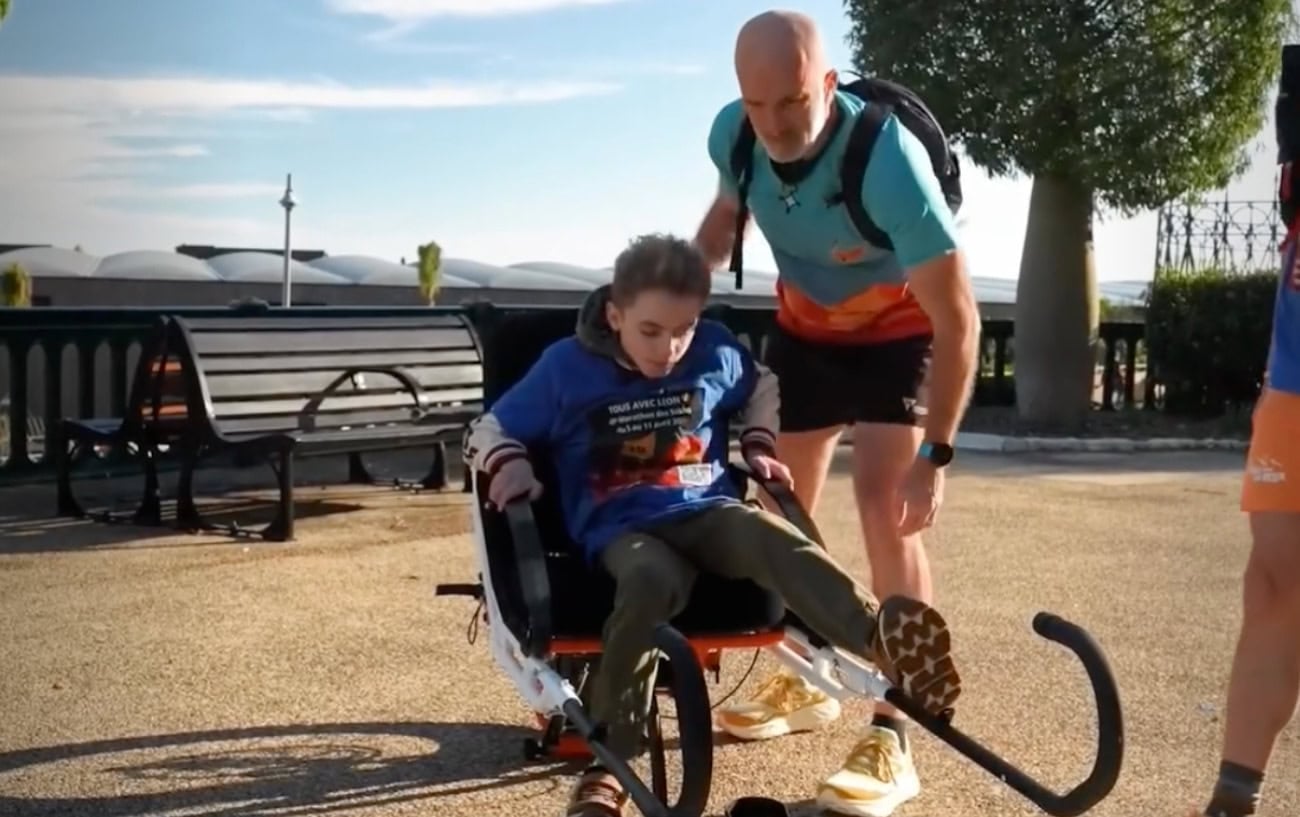
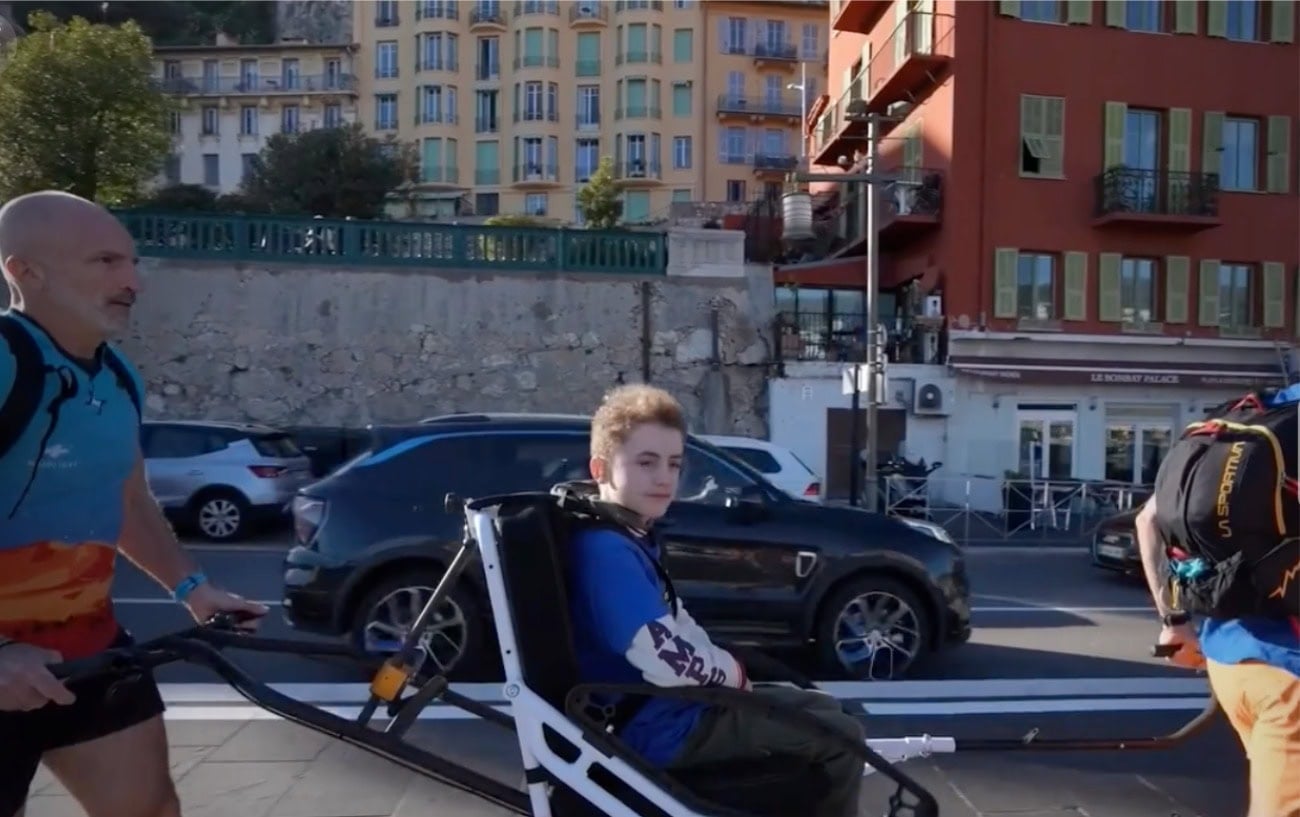
Carried in a joëlette — a specially adapted off-road wheelchair — Léon is competing in the 40th edition of the Marathon des Sables alongside a team of eight volunteer runners. Six stages. 270 kilometers. Temperatures up to 60°C. The same race that pushes even seasoned ultra-runners to their limit every year.
Why the race, why now
Léon’s parents, Alexandre and Emilie, founded the LEOZAN association after his diagnosis to fund research into GAN. The disease is so rare that only one lab in France — based in Lyon, affiliated with INSERM — has an active research lead. That work is currently suspended for lack of funding. The number they need: 150,000 euros, enough to keep a researcher working for three years.
The Marathon des Sables push is meant to raise exactly that. Three years ago, Léon was one of four child ambassadors for the French Telethon. This time, he isn’t asking people to watch. He’s out there himself.
“I’m ready, the bag is almost finished,” he said before departure. “I think it’s going to be great and a good experience.”
The doctor from Amiens who ran 100km a week to be there
Charlotte Foucart, 31, is a general practitioner from Amiens who discovered running two years ago and has since gone fully off the deep end — in the best way.
She signed up with Du Sable Dans les Yeux, a French association that brings children with disabilities into extreme endurance events. She had never met Léon in person before arriving in Morocco. Their relationship before the race: a few video calls and some texts.
She trained for six months, logging around 100 kilometers a week. She ran on sand, with her pack, knowing it would never fully simulate what was coming. “Over there, we will certainly have 50 or 60 degrees,” she said. “We cannot train in real conditions.” Anyone curious about what that preparation actually demands should read this honest account from a runner who’s been there.
Her eight-kilo pack was almost entirely freeze-dried food, repackaged down to the gram — the kind of logistical obsession that defines ultramarathon preparation at this level.
As a doctor, the cause hit close. “It deeply affects me that there are children in distress who don’t have treatment for their illness,” she said. “It resonates with me even more; it truly connects with my work.”
What’s at stake beyond the finish line
Léon’s father Alexandre is volunteering at the race, watching his son take on stages most adults wouldn’t attempt. The team — towing the joëlette through dunes and rocky flats — came together quickly once training began.
“It takes enormous courage,” Alexandre said before the race. “They’re all a little crazy, but you can see the energy of Charlotte and the others. There’s such kindness. They carry hope within them.”
That word — hope — keeps coming up around Léon. Not in a vague way, but in a specific, urgent one. The Lyon lab has a real lead on GAN. The research exists. It just needs money to continue.
A boy who can’t walk is crossing a desert to help find the thing that might one day let others like him do it on their own two feet. The race wraps up on April 11. Donations can be made now through the LEOZAN association’s fundraising page.