


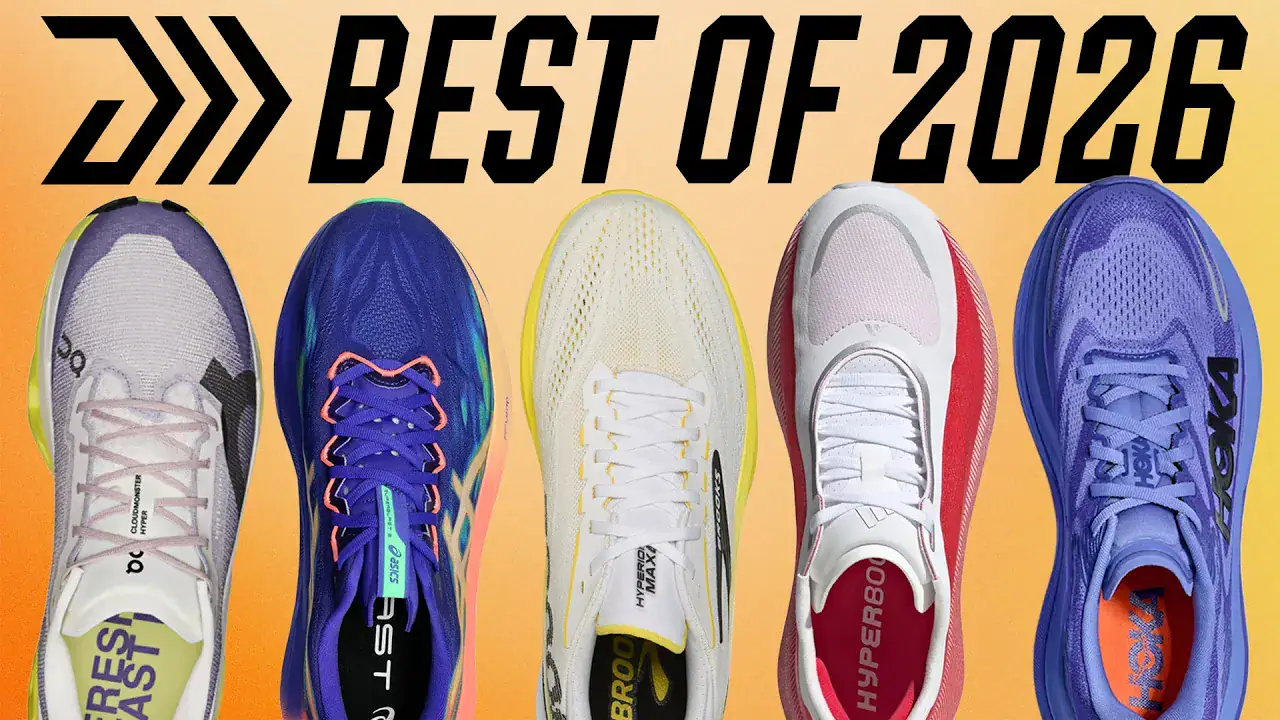
If there’s a type of shoe that defines 2026, it’s not the daily trainer. And it’s not even the super shoe. It’s what comes in the middle. The Super Trainer. Bouncy, responsive, protective, supportive shoes that can kind of do everything really well.
I’ve tested dozens of super trainers that came out in 2026, chose my five favorites, and ranked them from five to one to help you decide which one might be right for you. So let’s get into it.
The Top Workout Shoes On The Market Right Now:
#5 Best Shoe For Easier Paces: Hoka Skyward X 2
#4 Best Shoe For Versatility And Durability: Adidas Hyperboost Edge
#3 Best Shoe for Long Runs: On Cloudmonster 3 Hyper
#2 Best Shoe for Power Without Compromising Comfort: Brooks Hyperion Max 4
#1 Best Shoe overall: ASICS Superblast 3
The Honest Truth: Why One Shoe Won’t Do Tempos, Intervals, AND Long Runs
If a single trainer could win every workout, brand catalogs would be a lot shorter. Workout shoes have to absorb load, return energy, and survive repeated hard sessions — and the foam, plate, and geometry choices that make a shoe great at one of those jobs almost always make it worse at another. Below is the physiology I think runners deserve before they spend $200+ on a session-day shoe.
1. Tempo and threshold work: super-foam earns its money — but with a tax
The 4% running-economy edge first reported by Hoogkamer and colleagues for plated, PEBA-foam shoes is real and reproducible at marathon and threshold paces1Hoogkamer W, Kipp S, Frank JH, et al. A comparison of the energetic cost of running in marathon racing shoes. Sports Medicine. 2018;48(4):1009–1019.. That economy gain is what makes a super-trainer or super-shoe ideal for 6–12 km tempo blocks and threshold cruise intervals — you hold the same pace for fewer ml of oxygen per kilo per minute. The catch: stiff plates and tall stacks shift load distally. Calf, Achilles, and metatarsal-stress signals climb in runners who do all their hard sessions in plated shoes, especially without a softer rotation option2Tenforde AS, Hoenig T, Saxena A, Hollander K. Bone stress injuries in runners using carbon fiber plate insole running shoes. Frontiers in Sports and Active Living. 2023;5:1219700.. Use plated foam for the workout, not for every run that week.
2. Intervals shorter than 90 seconds reward stiffness, not stack
For 400 m, 600 m, and short hill reps, the limiter is ground contact time and elastic return at the ankle, not metabolic cost. A 35–40 mm stack with a long full-length plate dampens the very ground-reaction-force spike you’re trying to convert into propulsion. That’s why elite middle-distance and short-rep sessions are still done in lower-stack flats or spike-style trainers — the leg-spring stiffness needs a stiff platform underneath it3Farley CT, González O. Leg stiffness and stride frequency in human running. Journal of Biomechanics. 1996;29(2):181–186.. If the bulk of your Yasso 800s and short-rep work is in a maximal cushioned shoe, you’re leaving turnover on the table.
3. Long runs and progression sessions: durability beats peak energy return
For 90–150 minute long runs that finish with 5–10 km at marathon pace, the priority shifts from peak responsiveness to repeatable cushioning under fatigue. PEBA and TPE foams compress, recover, and degrade differently than EVA — in lab testing, super-foams lose meaningful percentage points of energy return after roughly 200–400 km of high-impact use, while well-formulated EVA/EVA-blends hold cushioning longer4Wang IL, Graham RB, Bourdon EJP, et al. Biomechanical comparison of running cycles in normal and worn shoes. Journal of Sports Sciences. 2022;40(15):1739–1746.. The right long-run shoe is one you can put 60–100 km a month through without it going dead under you on the back third — a daily-trainer geometry with a forgiving foam, not your race-day flier.
4. Stability matters more in workouts than in easy runs
Counter-intuitively, the runs that beat you up are the ones where stability and torsional rigidity earn their keep. Easy aerobic running self-regulates; threshold and interval running pushes you into late-stage fatigue mechanics, where pronation excursion and frontal-plane knee motion both increase. Modern guidance no longer prescribes “stability shoes” universally, but for runners with a history of medial tibial stress reactions or peroneal tendinopathy, a wider midsole and a structured midfoot is consistently associated with lower injury rates during high-intensity blocks5Malisoux L, Chambon N, Delattre N, et al. Injury risk in runners using shoes with motion control technology versus neutral shoes: A randomised controlled trial. British Journal of Sports Medicine. 2016;50(8):481–487.. Don’t pick your interval shoe purely on what felt fast in the store.
5. The mistake almost every runner makes
It’s buying a single “workout shoe” and using it for every hard session, every week, for a 12-week block. That gives you a fast adaptation to one stimulus and a stalled response to everything else — plus a cumulative-load profile to one tissue (most often the Achilles–soleus or metatarsals). A two-shoe rotation — one plated/responsive for tempo and threshold sessions, one firmer/lower-stack for short reps and strides — distributes load, preserves leg-spring stiffness, and tends to reduce running-related injury rates compared to single-shoe use6Malisoux L, Ramesh J, Mann R, et al. Can parallel use of different running shoes decrease running-related injury risk? Scandinavian Journal of Medicine & Science in Sports. 2015;25(1):110–115.. The picks below are organised with that rotation in mind.
#5 Best Shoe For Easier Paces:
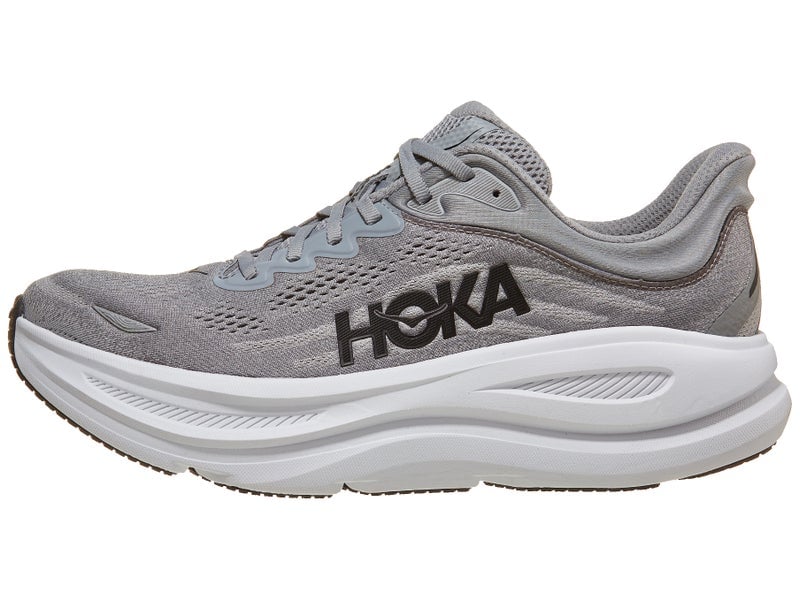
Hoka Skyward X 2
Score: 8.5
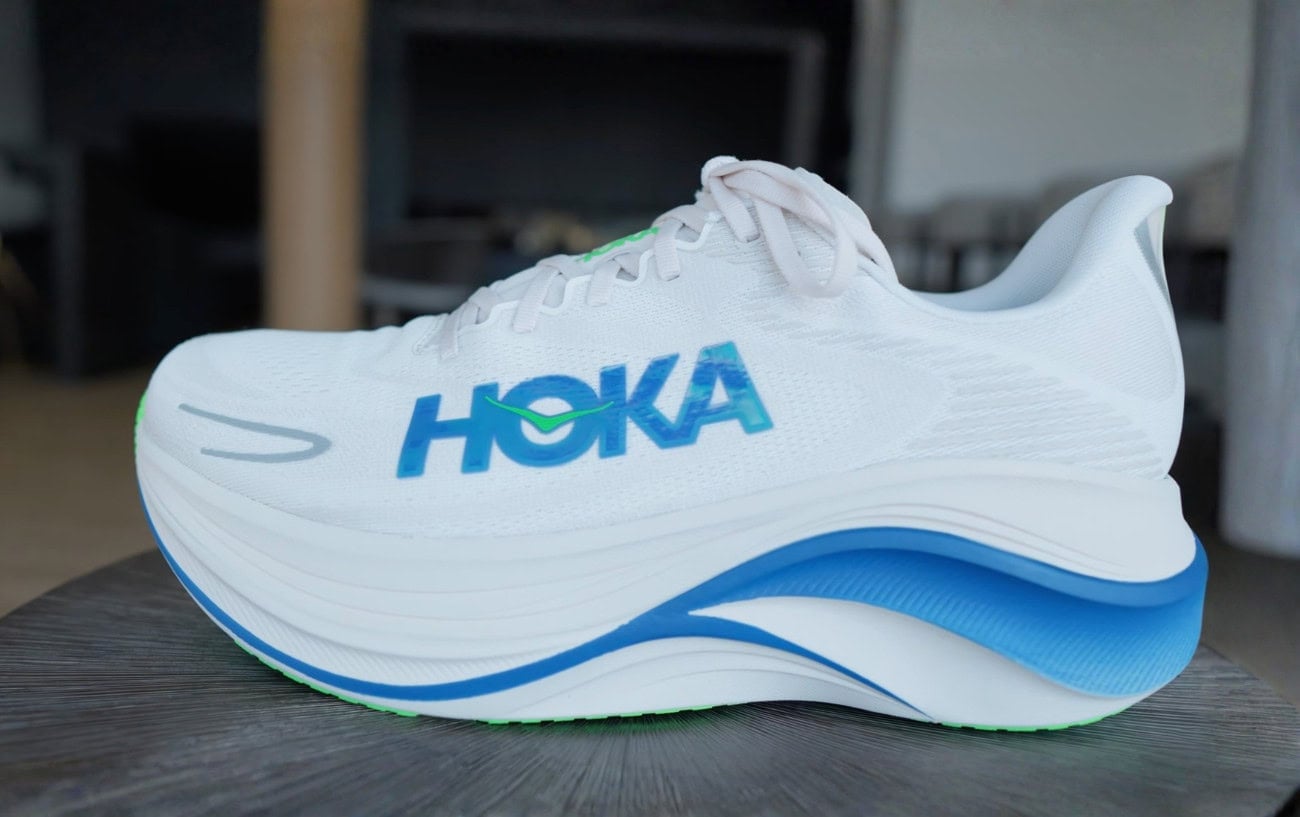
What you’ll notice with super shoes is that some are more geared for speed workouts, and others are more so made for long runs. The Skyward X2 is the latter. It’s a big, bulky, incredibly protective and durable shoe — especially for Hoka, which in the past has had some issues with the durability of their shoes.
The Skyward X2 is built different. It’s got 49 mm of stack height, making it one of the tallest shoes in the world. And that huge midsole is made of two foams: a PEBA foam up top for responsiveness, and a supercritical EVA at the bottom for stability and durability.
What I like about this shoe is that it’s a huge improvement from the Skyward X1, which was a massively weird shoe to put on the market back in 2024. When I tried it for the first time, it was big, tall, a little wobbly, and quite heavy. This shoe is lighter than its predecessor, and also importantly, it’s more stable. The carbon plate is shaped to give you forward propulsion, but also lateral stability — which is important when you’re 50 mm above ground.
Now, use cases for the Skyward X2: it’s not a fast interval shoe. It is a lot of material to carry around. But it’s excellent on long runs, even fartlek runs, and importantly, it can handle an easy run. I really like my super trainers to handle different paces. There are some super trainers I left out of this list because they’re so uncomfortable to run easy in. The Skyward X2 can kind of do everything.
We gave it an overall score of 8.5. Top marks for design. Props to the Hoka designers for making this shoe two years ago and breaking the mold a little bit — it was one of the very first super trainers on the market. And the two I really like because it dials in the problems that the one had. The one was too heavy, the one was too wobbly. This shoe takes care of both problems.

The Deets: Tech Specs For The Hoka Skyward X 2
- MSRP: $225 USD
- Stack height: Heel: 49mm; Forefoot: 44mm
- Weight: 10.0oz (283g)
- Heel-to-toe drop: 5mm
#4 Best Shoe For Versatility And Durability:
Adidas Hyperboost Edge
Score 8.5
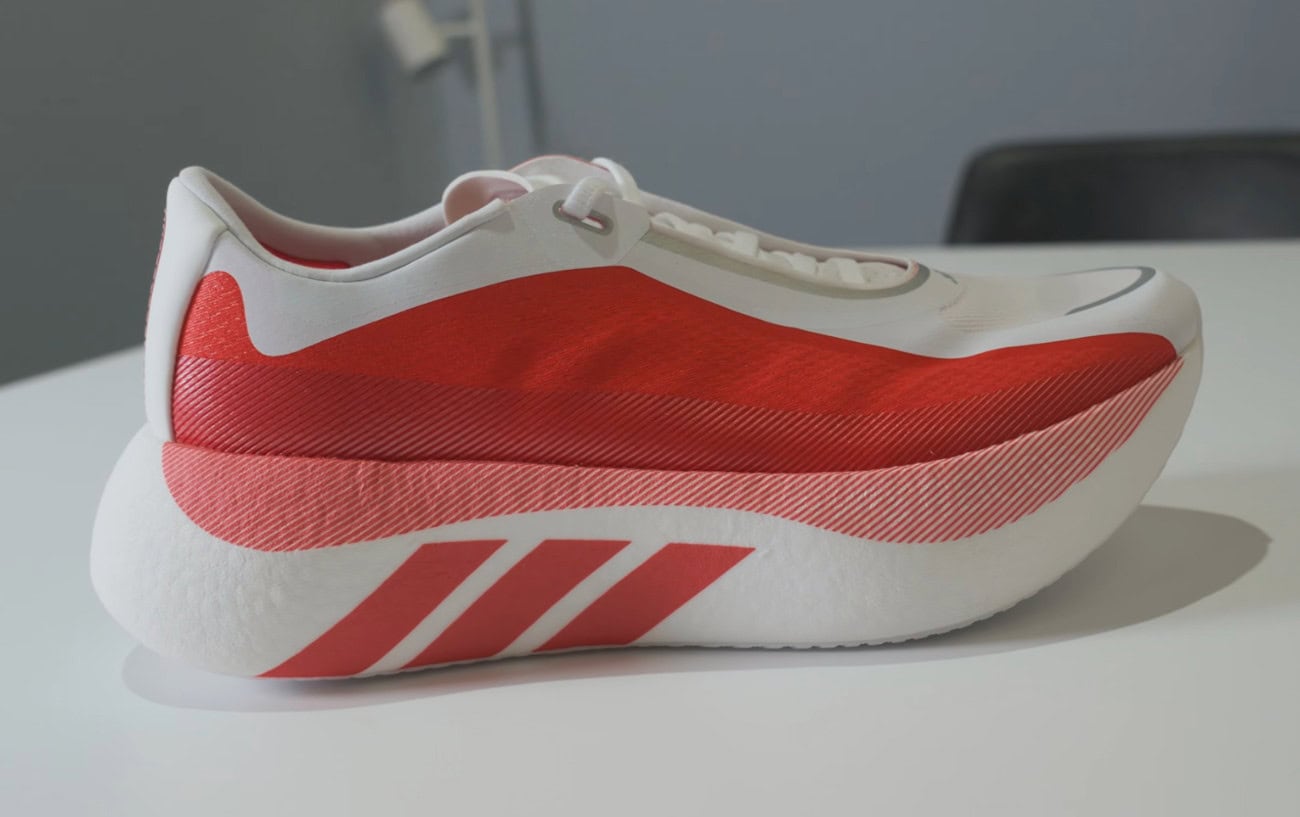
I didn’t see this shoe coming. Adidas had a problem inside of their shoe offering. They had super top-level racing shoes, especially seeing the success of the Pro Evo 3 on the feet of Sabastian Sawe and Yomif Kejelcha. And then on the other side of the spectrum, they have what might be the most popular shoe in the world in the Evo SL. I don’t really call that shoe a super trainer because it doesn’t quite have the power that all these shoes that I’m about to present have. What Adidas was missing was a powerful shoe that could handle your fastest workouts. And the Hyperboost Edge is pretty much that.
This shoe looks pretty simple, and it’s made of two parts. One part I like, and one part that I don’t.
What I really like is the midsole, called Hyperboost Pro. It’s a supercritical pellet-based foam that’s very responsive, very stable, and as far as I can tell, very durable as well. I’ve really enjoyed this shoe for workouts. I can run fast in it. I can run easy. It can handle a whole lot of different paces. Doesn’t hurt that the midsole looks good and doesn’t look too funky — I feel like I can wear this out and look kind of stylish. Maybe you be the judge on that.
But then on top of the midsole is the part that I don’t like. The upper is weird. It’s called Prime Weave, and it’s thick. It’s seemingly heavy, and it’s not that comfortable on the foot. So, disclaimer with this shoe: when I first put it on, my first couple runs, I developed a little blister over my Achilles tendon on both of my feet. Over time, that callused and went away, and now I don’t have any issues with the shoe. But still, in this day and age, you wouldn’t expect that to happen.
If not for the upper, this shoe would probably rank higher on my list. So clearly it lost marks in comfort, but we still gave it an overall score of 8.5. Its performance score really helped it here. I just love how it feels and how it moves. I think it’s actually my favorite shoe to wear on this list, but wearing it kind of comes at a cost. So it’s my number four. A version two of this has the potential to become my favorite shoe with a better upper.

The Deets: Tech Specs For The Adidas Hyperboost Edge
- MSRP: $200 USD
- Stack height: Heel: 45mm; Forefoot: 39mm
- Weight: 9.0oz (255g)
- Heel-to-toe drop: 6mm
#3 Best Shoe for Long Runs:
On Cloudmonster 3 Hyper
Score: 8.6
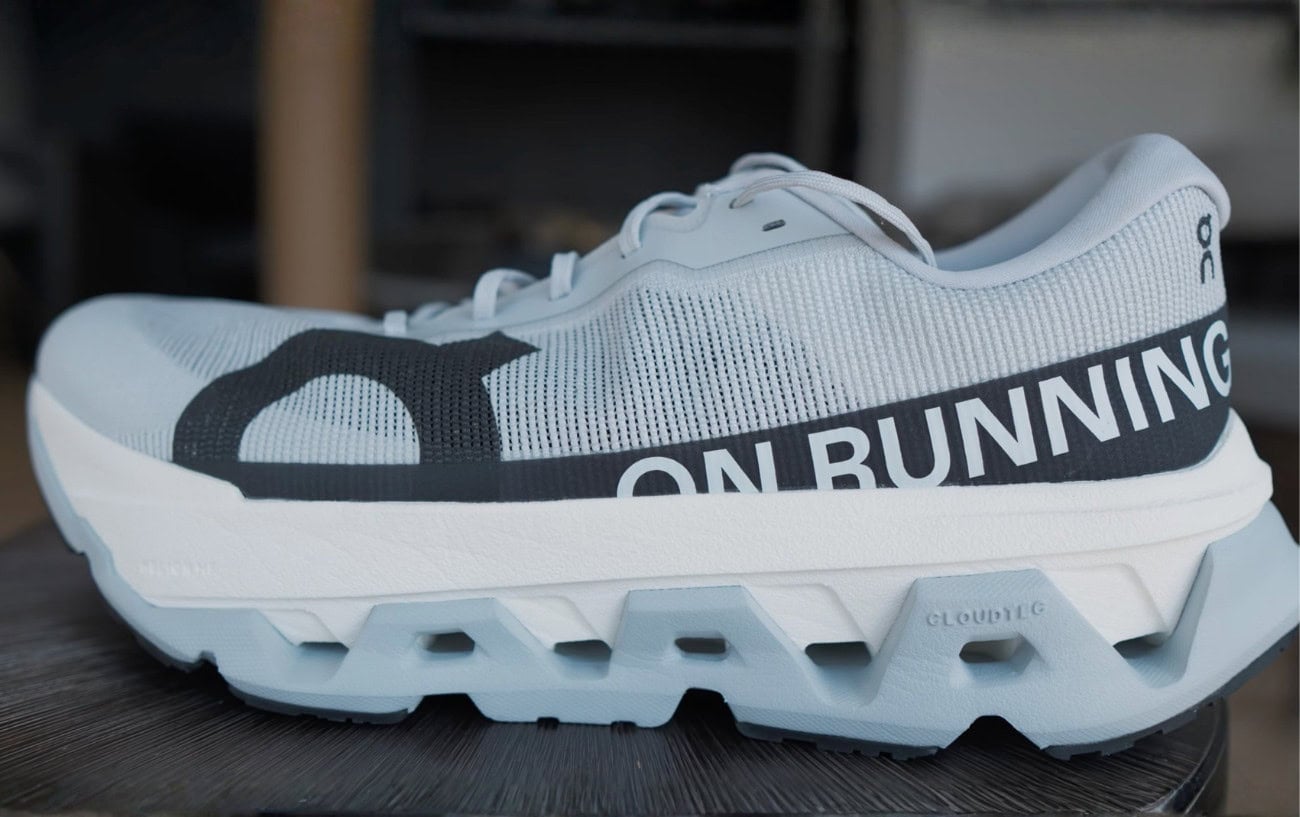
This is more of a speed-power super trainer than a cushioned and comfortable super trainer. The Cloudmonster Hyper series has always been speed-power, and this one is faster and more powerful than the previous.
To understand what’s going on with the Cloudmonster, we need to understand what’s going on with On. The brand is going through a not-so-subtle aesthetic change. We’ve come to know On as the shoe with tiny little cloud pods in its midsole. Those pods seem to be good for comfort, maybe even durability, but not so much for speed. So On’s fastest shoes seem to be slowly phasing those pods out. That’s what’s happening with the Cloudmonster 3 Hyper.
Instead of only having a half slab of supercritical foam like its predecessor did, this shoe has an entire slab from heel to toe, making it quite a bit faster. It still doubles with one layer of those Cloudtec pods to increase its stability and even durability, but in general, it feels a lot more like a super shoe than it does a daily trainer.
To me, the Cloudmonster is a bit too aggressive for easy runs, but I like it for long runs, for fartlek runs, and especially threshold runs — because it does have so much pop at the toe without being a full-on racing shoe.
I’ve also heard some complaints about comfort. Some people don’t like how the shoe feels on their feet. That hasn’t been the case for me. I’ve actually found the Cloudmonster 3 Hyper to be very comfortable. Maybe my favorite On shoe of all time, actually. So I gave it a pretty high rating in comfort and also performance.
The one drawback on this shoe is that it’s pretty pricey. $220 is almost as much as a super shoe. It will last you a long time, and it does feel good on the feet, but you could probably find something cheaper.

The Deets: Tech Specs For The On Cloudmonster 3 Hyper
- MSRP: $220 USD
- Stack height: Heel: 39.5mm; Forefoot: 33.5mm
- Weight: 9.6oz (272g)
- Heel-to-toe drop: 6mm
#2 Best Shoe for Power Without Compromising Comfort:
Brooks Hyperion Max 4
Score: 8.9
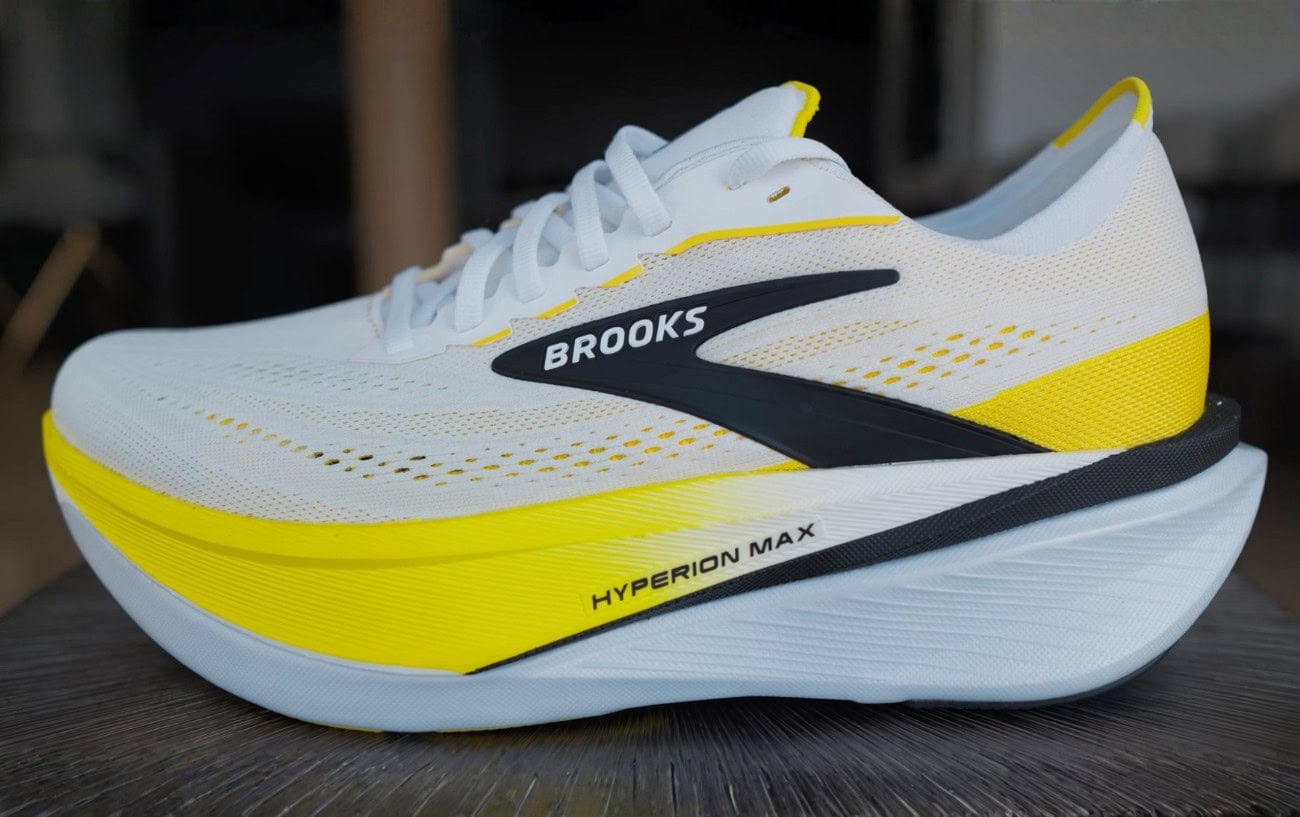
I’m especially a fan of this shoe because it represents a big revamp from Brooks. Not that the 4 is that different from the 3, but it’s solidifying Brooks as a brand that’s able to make not only light shoes and comfortable shoes, but powerful running shoes. And a couple years ago, that’s exactly what they were lacking.
The Hyperion Max 4 has three (actually four) components that I really like. The midsole is made of three parts: a DNA Gold PEBA foam up top, a supercritical EVA at the bottom for stability, and in the middle, a SpeedVault nylon plate. So not carbon — a little bit more forgiving, but still stiff enough to give you some pop. And on top is an upper that’s quite a bit more comfortable than most uppers we see in super trainers. So Brooks managed to find that balance between fast and aggressive and comfortable. I think it’s important for them to keep their shoes comfortable, because that’s kind of their trademark.
My one gripe with this shoe: somehow it’s the heaviest shoe on the list. I cannot believe that a shoe as big as the Skyward X2 is not heavier than the Brooks Hyperion Max 4. Brooks not only blew up their light shoes, they really gave them muscle — and it’s almost getting to be on the verge of too heavy, but it’s not there yet.
I love doing long runs in the Hyperion Max 4. I’ve done threshold runs, and I’ve even done hills, and those have felt good. It’s tough to make a big, powerful shoe that still feels good on the turnover, and I feel that Brooks has done that here.
Obviously, big points on design and comfort. Overall score: 8.9. I think this would have been the shoe of the year if not for our winning brand and our winning shoe’s magical release — I don’t think I can top number one. But this is clearly Brooks’s best super trainer to date.

The Deets: Tech Specs For The Brooks Hyperion Max 4
- MSRP: $200 USD
- Stack height: Heel: 46mm; Forefoot: 40mm
- Weight: 10.1 oz (286g)
- Heel-to-toe drop: 6mm
Honorable Mentions
A few quick honorable mentions before we move on to number one. I have two main ones here: the Brooks Glycerin Max 2 and the ASICS Magic Speed 5. The only reason that neither of these shoes has made it onto this list is that both exist too far on one side of the spectrum.
The Glycerin Max 2 is very comfortable and really fun to wear, but it doesn’t really have enough teeth to compete with these other shoes. You can run easy in this shoe. You can do a good long run. But as soon as you pick it up for a threshold, it feels like it’s missing a beat. That’s why I didn’t rank it in my top five. But the comfort of the shoe made it close.
And then the Magic Speed 5. I love this shoe. I do a lot of workouts in this shoe. I did not include it because it’s so aggressive that it almost feels like a racing shoe more than a workout shoe. And I’ve heard from a lot of people that they don’t find that this shoe has enough support to really be a workout shoe. So I kind of counted it more as a racing shoe, even though I know it’s for workouts. Anyway, maybe this is a call to action for people who like a stiff, fast running shoe for workouts to check out the Magic Speed 5, because I really like the shoe.

#1 Best Shoe overall:
ASICS Superblast 3
Need shoes for running too? See our picks for the best running shoes overall, the best marathon running shoes, and the best carbon plate running shoes for race day.
Score: 9.0
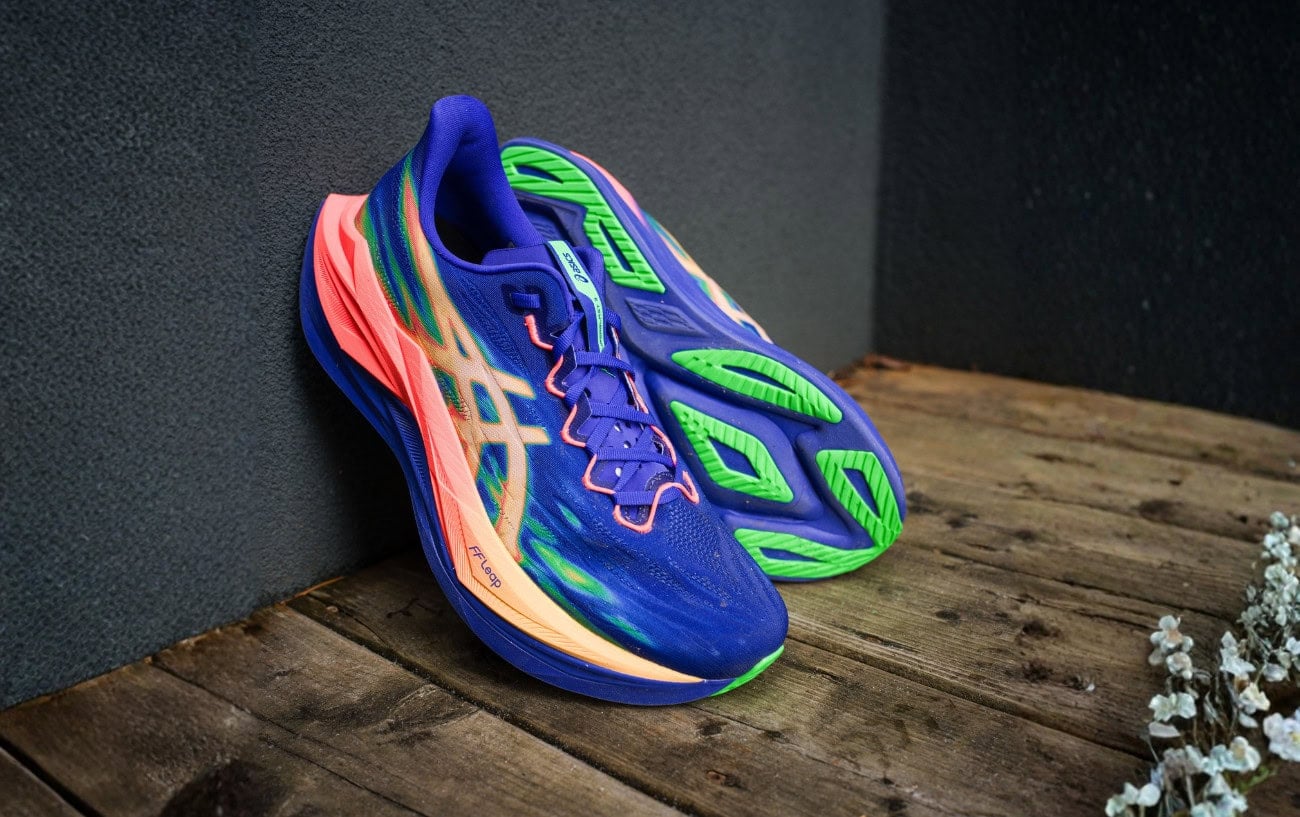
I’ve been a big Superblast fan since the 2. I challenged myself to find a shoe that I liked more, and I failed.
Here’s what’s cool about the Superblast. It’s the comfiest shoe on this list, but it’s also the lightest. It has a unique set of qualities that are hard to find in another shoe.
The Superblast’s secret weapon: ASICS took its FF Leap foam — their aTPU supercritical foam that they use in their racing shoes like the Metaspeed Ray — and put it inside of their super trainer’s midsole. Now, some people fear that it would make the shoe not all that durable, because that foam is known to not last that long. This has not been my experience. I have several hundreds of miles run in this shoe, and so far we’re doing fine. I think it was a brilliant move to put that really good foam inside of that shoe.
The drawback: it makes this shoe expensive. Like most super trainers on this list, you’re paying a premium to run in the Superblast 3. The bonus, and what they don’t want to tell you, is that that makes the Superblast 2, if you can find it, much cheaper than it used to be. So if you can get your hands on a pair of Superblast 2s, go for it. The changes are not that huge, but if you compare the two, the Superblast 3 still wins.
I would say the key quality of this shoe is that it feels good at every speed. You can very much run an easy run in this shoe. You can pick it up and go up to threshold pace. You can run a fartlek and feel good. You can even do hills and feel all right. On the spectrum, it’s more on the protection-and-support-and-stability side than it is on the speed-power side, but I’m starting to feel that you may not need a carbon plate in your super trainers. My own thoughts on this are evolving. We’ve talked about it on recent podcasts: should you have a carbon plate inside of your super trainers? That’s a whole other kettle of fish. But for now, I’ve become a big fan of the Superblast 3, and I bet you will too.
We ranked it at 9 out of 10. Good marks across the board. Value is the only knock, really, on the Superblast. Overall, it scored a tiny bit higher than our other shoes here, but it was close.

The Deets: Tech Specs For The ASICS Superblast 3
- MSRP: $270 USD
- Stack height: Heel: 45mm; Forefoot: 37mm
- Weight: 8.8oz (249g)
- Heel-to-toe drop: 8mm
A Few Last Takeaways If You’re About To Buy A Super Trainer
One: don’t be deterred by price. These shoes are expensive, but they’re made to offer a premium experience. And it’s true — they’re faster than your daily trainers, and they also last longer than super trainers of the past, and much longer than super shoes. So you’re paying a premium for something that’s a little bit better.
Two: this should be the third shoe in your rotation. If you’re starting to run, go for a daily trainer first, a super shoe second, and only then — when you’re getting specific about things and you’re running multiple times a week — do you stand to add a third shoe to your rotation. That’s when you probably need a super trainer.
And if you’re convinced that you want a super trainer, the main question you need to ask yourself is: are you more so looking for something that’s speedy and powerful, or something that’s more protective and durable? Because we have all kinds here.
Now, I like ranking super trainers more than super shoes and even daily trainers, because in those other categories, it’s kind of obvious how you have to rank them. But super trainers have a bit of an ambiguous purpose. They do a lot of different things. So I am very open to being debated in the comments as to which super trainer brings the best value and is the best. Find me in there.
Let me know what’s your favorite workout shoe of today. I’m curious to know your thoughts. And please, by all means, tell me why I’m wrong about the ASICS Superblast.
Happy running, and until next time.
References
RunClub — Free
Join 300,000+ runners in RunClub
Free training plans for every distance, a daily running game, exclusive coaching content, and a real community of runners. Create your free account in 20 seconds — no card.
Already a member? Log in →



Start the conversation