


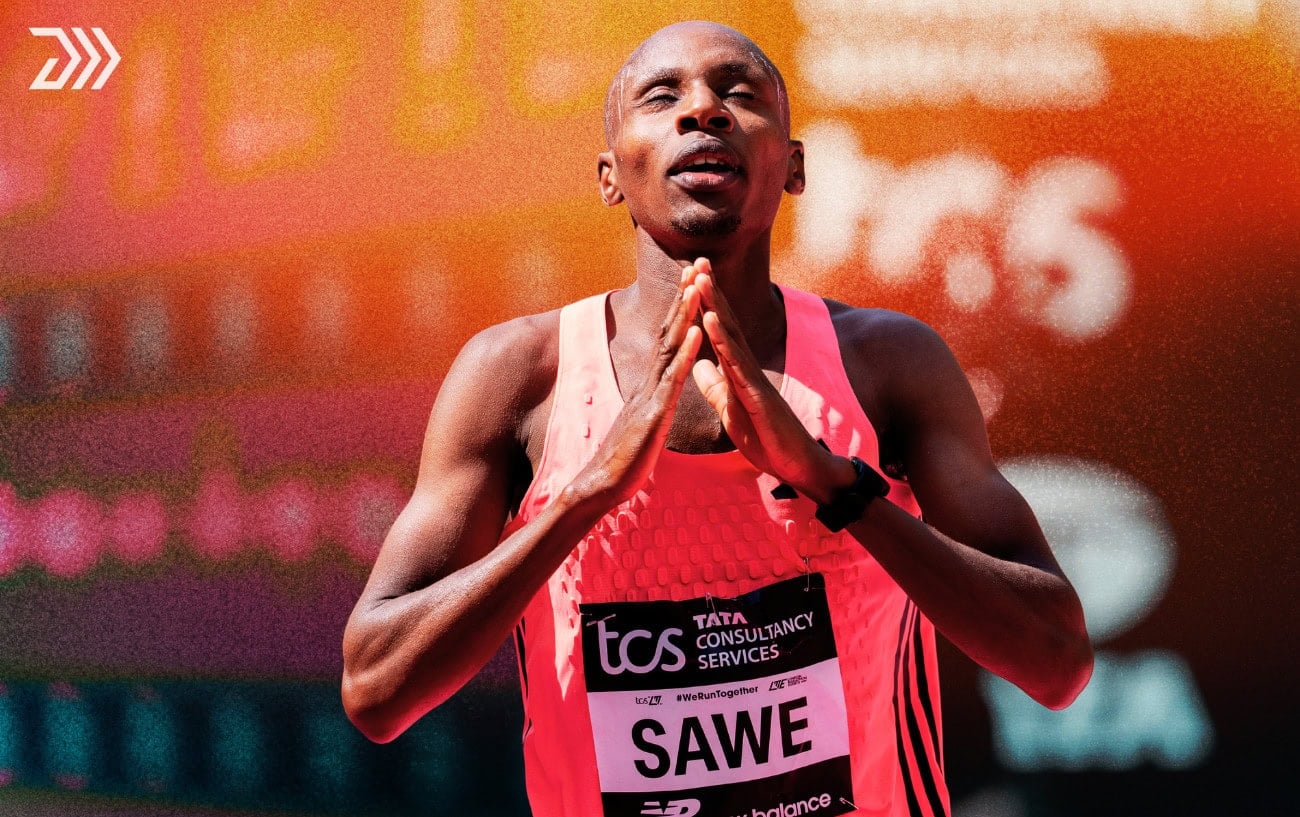
Update — 27 April 2026: Since this article was published, Sabastian Sawe became the first man to officially run a marathon under two hours, clocking 1:59:30 at the 2026 London Marathon to break Kelvin Kiptum’s previous men’s world record (2:00:35) by 65 seconds.
The Boston Marathon is one of the most iconic marathons in the world and one that many runners set their sights on as a long-term goal.
When thinking about running this famous marathon, you may wonder what the Boston Marathon average times are, as in most cases, you do need to qualify to be able to participate.
But what’s the average Boston Marathon time overall? How does the average Boston Marathon finish time compare to other marathons? And how have times changed in recent years with tighter qualifying standards?
We’ve crunched the numbers on 25 years of Boston Marathon data — from 2000 through 2025 — to answer all of these questions and more.

The Honest Truth About The Boston Marathon Average Time
The Boston Marathon’s average finish time is faster than every other major marathon — and that’s not because Boston runners are mysteriously stronger. It’s a measurement artefact created by qualifying standards, the course’s peculiar physiology, race-day weather, and a self-selecting field. Read the average without those four levers in mind and you’ll draw the wrong conclusions about how your time compares.
Why the field is faster: the BQ filter and selection bias
Boston is the only World Marathon Major with a strict qualifying time for general entry — the BQ standards range from roughly 3:00 for men 18–34 to 4:50 for women 80+. The result is a finishing distribution shifted left of any open-entry marathon. Modelling of mass-participation marathons by Vitti and colleagues shows median finishing times in BQ-regulated events sit roughly 25–45 minutes faster than open-entry races of comparable distance and field size 1Vitti A, Nikolaidis PT, Villiger E, Onywera V, Knechtle B. The “New York City Marathon”: participation and performance trends of 1.2M runners. J Sports Sci. 2020;38(6):635-43.. Charity entries dilute that effect at the slower end — roughly 12 to 15 percent of Boston bibs go through charity programmes — which means the average is shaped by two distinct populations: time-qualified runners clustered around their qualifying threshold, and a fundraising tail running roughly an hour slower 2Lepers R, Cattagni T. Do older athletes reach limits in their performance during marathon running? Age. 2012;34(3):773-81..
The course physiology: net downhill, but not actually fast
Boston drops about 137 m (450 ft) net from Hopkinton to Boylston Street, but that net is misleading. The first 26 km lose elevation aggressively, then the Newton Hills (km 26–33, including Heartbreak Hill at km 33) deliver four climbs into already-damaged quadriceps. Eccentric loading on the long downhill front-loads quadriceps muscle damage, raising creatine-kinase elevations measurably higher than flat-course controls 3Eston RG, Lemmey AB, McHugh P, Byrne C, Walsh SC. Effect of stride length on symptoms of exercise-induced muscle damage during a repeated bout of downhill running. Scand J Med Sci Sports. 2000;10(4):199-204.. The biomechanical evidence is consistent: downhill running at the same heart rate produces 30–50 percent more eccentric work than flat running, with the cost cashed in late in the race when the same legs have to climb 4Mizrahi J, Verbitsky O, Isakov E. Fatigue-related loading imbalance on the shank in running: a possible factor in stress fractures. Ann Biomed Eng. 2000;28(4):463-9.. The Boston positive split (back half slower than front) is bigger than at Berlin, Chicago, or London — and bigger than the wave-start staging accounts for. The course is not actually fast in any aerodynamic sense; it just looks downhill on the elevation profile.
Weather: the dominant year-to-year mover
Boston runs in mid-April; race-day temperatures have ranged from below freezing to near 30 °C in the last fifteen years, and the same field can produce average finishing times that vary by 8–15 minutes year to year almost entirely on weather. Ely et al. modelled marathon performance across 6 majors and 7 years and found roughly a 1–2 percent slow-down per 5 °C of additional ambient temperature above approximately 18 °C, with non-elite runners losing more than elites 5Ely MR, Cheuvront SN, Roberts WO, Montain SJ. Impact of weather on marathon-running performance. Med Sci Sports Exerc. 2007;39(3):487-93.. The 2012 Boston Marathon (race-day high near 27 °C) saw the average finish time slow by approximately 11 minutes versus the prior five-year mean, with disproportionate effects on the slowest 25 percent of finishers 6Vihma T. Effects of weather on the performance of marathon runners. Int J Biometeorol. 2010;54(3):297-306.. Headwind matters too: a sustained northeast headwind from Hopkinton can add 2–4 minutes via increased aerodynamic drag, while a tailwind shaves a similar amount 7Pugh LG. Oxygen intake in track and treadmill running with observations on the effect of air resistance. J Physiol. 1970;207(3):823-35..
Age, sex, and the masters-runner shift
The age-graded performance picture in marathon running peaks in the late 20s for elites and the early-to-mid 30s for the recreational mass field, then declines roughly 0.5–1.0 percent per year after age 40 in trained runners 8Lepers R, Stapley PJ. Master athletes are extending the limits of human endurance. Front Physiol. 2016;7:613.. Boston’s field skews older than open-entry majors because the BQ standards loosen with age, which pulls the average up modestly compared with the elite-dominated tip of other majors 9Ganse B, Degens H. Current insights in the age-related decline in sports performance of the older athlete. Int J Sports Med. 2021;42(10):879-88.. The men’s/women’s gap at Boston has narrowed over fifteen years — a pattern visible across all majors as women’s mass participation and training depth has expanded — and is currently around 9–11 percent at the median, smaller at the elite tip 10Joyner MJ, Hunter SK, Lucia A, Jones AM. Physiological and biomechanical aspects of distance running performance: a sex-specific review. J Appl Physiol. 2020;128(4):951-9..
When the average is the wrong number to compare yourself to
If you ran an open-entry marathon and want to know how you stack up against Boston runners, comparing your finish to the Boston average is misleading because of the BQ filter. Two more useful comparisons: age-graded percentile (which controls for both age and sex) and same-course comparisons against open-entry races of similar profile 11Knechtle B, Nikolaidis PT. Physiology and pathophysiology in ultra-marathon running. Front Physiol. 2018;9:634.. The other thing the “average” conceals is finisher percentage: Boston DNF rates run 1–3 percent in cool weather and climb to 6 percent or higher in heat years like 2012 and 2018, which truncates the slow tail of the distribution and pulls the recorded average artificially faster on hot days 12Roberts WO. A 12-yr profile of medical injury and illness for the Twin Cities Marathon. Med Sci Sports Exerc. 2000;32(9):1549-55.. The honest version of “what’s a good Boston time?’’ is your BQ for your age-sex group: meeting it in cool weather is a roughly 50th-percentile Boston run; beating it by 10–15 minutes lands you near the Boston median.
What Is the Average Boston Marathon Time?
The average Boston Marathon finish time from 2000 to 2025 is 3:52:12. This equates to an average pace of about 8:52 per mile (5:30 per km).
The BAA does not compile average finish time data in their published results, but Marathon Guide and other sources post basic statistics for each year since 2000, including the total number of finishers and the average finish time.
After combing through the Boston Marathon results for each year since 2000 (omitting 2020 because the race was virtual), we created the table below displaying the number of finishers and the average Boston Marathon finish time each year through 2025:
| Year | Number of Finishers | Average Boston Marathon Finish Time |
| 2000 | 15,680 | 3:41:39 |
| 2001 | 13,395 | 3:46:44 |
| 2002 | 14,400 | 3:43:01 |
| 2003 | 17,046 | 3:55:19 |
| 2004 | 16,743 | 4:13:02 |
| 2005 | 17,549 | 3:57:41 |
| 2006 | 19,688 | 3:50:03 |
| 2007 | 20,348 | 3:54:33 |
| 2008 | 21,963 | 3:51:40 |
| 2009 | 22,849 | 3:49:34 |
| 2010 | 22,540 | 3:50:25 |
| 2011 | 23,879 | 3:49:54 |
| 2012 | 21,557 | 4:18:27 |
| 2013 | 17,580 | 3:29:52 |
| 2014 | 31,805 | 4:02:30 |
| 2015 | 26,610 | 3:46:28 |
| 2016 | 26,639 | 3:55:03 |
| 2017 | 26,411 | 3:58:03 |
| 2018 | 25,746 | 3:57:09 |
| 2019 | 26,632 | 3:53:01 |
| 2021 | 15,374 | 3:53:59 |
| 2022 | 24,607 | 3:45:09 |
| 2023 | 26,598 | 3:45:26 |
| 2024 | 25,554 | 3:53:05 |
| 2025 | 28,384 | 3:43:13 |

It is interesting to look at the data and note the outliers. For example, the 2012 Boston Marathon average time was considerably slower than usual due to unprecedented heat on race day. Meanwhile, the 2013 average was the fastest on record at 3:29:52 — but this was the year of the tragic Boston Marathon bombing, so the race had to be stopped prematurely, and slower finishers were diverted away from the finish line.
More recently, the 2025 Boston Marathon saw one of the fastest overall fields in race history, with an average of 3:43:13 — about 10 minutes faster than 2024. Ideal weather conditions and tighter qualifying standards both played a role.
If we eliminate the 2013 outlier from the data, the average Boston Marathon time shifts to about 3:53:05. If we also remove the heat-affected 2012 race, it lands at approximately 3:52:05.
Average Boston Marathon Time by Gender
The average Boston Marathon finish time differs significantly between men and women. Based on recent data:
- Men’s average Boston Marathon time: approximately 3:35
- Women’s average Boston Marathon time: approximately 3:55
In the 2025 Boston Marathon specifically, 16,103 male finishers averaged 3:33:31, while 12,210 female finishers averaged 3:56:02. The race also saw 71 non-binary finishers — reflecting the BAA’s addition of a non-binary division starting in 2023.
The roughly 20-minute gap between men’s and women’s averages is consistent with the gender differences seen across marathon finishing times generally, and mirrors the 30-minute gap in Boston Marathon qualifying standards between men and women.
Is the Average Boston Marathon Time Fast?
Analyzing average Boston Marathon times is interesting because the instinct of many runners is that Boston Marathon average times are likely faster than the average marathon time for a typical marathon because runners have to qualify for the race.
That means that there’s a certain standard or level that runners have to have to even run the race, whereas most marathons are completely open to all ability levels or might have a generous cutoff time.
However, there are a couple of important caveats that actually render this a good idea in theory but not all that true in real life.
The average marathon finish time across both sexes, all age groups, and all levels is roughly 4:20 to 4:30 depending on the source and year.
The average Boston Marathon time of 3:52:12 is considerably faster than the typical marathon — but that’s because the field is pre-selected through qualifying standards. What’s more interesting is understanding why Boston’s average isn’t even faster given those standards.

The Course Is Deceptively Difficult
The Boston Marathon course is notoriously challenging and, in fact, deceptively so. It begins with about 10 kilometers (6.2 miles) of downhill running, which sounds easy in theory but can really trash your quads for the remaining 20 miles of the race.
Runners who have not done a lot of downhill training often face the brutal realization that a lot of early downhill pounding comes back to bite them in terms of their leg strength and energy in the later miles. Additionally, there are a series of hills with some significant climbs around miles 15 to 16 of the course — the famous Heartbreak Hill section.
Overall, the Boston Marathon course is certainly not as fast as a flat course like the Chicago Marathon or Berlin Marathon.

Charity and Invitational Runners
The second, and often overlooked factor, that affects the average Boston Marathon finish time is the fact that there are plenty of runners in the race who have not qualified but are running to represent a charity or have been invited to the race by the BAA.
These marathon runners may have a significantly slower race pace than Boston Marathon qualifiers and can ultimately bring down the average Boston Marathon time.
For example, entrants who sign up with a charity and commit to fundraising might only be able to finish the race in six hours, taking on the Boston Marathon as either an opportunity to raise awareness for a cause that is near and dear to their heart or to run the iconic race though they may never be close to qualifying.
While there is absolutely nothing wrong with these goals, and no goal is “better” or “less worthy” than another, these types of slower finish times will bring down the average.

Boston Marathon Course Records
The Boston Marathon course records, as of 2025, are:
- Men’s course record: 2:01:52 — John Korir (Kenya), 2026
- Women’s course record: 2:17:22 — Sharon Lokedi (Kenya), 2025
Lokedi’s 2025 record was a massive breakthrough, taking 2 minutes and 37 seconds off the previous women’s course record of 2:19:59 set by Hellen Obiri in 2024. It was the biggest improvement to the women’s course record in over a decade.
For context, the current marathon world records are 1:59:30 for men (Sabastian Sawe, London 2026) and 2:09:56 for women (Ruth Chepngetich, Chicago 2024). The gap between the world records and Boston course records reflects the difficulty of the Boston course compared to the flat, fast Berlin and Chicago courses where records tend to fall.
2025 Boston Marathon Results and Highlights
The 2025 Boston Marathon (the 129th running) took place on April 21, 2025, with 28,384 finishers — one of the largest fields in recent years. A 98.4% completion rate and favorable weather made it one of the fastest Boston Marathons on record for the overall field.
Key results from the 2025 Boston Marathon:
- Men’s winner: John Korir (Kenya) — 2:04:45, the second-fastest men’s winning time in race history. Korir became the first sibling pair to win the race, following his brother Wesley Korir’s 2012 victory.
- Women’s winner: Sharon Lokedi (Kenya) — 2:17:22, a new course record. Lokedi edged out two-time defending champion Hellen Obiri (2:17:41).
- Overall average finish time: 3:43:13
- Men’s average: 3:33:31 (16,103 finishers)
- Women’s average: 3:56:02 (12,210 finishers)
The 2025 race was roughly 10 minutes faster on average than the 2024 edition, which had been affected by warmer weather conditions.
Boston Marathon Qualifying Times (2026 Update)
To run the Boston Marathon, most runners need to achieve a qualifying time (known as a “BQ”) at an eligible marathon. The qualifying standards are graded by age and gender.
For the 2026 Boston Marathon (the 130th running), the BAA tightened qualifying standards by five minutes for athletes under the age of 60. This was in response to record numbers of qualifier applicants in previous years exceeding the available field size.
Here are the current qualifying times for the 2026 Boston Marathon:
| Age Group | Men | Women & Non-Binary |
| 18-34 | 2:55:00 | 3:25:00 |
| 35-39 | 3:00:00 | 3:30:00 |
| 40-44 | 3:05:00 | 3:35:00 |
| 45-49 | 3:15:00 | 3:45:00 |
| 50-54 | 3:20:00 | 3:50:00 |
| 55-59 | 3:30:00 | 4:00:00 |
| 60-64 | 3:50:00 | 4:20:00 |
| 65-69 | 4:05:00 | 4:35:00 |
| 70-74 | 4:20:00 | 4:50:00 |
| 75-79 | 4:35:00 | 5:05:00 |
| 80+ | 4:50:00 | 5:20:00 |
It’s important to note that meeting the qualifying standard does not guarantee entry. For the 2026 race, 33,267 qualifier applications were received, but only 24,362 were accepted. The effective cutoff was 4 minutes and 34 seconds faster than the qualifying time — the tightest cutoff in race history.
This means that to realistically get into Boston, you need to beat your qualifying time by at least 5-6 minutes as a safety margin. For more details, check out our complete guide to Boston Marathon qualifying times and cutoffs.

What Is the Boston Marathon?
For beginners who are unfamiliar with the race, the Boston Marathon is the oldest annual marathon in the world, with 1897 being the inaugural year. The 2026 edition marks the 130th running of the race.
It is organized by the Boston Athletic Association (BAA) and held on Patriots’ Day, which is the third Monday in April. The only exceptions in modern history were the 2020 Boston Marathon, which was virtual, and the 2021 edition, which was moved to October due to the COVID-19 pandemic.
Like all marathons, the Boston Marathon distance is 26.2 miles (42.195 kilometers).
As a point-to-point course, the Boston Marathon takes runners from the starting line in Hopkinton, Massachusetts, to the famous finish line on Boylston Street in Boston. The 2026 race features 30,000 participants from more than 130 countries and all 50 U.S. states, with a new six-wave start format (up from four) designed to improve the race-morning experience.
The Boston Marathon is one of the Abbott World Marathon Majors, along with the New York City, Chicago, Tokyo, Berlin, and London Marathons.
Frequently Asked Questions
What Is a Good Boston Marathon Time?
A “good” Boston Marathon time depends on your age and experience. Given that the overall average is about 3:52, finishing under 3:30 would put you well above the average field. For most age-group qualifiers, simply achieving the qualifying standard — and then beating it by enough to get accepted — represents an excellent performance. Anything sub-3:00 is exceptional for a non-elite runner on the challenging Boston course.
Is the Boston Marathon Harder Than Other Marathons?
Yes, the Boston Marathon course is generally considered harder than other major marathons. The early downhill miles can damage your quads, and the Newton hills (including Heartbreak Hill) come at miles 15-21 when fatigue is setting in. The course records are significantly slower than world records, which are typically set on flat courses like Berlin and Chicago. Most runners report that their Boston time is slower than their qualifying marathon time.
How Fast Do You Need to Run to Qualify for Boston?
As of the 2026 standards, the fastest qualifying time is 2:55:00 (men aged 18-34) and 3:25:00 (women and non-binary aged 18-34). The qualifying times get progressively more generous with age, up to 4:50:00 for men and 5:20:00 for women aged 80+. However, simply meeting the standard is usually not enough — in 2026, the effective cutoff was 4:34 faster than the qualifying time. Read our full Boston Marathon qualifying times guide for the complete breakdown.
Why Is the Boston Marathon Average Time Slower Than You’d Expect?
Three main reasons: (1) the course is hilly and deceptively difficult; (2) charity and invitational runners who didn’t need to qualify bring down the average; and (3) the qualifying standards are age-graded, so older runners with qualifying times of 4:30+ are part of the average. When you factor all of these together, the average Boston Marathon time of 3:52 makes sense despite it being a “qualifier-only” race.
Have you run the Boston Marathon, or are you working toward qualifying? Check out our complete guide to the Boston Marathon, our qualifying times guide, or browse our marathon training plans to help you get there.
References
RunClub — Free
Join 300,000+ runners in RunClub
Free training plans for every distance, a daily running game, exclusive coaching content, and a real community of runners. Create your free account in 20 seconds — no card.
Already a member? Log in →







Join the conversation
Exceptionally informative article and very well researched. A pleasure to read.