


Do grip strengtheners work? The short answer is yes — studies show that consistent use of grip trainers can significantly improve hand and forearm strength. But there are common mistakes that limit results. Here’s what the science says, plus 5 errors to avoid for maximum gains.
But, what is the best way to do so? Do grip strengtheners work? Short answer: they work! We’ll get into the details below.
Let’s dive in!
The Honest Truth: Grip Strengtheners Work — But Only For The Slice Of Grip Your Hand Actually Trains
Pinchable rubber donuts, spring-loaded clamps, and adjustable pistol-grip devices all do one thing well — they overload the long finger flexors and intrinsic hand muscles across a limited range of motion. What the marketing pages rarely say is that “grip” is not a single capacity: it is at least three distinguishable abilities — crushing strength, pinch strength, and support (hold) endurance — each of which responds to different training stimuli. That is why the peer-reviewed evidence is consistently positive but also consistently bounded: a decent strengthener routine reliably raises handgrip dynamometer numbers and forearm endurance, but the transfer to sport, everyday carrying tasks, and the mortality-associated “grip” measured in big epidemiology datasets is more modest and more specific than the device marketing implies.
Grip Strength Is A Real Mortality Marker — But Not Because Of The Hand
The reason “improve your grip” keeps showing up in longevity content is the PURE study: Leong and colleagues measured handgrip strength in 139,691 adults across 17 countries and found that every 5 kg drop in grip strength was associated with a 16% higher risk of all-cause mortality, a 17% higher risk of cardiovascular death, and a 7% higher risk of myocardial infarction over a median 4-year follow-up.1Leong DP, Teo KK, Rangarajan S, Lopez-Jaramillo P, Avezum A Jr, Orlandini A, Seron P, Ahmed SH, Rosengren A, Kelishadi R, et al. Prognostic value of grip strength: Findings from the Prospective Urban Rural Epidemiology (PURE) study. The Lancet. 2015;386(9990):266–273. Celis-Morales and colleagues replicated the signal in half a million UK Biobank participants and showed the relationship held across cardiovascular, respiratory, and cancer mortality.2Celis-Morales CA, Welsh P, Lyall DM, Steell L, Petermann F, Anderson J, Iliodromiti S, Sillars A, Graham N, Mackay DF, et al. Associations of grip strength with cardiovascular, respiratory, and cancer outcomes and all cause mortality: Prospective cohort study of half a million UK Biobank participants. BMJ. 2018;361:k1651. But Bohannon has been explicit for years that grip strength is a proxy for total skeletal muscle mass and neuromuscular integrity, not a causal lever — which means grinding out squeezes on a $15 gripper will raise your hand dynamometer number but does not, on its own, move the underlying whole-body biomarker the mortality studies are really measuring.3Bohannon RW. Grip strength: An indispensable biomarker for older adults. Clinical Interventions in Aging. 2019;14:1681–1691.
Device Training Transfers To The Hand — Transfer To Pull Strength Is Weaker
Controlled training studies do show meaningful adaptation at the hand itself. Trosclair and colleagues reviewed handgrip training protocols and reported average 10–30% gains in maximal grip strength across 4–12 weeks of structured crushing-device work, with the largest responders being previously sedentary adults.4Trosclair D, Bellar D, Judge LW, Smith J, Mazerat N, Brignac A. Hand-grip strength as a predictor of muscular strength and endurance. Journal of Strength and Conditioning Research. 2011;25(S1):S99. Balogun and colleagues showed 6 weeks of gripper-only training produced measurable grip-endurance gains but only small transfer to pull-up or deadlift performance — because those whole-body lifts are limited by shoulder, elbow, and trunk capacity long before the hand is the bottleneck.5Balogun JA, Akomolafe CT, Amusa LO. Grip strength: Effects of testing posture and elbow position. Archives of Physical Medicine and Rehabilitation. 1991;72(5):280–283. Cronin and colleagues reviewed the broader grip-training literature and concluded that specificity rules: device work raises device scores, dead-hang training raises dead-hang time, and thick-bar or barbell hold training transfers best to deadlift grip — which means picking the strengthener that matches your actual goal matters more than the brand on the box.6Cronin J, Lawton T, Harris N, Kilding A, McMaster DT. A brief review of handgrip strength and sport performance. Journal of Strength and Conditioning Research. 2017;31(11):3187–3217.
Climbers, Swimmers, And Combat Athletes Show Where The Ceiling Is
The ceiling on strengthener adaptation becomes clear in sports where forearm physiology is the limiter. Watts and colleagues reviewed rock-climbing physiology and showed finger-flexor oxidative capacity is a key predictor of grade, and that it adapts fast — most of the improvement from dedicated forearm training arrives in the first 4–8 weeks before performance plateaus and further gains require more specific sport exposure.7Watts PB. Physiology of difficult rock climbing. European Journal of Applied Physiology. 2004;91(4):361–372. Giles and colleagues operationalised this with a finger-flexor critical-force model — analogous to critical power for whole-body endurance — and demonstrated that climbers who track critical force rather than peak strength see more useful training signals.8Giles D, Hartley C, Maslen H, Hadley J, Taylor N, Torr O, Chidley J, Chidley C, Fryer S. An all-out test to determine finger flexor critical force in rock climbers. International Journal of Sports Physiology and Performance. 2021;16(7):942–949. Macdermid and Stannard showed similar adaptation curves for forearm fatigue resistance and noted the curve is steep early and shallow late — so if you are already a regular climber, pull-up athlete, or rower, a generic squeeze device adds very little on top of what the sport already trains.9Macdermid PW, Stannard SR. Mechanical work and physiological responses to simulated cross country mountain bike racing. Journal of Sports Sciences. 2012;30(14):1491–1501.
When A Grip Strengthener Actually Is The Right Tool
The honest use cases for a $10–25 squeeze device are narrower than the marketing suggests, but they are real. Grip strengtheners are a good choice when you need (1) a rehab tool after hand surgery, wrist injury, or immobilisation where the goal is to restore local forearm endurance under controlled load; (2) a portable, equipment-free supplement for travel or desk-work breaks where 3–4 sets of 15–20 squeezes per session can help offset sedentary hand posture; (3) a specific weak-link fix for a lifter whose deadlift drops because of grip failure, where paired work with a device plus heavy barbell holds gives more forearm volume than either alone; or (4) an entry-level way to build forearm endurance before graduating to the bigger transfer exercises — a dead hang on a bar and a proper compound lifting programme will move both your grip and the wider mortality-associated strength markers much more than any gripper alone. Use the device as a supplement, not a replacement.
What Is a Hand Grip Strengthener?
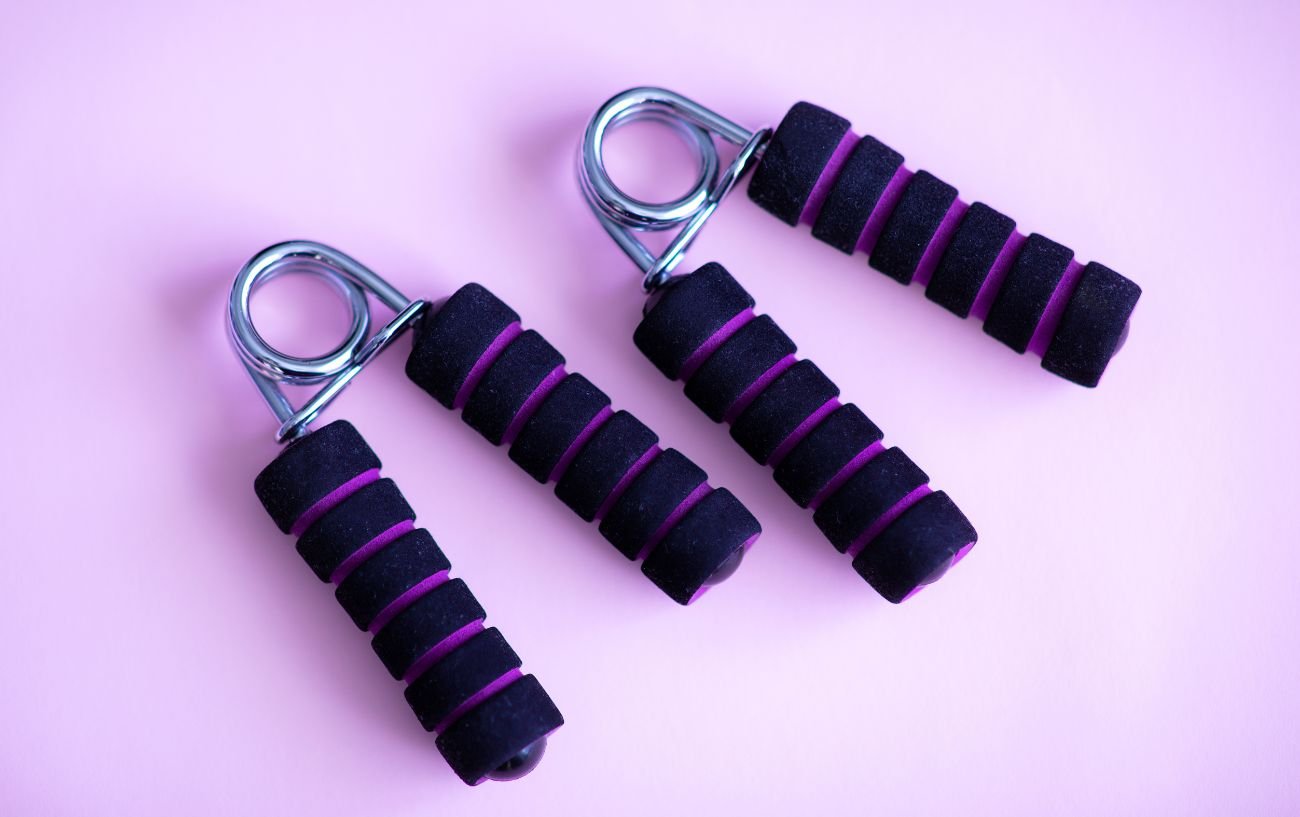
A hand grip strengthener, often called a hand gripper, forearm strengthened, grip strengthener, or grip squeezer, is a small, handheld device that is designed to increase hand grip strength.
A hand gripper looks like a letter V. There are two compressible handles that form the arms of the “V, “ and there is a spring mechanism or arrangement of coils that join together so that you can squeeze the handles (sides of the V) together.
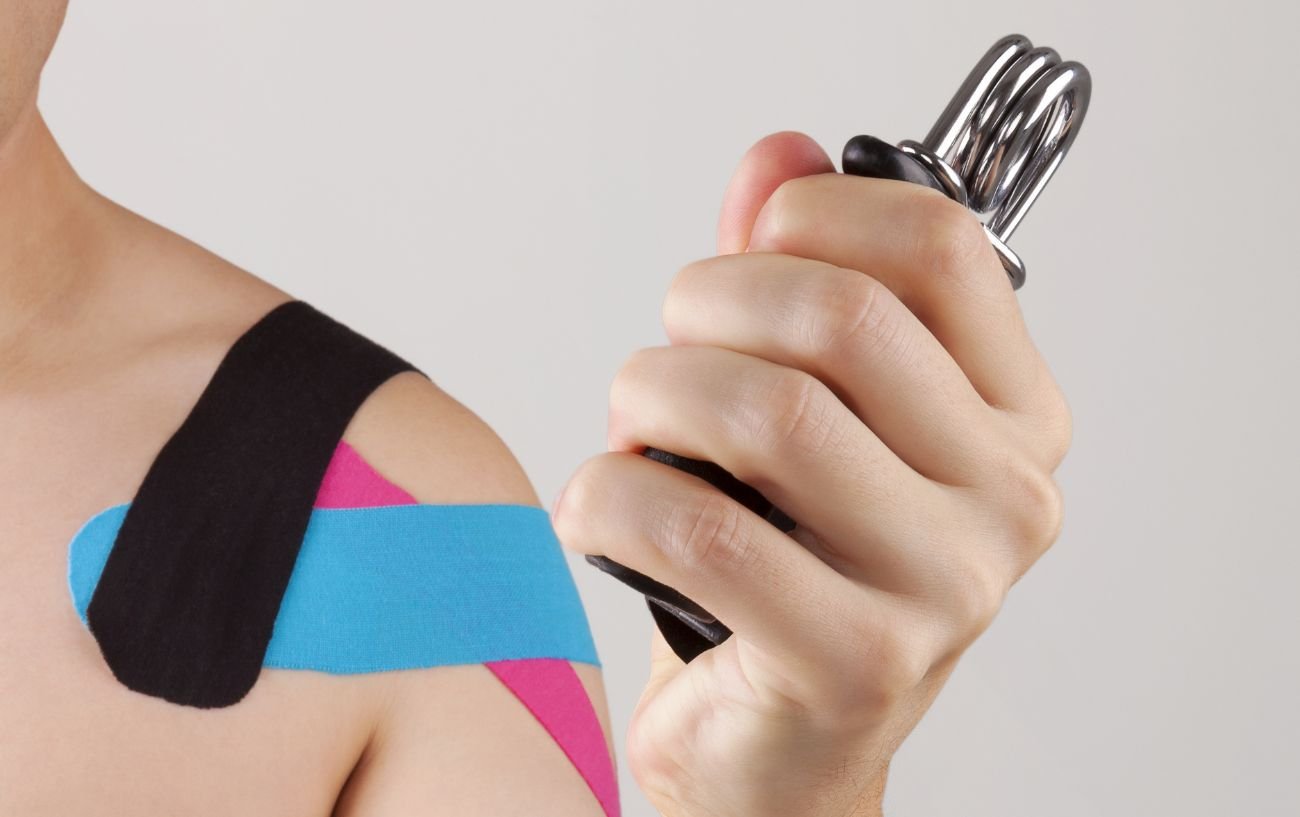
You hold the hand trainer or hand grip strengthener device in your palm and form a light fist around it.
Then, you contract the muscles in your hand around the hand gripper to compress the arms of the device together so that they are pressed parallel to one another rather than flared out from the pivot axis point.
Hand-held grip strengthener devices come in a variety of levels of resistance.

Beginner hand grippers have more accessibility and are ideal for elderly individuals10 Bohannon, R. W. (2019). Grip Strength: An Indispensable Biomarker For Older Adults. Clinical Interventions in Aging, 14, 1681–1691. https://doi.org/10.2147/CIA.S194543 or those who have weak grip strength.
As you get stronger, you can progress to stiffer more heavy-duty hand grippers.
The best hand grip strengtheners may even have adjustable hand grip resistance. The handles should be ergonomic and coated in some sort of material to aid comfort and traction in your hand, such as silicone, high-density foam, or soft rubber.
Even premium hand grip strength grippers are generally quite affordable, and because they are compact and do not require any power, buying a hand gripper can be a convenient, cost-effective way to incorporate grip training at home or on the go.

How Do You Use a Hand Grip Strengthener?
Unlike some pieces of exercise equipment, using a hand gripper to increase grip strength is extremely straightforward and does not require specialized training or technique.
This makes the hand gripper a beginner-friendly grip strength exercise, but more advanced and experienced rock climbers and weightlifters11 Wang, Y.-C., Bohannon, R. W., Li, X., Sindhu, B., & Kapellusch, J. (2018). Hand-Grip Strength: Normative Reference Values and Equations for Individuals 18 to 85 Years of Age Residing in the United States. Journal of Orthopaedic & Sports Physical Therapy, 48(9), 685–693. https://doi.org/10.2519/jospt.2018.7851, or just those looking for a stress relief tool, can also take advantage of the benefits of hand grip strengthening devices.
Here are the steps for how to use this piece of training equipment to improve grip strength:
- Place the hand grip exerciser in the palm of your hand with one handle against the fleshy pad at the base of your thumb and the other handle lining up along the bottom portion of the four opposing fingers.
- You can theoretically place the hand grip exerciser facing either direction in your hand in terms of where the pivot point is, but most people angle it so that the circular portion where the two handles meet points outward from your hand from the pinky side of your palm.
- Then, simply fold your hand around the hand gripper exerciser, squeezing as hard as you can to form a fist. Try to bring the two handles together so that they touch. However, if you are progressing in resistance level and cannot fully close your fist around the hand exerciser, you can still derive benefit from it by squeezing as hard as you can for as much range of motion as you can manage.
- Hold the squeeze, forming a tight fist as you continue to bear down along the handles for 2 to 5 seconds.
- Slowly release your grip in a controlled manner.
Repeat for the desired number of reps. As your hand strength improves, increase the number of reps as well as the length of the isometric contraction (fist squeeze) for each rep.
If you suffer from carpal tunnel syndrome, make sure you use the correct technique and build up the resistance gradually.
Do Grip Strengtheners Work?
So, do hand grip exercisers work? Will using a hand trainer increase grip strength in your hands, fingers, or forearms?
When you use the hand grip strengthener, the squeezing motion helps strengthen the finger flexor muscles, the muscles in the palm of your hand, as well as the muscles in your wrist and forearms. All of these muscles together determine your functional grip strength.
While the hand gripper can increase the crush strength of your hand and fingers, adding exercises that work the finger flexors and extensors, intrinsic hand muscles, wrist flexors and extensors, and forearm muscles will provide a more well-rounded grip strength training program for better results, functionality, and dexterity.
5 Common Mistakes Made When Using Grip Strengtheners
Although using a forearm strengthener is quite straightforward, there are still some common mistakes that people make when using hand grip trainers.
These mistakes can potentially injure your tissues. More so, hand gripper mistakes will decrease the effectiveness of improving your grip strength.

Here are some of the common mistakes made when using hand grip exercisers for grip strength workouts:
#1: Using the Wrong Resistance
As with any strength training exercise, you need to use the right resistance with the hand gripper in order actually to see improvements in grip strength.
If it is too easy to compress the hand strengthener, you will need to do a lot of reps in order to derive any benefits.
Even so, this will mainly improve your muscular endurance or your hand grip strength endurance rather than your maximum hand grip strength or forearm mass.
As with almost any strength training exercise, the resistance should be hard enough that you feel fatigued after your set.
The rep range for using a hand gripper is generally higher than for traditional strength training exercises with large muscle groups. Because the hand exerciser targets such small and delicate muscles, the resistance generally should not be so high that you can only manage a couple of reps.

If you are trying to build strength, try to back off the resistance until you have found a level that enables you to perform at least 5 to 10 complete reps per set. Add more sets with plenty of rest in between each to really build up your hand grip strength.
With hand grip exercises using a hand gripper, a rep range of 10 to 15 is ideal for hypertrophy.
If you are indeed looking to maximize muscular endurance, you can use a light-resistance hand gripper and perform as many reps as possible.
Some people even carry a hand strengthener as they walk around and intersperse sets of 1 to 3-4 minutes of hand squeezes throughout the course of the day if you are trying to build muscular endurance.
Surprisingly, more often than not, the issue is using a hand gripper that provides too much resistance.
The muscles and tendons in the hands and fingers responsible for squeezing the hand gripper are small, delicate tissues. If the resistance is too high, you can damage these structures and cause injury.
Unless you are an advanced athlete training grip strength, you should be choosing a resistance that enables you to perform 10 to 15 reps.
If you can only eke out a few full reps, the resistance is likely too high, and you may be setting yourself up to injure a finger flexor muscle or tendon.

#2: Using a Cheap Hand Grip Exerciser
Even the best hand grip strengtheners are relatively inexpensive, and it is advisable to spend a little bit more money for one of these high-quality units rather than buying a cheap one.
Inexpensive hand grippers are typically not very ergonomically, and the handles may not be coded in a way that will protect your hands.
This can lead to blisters and may injure your wrist if the shape of the hand gripper is not very ergonomic or does not fit your hand appropriately.
There are various sizes and designs of hand grip exercisers, so find one that feels right and fits well in your hands to prevent discomfort or injuries.
#3: Wrong Training Volume
As with any strength training exercise, you have to perform the right volume to increase grip strength without overtraining and increasing the risk of injury.
If you only use your hand grip exerciser every now and again, or even just once a week, you may not be able to discern appreciable improvements in hand grip strength.

More often than not, people overdo it with hand grippers.
As with any type of exercise, the muscles in your fingers, hands, wrists, and forearms that are worked by using a hand grip strengthener need rest.
Try to wait at least 48 hours between hand grip strengthener workouts to allow your muscles time to recover so that you do not risk overtraining. Gradually increase the number of sets, reps, and frequency of hand gripper workouts as your body adapts.
#4: Only Using Hand Grippers
If your goal is to increase functional forearm grip strength, just using a hand strength exerciser will not be nearly as effective as engaging in grip strength workouts that include a variety of dynamic and static exercises for grip strength.
#5: Not Doing Counter Exercise
If you just use your grip strength trainer you can end up with unbalanced hand strength and your fingers are more likely to curl closed when resting. This can be countered by adding a finger stretcher to your grip workout!
Also a forearm workout, the finger stretcher improves your finger strength by strengthening the top of your forearms.
The finger stretcher is a silicone gadget which wraps around each of your fingers with resistance bands which pull your fingers in towards your palm. Your job is to extend your fingers outwards against the resistance.
These finger exercisers don’t have adjustable resistance, so make sure you buy one that matches your strength level.

For more information about how to increase your grip strength, check out our guide to the best grip strength workout here.
References
RunClub — Free
Join 300,000+ runners in RunClub
Free training plans for every distance, a daily running game, exclusive coaching content, and a real community of runners. Create your free account in 20 seconds — no card.
Already a member? Log in →







Join the conversation
This was a really useful article. The most informative thing that I've read in some considerable time. Good science. Sound explanation. Specificity.
I just started using hand grips (I am 57). Thanks for advice to do it even second day