

Billy Mills And The Marathon
On the final day of the XVIII Olympiad in Tokyo 47 years ago, an orphaned U.S. Marine second lieutenant, from the University of Kansas by way of the Pine Ridge Indian Reservation in South Dakota, was the 14th runner to cross the finish line of the marathon. He was more than 10 minutes behind the winner. No one would have taken a second look at that athlete had it not been for a record run seven days earlier. When the future Makata Taka Hela rounded that final turn in the National Olympic Stadium and flew down the straightaway to win
the 10,000 meters in an Olympic record, people scrambled to know this American champion. He could have run under his soon-to-be Oglala Lakota Sioux Indian warrior name as far as most people were concerned, because the name Billy Mills solicited the same unrecognized response.
And often overlooked is that these remarkable feats were achieved by a 26-year-old body weakened by hypoglycemia—abnormally low glucose in the blood—with which he was diagnosed the year before the 1964 Games.
10K to 42K “My marathon experience was really quite, quite unique,” said Mills. In 1964, in an attempt to fill the combined 200 spots in the East Coast U.S. Olympic Marathon Trials held in Yonkers, New York, and the West Coast Trials in Culver City, California, a number of elite 10K runners were also allowed to compete. Interested at the time, and having never run a marathon, Mills recalled one pivotal training session when he was testing the waters. It was with friend and fellow U.S. Marine Alex Breckenridge, who in the 1960 Olympic Marathon in Rome was 30th at 2:29:38.
“We’re on a 25-mile run, and all we could hear on this run was our feet pounding against the earth,” said Mills, his hands rhythmically hitting a tabletop. “And I said, ‘Alex, how do you think you’ll do in the marathon?’ And he said he had a slim chance to get into the third-place [spot] like he did in 1960. A few more miles go by, and I said, ‘Alex, how do you think I will do if I run the marathon?’ And all we could hear for the next couple of miles was just our feet [Mills again rhythmically pounds his hands atop a table]. And he said, ‘You’ll beat me.’ And I felt so, I felt so uncomfortable [at the notion].”
They maintained their run. “I said, ‘Alex, I’m thinking about running the marathon. But be really honest with me, if you don’t want me to, I won’t,’” Mills said. “And we continued running. And he finally said, ‘You should run. But you’re gonna beat me.’”
Having decided to run the marathon, Mills was at a loss as to how to properly train and compete among the best at such a long distance. It was suggested that he contact Hal Higdon, who had competed in the 1952 Olympic Trials in the 10,000 and later was the first American finisher in the 1964 Boston Marathon. “
Bless Hal Higdon, he’s helped multitudes of people, but Hal Higdon—he knows I share this story on occasion—I ask him [about training], and Hal Higdon said, ‘You damn sprinters, moving up to a man’s race. Stick by me and I’ll tell you where to drop,’” Mills laughed. “I said, ‘Wow, these guys are tough!’ So I didn’t know who to ask. So I just didn’t ask anybody. “
Also, in 1963 I was diagnosed as hypoglycemic and prediabetic, so I go low blood sugar. Didn’t know how to deal with that,” continued Mills. “One day I was competitive, the next day I was dropping out. And they would say when I would drop out of a race—low self-esteem. Orphan, minority, poverty—you haven’t had to deal with those issues. So I didn’t know how to ask for help. Higdon says, ‘Stick by me and I’ll tell you where to drop,’” Mills laughed again.
U.S. Marine Corps
▲
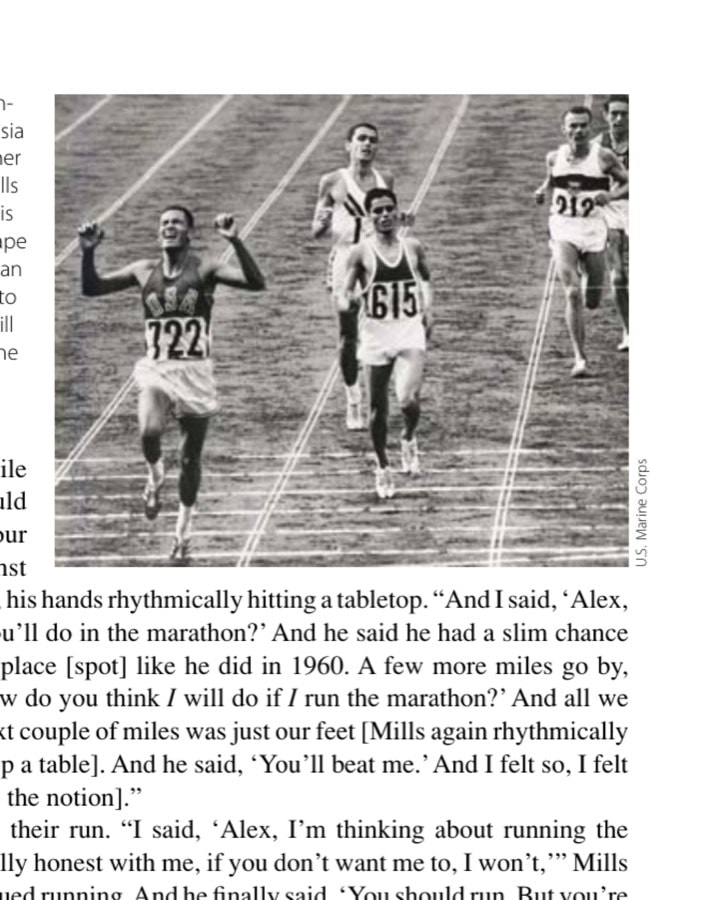
Just ahead of Mohammed Gammoudi of Tunisia (615) at the 1964 Summer Games in Tokyo, Billy Mills of the U.S. (722) raises his arms at the finish-line tape of the 10,000 meters in an Olympic record 28:24.4 to become the first, and still only, American to win the Olympic 10K.
Is he serious? When told of these remarks, Higdon, a prolific writer, says that while he doesn’t recall making those actual statements, if he did, it was surely not meant to be serious. “I don’t remember the comment, but I’m sure it was said in jest,” Higdon responded. “You also have to take into context the fact that I dropped out of my first three marathons (Boston twice and Culver City) because I tried to win the race rather than run with any intelligent thought. I finally finished my fourth marathon [attempt] at Yonkers, despite sitting down on the curb at 24 miles, devastated because the event had licked me.”
Higdon recalled he most likely first met Mills around 1959 while he ran for the University of Chicago Track Club (UCTC) and Mills was at Kansas. “We might have raced them in cross-country,” said Higdon, a cofounder in 1958 of the Road Runners Club of America (RRCA). “My impression then was that he was a talented runner who was somewhat erratic because I believe I beat him once or twice—and I shouldn’t have.”
The marathon trials Mills had to turn in one of the top times—not necessarily places—of Culver City and Yonkers in order to make the U.S. Olympic Marathon team. And that was a tremendous amount of pressure for Mills, who was competing in his first 26.2-mile competition.
Among others at Yonkers were Leonard “Buddy” Edelen and John J. “The Younger” Kelley. And with Mills in California were Peter McArdle and Higdon, the latter of whom in April 1964 turned in 2:21:55 at Boston.
Higdon recalled of the Culver City Trials: “I had been injured and had a bad race that day. But if I remember correctly, I was with the front-runners up to around 20 miles, then they pulled away from me and I struggled home. But Billy at this point was very much our third-best marathoner on any form charts, behind Buddy Edelen, who had set the world record the year before, and Peter, who had dominated road races at various distances for several years.”
Mills recalled no official water stops along the Culver City course, so he had to be inventive. And he did so with his wife and their own vehicle. “We had a little Corvair, and my wife, Pat, would drive up a mile ahead and she’d get ready with water,” he said. “And I’d say, ‘Water. Sponge.’ And she’d give me water, sponge. The marathoners were so mean to me about that,” Mills said, laughing.
Approaching the banner that marked 1,500 meters to go, Mills recalled being in second place with a good chance at qualifying.
“Buddy Edelen made the team, winning Yonkers, and now I’m moving into second place in Culver City, definitely the fastest second-place time so I’ll be the third runner on the team,” noted Mills. “Pat gave me water, and the marathoner that I just passed said, ‘Pat, give me water.’ (laughs) And I feel so guilty to this day [because] I turned around and went running back [and said to Pat], ‘Don’t you dare give him my water.’ Because they’d been so vicious to me.”
Mills came in second behind McArdle at Culver City and made the U.S. Olympic team. But it was quickly apparent the organizers hadn’t expected Mills to be anywhere near the top. “They had printed up really beautiful cards, [with] black print. Of the 100 people in the Trials, they printed up about 25 of those so they’d make sure that they had a card for those that made the team,” said Mills of the team posting. “They had no card for me (laughs). I see them tearing off a cardboard box, and they got a big pen and they put my name on there. So they had this nice, neat name up there—Peter McArdle—and then below it, in this tattered, gray cardboard box, it says Billy Mills. “
And they had this beautiful young lady who was a queen for the Trials, and she puts a crown on me—a wreath—and then she’s going to give me a kiss,” added Mills. “And then I just see her puck up her lips, and just as she’s ready to kiss me, this hand comes in and pushed her away (laughs). ‘I’ll give him his kiss.’ It was my wife. And we hug each other.”
Qualified controversy The 1964 U.S. Olympic Marathon team was comprised of McArdle and Mills from Culver City and Edelen from Yonkers. Absent from the roster was Connecticut’s own Kelley, at the time a 33-year-old former Olympian (1956, 1960) who had won Boston in 1957 and the Pan-American Games marathon in 1959 and was an eight-time national champion with wins at Yonkers from 1956 to 1963. “
John Kelley had placed second in the Trials in Yonkers behind Buddy, [with] only one to make the team,” said Higdon. “Johnny was just coming through a decade when he was our top marathoner, but he chose not to run Culver City where Peter and Billy qualified for the other two spots. But some of the New Englanders, or East Coasters, wanted to push to get Johnny on the team. This would happen only if Billy, or someone, yielded his spot. And I believe they were pressuring Billy, particularly after he made the team in the 10,000.”
Mills received many calls and letters in regard to his marathon spot; some merely requested him to reconsider, while others were more assertive. One of those forceful letters came from John “Jock” Semple, the rough-around-the-edges Scottish-born official of the Boston Marathon.
“Bless his heart, Jock wrote me a letter, which I kept, and he said, ‘Give up your spot in the marathon to the man who finished behind you. If you try running both, the 10K and the marathon, you’ll not only be a disgrace to the Olympic team, you’ll be an embarrassment to America,’” recalled Mills. “And then Jock recruited some of his colleagues, so we got about 20 letters from people saying, ‘You’re a flash in the pan.’ ‘Give up your spot in the marathon.’ ‘You try running both, you’re going to be an embarrassment to America.’ I kept most of those. Some of them are all tattered now, and you touch them and they just kind of turn to dust.”
Higdon added, “I think I heard or read somewhere that Billy once claimed I might have discouraged him from running the marathon. I don’t think that was true. If anything, it was the opposite. If he thinks that, he may have misinterpreted something I said.”
The harsh words and letters Mills received only fueled his competitive fire. He not only was going to run the marathon—as backing out was not even an option as far as he was concerned—but now he had loftier goals in mind. “
I was determined I was going to do well in the marathon,” he said. “I told my wife, ‘I think I can win a medal in the marathon.’”
Between events The Olympic 10K was held on October 14 and the marathon seven days later. Mills had that week to prepare for the 42K and wondered whether that would be enough time to recover from a hard-run 10,000.
Adding to Mills’s difficulty of physically recovering from his Olympic-record 10,000 was the fact that he found the atmosphere at the Games was not conducive to his mental recovery. “There was absolutely no rest. It was the ‘free’ Olympic Games, in a sense,” Mills said of the openness of the Games. “People would come in [to the Athlete’s Village]. Reporters [were] out in the lounges. The lounge would close at two o’clock, and a reporter would come to the Olympic Village and knock on the door and want to interview somebody. So you had no peace. And I was exhausted.”
Mills knew within that week he had to both rest from the 10,000 and prepare for the marathon. It was a difficult balance to achieve. He ended up going out for a training run with Edelen that week, but it turned into something unexpected for Mills. “
I went on a hard training run with Buddy, and he was trying to turn it into a race. He was just pounding it out,” recalled Mills. “And I said, ‘Buddy, slow down.’” But the adversity turned into advantage. “
He had a sciatic problem,” Mills said, “and he was just beating himself up on the roads before the race. So [Mills told himself], ‘I think I have a chance.’”
Olympic Marathon As one of the 68 runners at the start of the marathon, in front of an estimated half-million people, Mills toed the line with international legends such as defending champion Abebe Bikila of Ethiopia, Ron Clarke of Australia, Basil Heatley of Great Britain, Kokichi Tsuburaya of Japan, Ron Hill of Great Britain, Eino Oksanen of Finland, and Mamo Wolde of Ethiopia. Having won the previous Olympic marathon in Rome in his bare feet, Bikila was the favorite to repeat (which he did in a world and Olympic best 2:12:11.2). Heatley, who headed into the Games with the fastest marathon time of 2:13:55 when he won the Windsor-to-Chiswick Marathon four months earlier, was also a prerace favorite. But still riding high from his 10,000-meter gold, Mills nevertheless maintained that he could win a medal in the marathon in only his second race at that distance. The only problem was his lack of experience, which included the drink he was asked to supply for use on the course. “I didn’t know what to drink at the Olympic Marathon. They were starting to test the fluids you were drinking. I had no idea what to drink,” he confessed, “But [U.S. Marine] Colonel John Glenn had orbited the earth [in 1962], gone into space. I was a second lieutenant, and he was a colonel. He was like God to me. What did he drink when he orbited the earth? Tang.” So Mills thought, Oh, that’s what I’ll drink in the marathon. I’ll drink Tang. “One of the things I did, two and a half to three hours before I’d compete, I would take my powdered protein, thinking that it was the powdered protein I needed, which you don’t need. But my powdered protein was mixed with Tang, so I was getting some carbs,” he explained. “So I mixed up 40 grams of powdered protein, [because] I needed protein, with Tang. I needed salt, so I go to the training table and I put a bunch of salt in. Water, Tang, protein, salt—I turned that in for my drink.” The marathon started in the same stadium in which he had won the 10,000. By 10 miles into the race, Mills was happy with his performance, as he was still within reach of the top runners. “We crossed
the 10,000 meters [in] not a fast time, but I’d only run—the gold medal was my fifth 10K, so the first 10K of the marathon was my third-fastest 10K ever. And I thought, Oh, my gosh!” Mills laughs. “We cross the 10-mile mark and I’m competitive. I’m staying with the group.”
At 25 kilometers (15.53 miles), Mills was in eighth place in a time of 1:19:25, which was 2:45 behind leader Bikila, 2:35 behind James Hogan of Ireland for silver, and only 1:23 behind Clarke in the bronze-medal position.
But the sudden euphoria and lack of experience began to creep into his decision-making process, and Mills ignored the first few fluid stations. In fact,
he noted, he skipped all but the final one, which was located within the last six miles of the race. Tired, hypoglycemic, and dehydrated, Mills found his fluid bottle for his only hydration intake on the course. “
Out around 21 miles or so, thereabouts, at the last water stop, I grabbed my powdered protein—[with] Tang, salt, water—and took a sip,” said Mills. “And it tasted so foul. But by then, I’m dehydrated. And I’m also hypoglycemic. Of course, I had no idea what hypoglycemic meant when they told me I was hypoglycemic in 1963. I’m going low blood sugar, but I don’t really realize it yet and I’ve never really run that far before, except in the Trials.”
With approximately five miles remaining, and despite his weakened physical state, Mills now had only three men ahead of him. He was within reach of yet another medal— two medals in one Olympic week.
Medal contention “At 21 miles—we have a photo—I’m in fourth place in the Olympic marathon at 21 miles, [thinking] I can win a medal in the marathon,” recalled Mills, his excitement still palpable decades after.
Two miles later, with only about a 5K left until the stadium finish and a possible spot on the medal stand, the world began to cave in on Mills, and he could not fathom the impact. “At 23 miles, what’s happening to my body?” said Mills. “It was just like everything’s in slow motion. I’m going low blood sugar. I remember approaching the stadium, I’m in ninth place, Clarke’s ahead of me, and I don’t know if I can make it to the stadium. I’m going into hypoglycemic coma, basically. And I just didn’t know if I could make it. I was blurry eyed, I was nauseated—but I just assumed that’s the way all marathoners felt. It was like this great cloud coming in around me.”
It was inside the last 10K that Mills had begun to slip back. He had dropped from fourth to ninth place when he was quickly passed by Brian Kilby of Great Britain, Jozsef Suto of Hungary, Edelen, Aurele Vandendriessche of Belgium, and Kimihara Kenji of Japan. And it swiftly got worse, as he then faded to 10th, 11th, and beyond when he couldn’t hold off Clarke, Demissie Wolde of Ethiopia, Lee Sang-Hoon of Korea, Bakir Benaissa of Morocco, and Oksanen. “
Someone said, some English[-speaking] person right at the stadium, ‘Don’t let them go by you.’ And boom, boom, boom, boom, boom—looked like 150 people went by me,” Mills said. “I went from, I think, ninth to 14th. I came in the stadium and I finished and I was getting very, very sick.”
Within the final five miles, Mills dropped 10 spots—from fourth to 14th—and barely mustered enough energy to reach the finish line. But he did in 2:22:55.4.
He was dehydrated, weary, and in grave danger of slipping into a diabetic coma from the physical exertion and lack of fluids. “The drink of the Olympic Games in ’64 was Ovaltine,” Mills laughed. “And Coca-Cola had just gone into the Pacific Rim, so I drank some Ovaltine right after I finished. And they offered me Coca-Cola, and I drank the Coca-Cola, and within 20 minutes, getting the sugar back up, I felt great. Wow, if I could have just worked through this bad spell,” he thought afterward. “I still had no idea how close I was to hypoglycemic coma.”
Higdon, who during the Games was home in Chicago, had thought Mills’s chances in the marathon were better than in the 10,000. “He had not yet made his mark in that event,” Higdon said of the marathon. “I don’t remember whether there was TV from Tokyo or not, but certainly there was no live coverage. We still got our news via the radio. When I heard over the radio that Billy had won the 10,000, I was stunned. Well, so was everybody. Nobody expected him to come close to winning a medal. After he had, I thought if he ran that well in the 10,000, he really ought to do well in the marathon, maybe threaten Edelen or even Bikila. But while I don’t remember his marathon pace, he did not do that well. Probably he was drained emotionally as much as physically.”
Postrace As Mills was still groggy and recuperating from the marathon, he painfully walked around and found himself in the locker room, totally unprepared for a surprise meeting with a running legend. “
When I was still in this state, I go into this dressing room and Abebe Bikila comes out,” Mills said of meeting the victor. “He’s dressing—he’s putting on his pants, his shirt—and he walks out. I wanted to congratulate him. They told me he had won. I thought 14th was failure. I can’t speak. I’m so exhausted. But Abebe goes by and then he stops. Abebe didn’t speak to me, but another person spoke to me and said, ‘Abebe wants to congratulate you on a magnificent 10,000-meter run.’ And all I could go was ‘Uh-huh, uh-huh,’” Mills laughed. “So the only time I spoke with this great Abebe Bikila, I gave him two grunts (laughs).”
After the Bikila encounter, Mills finally collected himself, cleaned up, and located his wife. They were ready to return to the Athlete’s Village but could not locate the van that had brought them to the stadium.
They were without any transportation for the approximate six-mile return trip, so they slowly began to walk back on the streets of Tokyo. “My wife and I are holding hands and we’re walking back to the Village, and this black Mercedes pulled up and stopped,” he said. “‘Billy Mills! Who’s making you walk?’ It was Reverend Bob Richards, two-time Olympic gold medalist in the pole vault.”
Ordained in 1946 in the Church of the Brethren, the reverend won gold in 1952 and 1956 after a bronze medal in 1948, and was at the time a television broadcaster covering the Tokyo Games. “I said, ‘Well, the van didn’t wait for me,’” Mills said. “I had never seen anybody so furious. An Olympian representing an Olympian. ‘They made you walk! Hop in!’ So we got taken back to the Olympic Village in a Mercedes, and I got a chance to meet and talk to two-time Olympic gold medalist Bob Richards.”
10K gold A week before the marathon, Mills was among the 38 10K runners who included prerace favorites Ron Clarke of Australia, who held the world record; defending Olympic 10,000-meter champion Pyotr Bolotnikov; defending Olympic 5,000meter champion Murray Halberg of New Zealand; Mohammed Gammoudi of Tunisia; Mamo Wolde of Ethiopia; and fellow American Gerry Lindgren. More than a dozen in the race owned sub-29:00 times.
Lindgren, whose U.S. ranking in 1964 was second in the 10,000 and third in the 5,000, had beaten Mills in the 10K Trials. He had also run a 4:01.5 outdoor mile in 1964, his eventual personal best. “The race itself was really rough for me,” said Lindgren, who entered the Olympic 10,000 with an injured ankle. “For the first 2,000 meters, I just tried to stay near the front. Several times Billy passed me or I would pass him. Just before the 3,000-meter mark, I decided I could not just sit in the pack like that. I had to test my leg and see if I could race or not. I took off into the lead and tried to race. I got about half a lap before my ankle collapsed. I limped back into pace. As Billy went around me, I could still see his eyes were dilated and he was focused.”
As Lindgren slipped back, it later appeared the medals would be contested by Gammoudi, Clarke, and Mills. But the U.S. Marine’s effort was being hampered by his hypoglycemia. “On the last lap, I’m going low blood sugar,” said Mills. “But I can usually get through it in a 30-minute exercise. But I’m going low blood sugar and I’m starting to have all the symptoms, but not as drastically as in a marathon. But I don’t know how quickly it’s going to overcome me or if I’m going to finish or not.”
Everyone’s focus was on Clarke, the world record holder with a 28:15.6. But as the final lap began, the slower runners were being lapped by Clarke, Gammoudi, and Mills. At the bell, it was Mills and Clarke shoulder to shoulder, with Gammoudi right behind in third. At the first turn as Mills lapped a runner with Clarke, the Australian nudged the American aside and took the lead as Mills’s arms flailed in an attempt to regain his balance. Moments later, Gammoudi squeezed between Clarke on his left and Mills on his right to grab the lead.
Along the second turn, it was Gammoudi, Clarke, and Mills, with the U.S. runner seemingly fading behind along the straightaway. The order remained the same until just after the final turn, when Gammoudi and Clarke turned their attention to each other and the finish. Mills was focused on them. “
I’m coming down the backstretch. Clarke is ahead of me. Gammoudi’s ahead of me, and I’m trying to catch them, but I’m going a little bit low blood sugar,” Mills described. “I’m off the curve [and] as I come off the curve in the fourth lane, we’re lapping, they’re lapping, the German runner. He sees me coming, and he moves to the fifth lane and I’m in the fourth lane. As I go by him—[Mills thinking] One more try, one more try—I glance to the center of the German’s singlet [and see] an eagle.”
While closing in on the finish line, Mills recalled a private moment in time as a kid with his father soon after Mills’s mother had passed away. “I go back to my dad,” he said. “My dad told me when I was smaller after my mom died, my dad said, ‘Son, you have broken wings.’ He hugged me, and said, ‘But I’ll share something with you. Someday you’ll have wings of an eagle.’ And he would tell me stories,” Mills continued. “And he died when I was 12, but I tried to follow that storytelling that he shared with me.”
That story, in particular, stayed with Mills as that little boy grew to an adult competing in the Olympic race of his life. Amid the chaos of athletic battle, and fending off hypoglycemia and the best in the world, Mills settled down with that thought. “
I go back to my dad—wings of an eagle. I can win! I can win! I can win!” he coaxed himself over the final meters.
Homestretch for gold It was congested along that final stretch, where nearly a half-dozen runners were being lapped as Gammoudi appeared to separate himself from Clarke. But in a final burst of energy and pumping arms and legs, Mills steamed down lane three. He passed Clarke for silver, caught up to Gammoudi at 28:21, and 3.4 seconds later snapped the tape for gold. “
I break the tape! I win!” exclaimed Mills. “I go look at the German and there’s no eagle,” he paused. “He puts on his warm-up [jacket] and on the whole back of his warm-up is the eagle. So I must have seen the eagle and subconsciously thought of my dad, that I could do these things someday and have wings of an eagle.”
Mills became the first—and still only—American to win the Olympic 10,000 meters, and he did so in an Olympic record 28:24.4 over what many have said was the greatest field. Gammoudi (second at 28:24.8), Clarke (third at 28:25.8), and Wolde (fourth at 28:31.8) also broke the previous Olympic record. For the United States, Lindgren was ninth at 29:20.6 and Ron Larrieu was 24th at 30:42.6.
However unexpected that gold-medal victory was, the planning had begun years earlier for Mills. It was always in his head as he trained. But plausibility found its way in earnest a couple days prior to the 10,000 final when Lindgren had injured his ankle on a run with Mills and U.S. steeplechaser Jeff Fishback. “
When it was discovered that I had indeed severely strained my ankle, I felt miserable,” said Lindgren, who roomed with Mills. “Billy, however, was ecstatic. ‘Gerry!’ he repeated over and over again. ‘I can win the gold medal!’ He said he knew he could not beat me, but he thought he could beat Ron Clarke and all the other front-runners. For more than a day and a half, I listened to his telling me how he thought he could win the gold medal. His eyes were hyperdilated all that time and he could hardly sleep. In the middle of the night I would hear, ‘Gerry! I think I can win the gold medal.’”
10K Trials Lindgren said he first met Mills at California Polytechnic State University in San Luis Obispo, where the runners stayed throughout the Trials. While they talked only occasionally in the days leading up to the event, a bond developed during the 10,000 Trial. “
I didn’t really get to know him [before the race]. He did have a positive attitude about him that was very outstanding. I really got to know him in the Olympic Trials 10,000 final. I had sprinted a lap at mile four in the USA-Russia meet, and everyone knew I would do that same thing in the Trials,” Lindgren said of the 1964 US-USSR international competition in which as a teenager he beat two Russian 10K runners. “So, to confuse everyone a bit, I decided to sprint half a lap at mile three and then go back into pace. When I made that move and started to ease back, Billy Mills came up on my outside shoulder and said, ‘I’ll help you, Gerry.’ He kept us sprinting for the other half of my half-lap sprint. “
That was where I really got to know Billy Mills,” Lindgren continued. “He became my racing partner in the middle of the race. Before I sprinted at mile four, I told Billy we had to sprint again to break away from the other runners who were with us. At mile five, I looked back and saw Doug Brown and Ron Larrieu close. I told Billy we needed to sprint one more lap. This time he waved me on ahead, saying his leg was bothering him.”
Lindgren, who achieved greatness in high school—29:17.6 at 10,000; 13:44.0 at 5,000; 13:17.0 at three miles—was still a kid at 18 when he competed in the Olympic Games. “I was young in 1964 and knew almost nothing of Billy Mills,” he said. “All I knew of him I learned in the Olympic Trials, and I was impressed. We sprinted
at mile three, again at mile four, and a third time at mile five. He went with me at top speed two of those three sprint laps. Nobody had done that before.”
Negativity The positiveness in Mills was extremely beneficial at the Olympic Games, whether he was in training, in a race, or outside an event. One example of this during the Tokyo Games was when he was in line to meet famed Australian Coach Percy Cerutty, best known for coaching Olympic gold-medalist Herb Elliott and for incorporating running on sand dunes in training.
Mills overheard a conversation between Cerutty and the person ahead of him about the upcoming 10,000. “I haven’t shared this story too often, but I stood in line for 45 minutes to meet Percy Cerutty,” said Mills. “I’m one away to Percy Cerutty, I’m next, [and the question to Cerutty was] ‘How do you think little Gerry Lindgren, the American, is going to do? He’s supposed to be a phenomenal runner.’ I’m listening to this because I’m competing against Gerry also, and he’s my teammate. And Percy Cerutty said, ‘There’s not an American alive, there’s not an American tough enough, to win the 10K. They just can’t do it,’” Mills recalled of the comments.
The man ahead of Mills shook Cerutty’s hand and walked away with an autograph. Now, Mills was conflicted. He was about to compete in that 10,000, and before him was this famous running coach whose comments forced Mills to hastily ponder his next move. Surrounded by such a negative cloud, as an American Indian he worried about his spirit, his positive energy. He had to quickly decide what to do. “
Now it’s my turn,” Mills said. “I either had to shake his hand, and I felt I’d be losing power that I had if I stayed and shook his hand [or walk away]. So I just said, ‘Excuse me, sir, but I have to leave.’ And I walked away. I didn’t let his comment have a chance to take control of my soul. I just walked away and kept my power. “So I would do that [kind of thing] a lot.”
Greatness and failure The two Olympic events in which Mills competed were so monumental that Mills felt he should retire from one of them after the Games. With gold in the 10,000 and a top-15 performance in his second marathon, it was a difficult decision, especially since he could likely continue to be competitive at both distances. “I wanted one of my two events—the 10K or the marathon—to be my last race ever at the Games,” said Mills. “I chose never to run another marathon. I knew I
had to run another 10K, and the marathon’s the elite event at the Olympic Games, so I chose the marathon. So I always have this memory that my last marathon, my second only, my last ever, was the Olympic marathon. And that’s a great feeling to know [that]. Now, I’ve run 20 miles in marathons—taking people through 20 miles—but knowing I wasn’t going to finish.”
Deep in Mills’s heart, however, disappointment festered about his Olympic marathon result. It bothered Mills that he was within reach of a medal and came in 14th. He felt he had faltered, and no matter what he accomplished in the ensuing years, that feeling never left him.
It wasn’t until two decades later, while attending the 1984 Olympic Games in Los Angeles, that Mills had a revelation when Toshihiko Seko of Japan finished 14th and Alberto Salazar of the United States was 15th. “
I felt I had failed in the marathon,” Mills said. “I sat in the stadium, watching Seko and Salazar, two of the all-time greats, coming in 14th and 15th in the marathon. I’m sitting with my wife and I see them come in, and so respectable. And they’re up toward the front, 14th and 15th. It was phenomenal. I looked at my wife and I started crying, and I said, ‘I didn’t fail after all.’”
That moment lifted Mills, for he finally allowed himself to let go of that selfimposed disappointment from Tokyo. “I spent 20 years thinking I failed as a marathoner because I held it [in his soul] as the last Olympic race and would never run another one,” he said.
The gift To Mills, the 10K gold was a gift. Sure, he trained for it, he ran it, and he won it. But in his heart and soul, the achievement was a gift, and the price he had to pay for it would change his life. “
When I won, I thought, Wow, that has to be a gift—the victory. I orchestrated it, I choreographed it, but when it was delivered, it was a gift. I felt it was a gift from a higher power, so I wanted to give back,” he said. “I’ll spend the rest of my life, in some small way, every day, giving back for that one moment in time. And I’ve been blessed to be able to try to do that. “
So after the Olympic Games, that’s what I decided to do. To take that one moment in time and try to give back in perpetuity for that one moment that I feel was given to me as a gift,” he continued. “Take that one moment in time and be able to give back to help multitudes of people.”
Giving back After Mills stopped competing, he decided to write a book about his life that would show people, especially other American Indians, what can be accomplished in your life.
“My wife and I tried to write a book. Nobody published the book. They called it a poor attempt at War and Peace,” Mills laughed. “So my wife, Pat, says, ‘Let’s do a movie.’ We started doing a movie for television, and they pulled the television program. So we naively said, ‘Well, let’s do a major motion picture.’ I was going to give back to my Native American culture: [to] bring pride and respect to you, you give back to the people who helped you. So my giveaway was going to be that moment in time. The movie was going to give the inspiration that people gave me to empower my movie, to pass it on to many generations.”
In 1983, nearly 20 years after the Tokyo Games, the feature film Running Brave was released. It starred Robby Benson as Mills, Claudia Cron as his wife, and Pat Hingle as Kansas Coach Bill Easton. The film chronicled Mills’s life, his struggles and his triumphs. Later copies of the film on video and DVD featured updated footage of Mills describing his 10,000. “
After the movie came out, and after my gold medal, the tribe made me actually a warrior,” said Mills. “And they said, ‘You should continue to give.’ So that’s when I was trying to give, and one year I gave $28,000 out of earned income to charities. And I couldn’t afford it.”
Mills’s benevolence began to outgrow his means, and he was forced to pull back. He was faced with the prospect of not being able to give back in the way he dreamed, and that prospect hurt the champion.
Fortunately, he met up with the Christian Relief Services, and out of that came the organization Christian Relief Services Running Strong for American Indian Youth. “We started giving back to people that helped give me the inspiration to win a gold medal,” Mills said. “I started trying to get back to raising funds to help other people pursue their dreams. And [we] had a very positive connection [with]
USDA Photo by Bob Nichols
▲
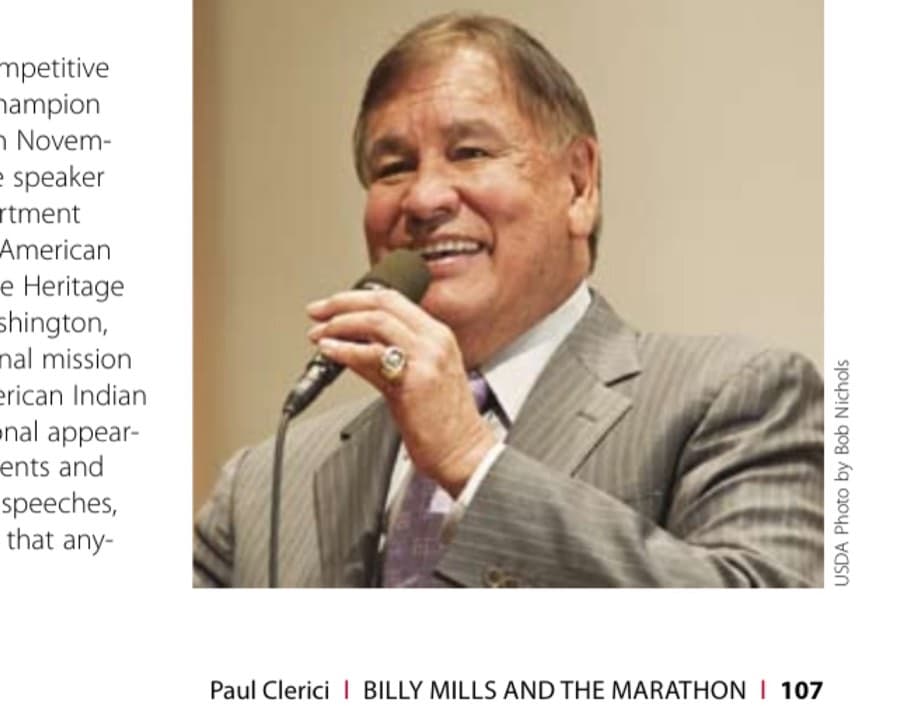
Long retired from competitive running, U.S. Olympic champion Billy Mills, shown here in November 2010 as the keynote speaker at a United States Department of Agriculture, National American Indian, and Alaska Native Heritage Month ceremony in Washington, DC, continues his personal mission to give back to the American Indian community. In his personal appearances at fund-raising events and numerous motivational speeches, he stresses his message that anything is possible.
multitudes of people throughout America, through the compassion of America, writing $15 checks once a year.” Mills had solved the problem by opening up his heart to the world, and it responded in kind, one person at a time. “
One lady wrote a letter and said, ‘Billy, I hope you accept my apology, but I’m elderly, I’m going blind.’ She was, like, 90 years old. ‘And I can’t give you $15 a year. So would you accept a check for $1,000 because I won’t live that long?’ And I just started to cry,” said Mills. “
Another man, giving $5 a month, saying ‘Someday I hope to meet you.’ So I’m writing a letter to him, saying, ‘Well, someday when I’m in your town I’m going to look you up.’ Then I go to the letter to see where he’s from. New Orleans,” paused Mills, as he reflects on the date of the letter and the timing of Hurricane Katrina. “He was lost,” Mills said, softly. “He was lost. I cried.”
Virtues As an Oglala Lakota Sioux, Mills embodies American Indian virtues in life such as bravery, fortitude, generosity, and wisdom. “How do you use those virtues and values? You take bravery and fortitude, and you go on a journey to the center of your soul. And that’s where you find the virtue of wisdom. You use the virtue of wisdom to empower yourself by making the right choices for yourself. As you make the right choices, then you go to the virtue of generosity and you empower others,” he said.
This is part of Mills. In fact, this is Mills. He is filled with these virtues and lives each day by them. Not only do they guide him at home, work, and play, but they also guided him during his competitions. “
I took the Native American virtues and values in my training,” he said. “The warrior: responsibility, humility, the power of giving a certain amount of core spirituality. I took the concept of the warrior into my training. And I tried to live the life of a warrior—taking those four most powerful virtues—and went to the center of my soul, making the right choices for myself. And the responsibility and humility and the power I was given centered around the core of spirituality,” he said. “
And the four steps the warrior seeks to fulfill,” Mills continued, “he seeks to be unique, he seeks to belong, he seeks to make a greater difference to society, and he seeks to understand. And through understanding [you] promote unity and diversity, global unity to global diversity.”
Added Lindgren, “Billy Mills, as a person and as a competitor, has one of the most positive attitudes I have ever had the pleasure of knowing. He was always looking at the bright side of races and life. His mind would look at any situation, and no matter how dark it was, Billy could always find the silver lining.”
This article originally appeared in Marathon & Beyond, Vol. 15, No. 1 (2011).
← Browse the full M&B ArchiveMore like this
1,000+ stories from 19 years of Marathon & Beyond
The complete archive of the legendary long-distance journal — digitized and free to read.
