Boston Femme

Boston Femme

FeatureVol. 17, No. 2 (2013)201341 min read

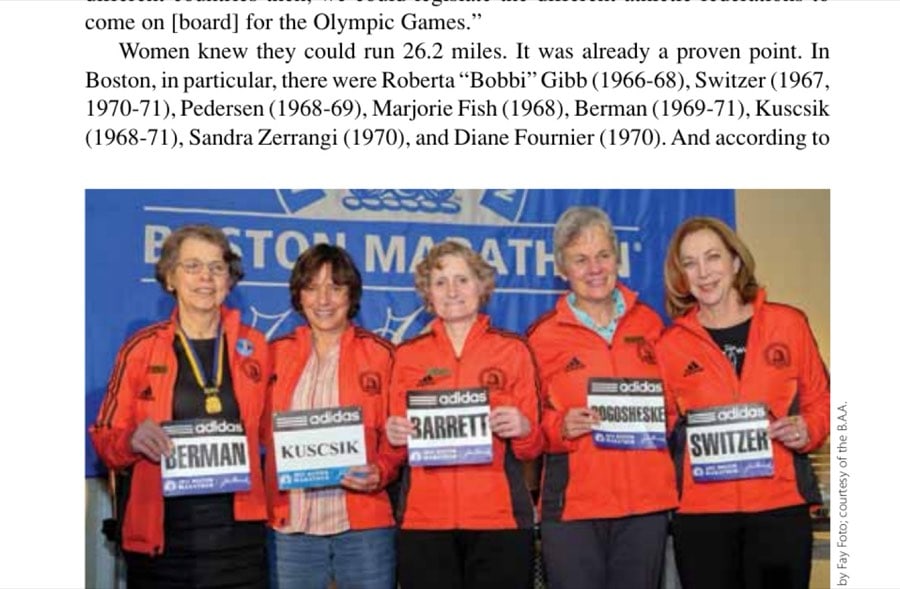
the Association of Road Racing Statisticians (ARRS), for marathons there was an estimate of at least 450 female finishers (235 in the US) in the 10 years leading up to the 1972 Boston.

But with all eyes upon them in 1972, especially in Boston, the tightknit sisterhood had one unmistakable goal—to finish.

“The early women runners had an unwritten pact that they had to be trained enough to finish, because it was still hanging over us—even after we were legal—that it could be taken away if we proved ourselves unworthy,” said Berman. “We had to finish. And I don’t know if we ever talked about it to each other, but we all sort of understood intuitively that we had to train well enough so we could finish. I think the first person who didn’t finish had a sprained ankle, so that was OK. That was a legitimate reason.”

Role models

There were so few women in the sport at the time these trailblazers were beginning their running that Switzer’s role model was actually the late Dame Margot Fonteyn de Arias, the great classical ballerina of the Royal Ballet in England.

“She took something that is extremely difficult and made it beautiful, and I always thought that running is incredibly heroic. I love the whole Greek image of it. I love the heroicness of Pheidippides. I love the quest of something that is impossible to do,” Switzer said. “It was all these combinations that led me to the marathon, and she was my athletic role model.”

For Rogosheske, however, it was someone closer to the sport.

“Kathrine was my role model,” she said in front of Switzer, who was warmly surprised. “I was living in Minnesota, and we didn’t have women participating in sports at that point, and I had read about that famous incident at the Boston Marathon. And then we were living in DC, and I was a physical education teacher and couldn’t even finish a mile. So that’s why I decided to jog and train.”

Barrett also points to Switzer as well as Kuscsik as inspirations for an impressionable teenage girl. “They were great. They encouraged me with races in New York, like the Crazylegs Mini-Marathon [later]. They helped me. All those things were really special to me,” she said.

Kuscsik found a connection when she saw a picture of the Boston Marathon

within a small enclosure of male spectators near the start line was someone with whom she would serendipitously share that same starting line four years later. The photo caption read, “Elaine Pedersen, who flew in from San Francisco with boyfriend Pax Beale just for the marathon, hides in crowd that is lining the course minutes before the race gets under way. She joined the pack as it passed and finished in about 4:30.”

Male support

The women pointed to the support they received from men in their lives—husbands, boyfriends, fathers, coaches—and from male runners as a crucial element in their progress and acceptance.

“T wasn’t being very motivated,” said Rogosheske, “and so my husband said, “You need a goal. Why don’t you train for a race?’ And the Boston Marathon was the only race I ever heard of,” she laughs, “‘so I started training for that race.”

Barrett was in high school at the time, and there was a lack of track teams for girls. But fortunately for her, she found support from a number of people, including the boys’ cross-country coach.

“He encouraged me to run with the boys team,” Barrett said. “We had the state championship coming up—I was a miler—and the most important thing he told me was, ‘This [running] is for the rest of your life. Go out and do it. Look at it as a lifelong thing, not just one race.’”

Berman good-naturedly blames her spouse for introducing her to running. “It was my husband’s fault,” she said with a chuckle. “He was a runner in high school and in college, and he got a lot of pleasure out of doing it. He thought it was something that I could do and I could feel good about. When I finally ran two miles around a track, I said, ‘Whew. I’m done.’ And he said, ‘Now you’ve got to run a little faster.’”

When he signed up for a five-mile handicap race, she joined in and ran. “The guys were absolutely wonderful. I started on the starting line with two little boys and two older men, and as the faster runners passed me, they were all very encouraging and very nice. And the officials didn’t mind me—I wasn’t wearing a number,” Berman said.

Added Switzer, “I must say this—the men in running have always been wonderful. You hear the story about Jock tackling me, but that was an anomaly, and he was a man trying to protect his race—that’s another story. But the men running have always been wonderful to us. They gave us encouragement, motivation, and help.”

Female nonsupport

Surprisingly, female runners did not receive as much support from their own sex as you might imagine. It was not automatic that women would support women. This movement of athletic freedom and empowerment seemed to go against some of their upbringing. It scared some of them, especially those who were not athletic and could not understand that mind-set.

“One of the things that was very sad for me was that in general, the ordinary woman was not supportive,” Switzer observed. “Women were not very supportive in general. Unfortunately, the only time people tried to run me off the road were

actually women. I remember I asked my coach [about it], and he said, ‘Oh, they’re just afraid. You’re free and they’re not free.’ I thought, Al/ they have to do is put on a pair of shoes. There’s going to come a day when it’s going to be reversed.”

Fortunately, at Boston, there was some female support. For years, obviously, race officials did not have to look for women. But when they began to join in, such as when Gibb first ran in 1966, it took some time before she was recognized for who she was in order to record her unofficial finish time. But as more women began to run, they were not alone.

“After the women began running, some of the wonderful old men who kept time at the finish were not quite sure if a girl had short hair and was very slim or if it was a girl or a boy. So it made a difference when Gloria Ratti and Bev Whitney came to the finish line and helped time the women,” Berman said in reference to Ratti, a current vice president of the B. A. A. board of governors and to Whitney, who was an AAU/TAC board member. “They didn’t miss any of the women.”

Kuscsik recalls those instances. When she ran the 1969 Boston, she was concerned about getting her finish time, so she devised a simple plan that turned out to be unnecessary.

“That was my first road race ever, and I knew we weren’t official. But as I was crossing the finish line, I looked at one of the male runners next to me and tried to see his number so I could find out what my official finish time was,” she said. “And when I crossed the finish line, there was Gloria keeping track of the women runners’ times.”

Getting to Boston

Heading into history, Kuscsik, Switzer, Berman, and Pedersen carried with them the most experience with a combined 40 marathons and 22 wins. In fact, in the 1971 ARRS World Marathon Rankings, Kuscsik was ranked third with a 2:56:04 (New York City), Berman was eighth with a 3:04:40 (Bay State Marathon, Massachusetts), and Switzer was 15th with a 3:15:28 (First Trust Marathon, New York).

“Nina and Sara became, really, media icons in terms of the fact that they won over the media by their performances. They got better and better and better, and soon the media were keeping records of these performances,” said Switzer. “It was no longer just ‘girls out running’; we were recognized as athletes.”

And according to ARRS records, Barrett, the kid of the group at 17 (well under the Boston age limit of 19), had already run two marathons—both in 1972. In January, she won the Jersey Shore Marathon in New Jersey, and in March, she was second to Kuscsik at the Earth Day Marathon in New York. Morrison

in Oklahoma. And both Rogosheske and Collins made their marathon debut at the 1972 Boston.

History in Hopkinton

Accommodations for women also were lacking, but with someone like Ratti on their side, the increasing female field was assured of at least some kind and friendly assistance. She was always there, especially at the start in Hopkinton when that sisterhood would come together.

“Who will forget Gloria at the church when we finally had a place, a gathering point. Gloria was always there with her radio, giving us weather reports; and she had tissues and sanitary products, and [was] running around and mother-henning us, and saying, ‘Come on, girls, come on! Let’s go!’ She was fantastic,” Switzer said. “She was always there for us, and she’s still there for us.”

Rogosheske, who couldn’t finish even a mile when she began to run but who trained hard for Boston, had heard that it was common for women to jump into the race, as Gibb had. So she was prepared to do just that.

“T had read and heard on TV and seen other reports of Kathrine and Bobbi and other women who had hidden in the bushes to run. So that was my plan,” she said. “But then about two weeks before the race, I heard that we could register. So I registered and ended up on the line with these lovely women.”

At Boston

Half of the women had already run Boston. But that familiarity with the race did not seem to matter when it came to the emotions that accompanied finally being an official entrant in 1972.

“We worked so hard. It was very exciting to be official,” noted Kuscsik. “Boston really welcomed us.”

Switzer, having already secured a place in Boston Marathon lore five years earlier, certainly recognized the historic meaning of this occasion.

“When the turning point came in ’72 and we were made official, stepping over that starting line in 1972, we knew we were stepping into history, as surely as our suffragette mothers had won the right to vote or to integrate universities for women,” she said. “It was a dramatic moment. And for us as athletes, it was fantastic because we had worked so hard. And so finally, we weren’t there just carrying the banner for the whole female sex. We were there running as athletes.”

Entering the 1972 Boston, Berman already had eight marathon victories, including three “wins” at Boston and the 1970 Road Runners Club of America (RRCA) National Women’s Marathon Championship in Atlantic City. She was ready for her home-state 42K. But all was not well for her.

“Tt was official, and I wanted to run very badly. Unfortunately, I had a slight fever—a flu or something—but I just had to come,” she said. “It wiped me out from competition for the next year. That’s not a very smart thing to do, but it was a very special time.”
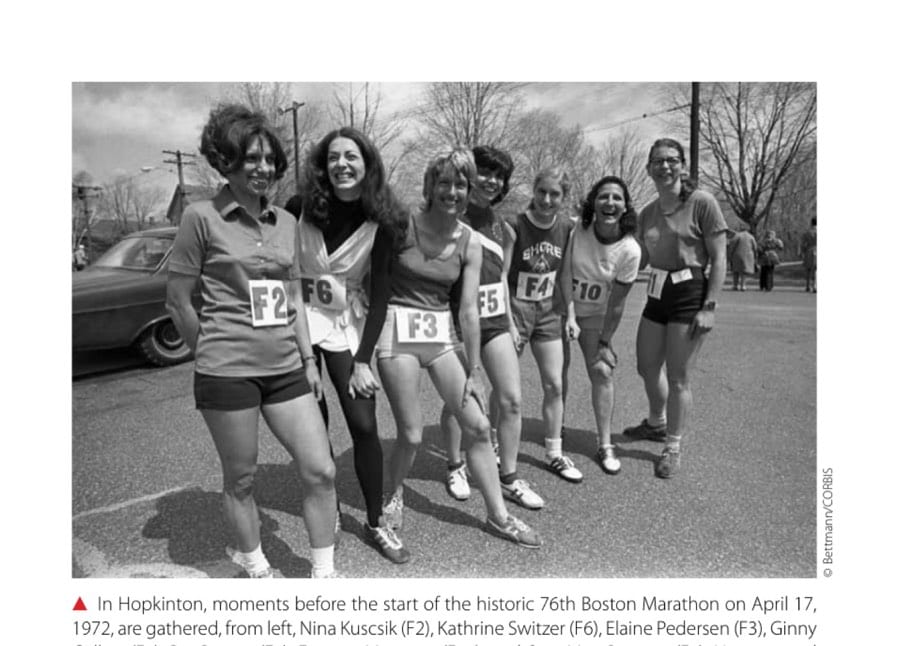
In Hopkinton, moments before the start of the historic 76th Boston Marathon on April 17, 1972, are gathered, from left, Nina Kuscsik (F2), Kathrine Switzer (F6), Elaine Pedersen (F3), Ginny Collins (F5), Pat Barrett (F4), Frances Morrison (F10), and Sara Mae Berman (F1). Not pictured is Valerie Rogosheske, who wore bib F7.

Added Barrett, “It was a great experience. It was wonderful. And it was so exciting to be in Boston and to have the privilege to run the Boston Marathon. Nina really encouraged me to be there. Kathrine and I ran some races in New York prior to Boston. And I had a lot of help from my male friends from the Shore Athletic Club.”

Unlike today, with size-specific sports bras, more narrow-width shoes, and fitted tops and sweats, the clothing line for female runners back then was primarily what the men wore. With very few exceptions, women had to wear outfits that were formed for men.

“In those days, they didn’t have any specialty clothing,” said Barrett. “We had the Jersey Shore Marathon in the winter, so I went to the sporting goods store to get something to wear for my legs. And the only thing they had was what they use for skiing,” she laughs. “I had to wear something!”

Women’s shoes at the time also lacked proper support, comfort, and traction. Rogosheske wore a pair of orienteering shoes from Sweden but eventually picked up the more running-friendly Tiger Marathon shoes. And Switzer trained in canvas

© Bettmann/CORBIS

PF Flyers and Keds, whose soles doubled as sleds in the winter. “I’d be sliding all over the place,” she laughed.

At the 1972 Boston, Pedersen wore a singlet and shorts; Collins and Barrett had sleeveless running-club shirts and shorts; Morrison and Berman wore shortsleeve T-shirts and shorts; Switzer was neck to ankle in long-sleeve black tights, highlighted by a white wraparound nod to ancient Greek athletes; and Kuscsik sported a short-sleeve, five-button, collared blouse and bike shorts.

“The reason I wore a blouse was because I had a problem with my shoulder and I could hang my thumb on my bra [in front] with the buttons down,” she laughs.

Four decades later, Rogosheske was reminded of the trail she had helped blaze when her daughters ran their first marathon together and she coached them through some injuries.

“T said, ‘Now, remember, you two, don’t be silly. If something’s hurting, quit.’ And my younger daughter said, ‘Mom, you ran 40 years ago to give us the option to quit,’” she said with a proud smile.

For the record, the results of the 76th Boston Marathon on April 17, 1972, are as follows: 1. Nina Kuscsik (3:10:26), 2. Elaine Pedersen (3:20:25), 3. Kathrine Switzer (3:29:51), 4. Patricia Barrett (3:40:29), 5. Sara Mae Berman (3:48:30), 6. Valerie Rogosheske (4:29:32), 7. Ginny Collins (4:48:32), 8. Frances Morrison (5:07:00), DNS (did not start) Charlotte Lettis (Richardson). ENE

Monumental Boston

The monuments to Boston are scattered far and wide.

In recognition of its historic impact on the sport of running, its participants, and the many lives it has touched, the race has been honored with numerous monuments and memorials.

| he Boston Marathon has earned its majestic stature since its birth in 1897.

Dave McGillivray recognizes the importance of such honors not only as the race director of Boston but also as an athlete who has run it since 1973.

“This race is so much about the history and tradition . . . and you begin to marvel at the fact that you are running on the same hallowed ground as all these iconic runners once did,” McGillivray said. “Nothing else like it in the world.”

On the course

Many statues and monuments are located along the marathon course and can be viewed by runners in the Patriots’ Day event.

Hopkinton

Several markers are located at Hopkinton Common, the site of the perennial “It All Starts Here” sign. A permanent ground-level plaque at the intersection of its two brick-laid pathways reads “Johnny Kelley Crossing” in honor of the late twotime champion who started the race a record 61 times. A sign on the access road parallel to Main Street, near the start, designates Marathon Way.

<@ Johnny Kelley Crossing, located at the intersection of two brick paths at the center of Hopkinton Common, is named in honor of two-time winner Johnny “The Elder” Kelley, who started a record 61 Bostons.

At the northeast corner of Ash Street and Marathon Way, on a 10-inch-high, 16-square-foot granite base, is The Starter, an 80-inch-tall bronze statue of George V. Brown. Brown served the Boston Athletic Association (B.A.A.) from 1899 until his death in 1937 in many positions, including athletic director, track and field games manager, governing committee member, and marathon manager and starter.

“George was born and lived his life in the town, was instrumental in moving the starting line to Hopkinton, and served as starter of the Boston Marathon for nearly 30 years, having been involved since just after its inception,” said Hopkinton sculptor Michael Alfano, who created the statue that was commissioned by the former Hopkinton Athletic Association (now the 26.2 Foundation). “We reviewed photos of George Brown and the early races and decided to depict him starting the race.”

The statue is precisely situated on the start-line extended, on the right-hand side of the runners as they begin the race.

“We placed the sculpture at the starting line to serve as a yearlong commemoration to it and to be a spot where people could pose with it as if they were starting the race, especially for photos,” Alfano said. “Many visitors to the town throughout the year do just that, and probably thousands do so every year on race weekend.”

However, The Starter traveled a bit before finding its current home. Shortly after the April 2008 unveiling at Hopkinton Common, the statue was moved to the Hopkinton Police Station while a permanent site was being proposed.

“The sculpture was commissioned knowing that it was wanted but not knowing where it would be located. Hopkinton has historicdistrict statutes, and one involves preserving the state of the Common. So getting approval to have it placed there took some work,” Alfano said.

Diagonally westward across the street from The Starter is the Korean Presbyterian Church in Greater Boston. Located at Two Main Street, the church is where

George V. Brown, the longtime official starter of the Boston Marathon,
is recognized with The Starter statue,
which is situated on Hopkinton Common and lined up with the start line.

Photo by Paul Clerici

the elite athletes begin their walk to the starting line. Situated on the front lawn is a flat, 16-square-foot, gray marble monument, which is slightly hidden from street-level view due to its rising only inches from the ground. In its center is a black outline of Korea over a colored yin and yang version of the Stars and Stripes. Encircling the design are three rows of data in Korean, in which some names and times differ from their listing in US sources: “Boston Marathon 1903-2003 Korean-American Centennial; 1947—1st Yun Bok Suh, 2:25:39 (world record), 1950—Ist Kee Yong Ham, 2:32:39/2nd Ki Yoon Song, 2:35:58/3rd Yun Chil Choi, 2:39:47; 2001—1st Bong Joo Lee, 2:9:43.”

To commemorate the 100th anniversary of Korean immigration, a monument designed by Douglas Duksoo Wohn was dedicated in 2004 by the New England Centennial Committee of Korean Immigration to the USA and donated by the Hopkinton church.

One mile into the marathon, on the left-hand side of the runners, is one of two statues named The Spirit of the Marathon and the only one in the United States. Reaching 14 feet high, including its base, the 3,400-pound hollow-bronze piece is located on the donated grounds of the Weston Nurseries Garden Center at 93 East Main Street on Route 135. The double-figure statue depicts Greek champions Spiridon Louis, winner of the 1896 inaugural modern Olympic Marathon (on the right), and Stylianos Kyriakides, who 50 years later won the 1946 Boston (on the left).

The original idea came from Kyriakides co-biographer Nick Tsiotos. In 1997, a decade after Kyriakides died, the initial concept was for a single-figure statue of the Boston winner to honor his postwar efforts to raise awareness of his devastated country, which was in great need of food and assistance following World War II. His win in the 50th Boston resulted in boatloads of supplies for his homeland, for which his son, Dimitri Kyriakides, is forever grateful.

“The statues help remind people of the story and for many other people to know the story after they see them. I now see Stylianos Kyriakides not as my father, but as a man, a human being that should be an example to all of us and to remind us all how we really should be if we want to make our world better,” Dimitri said from Greece. “I have spent much time and personal resources for spreading the legacy of my father over the past 15 years because I think that it is a story that must be told and that must be remembered.”

In an effort to join together Athens and Hopkinton as sister cities, the mayor of Athens accepted the statue as a gift from New Balance Athletic Shoe, which agreed to pay for a statue in each town. Unfortunately, Dimitri said, everything did not go as planned.

“The story is a Greek tragedy. In 2000, the mayor changed. In October 2001, we had the presentation of the book. In 2002, the Greek American delegation visited Athens and met [the new mayor], telling her that the statue will be ready

The Spirit of the Marathon statue of
1946 Boston winner Stylianos Kyriakides
(left) and 1896 Olympic marathon winner
Spiridon Louis (right) overlooks runners
of the Boston Marathon at mile 1 in
Hopkinton.

in 2003 and they want to give it to the city to be placed in front of the old marble stadium in Athens [to be] ready for the 2004 Olympic Games. [She] told them that this is not possible, and she will only accept the gift if they gave her one more statue” of Spiridon Louis, said Dimitri. “The delegation was shocked and in despair coming out of the office of the mayor.”

Time and funds did not favor a request for a separate statue to be designed and created. Fortunately, renowned sculptor Mico Kaufman of Tewksbury, Massachusetts, who was already working on the initial concept, arrived at a resolution. To the original statue he could add the Olympic champion—as a “spirit’”—at a significantly reduced cost in both money and time. Problem solved.

But the Greek tragedy continued. “In 2003, [the mayor] changed her mind and said that she does not want the statue! The Greek Americans were shocked,” Dimitri said. “So I said to them that if the statue cannot go at the finish of the marathon, then let’s try the start—the city of Marathon.”

The vice mayor of Marathon agreed in writing to accept the statue and to pay for the transportation from the United States and for its installation. But with the addition of the second figure, which had already begun, the original completion date in 2003 was closer to June 2004. The Olympics were set to begin in August.

But even when the newly designed statue was complete, the Greek tragedy continued. “The delegation was trying to reach the people in the city of Marathon to tell them that the statue was ready, but there was no response,” said Dimitri. “So lintervened again and contacted [the vice mayor], who to my amazement told me that the city had no money to pay for the transportation! This was because of the late readiness [of] the statue that [it] could no longer arrive in time by sea freight but had to be transported by air. Another shock, as you can imagine, for all of us.”

Photo by Paul Clerici

When the statue finally arrived in Greece, after a more reasonable air-transport fee was negotiated, another roadblock surfaced at customs in the form of steep import-duty fees “because the statue was a gift from a foreign company—New Balance—that was outside the EU (European Union). Money that the city of Marathon did not have,” Dimitri explained. “The statue was in the customs warehouse, and if we did not have a quick solution, the storage fines after 10 days were huge. Remember, it was just before the Olympics with so many equipment coming in the country and the warehouses full.”

Once again, Dimitri Kyriakides stepped in—as he had in finding an affordable air-transport fee—and found an answer.

“[I was told] that if the statue was presented as a gift from a Greek American society, then no import duty was needed,” he noted. “So, [we] ‘fabricated’ a letter and the statue came out of customs, finally, with 10 days to spare before the start of the Games.”

Nearly two years later, with much less drama and in time for the 2006 Boston Marathon, an identical statue was dedicated in Hopkinton. The top portion depicts a victorious Kyriakides running Boston in 1946 alongside Louis in spirit, who is shown not earthbound, having died six years before. On the east-facing side of the base is an image of Kyriakides wearing his laurel wreath from winning Boston.

“The rocky hills of the base are the hills near the plain of Marathon, where the Greek army was based in 490 BC. And on [the west-facing] side is demigod Pan that assisted the Athenians to win—according to the myth. Pan lived in a cave in the hills near Marathon,” said Dimitri, who added that the other figure on the base is Pheidippides, “who runs to Athens to announce the victory and then died.”

The site of this statue is near a landform once known as Lucky Rock, close to where the Boston Marathon start line was located decades ago, including in 1946.

Newton

Just past the 19-mile mark near Newton City Hall at 1000 Commonwealth Avenue is the Young at Heart statue of Johnny A. “The Elder” Kelley, who was 97 when he passed away in 2004. Located 75 feet in from the corner of Walnut Street and Commonwealth, the 1,500-pound double-figure statue stands 7 feet tall on top of a 40,000-pound granite base, which increases the overall height of the monument to approximately 9 feet, 4 inches. Initially titled Young at Heart: The Johnny Kelley Heartbreak Hill Heroic Sculpture (as noted in the statue’s dedication pamphlet), the two depictions of hand-holding Kelleys are of when he first won in 1935 (on the left) and when he last ran in 1992 (on the right).

The twin-body idea came from Dr. Wayman R. Spence, who was chairman of the Johnny Kelley Sculpture Committee. According to his explanation in the dedication pamphlet, while working on a separate project, Spence had awoken from a dream in which he had envisioned older and younger versions of Kelley

running together. He subsequently commissioned Oklahoma sculptor Rich Muno, who in 1991 created several smaller editions for the B.A.A., the New England Sports Museum, and Kelley.

Named after the 1953 song made famous by Frank Sinatra, which Kelley would often sing at the slightest request, the Young at Heart statue was dedicated the day before the 1993 Boston Marathon. The large gathering on hand included, among others, Spence, Muno, Kelley, and two-time defending Boston champion Ibrahim Hussein of Kenya, who became a friend of the honoree. The statue was located about a hundred feet from its current site, on the other side of Walnut Street and about 50 yards from the opposite corner of Commonwealth and Walnut. The statue was moved to its present location shortly after the dedication.

“T would say no more than six months later—this was before the next Boston Marathon—a car hit the statue,” recalled David Donahue, co-owner of Tody’s Service, the service garage called upon to clean up the accident scene and move the statue.

In the statue’s initial spot, the Kelleys faced the oncoming runners. After the statue was moved, it faced the hills in the same direction as the marathon field.

The process by which Tody’s gently moved the 41,500-pound piece of art was itself a work of art.

“My father, Tody, said we have to drop it down to the new spot with the crane,” recalled Donahue. He told [Newton Parks and Recreation Manager Carol Stapleton] to get 10 bags of ice. It was suspended by nylon straps underneath, and we placed it on the ice, positioned it, and when the ice melted, that’s where you see it now,” he marvels.

<4 The Young at Heart statue, a popular year-round tourist attraction, depicts Johnny “The Elder” Kelley when he won Boston in 1935 (left) and when he last ran Boston in 1992 (right). Located along the course near Newton City Hall, the statue faces the same direction as the runners.

& > B

The statue is visible from the course but can be difficult to see due to its distance from the street. But no one will ever see one thing that was added during its move.

“T put a $10 bill underneath,” Donahue said with a laugh. “Well, I was young and foolish back then. It was something to do. I always said that if you ever see Johnny Kelley on its side, that I needed the money.”

Boston

Approximately six miles farther, at about the 25.5-mile point, is the Tommy Leonard Bridge on Massachusetts Avenue at the intersection of Commonwealth Avenue. The bridge is named after the longtime bartender of the now-defunct Eliot Lounge, which any runners worth their salt had visited at least once. The B.A.A. has also given Leonard the title of Boston Marathon Official Greeter.

The bridge, which in 1982 was dedicated in the shadow of the Eliot Hotel and its lounge, is a rare monument that runners pass on two sides. The course at one time had participants exit Kenmore Square and continue on Commonwealth over Massachusetts, with the bridge to their left. That changed in 2006 when the course veered off the main portion of Commonwealth and diverted the voluminous foot traffic under Massachusetts and the Tommy Leonard Bridge, only to reappear on the main portion of Commonwealth a few hundred yards later en route to the Hereford Street turn to Boylston Street and the finish.

“T was totally overwhelmed. It was a total surprise,” Leonard said of the honor. “They had hinted about it, but I thought they were joking. And they weren’t. The city of Boston put on a big spread at the Eliot. I don’t think I was worthy of it.”

Less than a mile from the bridge are two separate marathon-related monuments in Copley Square Park, a public greenery one block east of the finish line and to the right of the runners as they proceed down Boylston after they finish. The first one is at the northwest corner of Boylston and Dartmouth streets, about 100 feet behind the finish. The 7-ton Boston Marathon Centennial Monument is in the shape of a flat, medallion-style, engraved circle 15 feet in circumference and marked by four opposing 40-inch pink marble bollards. Dedicated on April 9, 1996, in celebration of the race’s 100th anniversary, it was created by landscape architect Mark Flannery and artists Robert Shure and the late Robert Lamb.

According to B.A.A. Treasurer Gina Caruso, who at the time was the coordinator for all nonrunning-related centennial events, the criteria for the design specified that it should “be sensitive to its setting in Copley Square; reflect the legendary history of the Marathon, if not explicitly then symbolically, such as using the laurel wreath; allow spaces for acknowledging winners of the Marathon, past, present, and future; have a universal appeal and recognition from athletes and all world visitors.”

While the original accepted submission featured a large archway under which visitors could walk (it was eventually replaced by the four marble posts), the final

A |n Copley Square Park about 100 feet beyond the famous finish line is the Boston Marathon Centennial Monument, a predominantly flat, 7-ton, 42-piece granite commemorative work of art that was dedicated during the celebration of the race’s 100th anniversary in 1996.

version included the laurel wreath and names and the required symbiosis with its surroundings. It also had to be approved by nearly a dozen organizations, including the B.A.A., John Hancock Mutual Life Insurance Company, the Boston Parks Commission, Boston Art Commission, and several other entities associated with Copley Square, all of this within 14 months, from creation to dedication!

Etched in the common area walkway is a two-tone map and elevation chart of the course comprised of nine different pieces of granite and the names of every male and female overall, masters, and wheelchair winner. The monument is updated with each year’s list of six new champions.

“T like the way they used different color stone for the elevation and the different towns that you went through,” said the first woman to run Boston, Roberta “Bobbi” Gibb, one of the 10 chosen to pull back the tarp at its unveiling. “That was fun—pulling it back and seeing the course. It was very well done. I love the circle [of names, including hers] that can keep going out and out and pretty soon can take up the whole Square.”

From 11 separate quarries are 42 pieces of granite, all but one engraved. On each 3-foot marble post are reliefs by Shure and Lamb of the B.A.A.’s unicorn logo; a different aspect of the race (male runner, female runner, male and female winners, wheelchair athlete); and the seals of each town through which the marathon travels.

Photo by Paul Clerici

“T think it was very well conceived. I like the whole concept of it—the circle of time and the fact that it’s flat,” said Gibb, who is also an accomplished artist and sculptor. “They got all the symbols there. They put in all the towns, the different aspects of the race—wheelchair, the woman, the man—very well representative. A lot of variation that makes it interesting. Very imaginative. I thought it was a very great addition to the city landscape, actually, as well as a memorial. You see the care that went into it—a lot of careful thinking and careful execution.”

Gibb, who created the 12-inch bronze Olympia female figurine trophies that were awarded at the 1984 US Olympic Women’s Marathon Trials won by Joan Benoit Samuelson, pointed out that due to the monument’s location underfoot, several names have vanished over time. “Some of the names are fading. They need to go over it and redo the names and then put Plexiglas over it or some kind of epoxy or transparent ceramic so then you can walk over it, because it’s going to disappear.”

A short hop, skip, and a jump in Copley Square Park, toward Trinity Church and the 60-story John Hancock Tower, is the playful Tortoise and Hare statue, the slow-and-steady tale referenced in Aesop’s Fables. Also dedicated in honor

The two closely separated larger-than-life bronze animals—a 21 X 30 X 60-inch

tortoise and a 22 X 33 X 50-inch hare—were created by Newton sculptor Nancy Schon, whose sculptures encourage the interaction of children.

Off the course

Located nearby, but not along the actual course, are several more memorials, monuments, and physical honors that pay tribute to the Boston Marathon.

Hopkinton

At 5 Cedar Street, about three blocks from the start line, is the Thomas J. Brown Post Office Building. A 30-year postmaster, the late son of George V. Brown was also the 17th president of the B.A.A. and was an official Boston race starter, a Brown family tradition. Since legislation is required to name a federal building, US Senator John Kerry of Massachusetts, an official race starter himself, introduced a bill in 1999, and 10 months later, the building was dedicated.

Less than two blocks west of the start line, in front of the Hopkinton Public Library at 13 Main Street—is Running Wheel, another Michael Alfano-created gem. To honor the Boston Marathon, this was the original piece that was to be located at Hopkinton Common before it was eventually replaced by the George V. Brown statue.

“[It] features 26 spinning legs on one side and a sea of runners on a bas-relief on the reverse side, celebrating the democratic nature of the sport,” Alfano said. “However, given the historic nature of the downtown area where the starting line is, we determined a historic-themed sculpture (The Starter) would be a better fit.”

Running Wheel, when not on display in front of the library, is housed in a gallery until a permanent public space is found.

Ashland

For its first 27 years, the Boston Marathon began in Ashland. The original start area is just over four miles from the current start. In 1897 and 1898, the race began on Pleasant Street at the site of the former Metcalf’s Mill, remnants of which can still be seen where a fire destroyed it in the 1930s.

In recognition of this cherished parcel, the site was cleaned up in 2003 and Marathon Park was created. A walkway, benches, a decorative sign, and several monuments were installed on the quarter-acre piece of land in the first of several phases of construction. The first granite piece to be engraved reads, “Keepers of the Flame Boston Marathon 1928-1983: Bob Campbell—Referee, Champion Runner; Scottie McFetridge—Chief Track Official; Jerry Nason—Sports Writer; Tony Nota—Chief Timer; Jock Semple—RPT, Runner, Trainer.”

Nine years later, in front of a large crowd about two weeks before the 2012 Boston Marathon, a new, colorful, three-dimensional sign handmade by Lou

Mancini of Ashland was unveiled in the continuing effort to honor the race’s early roots in the small town.

State Senator Karen Silka of Ashland said at that dedication, “We have a jewel here. Ashland and Hopkinton have many ties that bind, a lot of common history. But one of the major things is the marathon. It’s really significant that it started here, and it’s really significant

that we commemorate it here. A The original start line of the Boston Marathon is This is a major piece of Mas- marked by this handcrafted sign at Marathon Park, a sachusetts history.” landscaped parcel of Ashland where it all started in 1897.

Directly across the street from Marathon Park, in line with the original start line, is a simple, small, whitepainted stone marker alongside the commuter railroad tracks. Inscribed in black lettering is B 25, for 25 miles to Boston. In the early days, the distance of the marathon was between 24 miles, 24.5 miles, and 40 kilometers (24.8 miles), the main purpose of which was to finish at the B.A.A. clubhouse in Boston.

Not so easily found, however, is where the marathon began from 1899 to 1906. For those eight years, the start line was moved west three-tenths of a mile behind the original start to what was known then as the Boston and Albany Railroad Bridge. The current bridge at that site is on High Street, between the Ashland commuter rail station and the Gryncel Little League Park. With an increase in interest and the 1906 marathon having registered a record 105 entrants, the bridge proved too small to contain the field. For the next 17 years, from 1907 to 1923, the start was near the corner of West Union and Frankland streets, in proximity to Valentine farm. The area is located on Route 135 near the current 4K mark, just before the Ashland Community Center and Ashland State Park.

At the 2012 sign dedication at Marathon Park, Dr. Leslie Marci, a director of the 26.2 Foundation, was struck by the historical connection to those who came before and said to those gathered, “I ask you to look around at the bridge, at the ground that you’re standing on or at the road behind you, and know that the runners stood here, stretched here. John McDermott, Tom Morrissey, Clarence DeMar were all winners of the Boston Marathon back when the race began right here.”

When the marathon distance grew to 26.2 miles in 1924, Hopkinton became the home to all subsequent start lines. Other than at Marathon Park, there are no discernible markers in Ashland to commemorate the start lines from 1899 to 1923.

& > B g

Way off the course

Several more statues and monuments are beyond the course itself and its immediate environs but still within Massachusetts.

Boston

Sprinkled throughout the 6.5-acre Faneuil Hall Marketplace, the 1742 “Cradle of Liberty” Freedom Trail site of shops and dining in the heart of Boston, are numerous statues. Three in particular are directly or indirectly related to the Boston Marathon.

On the South Market open plaza is a bronze pair of Bill Rodgers’s shoes. Dedicated in 2000 when the four-time Boston winner was inducted into the Faneuil Hall of Fame and joined Boston Celtic Larry Bird, whose bronze high-tops are nearby, the plaque reads: “Bill Rodgers ‘Boston Billy’ In Honor Of His 1999 Induction Into The National Track & Field Hall Of Fame, His Twenty Five Years Of Excellence In Distance Running, And His Unfaltering Dedication To The Boston Community, A Local Hero And International Competitor, Bill Rodgers Set A New Standard For Road-Racing Achievement. Four-Time Winner Of The Boston Marathon 1975, 1978, 1979, 1980.”

To the right of Rodgers’s shoes is a life-size statue of a sitting Arnold “Red” Auerbach, who as coach and general manager helped the Celtics win their first 15 NBA titles. Race official Jock Semple stored the early marathon application fees in a locked safe at Auerbach’s old Boston Garden office. Semple’s “office” was diagonally across the official office of Auerbach, who had been hired by B.A.A. President Walter A. Brown, owner of the Celtics.

Rodgers, when asked how it felt to be immortalized alongside such great sports figures, said with a laugh, “It feels very weird. My shoes are low to the

<4 With these bronze running shoes, Bill Rodgers was honored at Faneuil Hall Marketplace in 2000 when he was inducted into the Faneuil Hall of Fame, joining fellow Boston sport icons Larry Bird and Arnold “Red” Auerbach of the Boston Celtics.

z é >

g s é

ground and I don’t see them. I don’t go over and look at them. But it is an honor, of course. Faneuil Hall is where my store has been for over 35 years. And that was great to be there with Red Auerbach and all that.”

At the corner of Congress and North streets in front of Faneuil Hall’s North Market is a larger-than-life bronze statue of the late Mayor Kevin White. Traditionally, during his years in office, he placed the laurel wreath upon the head of the winners at the finish. Created by sculptor Pablo Eduardo of Gloucester, Massachusetts, there are also nine large bronze footprints that lead to the 10-foot statue of the mayor in midstride.

Literally on Winthrop Lane, a short alleyway that connects Arch Street and Otis Street near Winthrop Square, are commemorative bronze bricks mixed in with the usual nondescript red bricks. Formerly known as Snow Lane, the cutthrough walkway to the Downtown Crossing shopping district, it is the home of more than 100 special bricks that were installed in 1985 as part of the Boston Bricks initiative to recognize the history of Boston. Each one depicts a different image, and one shows a pair of running legs in honor of the Boston Marathon located a few feet from the Arch Street end of the alley.

Melrose

The winners of 10 Boston Marathons once lived in a town about a 10K north of Boston. Near Ell Pond on Main Street at the northeast side of Melrose Center is a 3-foot-tall, 1,100-pound granite monument that features a polished laser etching of a running figure of seven-time champion Clarence DeMar. Also noted on the monument is Bill Rodgers, who lived in Melrose when he won three of his four Bostons.

b> Seven-time winner Clarence DeMar, one of the greatest athletes ever to run the Boston Marathon, is depicted on this monument in Melrose, a suburb north of Boston where he once lived.

Photo by Paul Clerici

“The monument is made from black granite from India, and the etching and lettering were done at my shop,” said David DeFilippo of Woodlawn Memorials of Everett. “It was a thrill for me to be involved in this project because I am an avid runner and marathon finisher myself.”

Etched on the monument is the following: “Clarence DeMar, 1888-1958, Compositor, WWI Veteran, Friend Of Youth, Educator, Gentleman. Won Boston Marathon 1911, 22, 23, 24, 27, 28, 30. U.S. Olympian 1912-1924-1928, Won Bronze Medal 1924. Three Time National Marathon Champion. Achieved 700 Career Running Victories. Bill Rodgers Also Won Boston Marathon 1977-78-79 While A Resident Olympian. Melrose, Marathon City USA.”

“The monument was purchased by a group or organization affiliated with running. They had purchased this one [in Melrose] and another smaller gray monument,” said DeFilippo. “The funny thing is, after these monuments were [made], they couldn’t find a town willing to accept them. They were stored at my shop for more than a year before Melrose accepted one and Hopkinton accepted the other.”

Cape Cod

A cape island landmass of dozens of towns and villages in a fishing-hook shape that stretches eastward in Massachusetts, Cape Cod is rich with Boston Marathon history.

A few years after the Tommy Leonard Bridge dedication, its namesake, who in 1973 created the Falmouth Road Race, found himself once again honored. In 1985, a wooden bench was dedicated to him at the finish line of the seven-miler he envisioned. Located at the Falmouth Heights Beach corner of Grand Avenue and Central Park Avenue, the bench featured the inscription, in part, “‘Thanks Tommy’ For Making People Happy.” When in later years that area was cleaned up and relandscaped, the bench was moved across the street to make room for the Falmouth Finish Garden. Surrounded by four benches and a plaza of inscribed bricks is the centerpiece of a 3-foot-tall boulder with “Falmouth Road Race Est. 1973” etched in black, along with a lighthouse and figures of a wheelchair athlete and a running man and woman. In front of the stone is a granite plaque that reads, “Tommy Leonard Race Founder 1973.”

“I was speechless,” Leonard said. “At a moment like that, I forget my own name.”

In April 2012, Leonard, the Boston Marathon’s official greeter, was the recipient of yet another honor. The painted line where it all begins—on Water Street in Woods Hole—was renamed the Tommy Leonard Start Line and so designated with a 36 X 28-inch bronze plaque affixed to the exterior of the Captain Kidd Restaurant, whose front door is in line with the start line.

A Falmouth Road Race founder and Boston Marathon Official Greeter Tommy Leonard watches from a barstool during the unveiling of a plaque that designates the Tommy Leonard Start Line in Woods Hole, Cape Cod, where the Falmouth Road Race begins every August.

“This is the frosting on the cake with the cherry on top,” Leonard said moments before the dedication. “But it is not just me. There were so many people that have been behind this race.”

Johnny “The Elder” Kelley, who was a longtime local resident, is honored in several Cape Cod towns. South Dennis has the multipurpose Johnny Kelley Recreation Area, which includes a circular 1.25-mile Johnny Kelley Trail. A granite bust engraved simply, “Johnny Kelley ‘Marathon Man,’” is at the entranceway off Old Bass River Road. The 5-foot bust podium is surrounded by a walled-in landscape of cedar mulch and flowers. It is 17 miles west of Hyannis, where the Johnny Kelley Half-Marathon is held every Memorial Day weekend as part of the Great Hyannis Road Races. And in Brewster, inside the Roland C. Nickerson State Park, is a stone monument that was dedicated in 1981. The bronze plaque on the stone states, “John Kelley. In Commemoration Of Your 50th Boston Marathon. And In Appreciation For The Inspiration You Have Provided For Us All. With Warmth And Love, Cape Cod Athletic Association.”

Way, way off the course

As an international event, Boston Marathon-related statues and monuments can naturally also be found in other states and countries.

Rhode Island

A bronze plaque affixed to a granite post marks the beginning point of the Les Pawson Loop in the Ocean State’s Lincoln Woods State Park. The plaque features a running figure of Pawson, who was born in Pawtucket, and reads: “The Les Pawson Loop. Named For Leslie Samuel Pawson 1905-1992. Winner Of The Boston Marathon 1933, ’38 And ’41. U.S. Olympian 1940. A Gentle, Quiet Man Who Loved Running On This Trail And Through These Woods. Dedicated April 30, 1994.” The 2.5-mile loop inside the park in Lincoln travels around Olney Pond.

Maine

In the home state of two-time Boston winner Joan Benoit Samuelson is a statue of her on the grounds of the Thomas Memorial Library at 6 Scott Dyer Road in Cape Elizabeth. Dedicated in 1986, the 6-foot bronze statue stands atop a 2-foot, 300-pound granite base. Local sculptor Edward Materson created the full-body figure in a midstride pose modeled after Samuelson’s marathon victory lap at the 1984 Olympic Games, with her right arm waving the flag and her left hand grasping her hat. She is so popular in Maine that two years later the statue was stolen (and later recovered, repaired, and reinstalled).

Thirty-two miles northeast, at Bowdoin College in Brunswick, is another statue related to Samuelson and the Boston Marathon. Her alma mater in 1990 dedicated Time Out—a sculpture by Melita Brecher—on campus in front of the William Farley Field House on Watson Drive. The three-figure bronze statue is 4 feet tall atop a 32-inch granite base. Inspired by Samuelson’s achievements, a group of students ran the 1986 Boston as part of their “Run One For Bowdoin” goal.

In Davenport is the Quad City Times Bix 7 road race, which began in 1975 after local runner John Hudetz ran the previous year’s Boston and decided to create the seven-miler to replicate some of the energy and atmosphere he had experienced in the Hub. In 1999, a landscaped portion of Quad City Times property at 500 East Third Street was dedicated as Bix Plaza in honor of its hometown road-race namesake, the jazz musician Bix Beiderbecke. The first of several statues installed in 1999 was that of Samuelson and Rodgers in recognition of their combined half-dozen Bix 7 wins.

“Bill has run the Bix 7 [race] 33 consecutive years and Joan 28 of the last 31 years. We fell in love with both of them and centered our world-class event around them,” said its race director, Ed Froelich. ‘““We wanted the statues to be life sized [with] Bill and Joan running together since they are the two greatest road runners of all time.”

Samuelson set a course record in her first of four wins in 1983, and Rodgers ran a CR in both of his back-to-back wins (1980, 1981). “Bill and Joan are the

darlings of our race,” said Ellen Hermiston, director of operations, “so our statue of them is pretty special to us.”

Created by sculptor Ted McElhiney, the double-figure statue shows Samuelson and Rodgers in motion similar to the Young at Heart statue.

“The fact that the two are running together implies that our Bix 7 road race is there for all to participate. Seemed only natural for these two people to be frozen in space doing what they will always be remembered for,” said McElhiney of the 900-pound, 70-inch tall Bix Plaza statue. “Bill and Joan are not large people, but the sculpture was created to be approximately 10 percent larger than life size. [They] did not model during the creation of the sculptures. It was intended to be a surprise. And we had acquired many photos of the two over the years, so we had plenty of references.”

The two subjects were present for the summertime unveiling in 1999. “Bix is such a big race, it was an honor,” said Rodgers. “For someone to do that—to put the money into it, and the recognition—is very cool. It made me nervous a little,” he laughed about the unveiling. “I don’t think we look like that, but it doesn’t matter. It doesn’t. It’s just the thought behind it. It’s heartfelt! I love that little race. That race is like a Midwest Falmouth.”

Added Samuelson, “It was an honor having a statue of me at Bix, especially after surviving the flood of the Mississippi River.” During the Great Flood of 1993, the city experienced eight feet of water above the flood stage. Recalled Froelich, “Davenport was flooded, and the bronze statues were surrounded by flood water. We had to change the finish of the race to another location.”

Canada

Two-time Boston champion Johnny Miles (1926, 1929) is honored in several locations in his native Nova Scotia. A national hero and Member of the Order of Canada, when Miles died in 2003 at the age of 97, he was not only the oldest living Boston champion but also the oldest living Canadian Olympian.

In the town of Sydney Mines, the Johnny Miles Festival Society organizes a number of events throughout the year, including a multiday festival that features the Johnny Miles Memorial 5K. A larger-than-life statue at Johnny Miles Town Square was dedicated in 2008. Located outside the Jubilee Elementary School, near the Johnny Miles Gymnasium, the 7-foot bronze statue was created by sculptor Doug Bamford of Halifax. Miles is shown in midstride, with his right foot atop one end of a vertical railroad rail—its height more than double the statue’s—in a nod to the tracks along which he ran during the winter because they were always cleared for travel.

The Johnny Miles Memorial Trail was dedicated in 2005 at the 30th anniversary of the Johnny Miles Marathon in New Glasgow. Joining the Samson Trail and the Pioneer Trail, the Johnny Miles is a three-kilometer portion that is part of the overall 9K layout along the Pictou County East River.

Guatemala

Another national hero, Guamuch Doroteo Flores of Guatemala, who as Mateo Flores won Boston in 1952, received several honors, including the country’s highest civilian award, the Order of the Quetzal. Flores was born in the village of Cotio, Mixco, where a school is named after him as well as the Mateo Flores Roadway. And in Guatemala City, the former Olympic Stadium (although the Games were never played there) was renamed Mateo Flores National Stadium in 1954.

Ireland

With three top-five finishes in Boston, Johnny Hayes of New York is best known as the last American to win the Olympic Marathon until Frank Shorter in 1972. Finishing second behind Dorando Pietri of Italy at the 1908 Games, Hayes was awarded the gold medal when Pietri was disqualified for having been aided by officials. Hayes, of the Irish-American Athletic Club, had earned his way to the London Olympics three months earlier with his second-place 2:26:04 at Boston, which was an improvement over his fifth in 1906 and third in 1907.

ents were from Nenagh, Ireland, was honored on the Emerald Isle with a life-size bronze statue in North Tipperary on “the grounds of Nenagh Courthouse in Banba

Square,” said Aisling Hoey of the Tipperary County Athletics Association of Ireland. “Jeanne Rynhart, Bantry, County Cork, was the sculptor.”

Situated together in a triangular design are three separate statues of Hayes in midstride in the marathon, Matthew “Matt” McGrath in midspin in the 56-pound weight throw, and Robert “Bob” Tisdall leaping over the 400-meter hurdles.

Boston connection

In addition to Hayes, several elite marathoners who were never victorious in Boston but left their mark on the race have also been honored with statues. The impressive list includes Olympic medalists Frank Shorter, Abebe Bikila, Mamo Wolde, and Grete Waitz.

Shorter, while he did not win in his only competitive attempt in 1978—placing 23rd at 2:18:15—has returned to Boston several times as a television analyst and once ran the course with a microphone for some on-air commentary. A life-size statue of Shorter is near the finish line of the Bolder Boulder 10K, which Shorter helped found, on the University of Colorado campus.

The 1963 Boston Marathon featured defending and future Olympic Marathon gold medalists Bikila (1960, 1964) and Wolde (1968). The Ethiopian pair battled each other until the hills of Newton, where they began to fade to eventual finishes of fifth (Bikila) and 12th (Wolde) places. The two are honored by separate lifesize statues on the grounds of the St. Joseph Church Cemetery in Addis Ababa, where they were both interred (the statues were later vandalized, and recent reports indicate that the cemetery may be moved). And in Elgoibar, Spain, is a 6-foot aluminum-image monument of Wolde, who four times won that city’s Juan Muguerza International Cross-Country Championships.

Waitz, the favorite to win in 1982, ran Boston hard in an attempt to regain the world record, only to drop out on Beacon Street around mile 23. In later years, she was a regular favorite at numerous seminars at Boston. She died at the age of 57 on April 19, 2011, the date of the 115th Boston Marathon. She is honored with a statue in front of Bislett Stadium in Oslo in her home country of Norway and outside the Norway Pavilion at Walt Disney World’s Epcot World Showcase theme park in Orlando, Florida, where a plaque reads, “Marathon Champion Norway.”

And while neither an elite marathoner nor a Boston winner, the late Thian K. “Sy” Mah, a University of Toledo (UT) professor, entered the Guinness Book of World Records in 1989 with 524 lifetime marathons and ultras, including 20 Bostons, the 1988 edition of which was number 500. One of his missions was the promotion of running and fitness, which continues in races and scholarships in his name. In 2002, a life-size statue of Mah was dedicated at Olander Park in the town of Sylvania by the Toledo Road Runners Club, which commissioned fellow UT professor Thomas Lingeman to create the midstride, bespectacled bronze likeness.

This list of statues, monuments, and memorials is by no means complete and does not include those found in museums, halls of fame, or private collections or businesses. The list will never be complete because it will continue to grow. In fact, there are currently several statues in the planning stages.

Future honors

In Keene, New Hampshire, where Clarence DeMar once taught and coached, there has been interest in naming a new bridge after the Boston legend. In addition, while nothing has yet been officially proposed, a permanent physical honor somewhere near the finish line of the Clarence DeMar Marathon, which began in 1978, is a long-term possibility.

Closer to the marathon course, the Center School in Hopkinton is the proposed site for a statue of Dick and Rick Hoyt, the Team Hoyt duo who celebrated their 30th Boston in 2012. Beloved fixtures of the race who have competed in over 1,100 events, including six Ironman triathlons and more than 70 marathons, they have also been inducted into the Ironman Triathlon Hall of Fame in Kona, Hawaii.

What makes these accomplishments even more miraculous is that son Rick was born in 1962 with cerebral palsy and was diagnosed as a spastic quadriplegic. Unable to talk, he communicates through a Panasonic TuffTalker Convertible computer with EZ Keys software that from a mouse pad converts his head movements to words. This enabled him to graduate from Boston University in 1993 with a degree in special education.

“T feel so honored to be a part of history like the other bronze statues that have been made before me,” communicated Rick, with assistance from his personal care assistant, Jessica Gauthier. “My dad and me (along with my mom) have helped pave the pathway for other families with disabilities, and I am hoping people will also see that when they look at the bronze statue. I never thought I would have had a statue made of us. It is truly an honor.”

His father, Dick, a retired Air National Guard lieutenant colonel, pushes (in the bike and run events) and pulls (a dinghy in swim events) Rick in every competition. He is equally honored and humbled.

“Tt’s an awesome feeling,” he said. “I think back to when he was born and they said to put him away in an institution because he’s going to be nothing but a vegetable for the rest of his life, and all the things that we’ve been able to accomplish. My vegetable,” he said, holding back his emotions, “is now a bronze statue! I mean, how much better can it be? It can’t be any better.”

M&B

This article originally appeared in Marathon & Beyond, Vol. 17, No. 2 (2013).

← Browse the full M&B Archive