

Forever French
This short book has had a lengthy gestation. Following my documentary Race for Kenya, completed a dozen years ago, my backers agreed to fund a project on one of my athletics heroes, Emil Zátopek. Unfortunately, the company went bust shortly afterward, and Zátopek died in 2000.
Nevertheless, I decided to go ahead, and the first task was, inevitably, to interview the still vibrant Alain Mimoun, Zátopek’s great rival throughout their careers. So in late 2001, we went to film an interview at the house on the eastern edge of Paris where Mimoun still lives, at the time of this writing, with his wife of some 55-plus years, Germaine. The Zátopek project never materialized, but I had the idea to write up the Mimoun interview, putting it into the sort of perspective that is rarely attempted in a piece about a sporting hero. But the story that Mimoun had told, or rather embroidered for me, called for something different.
I wrote the majority of the piece in 2002, and when Mimoun starred in the IAAF World Athletics Championships in the Stade de France in 2003, I added the prologue. There is little place in the Anglophone publishing world for a monograph on a man little known or even remembered outside France and Algeria; similarly, a piece of close to 12,000 words was unlikely to have found a magazine home.
So I kept it and occasionally tinkered with it. And when I recently found myself at home in London for the lengthiest period (without traveling) in close to 30 years, I had time to think about publishing it myself.
At one point in my account, I mention that there is no major biographical work on Mimoun. However, when I was contacted in 2005 following publication of The Perfect Distance, my book on Seb Coe and Steve Ovett, by French documentary film maker Benjamin Rassat, we met later that year, and one of the subjects of our conversation was Mimoun. It turned out that Ben had had the idea of making a film on him, which he eventually did. It is called La Légende d’Alain Mimoun and was broadcast widely on Francophone television in 2010.
London, September 2011 During the television transmission of the men’s marathon at the World Athletics Championships in Paris in midsummer 2003, viewers saw an elderly but spritely man, dressed in gray flannels and a dark-blue blazer with a VIP accreditation flapping around his neck, running a lap of the track in Stade de France. When he finished, the crowd awaiting the arrival of the marathoners gave him a standing ovation, to which he responded fulsomely, going to trackside and signing autographs and kissing cheeks and children’s heads.
None of the foreign TV commentators I spoke to later had had a clue as to the old-timer’s identity; thus, their viewers would have remained in the dark. A few of the older, more perceptive viewers might have guessed who it was; even fewer might have recognized him since he hadn’t changed that much in the intervening five decades. In contrast, French viewers of all ages would have known him, the more so since he had spent the previous 30 minutes keeping the commentators of FR2/3 in stitches while regaling the téléspectateurs with versions of some of the following . . .
Forever French On October 17, 1961, the French security forces took summary revenge on Algerians living in Paris. It was the height of the War of Independence in Algeria, and the French Army was being harassed and bombed out of the country during one of the last colonial confrontations between Europe and Africa. The Front de la Libération Nationale in Algiers had made a call for a peaceful demonstration through Paris to protest the racist curfew imposed by the prefect of police, Maurice Papon. Thirty thousand people, many of them families, took to the streets.
But the police fired on the marchers, and 15,000 people were arrested. They were herded through streets, corralled on Metro platforms, and held in stadia and police cells around the capital. They were abused, beaten, and tortured. Some were executed and the bodies thrown into the Seine. Papon’s actions were defended by the president of the Fifth Republic, Charles de Gaulle. The 300 deaths are an estimate since only now, 50 years later, are questions being aired in France about the events of that night. In the interim, the incident had been as “forgotten” as the Chilean desaparecidos of the Pinochet era.
A few months after that massacre, de Gaulle, the wartime Resistance hero and legendary patriot, paid a visit to the Institut National du Sport in the Bois de Vincennes, on the eastern edge of Paris. Thrust into the front line to greet him was a man half his size and then almost as famous, a man who is still described as France’s greatest Olympian—the “Athlete of the Century.”
Alain Mimoun was Algerian born and bred; his original name was Ali. Confronted by “Big Charlie,” as de Gaulle was unceremoniously known to his few
critics, Mimoun drew himself up to his full height, just about up to Big Charlie’s jaw, and threw his best military salute. “Mon Général,” he intoned fiercely, “Alain Mimoun! Born in Algeria but forever French.”
Alain Mimoun is the most successful athlete in French history. He won an Olympic gold medal and three silvers and holds the record for the most national titles and for the highest number of selections for the national athletics squad. He was also awarded France’s highest honor, the Légion d’Honneur, for his bravery during the Second World War. Little surprise then that he should be voted the “French Athlete of the 20th Century” by Athlétisme magazine.
Yet even allowing for the restrictive nature of amateur athletics in the 1950s, how could Mimoun have returned from his crowning glory, winning the Olympic gold medal in the marathon at the Melbourne Olympics, and gone back to sharing two rooms without water or sanitation with his wife and newly born child in a rundown Paris suburb?
Perhaps it is the same reason that, in a career spanning 50 years and with numerous streets, parks, stadiums, squares, and sports centers around France named after him, there has never been a substantial biographical work produced on Mimoun.
The reason and its inevitable corollary were suggested recently (and separately) to me by a leading journalist on Libération, one of France’s most serious journals, and by an Algerian national athletics coach: “To the French, Mimoun is Algerian. To the Algerians, Mimoun is French.”
A great marathon runner is born The colonial experience has profoundly marked the last 300 years of world history. Its 21st-century aftermath, economic migration and political asylum, continues to create social problems in host nations. This is exacerbated in France by the unwillingness of successive governments to address the issues arising from colonialism.
Yet the vigor that immigration can bring to a country cannot be overlooked. Of the two other most famous French athletes of the last half-century, Michel Jazy is the son of an immigrant Polish miner and Marie-José Péréc is from Guadeloupe. Leading athletes from many other nations across the world have similar background stories. The will to belong often manifests itself in excellence, sporting or otherwise.
As long as he could remember, Alain Mimoun had wanted to be French. In fact, he wanted to be French even more than he wanted to beat Emil Zátopek, and he couldn’t say more than that. In any case, Emil was practically unbeatable. What’s more, Emil was his friend.
Mimoun had shed blood for France. That was the ultimate bond, the contract, the vouchsafe, better than any birthright. Ironically, it was in the beating of Emil Zátopek that Alain Mimoun would come closest to his life’s ambition.
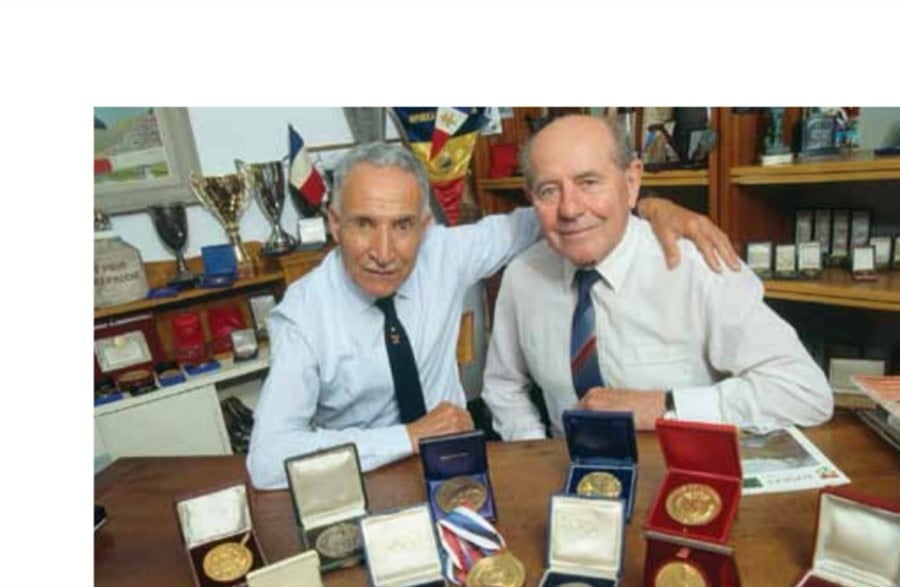
© Gilbert Iundt/TempSport/Corbis
▲ Zátopek (right) visits Mimoun in his Parisian home.
Ali Mimoun Ould Kacha was born of Berber stock in El Telagh in the Province of Oran, French Algeria on January 1, 1921. (I would venture that this is almost certainly not his true birthdate. Even nowadays, in rural communities in what we call third-world countries, January 1 is often given as a birth date for any child born in that year.)
Ali was a lively, intelligent child, and although his parents were poor peasants, he attended a local school, where he prospered both physically and academically. He recalls poring over maps of France and of his Corsican teachers instilling a love for La Mère Patrie in him, and, as he slyly admits, “I was in love with one of the woman teachers.” But as he grew up, he came to recognize that the legend above the school entrance, Liberté, egalité, fraternité, did not quite have the same resonance for him as it did for the children of the colons, the French immigrants—the armed forces, farming and business personnel.
Algeria had belonged to France since 1830, and the country had been widely colonized. France had a huge economic stake in Algeria, including the oil fields in the Sahara, and there were over a million colons and pieds-noirs (black feet)— Europeans born in Algeria—working and farming the land. According to what would become French colonial philosophy stretching even to those possessions like Polynesia, on the other side of the world, Algeria was an integral part of France.
What rankles most with Mimoun from that period of his young life is that when he was 10 years old, he was the only child not to get a grant for a secondary scholarship. “I was the only one rejected by the Academy, yet I had my school
certificate, with ‘good’ written across it. But all the colons’ sons got a grant, even the ones who’d only been there a year or so, from Italy, Spain, from anywhere.” Seventy years later, this slight still enrages Mimoun as he recalls it, sitting forward with color rising in his face, in the quiet back garden of the white pavilion, which he and wife, Germaine, built east of Paris in Champigny-Sur-Marne in the late 1950s. But what the young Ali lacked in privilege, he made up in charm and determination.
He was a handsome youth, and that may have been an additional factor in his first employer, the owner of a hardware store and his wife, a childless couple, inviting him to dine with them most evenings. “I was just 15, but I was put in charge of boys two and three years older than me. The boss was a good sort, a Frenchman, from France. He came one day and said, ‘You’re not getting enough to eat for the amount of work you’re doing. Come and eat with us.’ I told him he’d have to ask my mother first. But she was happy. I ate at table with him and his wife. Not even the Spanish maid did that. I ate as if I was their own son.”
But the young Ali had already decided that his future was elsewhere. The maps and pictures of France had excited his imagination. Coupled with the desire to overcome the humiliation of rejection by the education board, the idea became what he calls his “destiny,” a word that figures large in all his conversation. “Even as a kid, I said that’s where I belong. Over there! I saw villages with tiled roofs and cows in the fields, and I told my mother I don’t belong here, this isn’t my country. “
Don’t get me wrong, I never rejected Algeria, it’s my birthplace, the land. But Gaul was my country, that’s what they taught us at school, ‘Gaul is our country; our ancestors are the Gaulois.’ That’s why I couldn’t wait for my 18th birthday, so I could join up. I told my employer the same as I told my mother. This isn’t my country. Yes, I was born here, but my country is the other side of the Mediterranean. He couldn’t understand that. But I could. I didn’t accept colonialism, I was ahead of the times. I didn’t want to spend my life with the colons.”
If the convert is more Catholic than the pope, so it was with many of the colonized. They would adopt the country of their colonizers and embrace the culture with the passion of an inflamed lover. Equally, many of them would reject it just as quickly. Frantz Fanon was a contemporary of Mimoun. Born in Martinique in 1925, Fanon was a pupil of Aimé César, one of the 20th century’s first champions of black awareness, a movement characterised as “Négritude.” Fanon, like Mimoun, volunteered for the French armed forces for the Second World War. He was captured and spent the final years of the war in jail in Germany.
Later, Fanon studied psychology in Lyon before writing the seminal “end-ofcolonialism” studies Les Damnés de la Terre, L’An V de la Révolution Algérienne, and Pour La Révolution Africaine. Fanon enraged the French middle classes when, as head of psychiatry at the hospital in Blida-Joinville, in Algeria, he embraced the revolution and joined the Front de la Libération Nationale (FLN). He was
expelled from Algeria by the French but set up shop in neighboring Tunisia, where he edited the FLN newspaper, El Moudjahid. He was appointed ambassador to Ghana by the provisional FLN government but died of leukemia, aged 36, in 1961, the year of Papon’s Parisian massacres.
As a young intellectual in Martinique, Fanon had described himself as “more French than the French.” But writing in Peau Noire, Masques Blancs (Black Skin, White Masks), he recalled stepping onto French soil and discovering, with a sudden and irreversible shock, that he was, in French eyes, nothing more than a “black man,” a “nigger.”
Fanon saw clearly that the colonial relationship is not a dialectical one; it is not a two-way street. It is not a relationship at all but a one-way projection. For Fanon, the black man (or the Arab, who is equally “other”) has no independent existence. Though Mimoun is a bright, intelligent man who still has all his faculties at 80-plus years of age, he is no intellectual. Yet he understood Fanon’s conclusion intrinsically with his own refusal to accept colonialism. But whereas Fanon rejected all aspects of colonialism, beginning with the language of the oppressor and ending with a demand for the violent overthrow of the colonizers, Mimoun would travel to the end of the road of “more French than the French.” His love affair with La Mére Patrie would last a lifetime and provide the motor for his ambition—not only to be accepted but to colonize the colonizers.
ad
Mimoun’s opportunity to join the army would come sooner than he expected. War was declared in September 1939, and Mimoun immediately enlisted in the French Foreign Legion, which was stationed nearby. He claims he enlisted illegally, being three months younger than the minimum age of 18. But if, as he admits, he was born on January 1, 1921, he would have been three months short of his 19th rather than his 18th birthday when war was declared.
Transferred to the Third Regiment of Algerian Gunners, he spent six months training in Algiers, where he joined a local sports club, Gallia d’Alger. But he cannot recall running except as training for football and cycling. His first ambition was about to be realized, yet it could also shortly have been his last. Early in 1940, he was transferred to mainland France to help install telegraph communications on the infamous Maginot Line, which was supposed to halt the advance of the German invasion. “
Nous vaincrons, parce que nous sommes les plus forts” (We shall win, because we are the strongest) proved idle propaganda for the French troops, who were outflanked by the Germans. The “Bosch” invaders simply went around the French defenses. Mimoun was transferred to the hellholes that were the muddy trenches of the Belgian front. There he spent nine painful months before the French capitulation.
Fleeing before the aerial bombardment of the German and Italian gunners, he made his way south to Montpellier, where the remnants of the French army were demobilized. Since he had enlisted, however, he was transferred to the regimental town of Bourg-en-Bresse, north of Lyon in the wine-growing area known as Maconnais, a posting that would later give him a taste for good red wine. It would also introduce him to championship running. “
One evening, shortly after I arrived in Bourg-en-Bresse, I saw some kids running around a track. I suddenly had an urge to join in, so I just climbed over this sort of balustrade onto the track and started running with them. The trainer was a veteran from the ’14-’18 war, and he took to me and told me to come back the following week. After about a month of that, he got me an entry into the departmental (state or county) championships, and although I wasn’t allowed to compete officially, I beat the title holder.” With customary hyperbole but remarkable prescience, a reporter for the local newspaper, Progrès, wrote, “In the Departmental Championships, a great marathon runner is born.”
But it would be a while before Mimoun could build on that first victory. When German troops moved to occupy the center and south of France, with the French Pétainiste government stationed nearby in Vichy, he made a tactical withdrawal to barracks in Algeria. While training as a minelayer, an occupation he would follow for the rest of the war, he was able to run regularly and won the North African military cross-country championship as well as the 5,000 and 10,000 meters on the track. But within 18 months, he was back at the front.
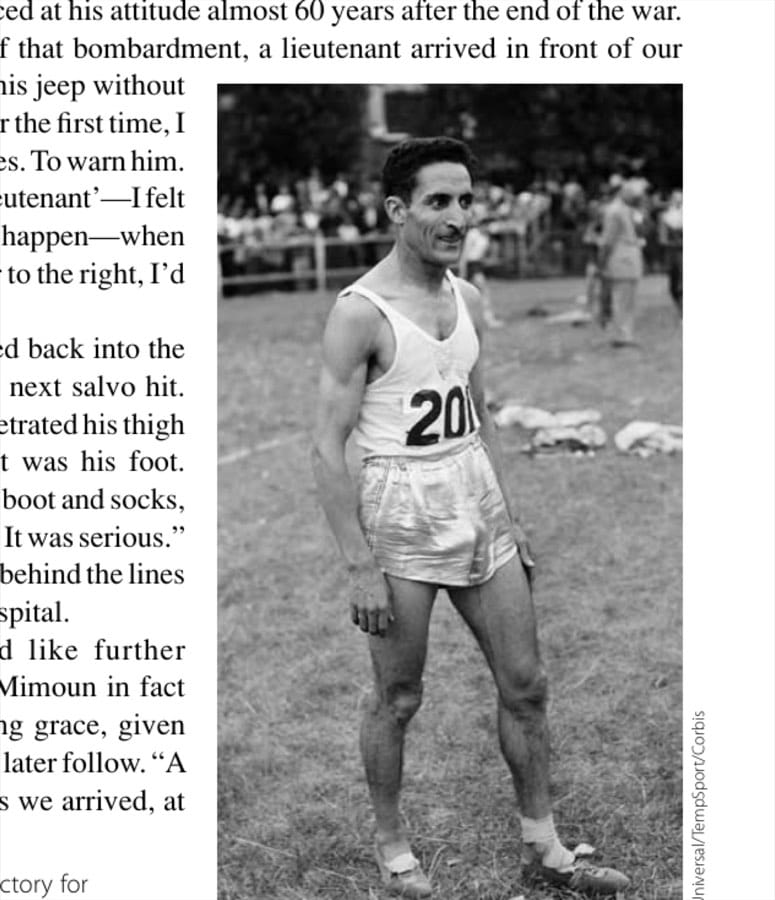
▲
Another cross-country victory for Mimoun.
© Universal/TempSport/Corbis
When the Allied troops landed in the north of France, he moved east from Algeria to fight against Rommel’s forces in the desert war in Tunisia. “It was terrible. We were so poor, so badly catered for, that we dressed in clothes we took off the prisoners.” Victorious after nine months of combat, he returned to celebrations in Algiers and a short period of retraining with American materiel before being sent on the Italian campaign.
Despite contentions in the British Parliament that Italy was little more than a holiday, in contrast to conditions in Normandy, Monte Cassino was one of the bloodiest engagements of the latter stages of the Second World War. Mimoun recalls “a veritable rain of fire. It was a living hell; we were pinned down for weeks. We were down in the valleys, and they were up above.” It was 1943, and Mimoun was just 22 years old.
And even though their combatants were German, the experience has left him with a suspicion and barely suppressed resentment of Italians, even now. “I’m always getting invitations to go to Italy and open this or that or be part of some sports ceremony, but I always manage to get out of it. Somehow, I can’t,” he relates, looking a little shamefaced at his attitude almost 60 years after the end of the war. “
On the 32nd day of that bombardment, a lieutenant arrived in front of our trenches and got out of his jeep without a helmet, just his cap. For the first time, I jumped out of the trenches. To warn him. But I’d barely yelled ‘Lieutenant’—I felt something was about to happen—when bang. If I’d been a meter to the right, I’d have been dust.”
Mimoun was dragged back into the trenches just before the next salvo hit. Shell fragments had penetrated his thigh and tibia, but the worst was his foot. “When they took off my boot and socks, the blood just pissed out. It was serious.” An ambulance took him behind the lines to an American field hospital.
Then what seemed like further misfortune for Private Mimoun in fact turned out to be a saving grace, given the career path he would later follow. “A huge storm broke just as we arrived, at
nightfall. I was stuck in the back of a truck. I spent the night calling for my mother. I was 22, 23 years old. I was hurting, and no one had treated me, no painkillers or anything—it was agony. And the storm had blown everything away, tents and all. Everything was flattened, but by dawn, it was calm. “
I was in the back of this covered wagon, and a French sentry happened past. He must have been shell shocked himself because when he spoke, he literally yelled out, ‘OK?’ I told him I had a headache and asked for some coffee. Two minutes later, he brings a mug of coffee. But when he says to me, ‘You’re in luck,’ I know he’s crazy. Luck? I thought, Look at me!”
But along with the coffee, whose taste Mimoun reckons will stay with him throughout his life, that French squaddie also brought what turned out to be lifesaving news. The US medics had intended to amputate his left leg, but a French surgeon had intervened, saying he thought it could be saved if Mimoun could be transferred to a French hospital in Naples. “
Just think, I might never have got to France, never run. There is a good God in Heaven. Otherwise, I’d be on crutches, drawing a pitiful pension. As it was, I was operated on by a medic I’d known in Algiers. When he’d finished the op, he looked at me and said, ‘OK, son, you’ll live to run again.’”
Later in life, Mimoun got back in touch with Monsieur Grasset, the surgeon who saved his leg, telling him that he had performed a miracle. “The miracle,” replied Grasset, “was that you ever became an Olympic runner, given the damage to your leg.” Yet within three weeks of the operation, Mimoun was setting out on the troop ships bound for the liberation of Provence under General Juin.
He had several near misses in the months before the liberation of France. Shortly after the disembarkation on the French mainland at Cogolin, he was helping colleagues prepare a meal in the open when he wandered off on some minor task. A dozen meters away, he watched in disbelief as six of his mates were blown to pieces. They had unwittingly built their fire over an antitank mine.
Mimoun was witness to several similar incidents while on mining duties, incidents that, he says, return to haunt him occasionally during sleepless nights. They are reminders of the internal scars that continue to lacerate a generation whose sacrifices provided the bedrock for the peace and freedom to wage sport and business across the world in relative safety.
Mimoun also fought in the Jura Mountains and in the Vosges, earning the Croix de Guerre with four citations for bravery. “We were a year in the Vosges because the Germans didn’t want to leave Strasbourg. A terrible winter! In fact, two terrible winters because it had been the same in Cassino the year before, minus 27 degrees. Then the winter in the Vosges, minus 26! We drank spirits to keep warm; that’s all we had, schnapps. It was hardly the best preparation for an athletic career. I had no special diet, just a destiny!” Part 2 of The Destiny of Ali Mimoun will appear in our January/February 2013 issue.
This article originally appeared in Marathon & Beyond, Vol. 16, No. 6 (2012).
← Browse the full M&B ArchiveMore like this
1,000+ stories from 19 years of Marathon & Beyond
The complete archive of the legendary long-distance journal — digitized and free to read.
