

In The Beginning
Alot fewer of us would be running today if an obscure relay record hadn’t been set on a dirt track in the central California town of Fresno more than 40 years ago. Hardly anyone paid attention when four University of Oregon runners set a world record in the four-mile relay at the West Coast Relays there in 1962. It was big news only in Eugene, Fresno, and New Zealand, home of the previous record holders. Almost no one had even heard of a four-mile relay anywhere else. No one anywhere could possibly have realized the significance of what had occurred.
Viewed now from another perspective, the record looks to be one of the most significant running achievements of the 20th century in the United States. It was the first link in a chain of events that culminated in a nationwide running movement that continues to thrive to this day.
Few people ran in 1962 unless they were part of a high school or college track team. Road races, trail races, and running shoes without spikes weren’t part of most peoples’ consciousness. There were no stores catering exclusively to runners. There weren’t any doctors specializing in running injuries. There was no Marathon & Beyond.
Only three marathons were run regularly in the United States at the time: Boston, Yonkers (New York), and Culver City (California). None had many entrants, with only 232 entered at Boston that year. All were men, most probably thought to be slightly eccentric, and many were foreigners. No one had even thought to ban women runners yet because there weren’t any.
By present standards, the times of the Oregon runners weren’t overly impressive. Archie San Romani Jr. led off with a 4:03.5, Vic Reeve followed with a 4:05.2, Keith Forman ran 4:02.5, and Dyrol Burleson finished with a 3:57.7. The total time of 16:08.9 was 14.9 seconds faster than the New Zealanders had run when they set the record in 1961. To them, this was an affront.
A disproportionate number of the world’s best runners lived in Eugene and New Zealand in the early ’60s. From 1960 to 1962, University of Oregon runners set world records in four individual outdoor events and two relays and won two gold medals at the Olympic
Games in Rome. New Zealand runners set world records in five individual events and one relay and won two golds and a bronze in Rome. Together, these two small groups of runners held world records for 100 yards, 100 meters, the 440-yard relay, 400 meters, 880 yards, 800 meters, one mile, two miles, three miles, and the four-mile relay.
THE FORMATIVE YEARS OF TWO COACHES Their coaches were Bill Bowerman in Oregon and Arthur Lydiard in New Zealand, both legends in the making at the time. After the Oregon runners broke the record, Lydiard invited Bowerman and his runners to New Zealand for a series of challenge races and clinics. The trip took place during the winter of 1962-’63. Led by the great Peter Snell and Murray Halberg, both Olympic gold medalists and individual world record holders, New Zealand regained its dignity by defeating the Oregonians in almost every instance, running a series of races on grass tracks marked out around the perimeter of rugby fields.
In Bowerman’s mind, though, the trip was a huge success. During the visit, he was introduced to a new form of exercise called “jogging” that had been developed and popularized—but not yet exported—by Lydiard less than two years before. Bowerman loved the idea and spent much of his time questioning Lydiard about it. He raved about a 74-year-old jogger named Arthur Steedman, who the 52-year-old Bowerman claimed “could run my legs off. He embarrassed me by his fitness.”
In each of the 12 towns Bowerman visited in New Zealand, he found a jogging club, a loosely organized group of people who met once a week to exercise together. Everywhere he went, he said, the people were “fit beyond belief.” New Zealand researchers already had found that joggers’ heart rates dropped dramatically after as little as three weeks’ exercise, their cholesterol levels decreased, their respiratory functions improved, and there was often a significant redistribution of weight. Bowerman started jogging while in New Zealand and claimed he quickly lost three inches off his waist although his weight remained the same.
Upon returning to Eugene in January, he began to spread the word. He talked to service clubs, was interviewed by the Eugene Register-Guard, and wrote a pamphlet called The Jogger’s Manual, which was distributed by a local bank. He had to explain the meaning of “jogging” to his readers. “
Jogging is a bit more than a walk,” he wrote. “Start with a short distance (50-100-150 yards), then increase as you improve. Jog until you are puffing, then walk until your breathing is normal again. Repeat until you have covered a mile or two, or if you do not like to think of distances, make it a jog of 5, 10, 15, or perhaps 30 minutes to start.”
Bowerman was accustomed to working with elite runners at the pinnacle of human fitness but had no trouble relating to nonathletes at a level they could un134 l MARATHON & BEYOND l MAR/APR 2006
derstand and accept. He knew that if the joggers tried to do too much too soon, they would become discouraged and quit. “Just use moderation as a guide,” he wrote. “Eat what you like, have a drink if you will, smoke if you like . . . but remember good sense is the best guide to healthful living.”
DON’T DO IT FOR WEIGHT REDUCTION
Phil Wolcott
He emphasized that jogging was “not a weight-reducing activity. Unless a person is just terribly fat, there isn’t going to be much weight loss.” Once Eugene had been saturated with his message, Bowerman took the jump from words to action. He announced the foundation of the Eugene Joggers Club and, through the Register-Guard, publicly invited “anyone interested—the old and young, the big and little, the male and female” to come to the first meeting on February 3. The newspaper advised people to wear “a pair of soft, comfortable shoes and whatever else can be worn comfortably.”
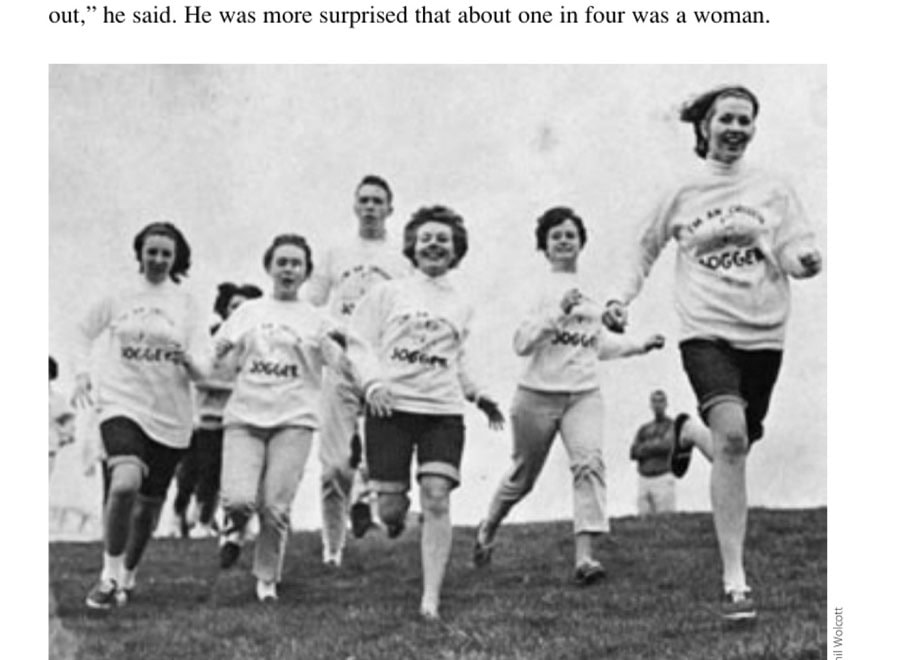
Bowerman was pleasantly surprised when about 200 showed up on the University of Oregon’s intramural track behind the west grandstand of Hayward Field, despite dark skies and scattered showers. “I had no idea this many would turn out,” he said. He was more surprised that about one in four was a woman.
▲ Many of the first female joggers were University of Oregon sorority girls.
Eugene Register-Guard
The next week was beyond surprising. A crowd somewhere in the neighborhood of 1,000 showed up. Many who came this time were middle-aged and overweight. Bowerman was a little nervous about that segment of the group. “We can’t take all these old guys out here,” he confided to Waldo Harris, a Eugene
cardiologist helping him monitor the physical effects of the jogging experiment. “We’ll kill them.” To them, Bowerman stressed Arthur Lydiard’s mantra: “Train but don’t strain.” Bowerman, Harris, and another local physician, Ralph Christianson, quickly
put together a gentle training schedule and a list of guidelines. The coach suggested that everyone find a partner of about equal ability and that the faster one should adjust his pace to jog with the slower one. He discouraged competition
and encouraged regularity, jogging a minimum of five days a week. “It really is easy,” he said. “As Lydiard says, all you have to do is step out your back door and you’re in business.” Bowerman had no idea whether the joggers’ club idea would spread to other
parts of the state or country, but his ideas took hold in Eugene. The Oregon weather cooperated by turning unseasonably warm. People who had been self-conscious about exercising in public realized that others were doing it and suddenly felt
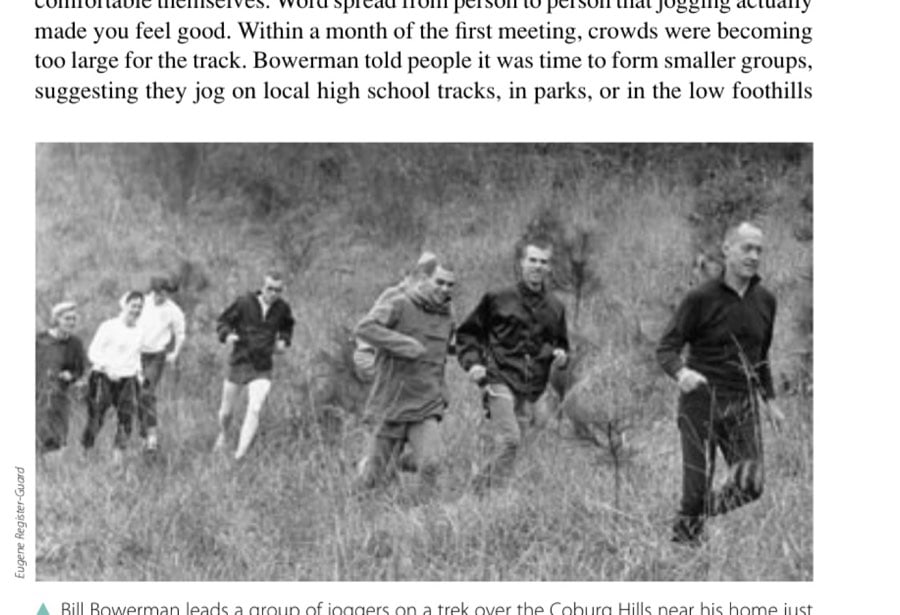
comfortable themselves. Word spread from person to person that jogging actually made you feel good. Within a month of the first meeting, crowds were becoming too large for the track. Bowerman told people it was time to form smaller groups,
suggesting they jog on local high school tracks, in parks, or in the low foothills
▲ Bill Bowerman leads a group of joggers on a trek over the Coburg Hills near his home just outside of Eugene, Oregon, in 1963.
around Eugene, although a group would continue to meet on the university’s intramural track. After a photographer from Life magazine came to Eugene one weekend to record the phenomenon, jogging became a topic of discussion nationwide. Again, talk was followed by action. Before long, jogging evolved into a national craze, which eventually would change the health and exercise pattern of an entire nation and lead to the creation of a billion-dollar running and fitness industry, with all its branches, from race promotion to shoe shops to running magazines to sports medicine clinics. All the end result of four guys running the seldom-contested four-mile relay.
This article originally appeared in Marathon & Beyond, Vol. 10, No. 2 (2006).
← Browse the full M&B ArchiveMore like this
1,000+ stories from 19 years of Marathon & Beyond
The complete archive of the legendary long-distance journal — digitized and free to read.
