

Ironman By Way Of Lottery
Every October the world’s top triathletes gather on an island in the middle of the Pacific Ocean to determine who is the fastest when it comes to swimming 2.4 miles, biking 112 miles, and running 26.2 miles. By the time they line up at the Kailua pier for the mass swim start, they have averaged 18 to 30 hours of training each week: seven miles of swimming, 225 miles of biking, and 48 miles of running.
Held in the small town of Kailua-Kona on the big island of Hawaii, the Hawaii Ironman World Championships is the most-storied race in the triathlon world. If the distance weren’t challenging enough, race-day conditions typically include temperatures in the 90s, high humidity, and 60 mph crosswind gusts on the bike course.
There is no shortage of competitors wanting in. Those winning a coveted slot represent the most talented 1 to 2 percent of triathletes, who have to be top finishers in their age divisions at another qualifying Ironman event. The 1,800 starters are the best of the approximately 110,000 competitors taking part in qualifying races around the world—except for a lucky few who are drawn in the annual Ironman lottery.
When the Hawaii Ironman changed hands in 1980 from founder John Collins to a local athletic club, it was under the agreement that there would always be spots available for the ordinary athlete. In 1983, a lottery was started, which has remained an Ironman tradition ever since. In 2011, more than 6,000 people applied for one of 150 US lottery spots. Keith Buell was one of the lucky winners. “
I started doing triathlons two years ago,” the 38-year-old resident of Falls Church, Virginia, said. “Before I’d even done a single shorter-distance race, I signed up for Ironman Lake Placid in July 2010. That went pretty well, but my
wife and kids weren’t so keen on the long training hours. So I said I wouldn’t do one in 2011, but I’d put my name in the Kona lottery and only do another one someday when I got in. Lo and behold, on April 15, I got chosen. “
I called my wife and said, ‘Honey, I’ve got good news and bad news,’” Buell recalled. “The good news is we’re going to Hawaii. The bad news is that I’m doing another Ironman. “The most interesting part of my story is not certain yet. I’m a lawyer for Verizon, and the labor contract with the union expires August 6. All management employees, including me, have been assigned a temporary job. I’ll be climbing telephone poles and installing phone service if the union walks out. We’re supposed to be working 12-hour days, six days a week. If that happens, I’m not sure how I’d fit training in. I also have a running injury, medial tibial-stress syndrome, and can’t run. But I’m determined to get through this event. I may never get another chance.”
Picked on the first try Cody Westheimer, of Los Angeles, was also drawn the first time he entered the lottery. “I had never even run a mile when I started working with the director of the 2007 film Ultramarathon Man about Dean Karnazes,” the 33-year-old composer said with a laugh. “I had taken marching band for PE credit so I wouldn’t have to run and didn’t even know what a marathon was. “
One day I needed to go to the bank, which was about a mile round trip, and I decided to run,” Westheimer recalled. “I was exhausted, but there was something about it. The next day I went a little bit farther. In January 2008, I ran the Houston Marathon and made a short film, Running for My Father, who had passed from a brain tumor.
© Charles Buell
▲
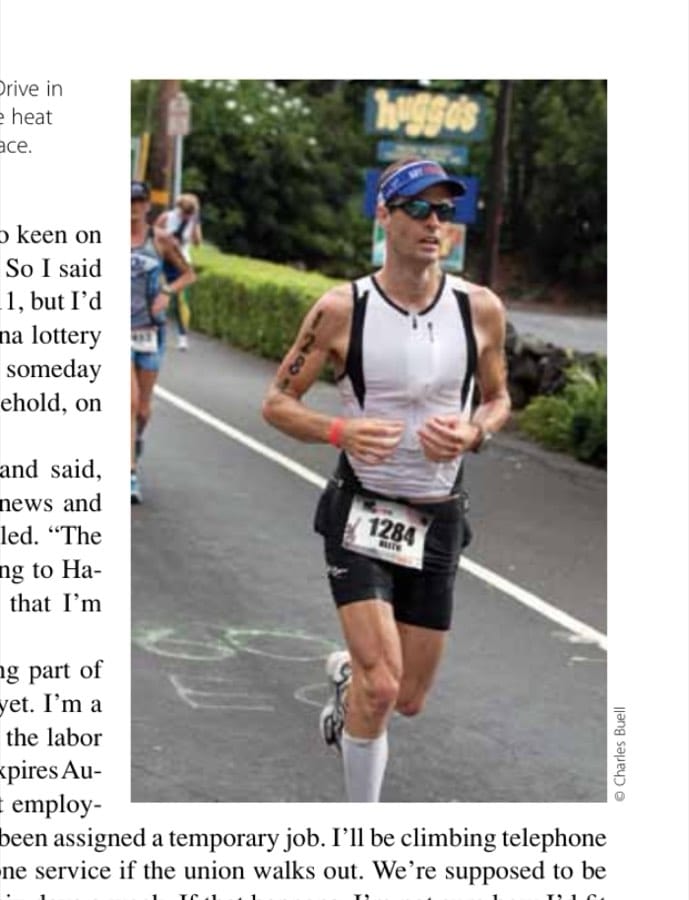
Keith Buell runs on Ali’i Drive in downtown Kailua-Kona. The heat index was 105 during the race.
© FinisherPix
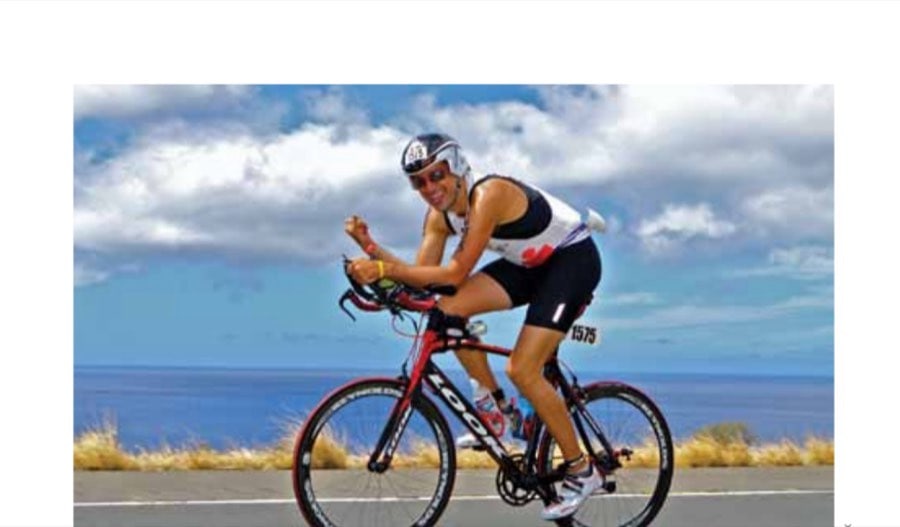
▲ Cody Westheimer enjoying every minute of his day in Kona.
“The month before my marathon, I had seen the Ironman special on television. Here I was trying to wrap my head around doing a marathon, and I couldn’t believe people were doing one after swimming 2.4 miles and biking 112. I told myself someday I am going to do an Ironman.”
Westheimer, who wrote the original music for Ultramarathon Man, The Runner (about David Horton’s Pacific Crest Trail run), and the 2011 Tour de France coverage on Versus, completed his first triathalon (Olympic distance) on his 30th birthday. “I was completely fulfilled and didn’t need to do another one. I told my wife I’d enter the lottery and would do another one sometime down the road if I got into Kona. When I saw my name on the list, I screamed and whooped so much that I woke her up.”
David Hoy, of Coral Springs, Florida, also won on his first try. “I’m relatively new to running and triathlons, having only started running for the first time in October 2009 at the age of 44,” the software engineer said. “I did my first sprint tri March 2010 and got totally hooked. A friend tried to convince me to sign up for an Ironman, and I just told her that she was sick. But the idea stuck in my head, and I decided to go for it. I picked Ironman South Africa, as I was born and raised there, and it seemed appropriate to do my first Ironman in my homeland. That, and my mother would be able to come see me do it! I had an amazing experience during the race and finished in 13 hours, 5 minutes, within five minutes
of my stretch goal of 13 hours. After I finished, I was on such a high, I was not tired at all. After getting my finisher medal from none other than past Hawaii Ironman winner Chrissie Wellington, I stayed in the finish area for three hours more cheering others across the line. I barely slept that night, I was so elated.”
Getting the news “I stayed in South Africa for another week to visit with family and friends,” Hoy continued, “and it was that Friday, just days after finishing my first Ironman, that I got the news about Kona. I recall it vividly; it was 6:00 p.m. local time, and I was online checking the Ironman website. A bunch of my friends had entered the lottery, too, and as soon as the lottery results were posted, I started scanning the list. I remember going slowly, looking for my friends’ names. When I got to the H’s I went even slower. Then the HO’s, of which there seemed to be a lot, and I was thinking that my name was not there. I scrolled down one more, and there it was! I sat in stunned silence for a few seconds, and then my phone started going nuts with text messages from my friends back here in the United States. I scanned the rest of the list, hoping that at least one of my friends would be on the list, too, but unfortunately that was not to be. I texted my wife a simple message: ‘How do you feel about going to Hawaii in October?’
ad
© Cathy Tibbetts
▲
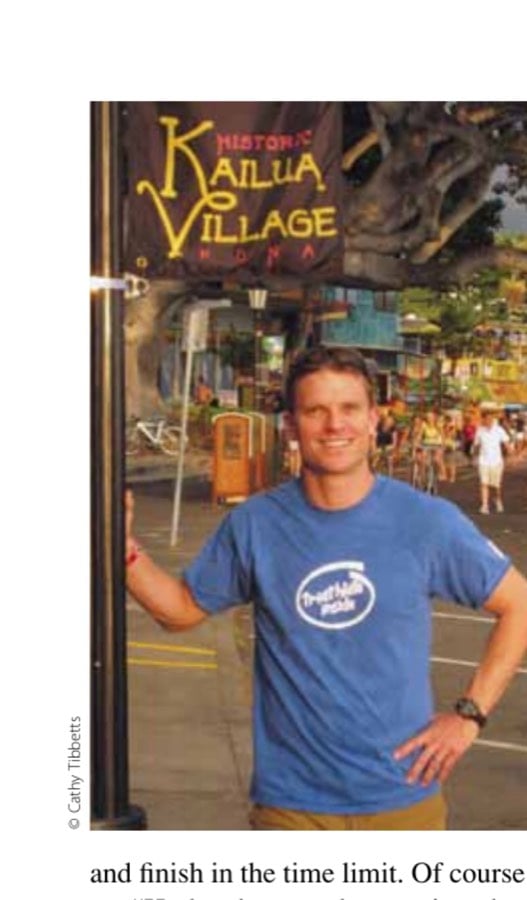
Jason Adams stands where the finishers’ chute will be on Ali’i Drive. On race day, this quaint spot will be mobbed with spectators cheering for the finishers.
“The whole thing is still somewhat like a dream, and I catch myself thinking that it can’t be true. But it is true, and while I may not have qualified for Kona, I’m going to do my best to prove worthy of the honor. I’m training
hard, have hired a running coach to help me improve my marathon time, and am working on my swim and bike, too. I train around eight to 12 hours per week at the moment, six days a week. I really want to make the most of this
opportunity, not just go out there and finish in the time limit. Of course, I still plan to have fun while doing it all!” “He has been so happy since he started doing Ironmans,” his wife, Joann, said as she was volunteering at the Kona bike check-in. “He’s like a little kid.
And when he’s happy, he tries to make me happy. This has made our relationship even better.” The first time was also a charm for Jason Adams, of Ann Arbor, Michigan. “This was the very first time that I entered the Kona lottery. I was actually drag
ging my feet, but my wife kept bugging me, and then she finally entered my name (obviously with my consent). This means that my wife is actually responsible for my lottery slot, and this knowledge has made her very supportive of the training
load required to make this all happen. This will be my first 140.6-distance race, a pretty big stage to start out on, but I am excited and I am doing all of the training to honor the spirit of the race. My wife and I had already decided that we were
going to go to Kona for the race regardless of whether I got in (we had already booked a place and bought plane tickets before the lottery). We are both turning 40 a month before the race, and we are also having our 15th wedding anniversary
shortly after the race, so Hawaii seemed like a nice place to celebrate these events. I was planning on volunteering at the race, maybe in the medical tent, as I am a physician in my nontriathlon life. Obviously, the lottery slot means no volunteer
position. In fact, I hope now that I do not get to see the inside of the medical tent.”
A message relayed “I actually did not look up the list,” Adams said. “I was in the hospital doing a case when my wife sent me a message, which was essentially (paraphrasing), ‘Holy (cow); you got in.’ I was pretty stunned, but in my deepest heart I will admit to not being as surprised as you would think. I had this feeling that I would get in. I guess I wouldn’t have been surprised if I didn’t get in, but it seemed like the stars were aligned as far as getting the vacation time, where I am in my life, etc. Although this is my first full Ironman, I am planning on racing, not just finishing the race. I am training harder than I have in many years. I think I can achieve a good result at this race. Obviously, the most conservative goal is to just finish, but I am hoping to do much better than that.”
There are a few other ways to get into the Hawaii Ironman. The World Triathlon Corporation auctions charity slots on eBay. In 2011, they went for $60,100; $50,100; $55,100; and $45,300, with all of the money going to charity. There are 44 slots for Hawaii residents: 24 for the Big Island and 20 for residents of the other islands. Kailua-Kona resident Bill Greentree entered the Big Island lottery and was the first name drawn. “
Four years ago I decided I was tired of being overweight and out of shape,” the FedEx airline captain said. “I’m not exactly the athletic type and never have been. My wife was getting really fit paddling outrigger canoes and started doing triathlons around Kona. I bought a little booklet called ‘Getting Started in Running’ that slowly built you up to running 20 minutes without stopping. I thought that would be really cool. So I ran in my sneakers and shorts for a while before getting real running gear. Somewhere along the line, I started doing a few races and hired a coach ’cause I was concerned about not being able to finish the run portion of a triathlon relay team I put together. Since then I’ve completed three marathons, eight half-marathons, and I have no clue how many 5Ks and 10Ks. I’ve also helped set up the swim course for Ironman here in Kona for the past five years as well as being a run-course volunteer the past two years. I started doing triathlons because I live in triathlon central and really got tired of answering the question, ‘Do you do Ironman?’ with ‘No. I’m just a runner.’ Nowhere else in the world do you have to apologize for being a mere runner. So I started this year with the Lavaman Waikoloa triathlon then the Ironman 70.3 race here. Kona will be my third triathlon—ever. As a pilot, I was in Japan at 2:46 p.m. on March 11, 2011 when the earthquake struck. I grew up in earthquake country (Northern California) and was in the San Francisco Bay area for the Loma Prieta earthquake. There was no comparison. This was by far the worst quake I’d ever felt, and it lasted a long time. I had no doubt the hotel I was in was going to collapse on me. If I can get through that, I can get through pretty much anything. Ironman training is a piece of cake compared to facing the thought of your imminent demise.”
At the 2011 race
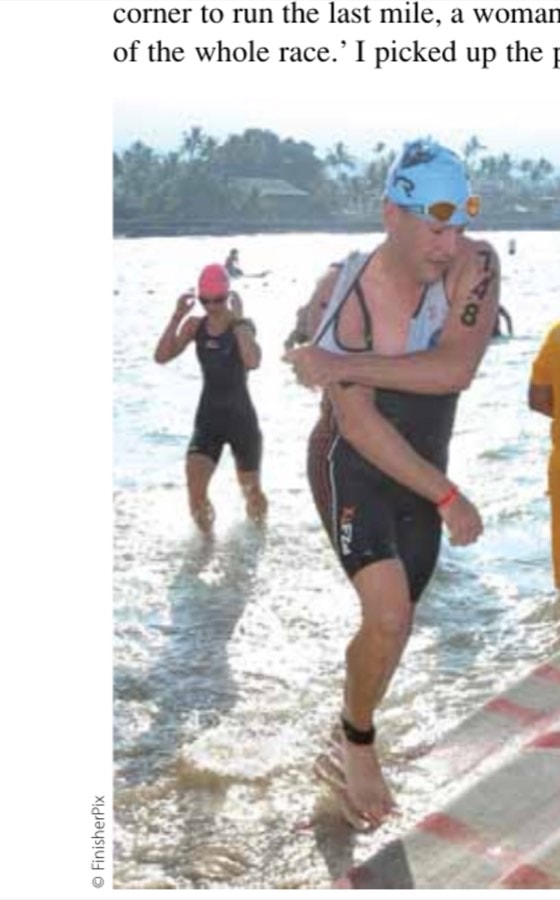
David Hoy exits the swim and heads toward the bike transition. ▲
© FinisherPix
The 2011 field included pros and amateurs from over 50 countries and almost all 50 states, ranging in age from 18 to 81. After the cannon went off for the pros at 6:30 a.m., the world’s luckiest lottery winners joined the world’s top age-group
triathletes in their swim to the starting buoys in Kailua Bay. Wading into the water minutes before the race start, Jason Adams stepped on a rock. “I had a 1.5-inch gash on the bottom of my foot all the way to the deep
tissue,” he said. “I made an executive decision to keep going, but I felt this big flap of skin flapping around for the entire swim. My luck got even worse on the bike. I came up behind somebody, he sped up, so I dropped back. The next thing
you know, the race officials pulled me over and gave me a four-minute drafting penalty. I really thought I had the mandatory four bike lengths between us. I was so mad. My foot really started to hurt when I was in the penalty tent. “
On the run I kept my target pace of 7:30-7:45 miles, but then my gut started acting up. You can’t believe how far out the turnaround is at the Energy Lab, and you keep thinking, It’s got to be coming. “
Miles 15 to 19 were a dark time for me, and I struggled. But as I turned the corner to run the last mile, a woman on the corner said, ‘This is the easiest mile of the whole race.’ I picked up the pace to a seven-minute mile and had energy
left at the end. “I can’t wait to do another one.” Jason’s time: 11:07:11. “The bike course was a lot harder than I expected,” David Hoy said. “Halfway back, my quads started cramping and I almost stopped. I
asked myself, ‘Why am I doing this? I am never doing another IM again.’ I walked two-thirds of the first 10 miles of the run. My legs were pretty tired, and I walked half of the next eight miles. Then,
while watching a beautiful sunset, I met Chip Thompson, also a lottery winner. We hit it off and encouraged each other to start running. Along
the way we picked IndyCar driver Tony Kanaan and ran with him for a while. He was a really nice guy. “But Chip and I agreed we weren’t going to let him beat us,” David said with a laugh. “Coming down the finisher chute, a woman was ahead of me. I didn’t want to race past her in the finish chute, so I slowed down a little to let her have her moment. Chip caught up with me while I was waiting for her, so we finished together. We even had finisher’s photos taken together, and now we’re friends.” David’s time: 12:51:36. And he beat Tony Kanaan.
In spite of a strike The Verizon strike lasted only two weeks, so Keith Buell did get some training in despite his running injury. “I saw a pod of dolphins on the swim; it was great,” Buell said. “My bike was going according to plan, too, until I got to where my family was supposed to be cheering, and they weren’t there. That was my lowest point—I was so discouraged. It’s amazing how a tiny little disappointment can affect you so much mentally. Then I saw them two minutes later and was happy for the rest of the bike. “
My legs felt awful coming off of the bike, but once I got my running shoes on, I felt fine for the first five miles of the run. At mile five, I started walking through the aid stations, and at mile 11, I felt nauseous and started walking. At mile 18, I met a woman from Sweden. She encouraged me, and that was everything. We ran the last eight miles together, and without her, I don’t know how much I would have tried.”
Keith’s time: 12:54:13. Being in the film industry, Cody Westheimer couldn’t resist carrying a GoPro— a waterproof, digital video camera. He edited 3.5 hours of footage down to 8.5 minutes and set it to music he had composed, and it hit over 10,000 views on YouTube in the first three days: http://www.youtube.com/watch?v=O_wk8E9Qe6s. “
My goal was to take in the race and enjoy it,” he said. “The spirit of the lottery is to be able to take part in the event, not to take part in the event fast. “But I’m an excitable and emotional guy, and it was easy to lose control of my pacing in the crowd. You could see it in the video. I’d pick it up when people were cheering. My heart rate was way too high, and it didn’t settle down until after the crowds. “
The winds on the bike lived up to their reputation and I thought, Wow, this is unbelievably brutal. “So I took a lot of time in T2 [bike to run transition] to set up for the run and felt great for the first six miles. Then I had stomach issues and had to stop four or five times but then saw the most spectacular sunset. I even saw the green flash,
▲
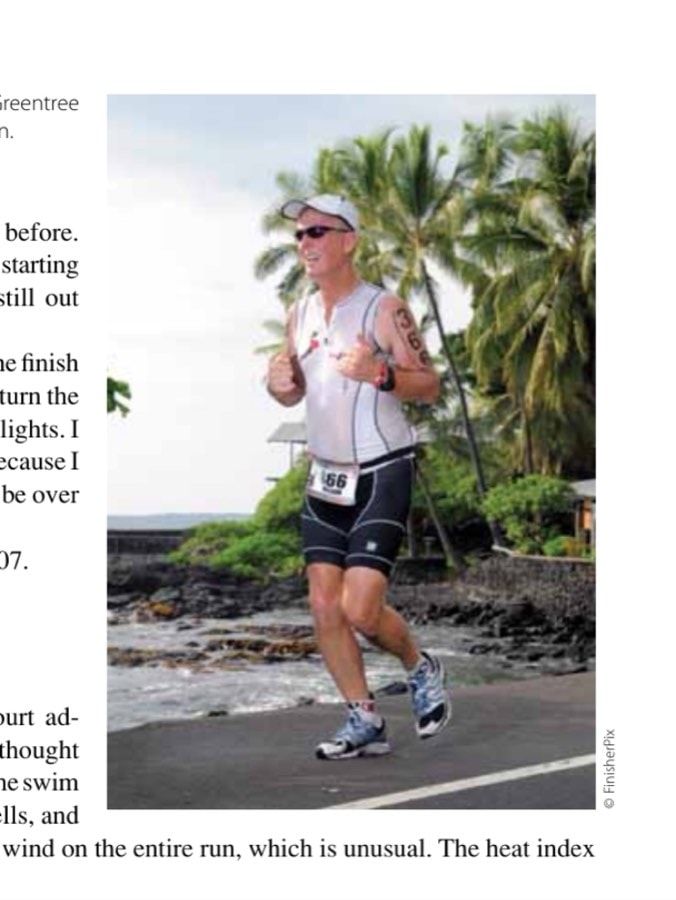
Hometown favorite Bill Greentree on Ali’i Drive early in the run.
which I had never seen before. There’s something about starting at sunrise, and you’re still out there for the sunset. “The last stretch on the finish line was so surreal. You turn the corner, and there are the lights. I stopped to take it all in because I knew it was all going to be over so quickly.” Cody’s time: 14:10:07.
Even with the home-court advantage, Bill Greentree thought the course was tough. “The swim was slow due to the swells, and there wasn’t a breath of wind on the entire run, which is unusual. The heat index was 105. “
A doctor in the medical tent told my wife there was a higher incidence of people being dehydrated. She was volunteering on the course and told us all to take more sodium. I averaged 400 milligrams an hour on the bike. “
On the run, I ran between aid stations but walked through them. And being from here, I stopped to chat with every person that I knew. Still, my stomach shut down early. “What I discovered was that the run part of an Ironman marathon is easier than a regular marathon for the first 20 miles. The last six miles are harder due to fatigue and the mental game to keep going. In a regular marathon, at mile 20 you think, I only have 10K to go. In an Ironman, you think, I still have 10K to go. “
Despite what people say, you do hear the announcer shout your name and ‘You are an Ironman!’ when you finish.” Bill’s time: 14:03:44. “I still think it’s cool to be able to run 20 minutes without stopping,” Bill Greentree said. “More people need to take up that goal. Who knows where that will lead you? In four years they, too, might be in the Ironman World Championships.”
© FinisherPix
No home-court advantage
This article originally appeared in Marathon & Beyond, Vol. 17, No. 2 (2013).
← Browse the full M&B ArchiveMore like this
1,000+ stories from 19 years of Marathon & Beyond
The complete archive of the legendary long-distance journal — digitized and free to read.
