

Murphy’s Story
Iwasn’t actually looking for a running partner, at least not in the beginning. My wife and I had made several trips to our local animal shelter: a new, clean, well-run facility that makes you want to come back to visit the dogs and cats. If you love animals, some shelters are just easier to avoid out of sympathy for the animals and their living conditions.
It had been over a year since we had to put down our Airedale mix at the age of 13. While she liked to go for shorter runs in her younger days, you wouldn’t call her a running partner. She had been a great pet, well behaved with our growing children, including our developmentally handicapped daughter, Lauren, who took great pleasure in grabbing any available canine appendage. Because of our success with orphaned pets from the animal shelter, we were convinced of the merits of again acquiring our next pet dog from the same source.
On previous visits, we had been befriended by a 3-year-old male Lab mix named Murphy. We thought it best to bring Lauren along for a get-acquainted session with the possible pooch. Many dogs, particularly adult ones, don’t appreciate being grabbed at by anyone, especially teenage strangers. Lauren never got the chance. One look at Lauren, even through the gate, set Murphy into a barking rage. Forget Murphy.
As luck would have it—or fate, as I’ve come to accept—a litter of four pups had just become available for adoption this day of our most recent visit. While we had spoken of adopting an adult dog—everyone knows they are less likely to be adopted—we were quickly won over by the inevitable charm of puppies: cuteness, playfulness, and energy. We rationalized to ourselves that here is an unspoiled pet, without the possible bad habits engrained in a mature dog adoptee. Besides, we figured a puppy could become accustomed to Lauren, and vice versa, during its growing years.
As always seems to happen when you are introduced to a litter of pups (or kittens, for that matter, but that’s another story), one seems to stand out and practically beg you to take it home. In our case, it was a particularly energetic red, shorthair male with a distinctive curlicue tail and ears that wanted to stand up tall
but flopped over at the tips. Based on the dog’s questionable lineage, the shelter staff suggested he could grow up to become a medium-sized adult dog. That’s a relative term. With our past family canine pets that included a 140-pound male Saint Bernard and the female Airedale mix, I just assumed medium-sized might translate into a dog the size of a setter or maybe a larger terrier. Either one of them could make a reasonable running partner, if so inclined. It was only months later that I slowly realized I had inflated my mental picture of medium-sized.
Even though our experiment with the adult Murphy hadn’t worked out, by then we were enamored of the name and gave it to the newest addition to our family. It has been a good fit.
NOBODY LIKES TO START RUNNING I’ve been fairly consistent at some minimum level of running for most of my adult life. Mostly I ran to support my eating habit and to keep my pants at more or less the same size. Off and on over the years, I might have entered the occasional 5K or 10K fun run, but I didn’t have much interest in longer runs. Then about six years ago—my wife is convinced it is a direct result of my turning 50 years old—I decided to tackle a 30K trail run staged in our local Bighorn Mountains in northcentral Wyoming. I was, as they say, hooked. Since that 30K race in 2000, I’ve completed 25 marathons,
Del Acker
▲
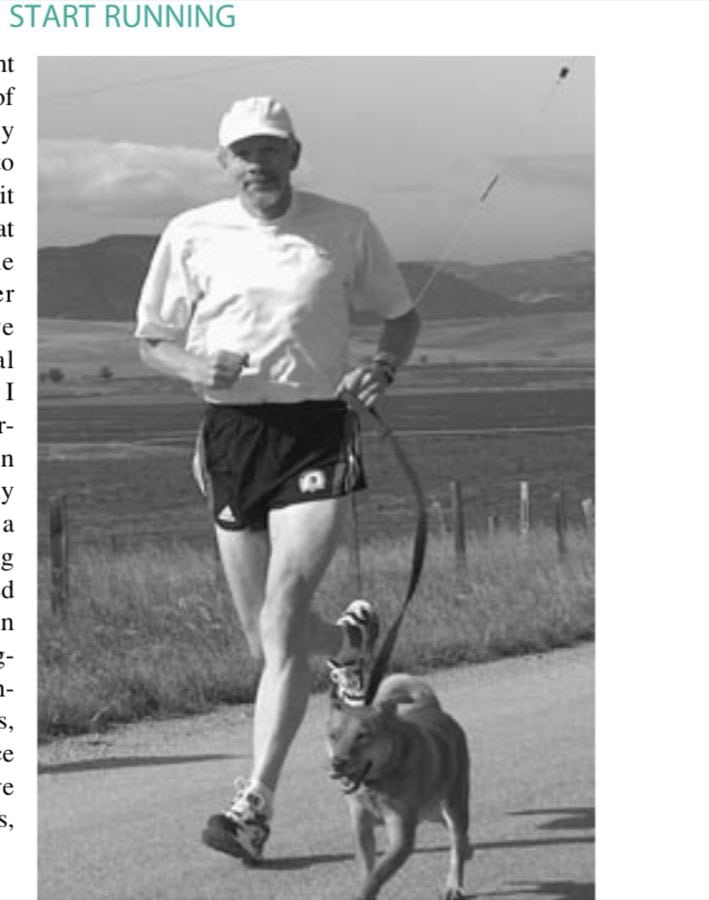
The author and Murphy on a training run in the country.
including the last five Boston Marathons. My goal is to complete four or five marathons per year, forever. When 8-week-old Murphy came to live with us in December 2002, he appropriately showed no interest in running. Being taken for walks, yes, but running, no. But what can you expect from a fellow who stood no taller than 12 inches at 12 weeks of age? My subtle introductions to running-partner training were limited to walks or slow jogs around the block with Murphy. It really wasn’t until sometime early the following spring that Murphy came to his own conclusions about running. I suspect they might have included that running is actually fun, it burns off some of that boundless energy of young dogs, and it got him out of the same old house and yard on a daily basis. I remember the first time Murphy and I actually ran in a race together. He was about 7 months of age when we ran in a fund-raising event for, fittingly, the animal shelter from which he was adopted. Even in that short two-mile race, he exhibited a competitive nature and love of running uncharacteristic for a dog of his age and size. He was, as they say, hooked.
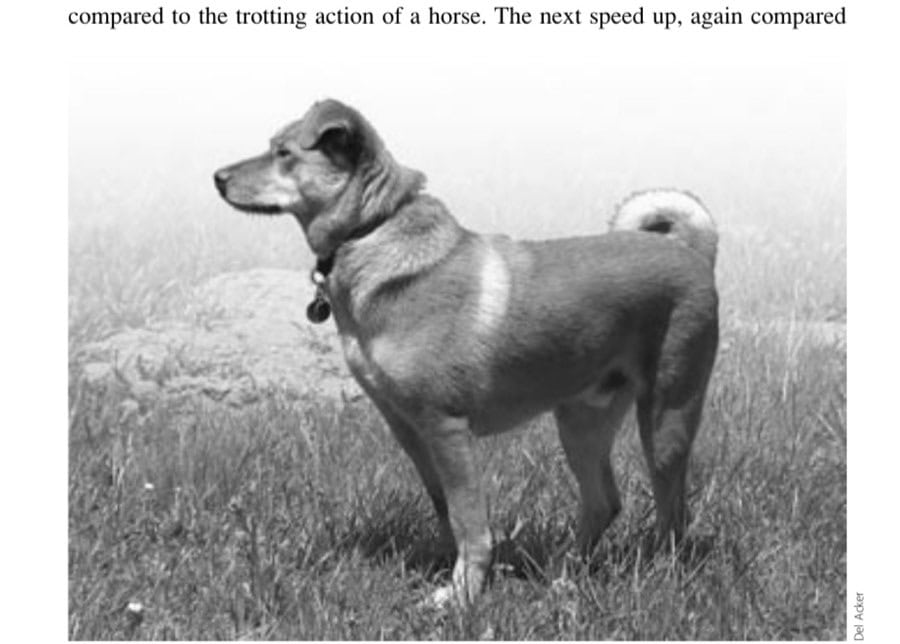
BUILDING UP THE MILES Today, as an adult dog of 4 years, Murphy could be described as achieving the small side of medium-sized. He is about 19 inches at the shoulders and weighs in at about 35 pounds. Despite his diminutive size, he now routinely accompanies me on all training runs, including the occasional long runs of 20-plus miles. At the conclusion of particularly long or tough training runs, I am amazed at how much energy he has in reserve and how little I have left.
Obviously Murphy didn’t start out with such long runs. Like any runner in training, he began with easy, short runs. When we had worked up to five-mile runs, I remember saying to myself and others, “I don’t think I’ll take him on runs any longer than five miles.” I distinctly recall each time I raised the limit based on his enthusiasm before, during, and after ever-longer runs. Don’t worry, this didn’t happen overnight. His buildup of a solid mileage base, resulting in 20-mile runs, evolved over a period of 12 to 18 months.
Speaking of worry, I was naturally concerned that his willing participation in my running program to maintain my health might not be the best thing for his health. Only after a number of regular checkups by our veterinarian have I become convinced that Murphy is reaping the same health benefits as two-legged runners.
Murphy’s vet does suggest the following precautions, which I faithfully adhere to: (1) make sure the dog’s pads are in good shape after any run, since they may not blister, but they are nevertheless susceptible to cuts or bruises from tough, long runs or hot pavement; (2) avoid running during hot periods of the day, as dogs are very susceptible to heat illness or injury; and (3) make sure they have access to plenty of water during and after a run.
SIZE HAS ITS ADVANTAGES
Del Acker
I guess, when you think about it, being small and having an interest in distance running is a good combination. When I compare elite male marathoners who average 130 to 140 pounds and are usually under 6 feet in height to my aging 6-foot-3-inch frame carrying 185 or so pounds, less is definitely more. The same principle should apply to animals, including dogs. While our Saint Bernard of many years ago actually enjoyed accompanying me on runs, neither of us was thinking about 26.2 miles.
Proportion has to come into play here also. A dachshund is small, but you just don’t see that many training with distance runners. A running friend of mine has two corgis; both love to run, for maybe a mile or so.
Murphy seems to be blessed with relatively long legs in proportion to a small body. He makes running look effortless, and when he gets into that lope of his, I’m convinced he could run at that pace all day.
On the subject of pace, I’ve taken to wearing a wrist-mounted GPS to better gauge my distance and pace. It wasn’t until after some months of wearing the gadget that I realized I have had a pretty good indicator of pace all along. Murphy, like most dogs, has essentially three running speeds. The slowest speed could be compared to the trotting action of a horse. The next speed up, again compared
▲ Murphy: all 19 inches and 35 pounds of him.
to a horse, is something like a canter. A dog’s top speed—used only in chasing cats, rabbits, or (thank goodness not in Murphy’s genes) cars—is full out for short distances. As long as my pace is over 7:30 per mile, Murphy stays out in front of me on the leash, in a trot. Whenever I hit or dip below 7:30-per-mile pace, Murphy kicks it into the next gear, a canter, and stays there until I am forced to slow down. All I have to do is look at the pooch on the end of the leash to get a very good sense of my speed. I must admit that as long as he’s on one end of the leash and I’m on the other, he has no opportunity to use his top speed.
I CAN’T QUIT NOW We run outside, year-round, in Wyoming. I hate treadmills anyway, and with Murphy, well that just wouldn’t work. Over the course of winter training, we’ve run in some pretty miserable, often dark conditions. Ice, snow, slush, and mud are common running surfaces. I must admit that I’ve never seen Murphy back away from running in any condition. We’ve returned home after particularly nasty runs, both caked in ice on any exposed facial hair. Recently we competed in a local half-marathon, in a steady rain for the entire distance. Murphy thrived on the chance to run with a crowd.
Like most runners, from time to time my left brain persuades the rest of me to lay off from a training run. It could be the weather, or my business schedule, or just plain laziness on my part, but Murphy doesn’t easily take no for an answer. At the first indication I may be suiting up for a run, Murphy disappears, only to reappear with leash in mouth, clearly excited to get out the door. How can I resist?
For some folks, training with other runners is critical to their continued participation. Some enjoy the camaraderie, others the competition, or maybe it’s the mutual commitment that keeps them going. I’ve never felt those needs. I like to decide when, where, how far, and at what speed I’ll train. Besides, I enjoy the tranquility of running alone. That said, having a canine running partner somehow fits like a glove. Murphy runs where I lead (for the most part) at my pace and doesn’t feel the need to engage in small talk. On occasion, when I’m away from home and run without him, well it just isn’t the same. I miss having him along.
Doggone it, why are dogs’ lives so short? I know that while Murphy is in his prime today, the years will go by quickly, and someday he will be just too old for running. However, I don’t see that principle ever applying to me. For now though, we both put in, on average, 30 to 35 miles per week, 52 weeks a year. I figure that makes Murphy just about the fittest dog in town.
Wherever we run, Murphy and I encounter chained-up or fenced barking dogs. I suspect their canine message is really something like “Get me out of here; take me along!” If that dog belongs to you, don’t you think it’s about time you did?
This article originally appeared in Marathon & Beyond, Vol. 10, No. 5 (2006).
← Browse the full M&B ArchiveMore like this
1,000+ stories from 19 years of Marathon & Beyond
The complete archive of the legendary long-distance journal — digitized and free to read.
