

My High-Altitude Marathon
After years of therapy, I now have the courage to write about a challenging marathon held in 2002 in the Western Rockies. It was a double-loop marathon course at 9,000 feet of altitude on trails at the YMCA Snow Mountain Ranch. The race was ominously called the “Snow Mountain Trail Challenge”—which are four words you never want to see in a race title.
What’s in a name? The word “snow” implies frigid, blizzardlike conditions, which is great if you are a chubby man in a sleigh with a team of reindeer but not if you are a marathoner. Fortunately, so as not to interfere with ski season (and cut down on frostbite), the marathon was held in July in 80-degree weather.
The word “mountain” also appears in the title, implying not only hills but less air. I did not become concerned until I reached the first aid station, and to my chagrin, I saw volunteers wearing oxygen masks! (Well, OK. Maybe I’m exaggerating a little bit.) But if I ever go back, I think I’ll sell T-shirts based on the 1980s “Got milk?” ad campaign. “Got oxygen? O2 does a body good.” One bonus was that the volunteers did conduct a free deer-tick check at each aid station. This was helpful, as I have returned from marathons with injuries and other strange maladies but never with Lyme disease.
The third word in this race was “trail,” which had a multitude of meanings. In some instances it meant “double track” like an old farmer’s road or “single track” like an off-road bike course. Other times it was “no track,” like exploring with Dr. Livingstone in the wilds of Africa.
The final word in this race title was “challenge,” which the organizers selected because “fun run” was too cruel and “torture” was deemed too politically incorrect. All four words combined to describe a gritty race west of Denver.
The proper training I am from Tallahassee, which is almost at sea level, and I’ve been known to get dizzy on the observation deck at the capitol building (altitude: 400 feet). The key question was, How do I get used to less oxygen at high altitudes? My first inspiration was a bizarre ritual that involved laughing gas. However, after my involvement in the infamous “bicuspid giggles” affair—that included two dental assistants and a janitor—my plea bargain prohibits me from using laughing gas or any other controlled substance in Leon County. I also attempted to hold my breath while running, as Emil Zatopek reputedly did (hint: it doesn’t work), and visiting local bars (which involved a lot of chain-smoking and secondhand smoke). I also watched Alfred Hitchcock’s thriller Vertigo to alleviate my fear of heights. (That did not help.)
The race Ready or not, I stood there about to plunge into the forest in the wee, wee hours of July 13. All I had were my running clothes, my watch, a full complement of GU packets, and a nicotine patch. (I’ll be darned! Those cigarettes really are addictive, even if it’s somebody else smoking them.) I also brought some fairly
ad
lofty goals. Last year’s winner won in an impressive 3:21—which was slower than my PR. I planned on running a 3:15 to give me a comfortable cushion. I had a good strategy and plenty of prerace preparation, but just like the 2000 Florida presidential election results, it took a little longer than expected.
The hills As I warmed up, I tried to convince myself that this whole altitude thing was just psychological, or if it did matter, that my tough mental fortitude would overcome any ill effects. I was wrong on both counts. As I crested the first hill at mile one, my lungs were screaming. No, wait a minute. I think I was screaming! It was then that I decided to adjust my goals. Rather than win in a glorious 3:15, my new goal was to reach mile 14, establish a base camp, rest for the night, and make an attempt at the summit at mile 21 on Sunday. This might have worked, but the race volunteers told me that the course closed in 7 1/2 hours and, as dusk approached, to watch out for wolves. I had no choice but to trudge forward.
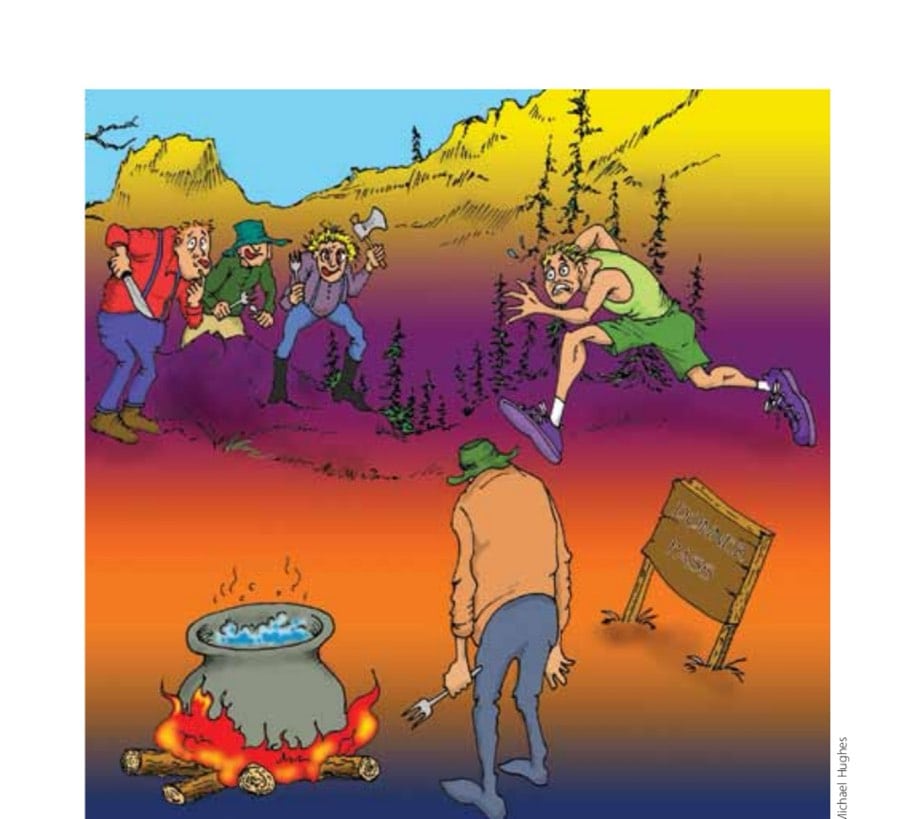
The Donner Pass Most of the race was uneventful if you consider pain and suffering pedestrian for a high-altitude marathon. I had some dicey moments, but like The Little Engine That Could, I kept saying, “I think I can, I think I can,” until I willed myself to the finish line. I do want to comment on two amusing incidents along the way. As I was running, I saw a trail marked Donner Pass. As you may recall, the Donner party was the group of pioneers that got stuck on the wrong side of the Sierra Nevada for the winter and had to resort to cannibalism (thank God I had those extra GU packets). Therefore, I took extra care not to get lost on that trail. I have had to worry about many things while running marathons, but cannibalism, at least to that point, had not been one of them.
The wildlife Another amusing moment came when I was running by myself on a single-track trail near mile 21 and saw a deer standing on the trail—a big, fat one. I was told it was a mule deer—which apparently get their name not because they are as big as a mule but because they are as stubborn. The one I encountered seemed particularly stubborn and was resistant to moving as I approached. I wasn’t exactly sure how to proceed, since the race directors never warned us about mule deer during the prerace meeting. When I got within 30 yards, I saw that he didn’t have antlers, so I lowered my head and charged. He seemed more annoyed than scared as he finally relented and bounded off the trail. But wait. If the deer didn’t have antlers, why am I referring to him as a him when he so obviously wasn’t?
Michael Hughes
The finish I finished third overall (only 33 finished the entire 26.2 miles) and was edged out by two runners, one in 3:08 and another in 3:12. I ran 3:39. (Well, OK, maybe I finished a distant third—I’m blaming it on the deer. It was his . . . er . . . her fault.) Overall, the race was an enjoyable experience, and unlike the South Park cartoon, while visiting Colorado I did not see any foulmouthed third-graders in snowcaps. Everyone was very polite.
Years later, I looked for the race results from 2003 and other years but could only assume that the race was permanently canceled. That’s a shame. I enjoyed this high-altitude marathon so much that I booked passage to Katmandu, although now that Colorado has passed the free-to-be-stoned marijuana law, I guess being high takes on a meaning separate from altitude. Mule deer without antlers are female, right?
This article originally appeared in Marathon & Beyond, Vol. 19, No. 1 (2015).
← Browse the full M&B ArchiveMore like this
1,000+ stories from 19 years of Marathon & Beyond
The complete archive of the legendary long-distance journal — digitized and free to read.
