

My New Training Partner
As far as pregnancies go, except for some morning sickness in the first and third trimesters, mine wasn’t that bad—which I attribute to my running. As my belly blossomed and my hormones raged, running kept me toned and emotionally on an even keel. I ran, did NordicTrack, or walked every day.
Running became more labored by the end, but I could still do a few miles at a comfortable pace. The morning of July 19, 2 1/2 weeks before my due date, I coached a client at the Newton [New Jersey] High School track from 8:30 to 9:30. It was the hottest day of the year, and during our mile warm-up, I was bothered by cramps. I figured I was dehydrated and was embarrassed that I couldn’t finish the mile warm-up with my female client. I had a break before my afternoon client, so I decided to combine getting some fluids and food with my errands and headed to Wal-Mart. The cramps persisted.
Part way through my Wal-Mart shopping, it occurred to me that these cramps were getting worse and coming in cycles. I had never been pregnant before, so I hustled to the baby department, found a copy of What to Expect When You’re Expecting, and looked up “contractions.” That was at about 10:00 A.M. Long story short: went home (still in denial); called my husband, who told me to call the doctor; called the doctor’s office, which said, “Get over here now!”; drove myself, now scared and timing the cramps at two minutes apart; got to the doctor’s, which got me in; water broke; husband arrived and rushed me to hospital; no time for epidural or anything; baby arrived 20 minutes later.
Nurses of 20-plus years said the delivery was one of the fastest and most intense they had ever seen. Unfortunately, the intensity took its toll in the form of my blood pressure spiking dramatically, so much so that I was readmitted to the emergency room the day after I was discharged. I don’t recall the top number, but my bottom number was 125, and I nearly died of a stroke.
For the next two months, I endured sleepless nights with a newborn that were accompanied by mandated high doses of blood-pressure medicine. Without them, my diastolic pressure was 90 or above, a far cry from my prebirth low in the 70s. I went to my cardiologist (who is also a runner) every few weeks, and he wanted me to stay on the medication. I hated how it made me feel; when I tried to run, I felt that the whole world was spinning.
TAKING MY MEDICINE—OR NOT
▲
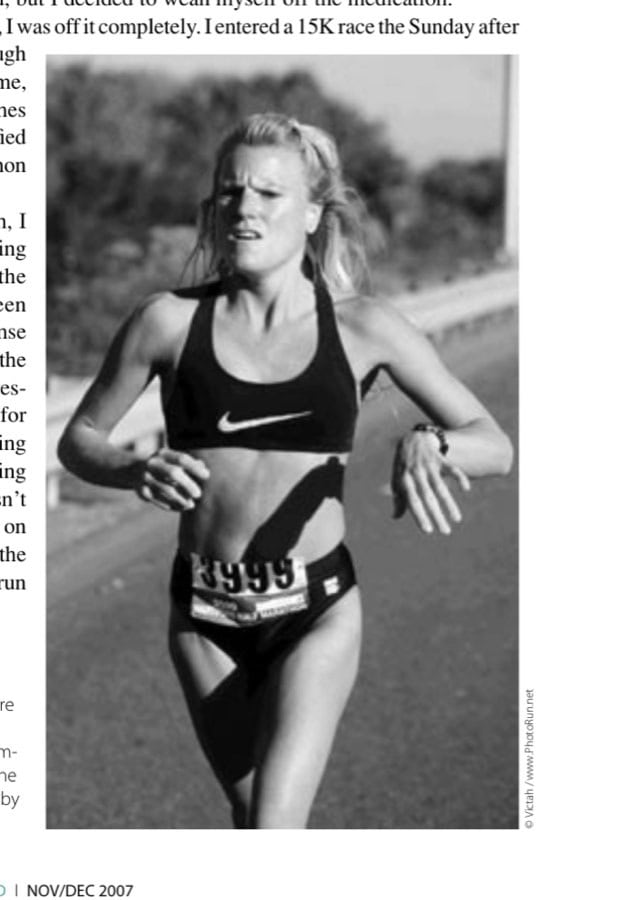
The author, shown here in the Hartford Half-Marathon, ran in the 2000 Olympic Marathon Trials just one month after being struck by a car while training.
© Victah / www.PhotoRun.net
As summer turned to fall and the leaves began changing color, I fell one day while running on the trail because of vertigo from the medicine. That was it. I don’t recommend what I did, but I decided to wean myself off the medication.
By mid-November, I was off it completely. I entered a 15K race the Sunday after Thanksgiving, and though I finished in a decent time, it was a far cry from times I ran back when I qualified for the Olympic Marathon Trials.
Before giving birth, I had planned to do a spring marathon, but after the “marathon” I had been through with the intense delivery followed by the battle of the blood pressure on top of caring for a newborn and balancing my coaching and writing jobs, I realized it wasn’t meant to be. The icing on the cake came when the marathon I planned to run was canceled.
A NEW TRAINING PARTNER My new plan was to be ready for the Long Branch Half-Marathon on April 30. I had a lot of running to do. I was determined, but the greatest strength came from the help of a great new training partner. She was different from any training partner I had had in the past. Amazingly, though she didn’t speak English very well and wasn’t a runner, her encouragement was immeasurable.
When the weather was bad, she would get me through arduous runs on the treadmill. When the weather got warmer, she rode along with me as I had to retrain my body to run up hills. I thought I could just bounce back, but that wasn’t to be. Some days I had to walk some of the uphills, but undaunted, my training partner rode along with me.
I did several runs without her on some weekends when I ran with my husband and his friends. And a few times I did a race without her. The long runs seemed to take forever compared with long runs in the past, and my 5K race times were two minutes slower than I wanted them to be, but I persevered. My training partner came to most of my races, at least as her schedule allowed, and she watched from the sidelines.
Finally, I had one hard effort left going into the April 30 half. It was the week before the race, and I knew I had to prove to myself that I could do a hard 11 miles, or I would have doubts about finishing the half. The problem was that I had to do it on the treadmill. That would be a bear to tackle.
Undaunted, my faithful training partner stayed with me through the first five miles. She had some emotional issues, but she got me through the pivotal first half of the run before she had to go. On April 30, I ran the Long Branch Half-Marathon in 1:31:39 and placed eighth female out of 1,186 in the race. It wasn’t the 1:17 I ran years ago, nor was it the pace I ran for 26.2 miles in the 2000 Olympic Marathon Trials, but it was a victory and made me thankful for my health—my blood pressure is back to
ad
▲
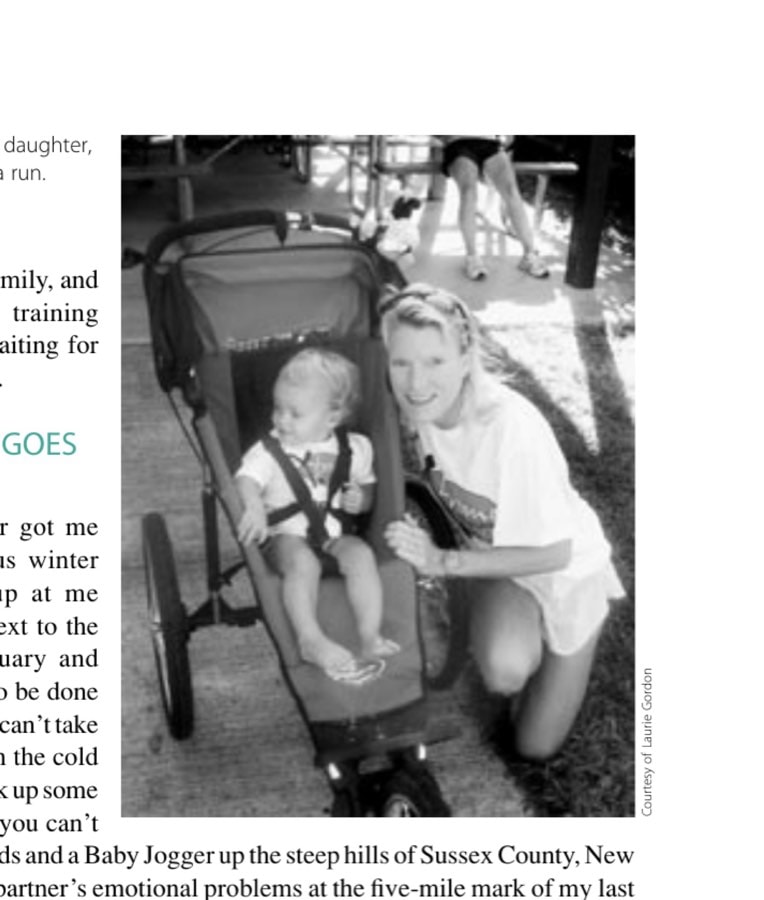
The author and her daughter, Ashley Rose, ready for a run.
106 over 73—my family, and above all, my new training partner, who was waiting for me at the finish line.
My training partner got me through the arduous winter runs by smiling up at me from her playpen next to the treadmill. The January and February runs had to be done indoors because you can’t take a 6-month-old out in the cold weather. I had to walk up some of the hills because you can’t run pushing 20 pounds and a Baby Jogger up the steep hills of Sussex County, New Jersey. My training partner’s emotional problems at the five-mile mark of my last workout were because it was her nap time, and it was time to stop the treadmill, put her in her crib, turn on the baby monitor, then resume the 11-mile run.
You see, my new running partner isn’t just anyone. She’s my baby, Ashley Rose, and I love her with all my heart. Being a new mom is a whole new world, and for any woman runner out there who thinks you can’t run and have a baby, you’re wrong. Your times may not be as fast as they used to be, but you can find the time and a way to train if you want to. You just have to be creative. If someone had told me several years ago that I could balance two jobs and a baby, I would have said “No way!” But somehow it works. Ashley comes along with me to do my interviews for the articles I write for the Herald. When my husband is working when I have clients, Ashley is there in her stroller or playpen when I train people. My life is fulfilled with Ashley Rose in it. If you set your mind to something, you can do almost anything. The determination I learned from my years of competitive running and racing is transferable to being a mom.
Courtesy of Laurie Gordon
A LITTLE SMILE GOES A LONG WAY
This article originally appeared in Marathon & Beyond, Vol. 11, No. 6 (2007).
← Browse the full M&B ArchiveMore like this
1,000+ stories from 19 years of Marathon & Beyond
The complete archive of the legendary long-distance journal — digitized and free to read.
