

Pheidippides And The Battle Of Marathon: Faq
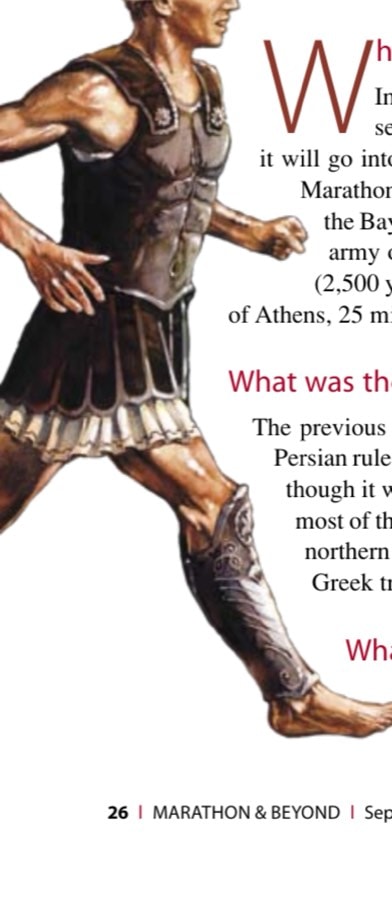
The Marathon’s 2,500th Anniversary
Pheidippides and the Battle of Marathon: FAQ Who won? Who ran? Who collapsed and died? by Roger Robinson
Why “marathon?” What does it mean?
In Greek the word means “field of fennel.” The small seaside settlement called Marathónas (that’s as near as it will go into our alphabet) is in Attica, Greece, on the plain of Marathon (where the fennel grew), a short way inland from the Bay of Marathon. The beach there is where the invading army of the Persian Empire landed in September 490 b.c. (2,500 years ago this year), intending to attack the city-state of Athens, 25 miles away.
What was the war about? The previous year, Athens had rashly supported a revolt against Persian rule by the cities of Ionia. That miffed King Darius, even though it was a fleabite against his vast empire, which covered most of the modern Middle East: Iran, Iraq, Syria, Turkey, and northern Greece. So he sent an invasion force to sort out the Greek troublemakers.
What happened in the battle? The bad guys lost. The Persians had huge numerical and technological superiority, but the small
Marathon: A Hero’s Journey
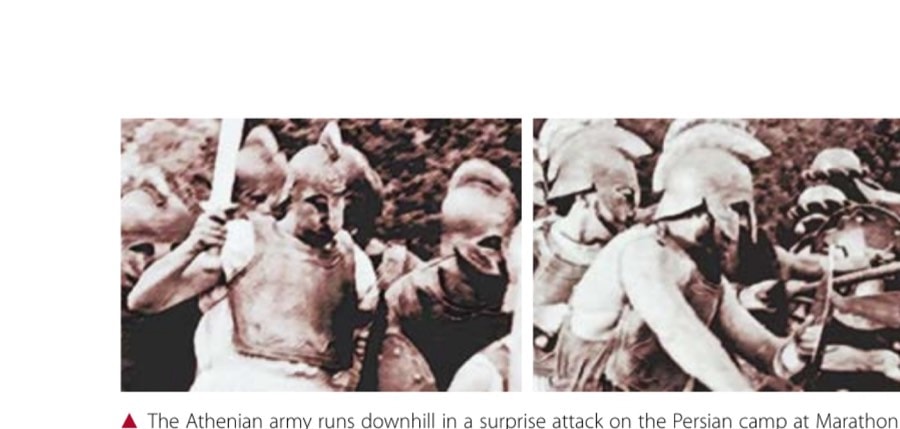
▲ The Athenian army runs downhill in a surprise attack on the Persian camp at Marathon.
Athenian army of infantry citizen-soldiers (“hoplites”) surprised them with a fast early-morning attack.
It can’t have been that simple. How did the Greek generals pull it off? Probably by attacking before the Persian cavalry was ready. The invaders had crossed the Aegean in an armada of 600 ships, some specially designed to carry lots of horses, and their main strength in battle was their horseback bow-andarrow men. Maybe the horses were being watered, or, more probably, many of them had been reembarked. The Persians thought the Athenians were dithering, as they often did, and knew they were waiting for support from Sparta. So the Persians figured they should divide their force and send part of it to sail round Cape Sounion and take Athens directly, while the main Athenian force was watching the Persian encampment at Marathon. Whatever the explanation, the Persians’ cavalry seems not to have been in action. And their long-range projectiles were useless because the Athenians moved so fast.
What does that mean? How did they move so fast? The usual hoplite method was to attack in tight-packed lines (a phalanx) using big shields and jabbing with long spears. That sounds almost mechanical, but they were also mobile when they needed to be. They were a force of free citizens, supported by slaves who carried their equipment on the march but didn’t fight. Young male citizens were educated at places that were a combination of liberal arts colleges and sports training centers called “gymnasiums.” The most famous of these were the “Academia” and the “Lyceum.” That’s where we get our words “gym” and “academic,” and the French “lycée” (grammar school).
Unlike us, the Athenians saw intellectual education and physical education as inseparable and equal, both necessary for preparing a citizen to be capable of participating in a democracy. Smart thinking. The students spent their time practicing running, jumping, and wrestling, with philosophy professors hanging about in shaded corners decorated with statues and artworks, ready to chat with them during rest periods. The result—they were smart, well informed, and disciplined; they were in great shape; and as part-time soldiers they could move fast, even carrying heavy shields. In 490 b.c. they seem to have covered about a mile down a steady slope at a fast pace, running much or all of it, and engaged the enemy with their moving wall of shields and spears before the Persians could get the artillery and cavalry into action. The Persians wore little armor—they relied on sheer numbers, on their cavalry, and on mobility, which the Athenians prevented by attacking so fast and hemming them in.
Then the Greeks had to move fast again to get back to Athens, because the bruised Persian fleet immediately sailed off to go round Cape Sounion, hoping to catch the city unprotected. Part of the fleet may have sailed even before the battle, so heading them off was urgent. Again, the in-shape Athenians made it. They must have force-marched or partly run the 25 miles, with shields and spears. All that training paid off, as it usually does. The battle and the whole campaign were to a significant extent won by running.
How convincing was the victory? The Athenians broke both Persian wings and then closed in on the center with a pincer movement, literally crushing the Persians between their big shields and causing a confused retreat to the ships. There is no doubt that it was a victory against heavy odds—10,000 against 30,000 seems a likely estimate for the rival infantry numbers, and the only support Athens had was a small force of about 1,000 from Plataea. The official casualty figures—6,400 Persians killed and only 192 Athenians—probably have an element of propaganda spin, but battles in those days often produced extremely uneven casualties, because a lot of killing was done after the fight was decided. At Marathon many Persians were speared trying to struggle out of the marshy ground at the edge of the battlefield, and no doubt any ships that didn’t get away quickly were boarded and cleaned out.
Why is the battle regarded as so important? Athens had a fledgling democracy, with all male citizens (not women or slaves) participating, and a developing culture that soon produced one of the greatest artistic and intellectual flowerings in human history. For instance, the first great playwright, Aeschylus, as a young man fought in the battle. If the Persians had
won, they were going to install a tyrant (absolute ruler under the control of the empire). They had promised the job to an Athenian traitor called Hippias, who had helped guide them to the safe landing at the beach of Marathon. He had been kicked out once, so life would have been unpleasant under his rule. Many things our modern world values—such as democracy, freedom, science, the arts, history, and sports—would have been seriously set back if the battle of Marathon had gone the other way.
So what about the runner? A running messenger (“day-runner”) named Pheidippides, or sometimes Philippides, appears in the history of the war by Herodotus, which is our only real source. Herodotus is deservedly regarded as “the father of history,” although
that doesn’t mean every story he told is strictly accurate (see below). Herodotus was not born at the time of Marathon, and his Histories (as he titled them on the outside of the roll of papyrus) were written 40 years after the battle. He did his
best, interviewing ex-soldiers, but not many of the commanders were still alive. And naturally Herodotus doesn’t give the Persian side. OK, the runner. This is what Herodotus says: “Before they left the city [to march to Marathon] the Athenian generals sent
off a message to Sparta. The messenger was an Athenian named Pheidippides, a professional long-distance messenger. . . . Pheidippides reached Sparta the day after he left Athens and delivered his message to the Spartan government. . . .
The Spartans were willing to help . . . but said they could not take the field until the moon was full” (translation de Selincourt, 1954).
Marathon: A Hero’s Journey
▲
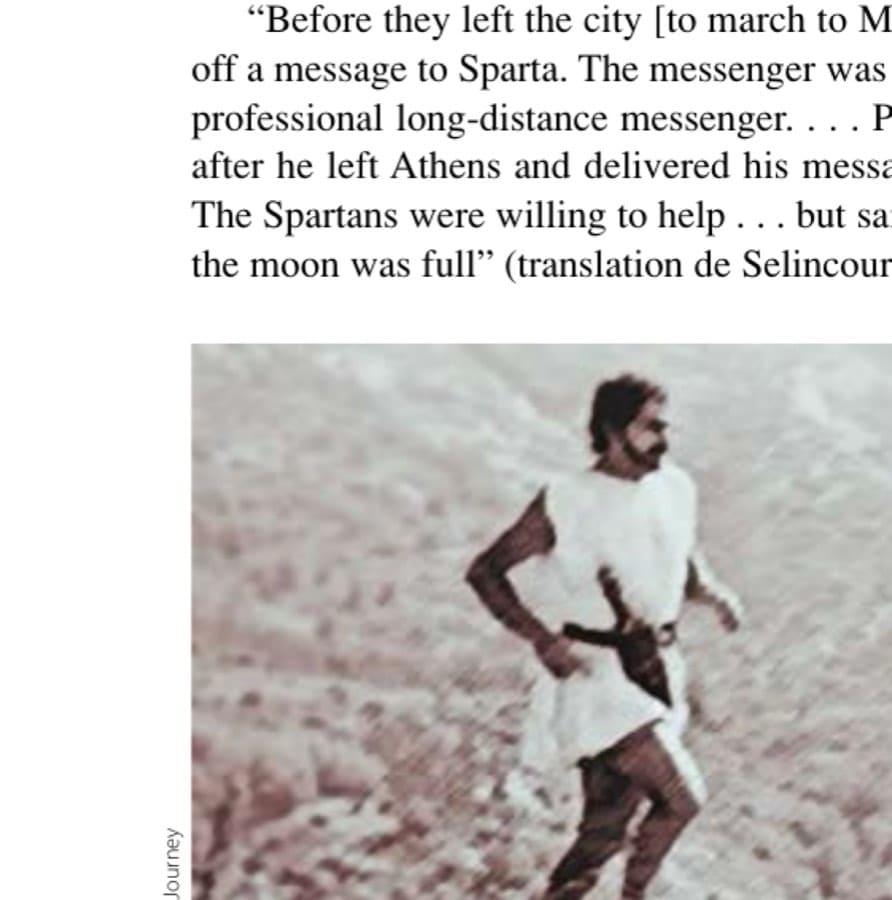
The messenger Pheidippides runs 150 miles from Athens to Sparta and back (Yiannis Kouros as Pheidippides).
Marathon: A Hero’s Journey
▲
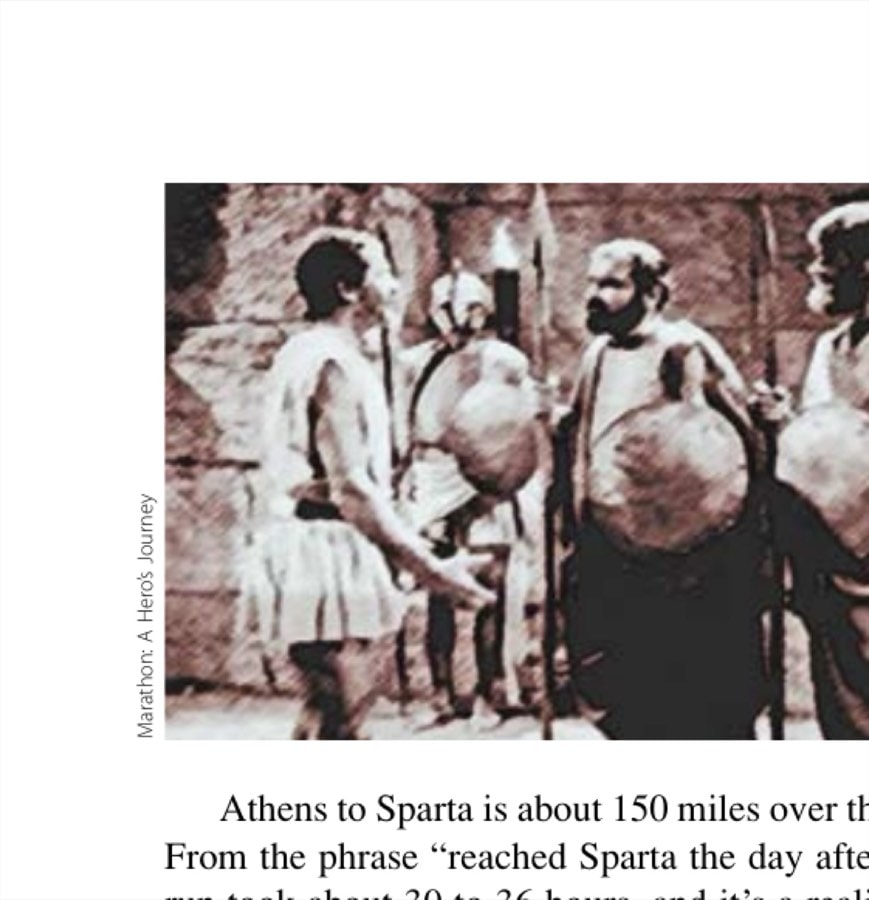
Pheidippides delivers the Athenians’ request for help, but the Spartans prefer to delay.
Athens to Sparta is about 150 miles over the hilly tracks he would have used. From the phrase “reached Sparta the day after he left Athens,” I guess that the run took about 30 to 36 hours, and it’s a realistic estimate that a highly trained ultrarunner could average about 14 minutes per mile over that ground, which he probably knew well. The generals needed help from Sparta and are likely to have sent the best guy in the messenger corps. He had to cross some territory already under Persian control and may have had to cope with brigands and wolves and so on. And he had to run all the way back, too. I’m happy to count him as a heroic figure in running history.
Is that all the running? That’s it. Pheidippides ran from Athens to Sparta and then ran back again with the bad news that the Spartans said “not just yet, thanks.” Herodotus added some colorful material, like one story of how the defector Hippias had a nasty dream the night before the battle (serves him right) and another of how the messenger Pheidippides met the god Pan on the way back from Sparta, on Mount Parthenium. That’s the part of the story that interested Herodotus most. His History reports that Pan (the half-goat god of nature) gave the runner a message to carry to the Athenians, complaining that they had been lax in their worship but promising to help in the coming battle.
What is all that about? Depending on your religious beliefs, you might think the encounter was true and significant, the deluded fantasy of a very tired and sleep-deprived runner, or a convenient invention by the Greek generals to lift troop morale when the bad news arrived that the Spartans were not going to show up. Most armies claim divine support on their own side, but there are other meanings to the story. Personally,
I like the idea that the nature god chose a runner to carry a message telling the Athenians (and all of us) to remember and respect the natural world we live in.
Didn’t Pheidippides run from the battlefield at Marathon to Athens? Someone did, for sure, but the Athenian generals are unlikely to have chosen the poor guy with the wobbly legs who had already run 300 miles almost nonstop with no sleep for four days. The message was too important, and they had a whole corps of trained messengers to choose from. They would have sent something like, “We drove them back to their ships (Yea!), but now they’re sailing round Cape Sounion, so prepare to meet an attack from that direction. We’re getting there as fast as we can.”
So who collapsed and died?
Marathon: A Hero’s Journey
Consider: these messengers were highly trained, and highly trained long-distance runners do not die after running 25 miles. If they did, this magazine would go out of business. Nor did messengers fight in the battles. That was the job of the hoplites. Messengers had to travel light, as they sometimes had to run all day, or for almost four days in the case of Pheidippides, and you can’t do that carrying a heavy shield and spear. So there are several doubtful things about the later story that tells how a messenger “ran in full armor, hot from the battle, and, bursting in at the door of the leaders of the state, could only say, ‘Greetings! We are victorious!’ and immediately fell dead.”
▲
The messenger announces the news of victory from the battle of Marathon, then falls dead.
That’s compelling stuff and would make a great movie scene, but as a literary critic, I think it sounds like inventive fiction by someone good at creating the full lurid drama.
What do you mean by “the later story”? There is one straightforward reference to Pheidippides running to Sparta, written nearly 600 years after the battle (in the Natural History, in Latin, by Pliny the Elder, a.d. 79). The first we hear of a messenger who collapsed and died is about a.d. 110, more than 600 years after Marathon. That’s like the story of Christopher Columbus showing up for the first time next week. It comes in the Moral Essays by Plutarch, who names the exhausted hero as Eucles (pronounced “Yoo-klees”) or Thersippus. Plutarch says there are different versions of the name, but the story comes from sources that had already disappeared. Note that Pheidippides is not mentioned. And Plutarch tells the same story again in a different book (Life of Aristides), but this time he says it happened after the battle of Plataea, which was 11 years later than Marathon. So forgive a little skepticism about the accuracy.
So how did the hero get switched to Pheidippides? A writer called Lucian mixed up the two stories. People mix things up all the time. I often get introduced as Roger Bannister. In about a.d. 180, Lucian was writing about the greeting “Rejoice!” (much like “Have a nice day”) and referred to “the anecdote of the runner Pheidippides, who announced the victory at Marathon . . . in these words: ‘Rejoice, we are victorious!’ And no sooner had he uttered them then he fell down dead.”
A small mistake, conflating two stories, but it stuck. The next we hear of the story is in the 1800s, a time when heroic legends from ancient Greece were fashionable. They still are. Think of all those digitalized Persians getting speared in 300 Spartans, or Brad Pitt in Troy, pumping up his biceps to try desperately to look like Achilles. In the mid 1800s, the equivalent of Hollywood-spectacle movies was narrative poetry about historical stories. I’m not kidding. Two highly entertaining action poems about Marathon were written at different times by the dynamic duo of Elizabeth Barrett Browning and Robert Browning. EBB’s teenage “The Battle of Marathon” tells only the original run to Sparta and back. But after her death, her husband, Robert, found her youthful poem and wrote his own version, focusing on the runner, and telling both stories. It’s called “Pheidippides.”
What is Browning’s poem about? Browning’s runner does it all. He is the total all-around hero. He runs to Sparta, he delivers the first message, he runs all the way back again, he meets Pan on
the way (big scene), he delivers the Spartans’ message and Pan’s, he fights in the battle (very big scene), he thinks passionately about his girlfriend (the sexand-romance interest that had been missing up to now), he gallantly asks for the honor of delivering the news of victory, he runs through the fennel fields from Marathon to Athens, and he collapses and dies, uttering the last words that have deservedly become so famous, “Rejoice, we conquer!” Those words are Browning’s, an inspired version of the original “Hail, we are victorious!” or “Have a nice day, we trashed them.” Or, since
the messenger (whoever he was) was in the military, his report probably went more like, “Permission requested to speak, sah! General Miltiades reports enemy repelled. Enemy fleet advancing round Cape Sounion. Our forces returning at full speed. Permission requested to collapse and die, sah!”
How do we get from an English poem to the first modern Olympic Games in Athens? Via a French professor of languages, Michel Bréal. Maybe there were other versions of the double story that he knew, as well as Browning’s, since he was fluent in several languages, but I haven’t found any yet. Browning’s poem was recently
ad
published (1879) and it is the most likely place where Bréal would have found the full heroic story. Anyway, in 1894 Bréal wrote to the committee organizing the first modern Olympic Games for 1896 in Athens and offered to donate a cup for “a race from Marathon” on the route of “the Greek warrior.” He didn’t give a name, but the messenger’s heroic run and death seem to have been attributed from that point on to Pheidippides, presumably because of Browning’s poem since there is no mention of it in Herodotus. And the rest, as they say, is history. Spiridon Louis won that Olympic race, giving Greece its only victory of the 1896 Games. That unleashed national ecstasy, fixed the marathon as a regular Olympic event, and inspired a visiting group from Boston to start its own “marathon race” a year later. Twelve years on, the drama of Dorando Pietri’s collapse in the 1908 London Olympics led (eventually) to the adoption of the now-standard distance of 26 miles, 385 yards. So all around the globe, millions of people every year now race (or walk) that eccentric 26.2-mile distance, which was established to honor a runner [Pietri] who completed it only after collapsing five times, receiving assistance, and getting disqualified. They race it to celebrate the famous run from the battlefield of Marathon to the senate house in Athens that Pheidippides almost certainly never did. They are inspired by the heroic courage and the dramatic death of a doomed runner who probably lived out a comfortable old age in the Athens Army Messengers’ Retirement Home. I hope so, anyway. All of which is fine. It’s a wonderful story. My wedding ring is engraved with Pheidippides’s dying words, in Browning’s version. I believed the fiction of his heroic death every time I ran a marathon. I will believe it again on October 31, when I’m in Greece to watch 12,000 runners (outnumbering the Athenian army) take part in the marathon from Marathon to Athens, the astonishing celebration by our own culture of the momentous battle 2,500 years ago. Rejoice, we conquer! Note on sources: I have drawn on many sources for this article, from Herodotus and Plutarch to Wikipedia and Colonel Warren Switzer, PhD, who advised me about battle tactics and gave me access to his library of military history. The fullest discussion of the evolution of the runner-messenger stories and of Robert Browning’s poem “Pheidippides” is in my book Running in Literature (2003). I more recently discovered “The Battle of Marathon” among Elizabeth Barrett Browning’s juvenilia. At least two books about the battle by classical historians are due to be published in 2010, but I have not yet seen them. The illustrations are from the dramatized TV documentary, “Marathon: A Hero’s Journey” (Cultural Horizons, Athens, script
by Roger Robinson), with the great Greek ultrarunner Yiannis Kouros playing Pheidippides.
This article originally appeared in Marathon & Beyond, Vol. 14, No. 5 (2010).
← Browse the full M&B ArchiveMore like this
1,000+ stories from 19 years of Marathon & Beyond
The complete archive of the legendary long-distance journal — digitized and free to read.
