

Pushing To The Finish Line
Light and darkness began to separate in the cloudless morning sky while David Slomkowski drove his gray Toyota pickup truck toward parking lot H at M&T Bank Stadium. “You know,” Slomkowski asked his veteran racing buddy riding shotgun, “we gotta race against 18,000 people today?” “
That’s no problem,” 10-year-old James Banks shot back. Slomkowski smiled. The adolescent’s retort was hardly wild-eyed enthusiasm. The duo had completed the Harrisburg, Pennsylvania, triathlon two months earlier and had even trekked 26.2 miles through Baltimore’s neighborhoods last year, so the 2008 Baltimore Marathon wasn’t anything new.
Still, anticipation for their latest adventure left both runners restless in the waking hours of Saturday, October 11. Once they parked, James cranked up the truck’s stereo, his slender index finger wheeling the black volume knob until the heated cabin vibrated, while Slomkowski untied the dark-blue carriage from the truck’s flatbed. The howling wind off the inner harbor didn’t affect some of the men and women wearing mesh tank tops and grazing on the blacktop pasture, but Bruce Springsteen pelting “Oh, Mary, don’t you weep no more!” from the Toyota’s speakers quickly drew their attention.
Forty-year-old Slomkowski seamlessly melted into the church choir refrain when he opened the passenger-side door. “Oh, James, don’t you weep no more,” he screamed, overpowering the stereo, while he slid his right arm underneath James’s knees and wrapped his left arm around the child’s back.
He placed his young frail companion in the carriage emblazoned with yellowlettered “ATHLETE” just above his head and applied the finishing touches: James’s red sunglasses, their racing bibs, and stickers denoting that they were running the full marathon. Before buckling him in completely, Slomkowski slid a gray
![ASA's founder David Slomkowski is tethered to Patrick Lewis's raft during the opening leg of the Pocomoke City [Maryland] Triathlon in May 2008.](https://marathonhandbook.com/wp-content/uploads/906134_fig4.jpg "Pushing To The Finish Line 10")
Courtesy of Athletes Serving Athletes
“Athletes Serving Athletes” T-shirt over James’s brown collared shirt. The team was now in uniform. Athletes Serving Athletes (ASA), the nonprofit organization that Slomkowski created and has operated since late 2006, strives to help physically handicapped children in Baltimore experience the thrill of the athletic experience. Beginning with the September 11, 2007, Run To Remember in downtown Baltimore, ASA has enabled over 50 disabled children to complete races that range from triathlons and marathons to shorter 5 and 10Ks. “
You’re doing something you love, but you’re doing it for someone else,” says Slomkowski, who has helped James race over 90 miles. “Just being a part of that team, I get so much back. He’s giving back to us way more than we are giving him.” * * * In his sleek black and green electronic wheelchair, James zips through the lockerlined hallways at the William S. Baer School for physically challenged children in West Baltimore the day before the marathon, exclaiming, “Look how fast I can go!”
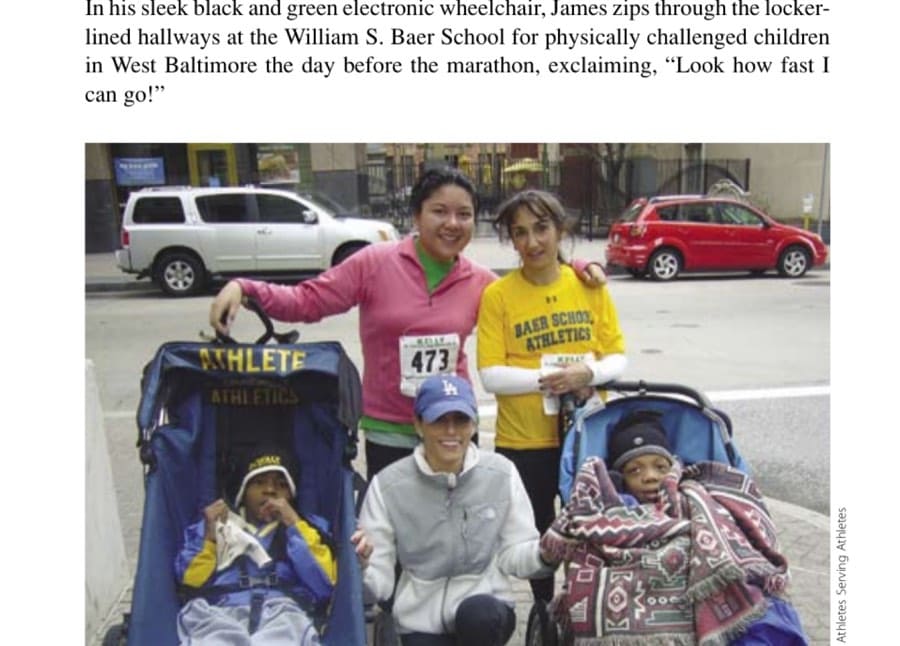
▲ Diana Desierto (pink shirt), Nancy Doran (yellow shirt), and Lauren Altman (kneeling), all teachers at the William S. Baer School, help James Banks (front left) and Tyquon Ward (front right) complete the Kelly Shamrock 5K in March 2009.
His teachers, who often revel in James’s intelligence, charm, and personality, serve as the traffic cops in their tiled thoroughfares. “Sometimes he has to be reminded he’s not on the beltway,” says James’s language-arts teacher, Bernice Davis, in a firm tone. But speed isn’t taught, it’s in your chemical makeup like your hair or eye color.
While James’s mother, Chiffon Edmunds, was pregnant with him, her husband (James’s father) crashed a stolen car while evading the police. His injuries proved fatal, but Edmunds, in the back seat, survived the crash. When paramedics arrived, they found the seatbelt wrapped tightly around her stomach. They feared that it was cutting off oxygen to her baby and rushed her to the hospital, where they induced labor. It was a miracle that James even made it into this world, and his grandmother considered him a gift from God. She calls him her “little turtledove.”
James was born with cerebral palsy and has been unable to move his legs since birth, though his handicap hardly threatens his racing aspirations. At the slightest mention of a race or Slomkowski (“My friend!” James boasts), the preteen smiles and jubilantly contorts his stiff limbs like someone riding on Space Mountain for the first time. “
James is an athlete,” says Slomkowski. “He’s ready to go 100 miles per hour.” The restricted child with an endless well of energy sometimes has trouble articulating his thoughts, but when they race, Slomkowski hears only, “Faster, Mr. Dave! Faster!” * * * Slomkowski speeds to the starting line through the crowded celebration village at the 2008 Baltimore Running Festival. The three-wheeled ASA carriage maneuvers gracefully through the diverse populace that gazes quizzically at the Caucasian muscular driver and his 10-year-old passenger. But Slomkowski enjoys the attention, mainly because he likes to stare at the other participants. The different body types, ages, and ethnicities of the racing public captivate Slomkowski. “Athletics breaks down barriers,” he says. “You can’t explain it.”
The duo has benefited from a year’s experience of racing. The 2007 Baltimore Marathon was their first race together, but they didn’t do it alone. Jeff Munson, Slomkowski’s best friend and longtime athletic companion, met the tenderfoot team at mile 15 last year and served as Slomkowski’s spotter for the remainder of the race. “
It was a pretty powerful thing seeing peoples’ faces and reactions to us pushing kids,” Munson recalls. “I can’t tell you how awesome it is seeing these kids cross the finish line. That’s something we take for granted.”
Grabbing water for Slomkowski at select points and alerting other runners to the team’s presence with calls like, “On your left,” Munson had a special view of the beginning of ASA.
Courtesy of Athletes Serving Athletes
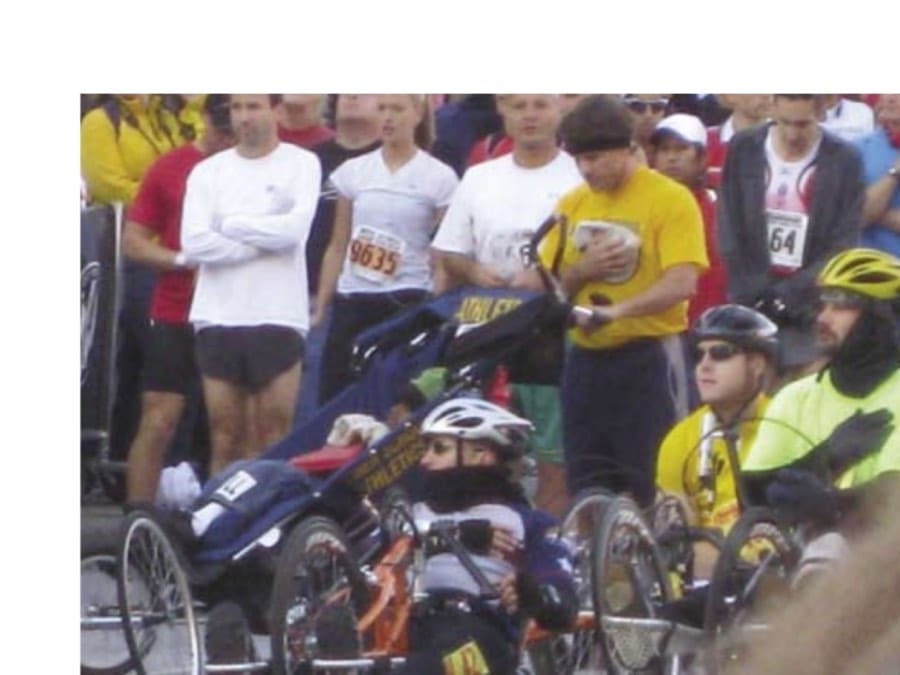
▲ David Slomkowski, James Banks, and the other runners honor the National Anthem before the start of the Baltimore Marathon.
“A certain amount of healing went on pushing James Banks last year,” Munson continued. “I think it was a turning point in David’s life. He finally saw what life was all about.” Sports have dominated Slomkowski’s calendar for most of his life. If he wasn’t pounding on the basketball courts with a few buddies or breezing along one of Maryland’s many waterways atop a pair of water skis, then he was basking in the sun at a summer lacrosse tournament or biking through mid-Atlantic woodlands.
His athletic passion drove him through DeMatha Catholic High School, where he was a multisport athlete, and Washington College [Maryland], where he was a goalie on the lacrosse team. Along the way, the victories and defeats were marked the same way. Alcohol and athletics became indelibly linked in Slomkowski’s world—he drunkenly committed to long-distance running with Munson three hours after the ball dropped during a late-’90s New Year’s celebration—and that relationship, as it often does, proved toxic. In the summer of 2006, navigating through a divorce and sharing custody of his two daughters, Slomkowski received another blow when his good friend and sports enthusiast Tommy Donahue got in a serious motorcycle accident and lost the use of his arms and legs.
▲
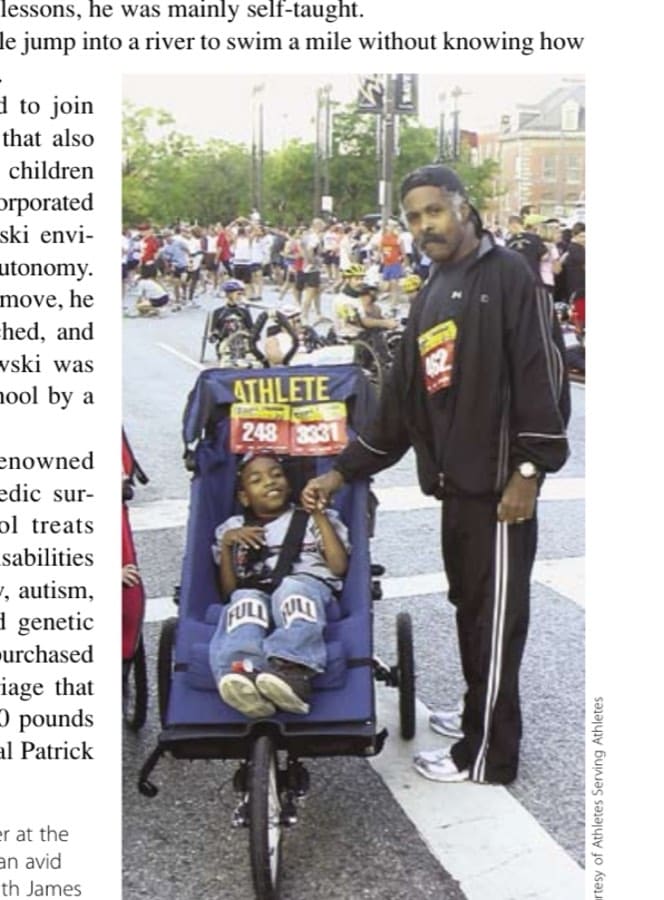
Maxwell Brooks, a teacher at the William S. Baer School and an avid runner, greets and poses with James Banks before the Baltimore Marathon.
Courtesy of Athletes Serving Athletes
The news shocked and numbed Slomkowski, like a boy falling through the ice into a lake. It was a heavy reminder of his vulnerability and frailty in this insecure world. But he didn’t turn to his debilitating habit for consolation; instead, he looked to his embattled Christian background. Slomkowski wanted to consecrate his abilities and passion, pain fueling his reaffirmation with God.
Soon after Donahue’s accident, Slomkowski discovered the story about Dick and Rick Hoyt, a father-son team that has traveled thousands of miles through different races with Dick pushing or pulling his quadriplegic son, Rick. Slomkowski loved the selfless yet empowering act of helping the handicapped experience the thrill of racing.
He jumped headfirst into this venture. In anticipation of helping people complete triathlons, Slomkowski, according to Munson, needed to learn how to swim first. And despite a few lessons, he was mainly self-taught. “
Not too many people jump into a river to swim a mile without knowing how to swim,” says Munson. Slomkowski looked to join different organizations that also work with handicapped children athletically, but none incorporated the activities Slomkowski envisioned. He also wanted autonomy. Contemplating his next move, he sought counsel, researched, and prayed. Then Slomkowski was told about the Baer School by a woman in his church.
Named after the renowned Johns Hopkins orthopedic surgeon, the Baer School treats students with various disabilities including cerebral palsy, autism, mental retardation, and genetic disorders. Slomkowski purchased an oversized baby carriage that could support up to 200 pounds and called Baer principal Patrick
Crouse in the fall of 2006 about seeing whether any of his students would be interested in racing. “David,” Crouse said to Slomkowski, “we’ve got 200 of ’em. When do you want to start?” * * * James idly waits while Slomkowski stretches in the crosswalk near the intersection of Paca Street and Washington Boulevard, the starting point of the 2008 Baltimore Marathon. A procession of public figures walks on the makeshift stage in front of Slomkowski with the race now minutes away.
The duo is joined in the crosswalk by a New Jersey man they met at last year’s race. He shakes Slomkowski’s hand, waves to James, and returns to his red dual stroller where his two blond-haired boys sit staring at the well-wishing fans. They were the only two carts to participate in this year’s marathon (a few paraplegic participants operated self-powered racers), and they led the pack of anxious runners into the deserted streets of Baltimore.
A racing maxim states: finishing is the easy part; getting to the starting line is hard. Slomkowski agrees. “It takes a lot of work to get James and others to the starting line.” Armed with a cell phone and a Web site (www.athletesservingathletes.org), this entrepreneur hustles nonstop to corral more children as participants, to create new ASA events, and to find different races—not to mention to train for the grueling contests. Slomkowski thankfully had a strong core of friends who helped buoy his efforts to form the organization. William Gould, a member of the University of Maryland’s 1975 NCAA lacrosse championship team and Slomkowski’s religious guide, and Geoff Miller, the director of athletics at Goucher College [Maryland] and Slomkowski’s athletic director when he was at Washington College, serve as ASA’s secretary and treasurer, respectively.
The organization aims to make the experience as memorable as possible for the children. So any money raised has gone back into ASA. Race fees, travel expenses, equipment costs, and embroidered uniforms are all paid for by ASA. Though Slomkowski—the founder, president, and primary racer of ASA—is clearly the center of this movement, he routinely diverts attention from himself and focuses it on the kids. On the results list at each race, only the child’s name is entered next to the final race time.
Word of ASA quickly spread through the handicapped community from the Baer School after the slew of races they ran in the fall of 2007. Mary Ann Lewis, supervisor of occupational therapy at the Maryland School for the Blind, heard of Slomkowski’s organization and placed a call for her blind, nonverbal 16-yearold son, Patrick. Slomkowski and Patrick teamed up for a 10K in Susquehanna, Pennsylvania, and then chose the Pocomoke City [Maryland] Triathlon in May 2008 as their next race. Coming in at 5 feet, 9 inches and 140 pounds, Patrick
Courtesy of Athletes Serving Athletes
▲ ASA’s founder David Slomkowski is tethered to Patrick Lewis’s raft during the opening leg of the Pocomoke City [Maryland] Triathlon in May 2008.
proved a little more challenging for Slomkowski, especially in the swimming portion where Slomkowski pulled his teammate in a raft. But they persevered, finishing second in the 1-to-19 age group; Patrick’s able-bodied younger brother, Dustin, placed first. “
From a mom’s perspective,” Mary said, speaking of her steely-eyed teenager, “it’s so neat to see him participate in a community. Dave really, genuinely cares about these kids.” “He becomes the heart and soul of the children he’s pushing,” attests Crouse. “
I’m just doing what I’m supposed to do with my blessings,” says Slomkowski. Mary considers herself a double agent for ASA. She not only uses the organization’s services but also spreads the word to families she meets. Both she and Slomkowski agree that ASA will soon venture into other athletic avenues for children with the use of adaptive equipment for soccer, baseball, and lacrosse. Also, Slomkowski would like to fund a program for handicapped war veterans and other disabled adults.
But for now, it’s running. And the explosion of cheers that Slomkowski and James hear as they wind through the city is inspiration enough. You the man, James! Way to go; keep it up, brother! These cheers inundate the duo at every turn. They loft down from the Light Street skywalk. They issue from other runners on 33rd Street. They hurl from the throngs on the home stretch on Eutaw Street. They erupt from James’s mom, grandfather, and grandmother, standing just beyond the finish line. “They make the pain worth it,” says Slomkowski.
This article originally appeared in Marathon & Beyond, Vol. 14, No. 1 (2010).
← Browse the full M&B ArchiveMore like this
1,000+ stories from 19 years of Marathon & Beyond
The complete archive of the legendary long-distance journal — digitized and free to read.
