

Ready To Hitthe Road
My flight was delayed, but I didn’t think too much about it. After all, I had all day to get from Toronto to Indianapolis. I was on my way from my sensible life (managing a software-implementation project in Canada) to my completely nonsensical life (running the inaugural Tecumseh Trail Marathon, somewhere in the hills of southern Indiana). It was already an insane endeavor; outside of Honolulu or Tucson, who had ever heard of a December marathon? I was a relative newbie—I had run only nine marathons at that point in my career— and was a bit naive about these things. What could go wrong?
Because of the flight schedules, I had been forced to budget a full day for the travel. When the flight from Toronto to Chicago was first delayed, I didn’t worry. When it was delayed again, I realized that I would probably miss my connection in Chicago, and I started to strategize about getting from Chicago to Indianapolis to Bloomington. I had no doubts that I could get to the race in time; I had plenty of running friends in Chicago who were making the trek, and I figured that, at the very least, they could help me deal with the travel from Chicago to Bloomington. But then it hit me, like a bolt out of the (cloudy) blue sky: I had broken a cardinal rule of marathoning. Every piece of running gear that I had packed for this race was checked in baggage on a flight that was starting to look very doubtful. While I might make it to Bloomington on time, suddenly I was not so sure about my bag. What the heck was I going to do?
Lucky for me, I’m a list maker, and in my trusty old Palm Pilot, I had an everexpanding marathon packing list stored in “Memos.” If my stuff did not arrive, I knew that all I had to do was consult my Pilot. Everything (well, theoretically everything) that I might need for the Saturday-morning race would be on that list. The question was whether I could replace everything in time.
What’s on Your Packing List? My packing list, like any good packing list, starts with the essentials, and as you go further down the list, you run into the “really good idea to have,” then the
“nice to have,” and finally, you reach the “everything but the kitchen sink” stuff. No matter, it’s all good stuff. Now, after completing 40 marathons, I like to think I have the packing thing down, but it’s amazing what vital things I might leave behind if I don’t look at that list. So what makes up a perfect marathon bag?
Essentials Items that are essential to getting to the starting line comprise the list of “Basics.” These are items that would be most risky—or painful—to have to replace at the last minute. That tried-and-true pair of shoes that you’ve so carefully broken in? Essential. The running bra that you know won’t chafe? Essential. The RaceReady shorts that have served you well in the last several marathons? Essential. The list of essentials is surprisingly short; these are the things that you should always carry on board the plane with you if traveling by air (my example notwithstanding). •
Shoes represent the number one essential for the packing list and the number one essential to carry on board the plane. Whether you use wellbroken-in shoes, or, like Daniel “Deeter” Dietz of Smyrna, Georgia, you
don a brand-new pair on race day, the shoes you wear for the marathon should be familiar to you. By the time race day rolls around, you will have a make and model that you know work for you over a long distance, and
those are the shoes you want to lace up early on race morning. • Choose a pair of shorts or tights that you’ve worn before on long runs and that you know won’t chafe. By race morning, you will have dealt with
any annoying, potentially chafing interior labels. If, like me, you rely on the pockets in your RaceReady shorts for gels, these shorts are essential for getting through the 26.2-mile journey. • Most women know all too well the chafing that can occur with a running
bra that is not familiar or broken in. Pack (or wear) an old, familiar Jogbra, and make sure that you take it on the plane with you.
ad
• Whether you’re male or female, you’ll need a singlet or T-shirt on which to pin your bib. Your top should be familiar and comfortable; this is another clothing item that you don’t want to chafe. • Perhaps not as important to your feet as your shoes but running a close
second is your choice of socks. Race day is not a day to experiment with those cool Injinji socks that you pick up at the expo; it’s better to have a pair of tried and tested socks that you know won’t have you limping with
blisters at mile 15. • If you run with custom orthotics, make sure that you have them installed in the shoes that you carry on. • Likewise with prescription eyewear. If you can’t see the finish line sign (
or the start line, either) without your prescription glasses or sunglasses, make sure that you have them with you when you board the plane. • Some races send out a confirmation that is required for packet pickup. This
might be a postcard (Boston Marathon), a booklet (Pikes Peak Marathon), or just an e-mail (too numerous to mention). In most cases, a photo ID will suffice. But for those races that require the confirmation for packet
pickup, this becomes another essential item. The good news about the essentials is that—other than the shoes—they can easily be packed in a Ziploc bag and shoved into a small carry-on, or even into a large purse. Many serious marathoners keep a bag with the essentials packed at all times—just in case they get an itch to run a marathon on minimal notice!
Nice To Have After you pack your essentials, what next? A large part of the answer to that question depends on whether you’re a light traveler (carry-on only; one duffel for a weekend seems like a lot of luggage to you) or someone who can’t leave home without your entire closet in tow. (Do not ask my friends and family which category I fall into.)
Your packing list will be guided by what you need to survive in an ever-changing landscape of climates. Even if the race day ends up being a bright 80 degrees and sunny, most marathons will start in cool morning hours, and many start in the dark. The minimalist packing approach calls for a large garbage bag (lawn size) and throwaway gloves (some people use old tube socks; others stock up on cheap cotton gloves at expos or at places like Target). The rest of us will pack these items, but we’ll also throw in a variety of other items: warm-up pants, long-sleeve shirt(s) (keepers to drop in a bag at the start line and throwaway shirts to ditch along the course), headband and/or running hat, fleece jacket or pullover (amazingly effective at keeping out moisture as well as cold), and running jacket. After the 2007 Boston
The marathon travel bag: for minimalists, it’s all you need. For everyone else, it’s a good start.
Marathon, I’ve given some thought to even packing a second pair of shoes; my shoes got soaked while I was waiting to board the buses at the Boston Commons, and I would have loved to have had a second, dry pair to change into at Hopkinton. Hindsight makes you wiser but also adds considerably to your packing list.
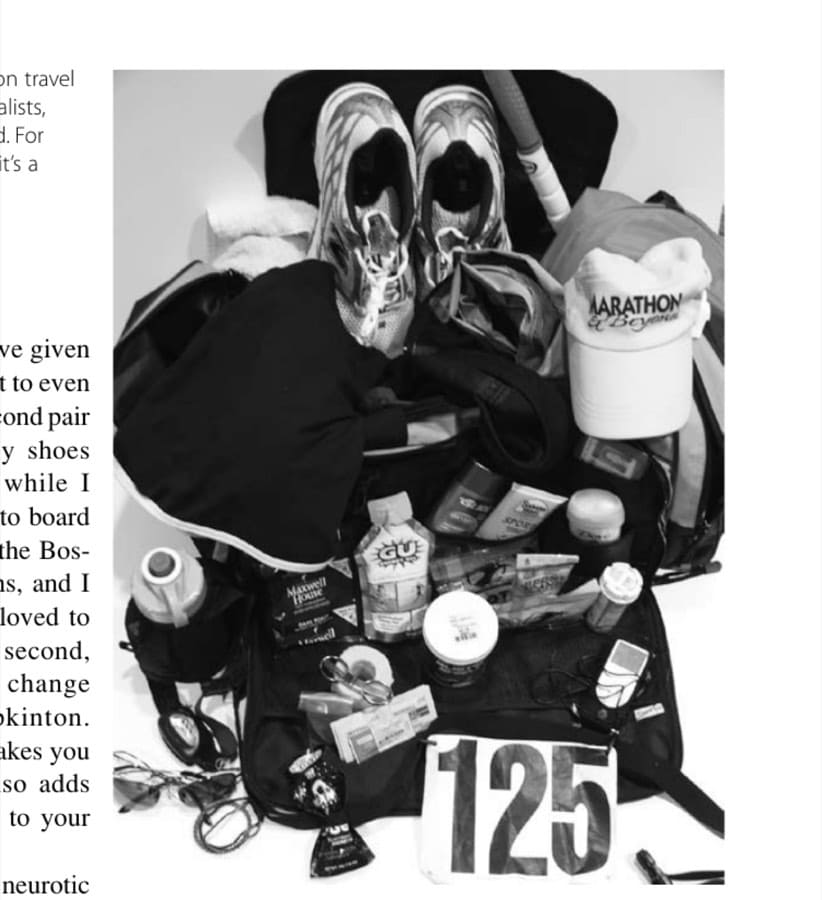
If you are neurotic about your splits and heart rate and overall time, your favorite running watch (including GPS units) and heart rate monitor will be among the first things into your suitcase. A good packing list will include a race kit that consists of a variety of nonclothing items that should be standard issue for any marathon. My list, in no particular order, includes safety pins (very easy to carry extras), lip balm, sunscreen (experiment with this before race day!), Bodyglide or Aquaphor, ibuprofen (reverentially called “Vitamin I” by my running friends) or Tylenol (preferably the eight-hour kind), Imodium, gels, Claritin, individually wrapped moisture wipes or toilet paper, Icee Hot (or similar product), spare batteries or chargers for MP3 players, and ponytail holders. These are all items that can be packed minimally.
Electronic gear seems to take up an increasing amount of space (more mental than physical) these days as I pack for marathons. In addition to standard gear like a cell phone, Blackberry, or laptop (the latter two taken primarily so that my day job does not disappear on me while I’m off on a quest to bag another state), there are a couple of near essentials that I take on every trip. My small Canon
EOS camera is great for pre- and postmarathon photos. I even carried it with me on my latest run at Boston to memorialize all my favorite spots on that course. Trumping the camera is my Brookstone battery-operated alarm clock that syncs with the U.S. atomic clock in Fort Collins, Colorado. The great advantage of the alarm clock is that—unlike hotel alarms—I know how to set it, and I know that it is very reliable. It’s a very small, easily packable item, and it provides great peace of mind. (Not to mention the fact that I also typically get a wake-up call as well as setting the alarm on my running watch. I never said that I’m not neurotic. But then again, I’ve never overslept for a marathon start. Knock on wood.)
Food, Glorious Food Ah, yes. The race advertises gels along the course, as well as electrolyte replacement fluids. Your hotel advertises a race-morning buffet. You’re golden when it comes to food. But wait. You’ve trained with yummy Chocolate Outrage GU, and the race is offering orange PowerGel on the course. You are used to blue (swimming-pool flavored) Gatorade, and the race is offering Ultima. Your hotel buffet is huge and bountiful—but since the race is on a weekend, the buffet doesn’t open until 8:00 a.m. Unfortunately, the race starts at 7:00 a.m.
If you have an iron stomach and an iron will, then you don’t have to worry about packing food for the marathon. But the rest of us normally put some thought into the food stuff that we bring to the starting line. At the bare minimum, any sustenance that you plan to take along the course—unless you usually train with PowerGel and Ultima—should travel with you, not only on your journey to the race locale, but on your 26.2-mile journey as well. It’s risky business to leave your race nutrition in the hands of volunteers (and supplies) that may or may not show up. Better to stuff your favorite gel flavors into your shorts pockets or your fuel belt.
ad
Michael Hughes
Race-morning nutrition is a little trickier, but it can be managed. Most hotels offer in-room coffee service, but if the quality of your morning joe is important, pack that small cache of Starbucks and bring it with you. If you are counting on a race-morning bagel, it’s safest to carry the bagel with you (and to hope for a fresher version from the hotel once you get there—the ducks and geese at your local pond will appreciate the stale bagel if you happen to carry one home with you). Are you an oatmeal lover? Then bring a packet of your favorite instant flavor for race morning. A banana might get squashed a bit in transit, but a squashed banana is better than no banana at all. You get the drift: if your eating plan is important to you (and it should be!), then don’t count on anyone other than yourself to provide your race-day vittles.
Everything but the Kitchen Sink There are minimalists, and then there are the rest of us. We’re the folks who can’t survive without our talismans, our favorite teddy bear, our lucky rocks.
For us, it’s often best if we drive to our races, since the list of stuff we need—in addition to the essentials and the good-to-haves—can be quite substantial. And quite unorthodox. Take Dennis Miller, from Salem, Oregon, for example. Dennis always travels with two bottles of Dead Guy Ale. He relaxes with the brew when he dips into his ice bath after each marathon. Or take Dawn Woodcox, of Redmond, Washington. Dawnie, a marathoner and triathlete, travels with her own toaster so that she has the perfectly toasted bagel on marathon morning. Or take Ariel Parrish, another marathoner and multitime Ironman who lives in the Northern California Bay Area. Ariel is a tea aficionado, so she carries her own tea-making kit with her to each event: tea, hot pot, raw sugar. Hotel-room-issue Lipton just doesn’t do it for all of us.
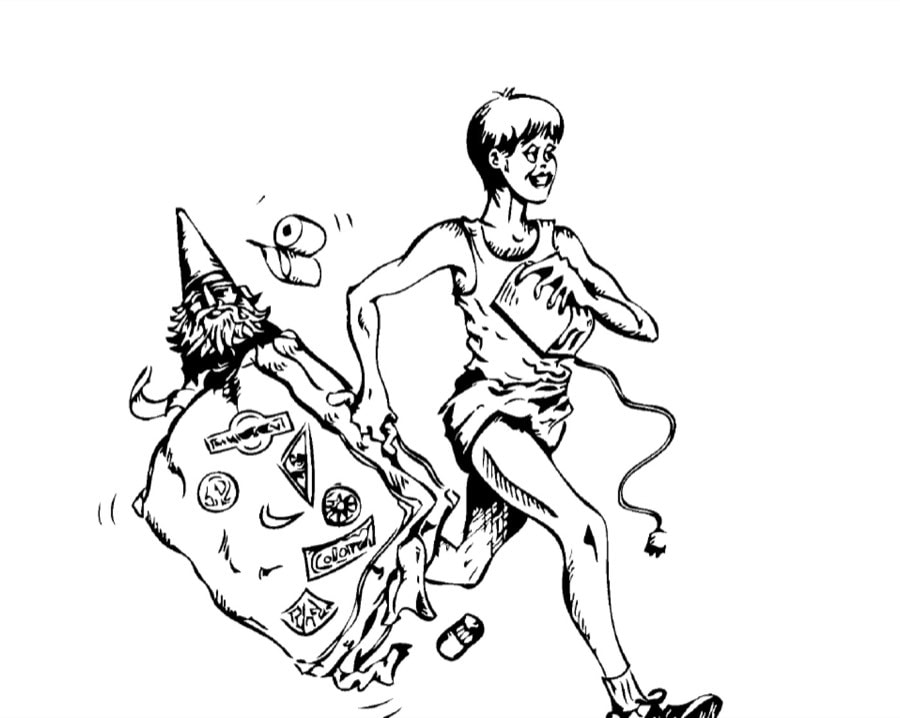
Ariel also wins the consolation prize in the contest for the most unusual race talisman packed in a marathon bag. When Ariel competed in Ironman New Zealand a few years ago, she packed the Travelocity Roaming Gnome along with all her other race gear and took photos during her journey Down Under. (Full disclosure: Ariel was employed by Travelocity at the time, so she didn’t actually have to kidnap the little fellow.) But grand prize in the contest goes to Rita Trimarchi, who took her mother’s ashes with her when she ran the Bank of America Marathon by Tampa Bay, so that she could share them with other family members after the marathon. At least her bag for the trip home was lighter.
The Airline Comes Through On that trip to the Tecumseh Trail Marathon, the airlines finally came through for me, and I was delivered to Indianapolis many hours after my originally scheduled arrival time. The plane landed, and we sat on the tarmac for what seemed like hours but what was in reality probably just a few minutes. From my cell phone, I called my friend Rick, who was picking me up, and warned him that we might need to make an emergency stop at a running store before we headed down to Bloomington. I sat on the plane and wondered about the chances that my running shoes were actually somewhere down in the cargo hold of that plane.
Rick met me exactly where he said he would be, and we made our way to baggage claim. We stood awaiting the bags to arrive, and I nervously joked about wearing my street clothes for the trail race the next morning. I have never been so happy to see a bag arrive on a baggage carousel as when my red Samsonite rolled into sight that night.
And a good thing, too. It had rained in southern Indiana, and the trails were wet and muddy the next day. It was cool and damp waiting for the race to start, and then again while waiting at the finish while all of my friends came in and gathered in the shelter house at the finish line. I was comfortable running in my
shorts and long-sleeve shirt, but I was also comfortable before and after in my warm-up pants and fleece jacket. I wore just about every stitch of clothing that I had packed.
Marathon Packing List Essentials
Electronic gear
Shoes Shorts or tights Singlet or t-shirt (non-cotton) Running bra (women) Socks Orthotics Prescription eyewear Race confirmation/packet
Watch or GPS Heart rate monitor iPod or mp3 player (check race information for allowability) Mobile phone Travel alarm clock Camera Spare batteries and chargers for all gear
Nice to Have Cold weather gear Tights Long-sleeved shirt(s), including a throwaway top Gloves Garbage bags (large lawn size) Hat, visor, or headband Warm weather gear Sunscreen ** Food Items ** Sports gels Race morning staples, such as bagels or PowerBars Powdered drink mixes Coffee or tea Packaged instant oatmeal Any other tried-and-true race-day nutritional fixes—Gummy Bears, Sharkies, gum, etc.
Miscellaneous ** Bodyglide or other lubricant Lip balm Safety pins Ibuprofen or Tylenol Claritin Icee Hot Moisture wipes Ponytail holders Paperwork, including hotel and rental car confirmations, driving instructions, phone numbers of friends you’ll be meeting **Check the TSA Web site at http://www. tsa.gov/travelers/airtravel for a comprehensive list of prohibited/permitted items. As of the date of this article, the general rule of thumb is that most gels and liquids are permitted on board airlines as long as they are in 3-oz or smaller containers.
This article originally appeared in Marathon & Beyond, Vol. 12, No. 6 (2008).
← Browse the full M&B ArchiveMore like this
1,000+ stories from 19 years of Marathon & Beyond
The complete archive of the legendary long-distance journal — digitized and free to read.
