

Revealing Look At A Streaker
Psst! Hey! Hey you! Psst, yeah, you. Come over here. Shhhhh! Hurry! Let me ask you something. Have you ever talked to a streaker before? Ever see one in action? Ever get to know one? Do you wonder: What does it feel like? Is it exhilarating? What kind of person would allow himself to become one? Why must streakers go against what’s generally accepted as normal behavior? When you see them from a distance, you look closely, and you wonder, are they nuts?
I’ll be up front with you; I’ve got nothing to hide. I’m a streaker, have been since November 2000. I’m not ashamed of it at all. I mean, why fight it? It doesn’t hurt anyone. It usually feels good. At first it felt strange. I worried: What kind of problems is this going to cause? Will I get hurt? Yet, the longer I did it, the more I liked it. Trust me; I’m not the only one around here who’s into this. There are plenty of others. Quite frankly, I think most everyone should try it. Why not? Are you surprised to hear this? Hey, keep your clothes on. It’s not really that unusual; actually it’s a natural high.
I mean, why not become a streaker and run every day of the week, every day of the month, 365 days a year? After all, streakers peel away the general adage that a body needs one or preferably two days off a week to heal. If streakers crosstrain, they do it along with, not in place of, their daily mileage. Sure, this butts up against the general body of knowledge. Are they less of a runner because of it? The naked truth is that I don’t know, but does anyone know? Do streakers injure themselves more often; are they sick more frequently than nonstreakers? Probably not, or they wouldn’t be able to maintain their streaks. My hunch is that streakers incur far fewer injuries than nonstreakers over comparable weekly distances.
I don’t have any hard data to support this claim; all I have is intuition and reasoning such as this: A streaker is like a car. It performs better if it runs every day; let it set idle for a while, and it takes longer for its engine to turn. Keep it at home for a few weeks, and it’s really tough to get it going. It might even need some type of jump-start. In a way, a person’s joints, ligaments, muscles, and cardiovascular system are similar to a car’s seals, gaskets, electrical wiring, hydraulics, and
lubrication systems. This isn’t to say that a car performs better and lasts longer if it is driven fast and over long distances every day. No, not at all! On most days, three, four, or five miles will do just fine, although a long drive once a week provides even more benefit. And every once in a while, it’s advantageous to crank up its speed, busting loose the carbon from its cylinders. Streakers, like owners of high-end cars, stay carefully attuned to subtle nuances in performance. They instinctively know when to ease off and when they can extract higher levels of effort.
THERE IS THE BODY TO CONSIDER, BUT THE MIND MATTERS, TOO Even more important than the biomechanics of running every day are the psychological effects. We sleep and eat every day. Our bodies don’t seem to mind. I can’t remember the last time I enjoyed a total day of fasting or a complete day off from sleeping. Why should our running routine be any different?
On a busy day when time is short, most Americans need the exercise more than the food. And besides, consistency is the key to developing a good habit. The best way to save money for retirement is to stash away a chunk every paycheck. The best way to stop smoking is to refrain from smoking every day. For those who are out of shape and considering the hobby of running, the best way to become and remain a real-deal runner is to run every day as if the length and quality of your life depended on it, because, in a way, it does.
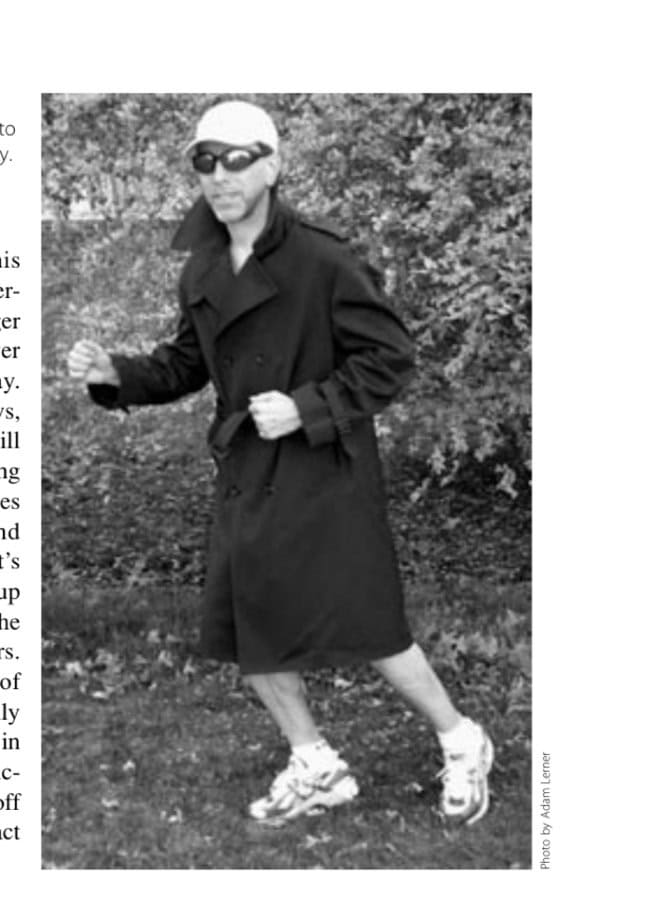
Photo by Adam Lerner
▲
Running streaker Steve Lerner set to expose himself to the faded light of another day.
There are millions of runner-wannabees and runner-use-to-bees. They liked the idea of running but could never make it a habit. They had a goal of training four days a week but could manage only two or three times because of the weather, or school, or the kids, or headaches, or stress, or the weekend—or whatever. They would run Monday and then for one reason or another miss a planned session on Wednesday and then rationalize while taking the subsequent Friday off that they would start in earnest the following Monday. Then as that Monday arrived, they noticed that it was toward the end of the month, so they would skip this day too and plan to start once again fresh on the first day of the following month. But the following Monday was in December, so then they decided to hold off until the New Year. But that New Year was 1999, so then they decided to hold off until the new millennium. You get the idea. When a novice runner doesn’t try to streak, it is easy for him or her to dream up valid reasons to skip planned runs. In reality, there are very, very few justifications for a streaker to miss his daily run. Some barely acceptable ones are imprisonment, a leg in traction, or a case of the Ebola virus. Weather conditions are not excuses unless the streaker is trapped within the snow of an avalanche flow or is temporarily immobilized in the muddy quagmire of an unexpected tidal bog. (You should still, however, move the upper torso for a while to get at least some cardiovascular exercise for the day.)
Streakers know that it is easier to attain weekly mileage goals by spreading out their training over seven days, rather than six, five, or four. Three miles a day gets them 21 miles per week; running five miles over four days gets them only 20. This is not to say that a runner should run the same distance every day of the week. There ought to be hard days and easy days; it’s just that the easy days don’t have to be total days off. Despite what some of my nonstreaking friends say, there is no such thing as a rest interval. As a general rule, a seven-day running week should consist of one long run, one short easy run, one fast run, and four comfortable runs. Under this approach, weekly mileage of 21 miles would be comprised as follows: three miles, three miles, three miles (fast), three miles, three miles, five miles (slow), and one mile. Sixty weekly miles would break down as eight miles, eight miles, eight miles (fast), eight miles, eight miles, 16 miles (slow), and four miles.
MEET A STREAKER With all this in mind, let’s take a revealing look at a streaker. Steve Lerner has not missed a day of running since the 10th of November in 1988, when President Reagan was in office, the Seoul Summer Olympics had just finished, and Rain Man was the box office smash hit. According to Steve, he must run at least one continuous mile per day to maintain his streak, although he averages much more than that—about eight miles per day. While he admits that maintaining his streak
has periodically caused him some injuries and overtraining fatigue, he feels that, all things considered, streaking has made him a better runner and person. He says his daily run is a “natural high and a cleansing process.” He credits Virginia’s Tidewater Striders Distance Series—three races in the January/February time frame at distances of 20K, 25K, and 30K—as being among his best training runs. Steve’s proudest running achievement to date has been breaking three hours in a marathon. It took him 14 tries over five and a half years to do so; he now has 60 marathons under his belt along with one 50-miler.
To maintain the streak, Steve has had to overcome adversity. While his wife was in the hospital expecting prompt delivery of his second child, Steve channeled his nervousness into a run on a nearby track while his 4-year-old son played in the infield. On other days, he would wake up at 3:00 in the morning to log in his daily run prior to boarding an early business flight. He has also run at least one mile with severely sprained ankles and pulled muscles; after injuring a hamstring halfway through a marathon in West Virginia, Steve soldiered on and managed to finish the race despite the pain. When he had the flu or a virus, he readily accepted that maintaining his streak might cause him to spit up blood. He would, however, have enough common sense to reduce the discomfort by decreasing his distance and slowing his pace, thereby proving that a streaker can be a bedrock of reason. His most serious injury occurred two years ago when he became “overzealous with recent success” and overdid his racing, hill workouts, and weekly mileage. While he managed to maintain his streak, it took him well over a year to regain his form.
While Steve’s streaking credentials are indeed impressive, some runners out there have even longer streaks or even less sense, depending on a person’s point of view. There is even an organization devoted to streakers called the United States Running Streak Association (USRSA), which was established in 2000. John Strumsky, one of America’s premier experts on running streaks, is the president. He and is wife, Dawn, maintain the organization’s Web site at http://www.runev eryday.com/. They also publish an official, quarterly newsletter called the Streak Registry. Although Steve is not a member, his determination of what constitutes a streak is remarkably similar to that of the USRSA, which requires that runners run “at least one continuous mile within each calendar day under one’s own body power (without the utilization of any type of health or mechanical aid other than prosthetic devices).” Compared with most runners, Steve’s streak is almost off the charts. After all, Strumsky estimates that less than 1/10th of 1 percent of all runners currently have streaks longer than one year. However, when compared with some of the diehard, elite runners listed on the Streak Registry (see page 102), Steve’s streak is good, but not exceptional.
For example, the longest active streakers as certified by the USRSA are as follows: Mark Covert from Lancaster, California, hasn’t missed a day since July
23, 1968; Jon Sutherland has run every day since May 26, 1969; and Jim Pearson has been streaking since February 16, 1970. The legendary Ron Hill of Great Britain, who won the Boston Marathon in 1970, has a streak that dates back over three decades. The Web site also publishes information about the longest retired streaks and streakers. Robert C. Ray of Baltimore, Maryland, has the longest stretch of certified streaking. He ran every day for 38 years and four days during the period April 4, 1967, to April 7, 2005.
Numerous insights can be gleaned from Steve’s and others’ ongoing streaks. On the plus side, running every day of the year isn’t all that hard. A person can run despite being sick with the flu or hampered by a modest injury. Most important, a runner does not physically need a day off. On the downside, streakers are no different in one regard from other runners. When they overtrain by suddenly increasing their
Official U.S.A. Active Running Streak List as Certified to the United States Running Streak Association, Inc. (Data as of December 1, 2006) Runner
Start of streak
Length of streak
35+ Years Mark Covert
07/23/68
14,011 days (38 years 132 days)
Jon Sutherland
05/26/69
13,704 days (37 years 190 days)
Jim Pearson
02/16/70
13,438 days (36 years 289 days)
Kenneth C. Young
07/06/70
13,298 days (36 years 149 days)
Stephen W. DeBoer
06/07/71
12,962 days (35 years 178 days)
12/22/71
12,764 days (34 years 346 days)
30+ Years Alex T. Galbraith David L. Hamilton
08/14/72
12,528 days (34 years 110 days)
Steve Gathje
09/25/72
12,486 days (34 years 68 days)
Walter O. Byerly
11/05/74
11,715 days (32 years 27 days)
Robert R. Kraft
01/01/75
11,658 days (31 years 335 days)
James F. Behr
03/19/75
11,581 days (31 years 258 days)
Dick Vincent
04/23/75
11,546 days (31 years 223 days)
Ronald Kmiec
11/28/75
11,327 days (31 years 4 days)
Stephen D. Reed
06/16/76
11,126 days (30 years 169 days)
Robert J. Zarambo
06/16/76
11,126 days (30 years 169 days)
William S. Stark
09/10/76
11,040 days (30 years 83 days)
Bill Anderson
09/27/76
11,023 days (30 years 65 days)
Geza Feld
10/01/76
11,019 days (30 years 61 days)
▲

Ron Hill of Great Britain, the 1970 Boston Marathon winner, has a streak that dates more than three decades.
Jeff Johnson
mileage, training pace, and/or general level of effort, their risk of injury increases. Admittedly, some daily runs are counterproductive. Even most die-hard streakers would confess that it is probably not a good decision to run if they are spewing blood or limping like an awakened mummy. And it is best to forgo the streak if a pregnant wife should insist on the presence of her husband during 24 hours of continuous labor.
THE CHALLENGE: FIND THE HAPPY MEDIUM In this yin and yang world of ours, there is probably a happy medium between running every day of our adult life and not running at all. Realistically, an attainable goal over a decade-long period might be to run daily at least 90 percent of
the time, or about 27 days a month and 325 days a year. But what the heck: If one is not spitting up blood, suffering from the flu, or otherwise feeling pain, why not run all 3,652 days of a decade? Steve Lerner plans on maintaining his habit
of running for the next 30 years (and beyond) as he enters his 80s. His advice to new runners: “Wear good shoes.” These are words of wisdom, especially to a new runner who plans on running every day for the next 18-plus years as Steve has.
Well, hello—are you still there? Have your eyes been opened? Have you been intrigued by this streaking revelation? Hey, loosen up. Don’t be shy. Discard those work clothes, bare your soul, disrobe your inhibitions, and expose yourself to the
wonders of it all. What do you say we put on our shoes; we don’t really need much else—and let’s go streaking.
This article originally appeared in Marathon & Beyond, Vol. 11, No. 2 (2007).
← Browse the full M&B ArchiveMore like this
1,000+ stories from 19 years of Marathon & Beyond
The complete archive of the legendary long-distance journal — digitized and free to read.
