

Running The Ramsay
In 1978, a Scottish mountain runner set off on an adventure in Scotland’s Central Highlands that would affix his name in history. He was attempting to complete a “round” of 24 peaks in 24 hours, linking five mountain groups and circuiting a lake for a total of 56 miles. The route entailed 28,500 feet of vertical ascent and class-four ridge climbing, ending with the iconic Ben Nevis, known as “the roof of Britain,” the highest mountain in the UK.
At 34, Charlie Ramsay was in peak condition, having excelled at “fell” or “hill running,” as the Scots call mountain running, and having scoured these ridges for years. Originally a cyclist, he took up running during a stint in England without his bike. Back in his native Edinburgh, he began training in the nearby Pentland Hills. When I met him at his home in an Edinburgh suburb in the summer of 2010, he pointed to these neon-green hills in the distance, where he still hikes religiously today. Now in his 60s, with a clean-shaven head, angular cheekbones, and infectious high energy, Charlie exudes good health and humor. We sat in his backyard, an Ordnance Survey map as big as a tablecloth spread before us, as he talked of his famous round. In the neighborhood, soldiers practiced the bagpipes for an upcoming tattoo (parade), strains of which floated our way.
Charlie initially worked in the swimming-pool business—performing safety audits, coaching, training lifeguards—alongside a gruff, curmudgeonly colleague. “He was old school and took umbrage to new people coming in.” The one thing they had in common was a passion for running. Charlie said that one day he proudly told his coworker that he could run up and down the Pentland Hills in a morning. Unimpressed, the fellow replied, “That’s nothing. There’s guys running up Ben Nevis.” “
That got me going,” Charlie said. His workplace abutted Arthur’s Seat, a camel hump in the Queen’s Park, where Charlie spent his lunch breaks, gaining and losing permutations (elevation). He entered and ran the legendary Ben Nevis Hill Race—Scotland’s oldest and today most-popular mountain run, 14 kilometers and 4,400 vertical feet—fast enough to get the attention of those in the local
Ramsay’s Round Aonach Mor
Stob a’ Choire Stob Choire Meadhoin Claurigh Stob Choire Carn Mor an Laoigh Dearg Aonach Stob Coire Beag Easain Stob Ban Sgurr Ben Choinnich Nevis Mor An Sgurr a’ Gearanach Binnein Mhaim Beag Luibeilt
Chno Dearg
evi
Loc h
nN
Glen Nevis Youth Hostel
Gle
Start
Tre ig
Fort William
sMullach nan Coirean
Sgorr an Iubhair
Binnein Sgurr Eilde Mor Stob Ban Mor Am Bodach Na Gruagaichean Stob Coire MAMORES a’ Chairn
Stob Coire Sgriodain Beinn na Lap
ch Lo
nsia
Os
Corrour Station 5 Kilometers 3 Miles
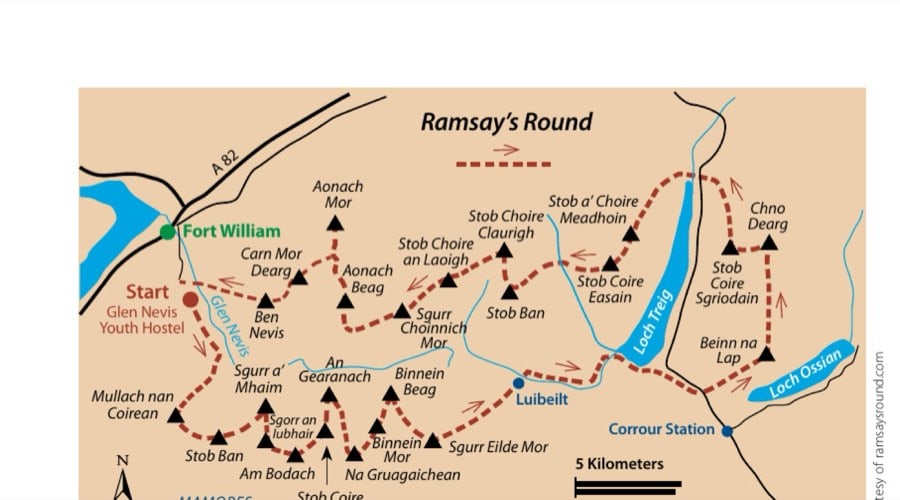
▲ A map of Ramsay’s Round.
Lochaber running club, who invited him to join their team. Though the Lochaber Athletic Club is based in Fort William, near the Nevis Range, a three-hour drive northwest of Edinburgh, Charlie became part of the Edinburgh contingent, a group of five runners that represented the club in hill races. So began his love affair with the Central Highland mountains and their unique challenges—such as the weather, which is often driech (wet).
Fort William averages 200 centimeters of rain annually, and the summit of Ben Nevis is shrouded in clouds about 300 days of the year. Between Fort William and the top of the Ben, the temperature difference is almost 20 degrees Fahrenheit, so while it might be a mild 50 degrees in town, it can be freezing up there. “Lochaber is probably the only place where you can get sunstroke and hypothermia in one day,” Charlie said. In addition, being on the west coast of Scotland, with just a few islands between them and the Atlantic, the Central Highlands take the brunt of low-pressure storms as they sweep inland. These can move in suddenly and dramatically, isolating a person in an impenetrable fog. This is how people have fatally walked off the plateau-summit of Ben Nevis, which has precipitous cliffs on both the north and south sides. Hill running, then, requires brains as much as brawn. Charlie became adept at navigating with compass and map in the pre-GPS era.
Ramsay conceives a route, then attempts it Given these conditions, the round Charlie conceived of and set out to do in 1978 required careful preparation. There was just one point where a crew could drive
Courtesy of ramsaysround.com
A82
within a mile of the route. Alternatively, someone could take a train to a remote station and hike in a mile, carrying supplies. The rest was accessible only on foot. Charlie recruited teammates from Lochaber as pacers, “more men than the Queen’s army.” As British fell runner Mark Hartell explained to me, in the UK, “the pacers are there to carry stuff, feed you—pretty much anything except pick you up and carry you.” Charlie wanted to raise money for the Lochaber Mountain Rescue Team, so the Fort William press garnered his mission some fanfare. He set off at noon on July 8, one of the longest days of the year, with clear weather and a full moon to light the way at night. Though Charlie had “reccied” the route, he had never put it all together before, much less under time constraints.
The Scots have a long tradition of hill running—the first Ben Nevis Hill Race was in 1899—and of tackling rounds of mountains. The latter perhaps is a cosmic aesthetic that has coursed in their veins since the ancient pagans erected monumental circles of stone. The way Charlie explained it, about a century ago, two explorers, Robertson and Munro, “began knocking off Munros”—that is, mountains over 3,000 feet, of which Scotland has 283. Within the limitations of weather windows, access to remote peaks, and holidays, he said, “It became an obsession to try to do as many as possible in one go.” The first “Munroist” completed a round of all the peaks over 3,000 feet in 1901. Today, there are over 1,000 Scottish Munroists, Charlie among them. One, renowned Scottish hill runner Steven Fallon, has climbed all 283 Munros 14 times and is probably working on another round of them.
In 1966, two Munroists, Blyth Wright and Philip Tranter, created Tranter’s Round, 19 Munros in a 36-mile loop around the valley of Glen Nevis with 20,600 feet of vertical gain in 24 hours. Tranter’s became, and still is, a hill runner’s holy grail. Charlie has run it “seven or eight times.” During one of these, he recalled, “I looked over at the Easains,” two peaks to the east, “and thought I could expand it.” In fact, Charlie extended Tranter’s significantly, adding five peaks across mostly off-trail wild terrain and 20 miles. In short, he created his own personal race.
Starting from the Glen Nevis Youth Hostel, Charlie ran counterclockwise, first ascending into the Mamores range, where he picked off 11 peaks in seven hours, including an out-and-back excursion on the class-four Devil’s Ridge and another out-and-back ridge climb to the peak An Gearanach. (The peaks generally have Gaelic names. When I choked on them, Charlie cordially said, “I can’t pronounce them either.”) Next he ran the long, woolly descent through heather and bog to three peaks on the east side of Loch Treig, where night fell and his pace slackened a bit. By dawn he had rounded the lake and was descending out of the Easains. Two-thirds of the distance was behind him, but eight peaks and the toughest climbs still loomed ahead, and just eight hours remained on his selfimposed clock. With clear weather and friends encouraging him, Charlie switched gears, accelerating through the next range, known as the Grey Corries.
Then came the steepest ascent, up Aonach Beag, the sixth-highest peak in Britain. “It’s so steep that when you need a rest, you can just lean your elbow against the mountainside,” he joked. From the top of Aonach Beag is an easy lope across to neighboring Aonach Mor that takes about 20 minutes, but for this section Charlie was alone and he erred, descending unnecessarily to a col and having to expend an hour climbing back up to tag Aonach Mor. “At that point, I was away with the fairies,” he recalled.
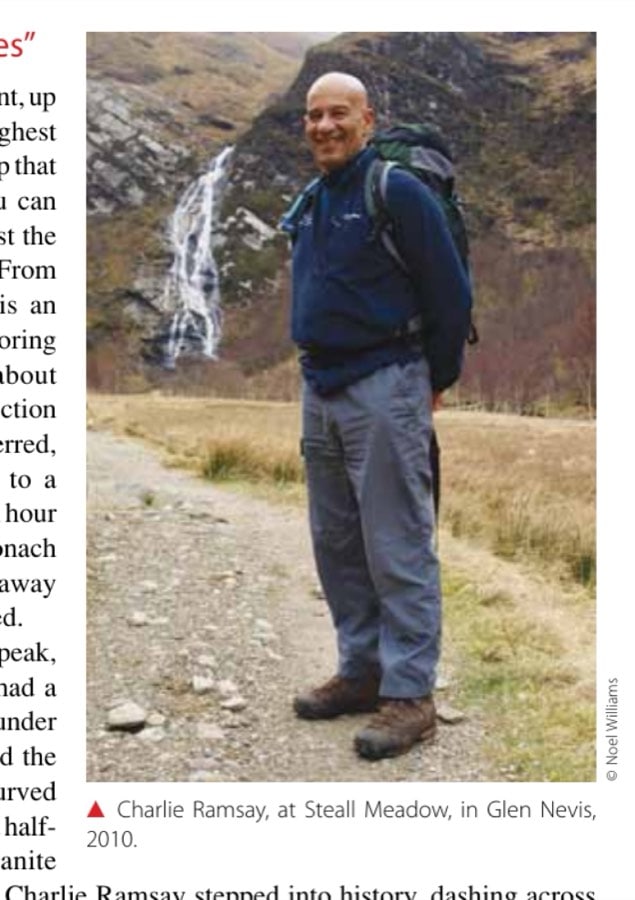
On the second-to-last peak, Carn Mor Dearg, Charlie had a mere 70 minutes to finish under 24 hours. Between him and the final Munro, Ben Nevis, curved ▲ Charlie Ramsay, at Steall Meadow, in Glen Nevis, the Carn Mor Dearg Arête, a half- 2010. mile-long exposed red-granite ridge, a no-fall zone. Here Charlie Ramsay stepped into history, dashing across the arête in 35 minutes and sprinting down the familiar steep slopes of Ben Nevis, where his hill running had first earned him glory, 4,400 feet in 33 minutes. When he stopped at the finish, the Glen Nevis Youth Hostel, where he had started this epic adventure, the clock read 23:58. A new and formidable challenge entered hill-running legend: Ramsay’s Round.
An enticing challenge . . . accepted When I committed to a family trip to Scotland in May 2010, I found Ramsay’s Round on an international ultrarunning calendar, where Charlie had posted it. That linked me to the Ramsay’s Round website, where the hallowed record of successful efforts is kept. Since 1978, just 69 people have made it around the Ramsay in 24 hours, most from the UK, three of them women. “It was particularly good to hear of international interest regarding the round,” Charlie e-mailed back then, in reply to my enquiries. “This year there have been a few injuries that have prevented success, including Anne Johnson [England’s renowned ultrarunner]
© Noel Williams
“Away with the fairies”
. . . . The two recent attempts have resulted in failure due to sickness and absolute foul weather.” Among the successful finishers, I recognized one name—Mark Hartell, a British ultrarunner whom I met briefly in the dark on the 100-mile Hardrock footrace course in 2007 while I was pacing my friend Ricky Denesik. When I e-mailed Mark, he was in the midst of marrying and honeymooning; otherwise, he said, he might have been able to come up to Scotland to pace me. I relayed to him that I live in the Colorado Rockies, had finished Hardrock myself, albeit not very fast since I had stomach flu, and ran the Utah mountain race Wasatch Front 100 in 26:30. Having won Hardrock and placed eighth at Wasatch, Mark was in a position to provide some perspective on running the Ramsay, which he did generously and in frank detail: “I don’t know if you know the Scottish highlands, weather conditions, etc., so if my answers seem patronising they are not intended to be. It’s just that I am assuming you are a tough mountain girl who has not been to Scotland. Hardrock is the closest comparison, but I would say, mile for mile, this is tougher. The Ramsay cleaves to the ridges and summits. You will encounter deep heather in parts and a lot of rocky/scree running.” In his first effort, Mark said he “took a bad fall coming off the Mamores (clockwise) after seven or eight hours that gashed my knee and ended the attempt. My successful round was solo and
Mullach nan Coirean Stob Ban
Sgurr a’ Mhaim Devil’s Ridge Sgorr an Am Bodach Iubhair
Lairig Mor
Ben Nevis
Carn Mor Dearg
Aonach Beag Aonach Mor
Binnein Mor An Garbhanach/ Na Gruagaichean An Gearanach
Coire na Ba
Kinlochleven
Penstock
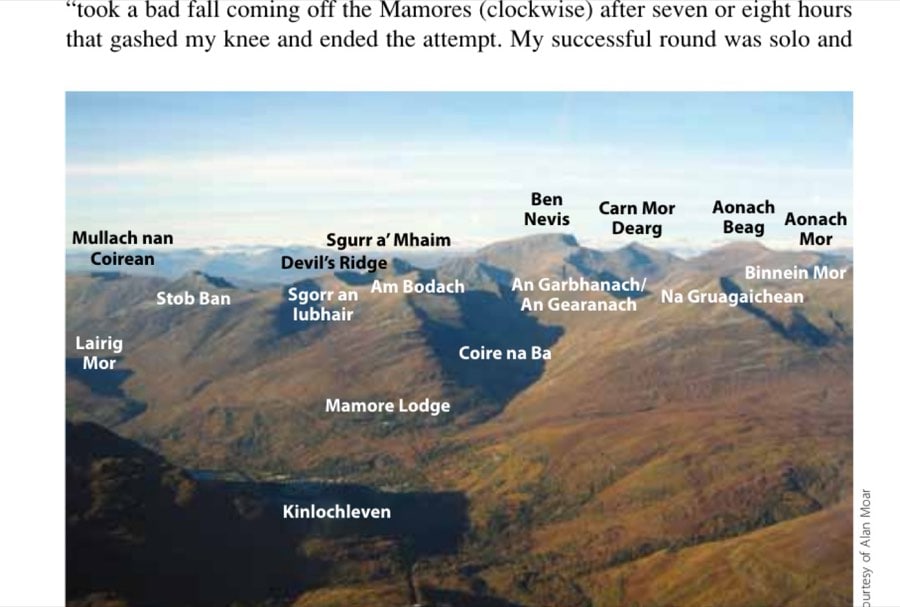
▲ An aerial view of several peaks in the Ramsay: the town, Kinlochleven, and the Mamores Range in the foreground, and Ben Nevis, the bulging high peak in the middle background.
Photo courtesy of Alan Moar
Mamore Lodge
unsupported . . . . It was close to the longest day of the year (minimal darkness) and very hot. I ate very little, got a lot dehydrated on the first day, and had really sore soles on my feet. The final descent of the Ben was purgatory.” “The route is stunning,” he said, and “likely to be and feel wilder and more remote than you will have encountered on Wasatch or Hardrock, etc. Wet rock will slow the attempt down considerably—e.g., the Carn Mor Dearg arête scramble can be awful in cloud and rain.”
Advice from a Luddite Mark relied solely on map and compass: “I am a Luddite, so no GPS.” He wrote, though there are “generally obvious trails along the ridges, some of your routes on and off tops will be . . . completely trackless sessions. Unless you know how to navigate on contours and with compass in very low visibility, you could have a lot of problems.”
Mark has run the three UK rounds, England’s Bob Graham Round, the Paddy Buckley Round in Wales, and the Ramsay. He later wrote, “I don’t want to put you off—in fact, I think it’s super exciting that you know about the round and are prepared to have a go. I do want you to go into it eyes wide open, though—of the three big rounds, it’s regarded as the toughest, and it is the most difficult to support.” He then suggested that I consider breaking the route up into a three-day excursion, staying in bothies (huts).
Though my ego bristled at Mark’s advice, he is arguably one of the most accomplished British fell runners ever, and now, with hindsight, I see its kindness and wisdom. Who knows? He might have saved my life. I am wont to venture on my own all-day solo rounds of the San Juan Mountains of Colorado, but I have also been known to take wrong ridges or drainages and to straddle downfall for miles, having missed an obvious trail in clear daylight, map in hand. Mark’s cautions gave me pause. Thereafter, I began seeking local pacers in earnest. Not surprisingly, throngs of runners were not answering my call in the fell-running cyber world, anxious to schlep my food and clothes, slog up and down scree and through bog in the dark, and keep me on course so that I could be the next victor. It was an almost ludicrous request. All that I could offer in exchange was the same hospitality in Colorado, since I live just a mile from the Hardrock course and could guide, pace, or crew a racer on this end.
In July 2010, word came from Charlie that, within days of each other, four Scotsmen joined the magic list. The first two, Alan Smith and Bruce Poll, saw a weather window and pounced, departing at 5:00 p.m. They finished in 22:47, enjoying “fantastic” conditions, the only mishap being that a wild boar apparently destroyed a cache. Alan found and packed out an antler as a Ramsay’s Round trophy. “Totally elated,” they recapped.
Richard Cunningham
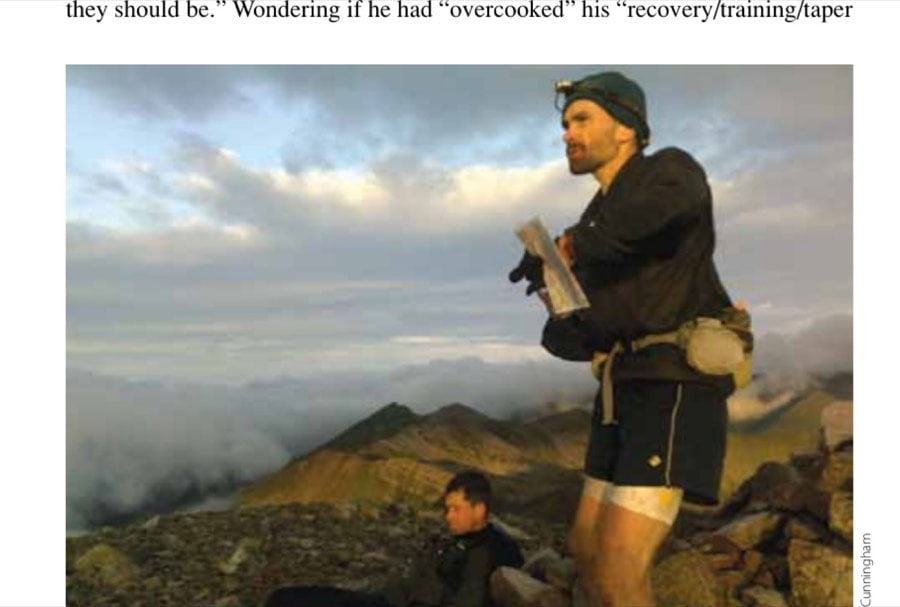
The other two, though more prepared, experienced worse weather. Following Charlie’s schedule, Peter Duggan and Jon Gay left at noon, going “anticlockwise.” In his excellent blog account, Peter wrote, “Jon and I were almost immediately subjected to a heavy shower as we ran up the forestry track towards Mullach nan Coirean,” the first peak of the Mamores. Then the weather improved, and by dark they had gained an hour on Charlie’s time in the mountains east of Loch Treig. Suddenly, though, conditions became “cold, wet, and windy,” and they were “quickly spending that precious time we’d banked with half a sole off one of Jon’s new shoes and needing repair, more clothing required for everyone and tortuous navigation.”
Though this was primarily Peter’s attempt, and Jon’s plan was to pace him around the lake as far as Fersit Dam, the one easy access point where other pacers would take over, Jon decided to keep going. In his classic, exuberant style, Peter continued, “Now, while I’d been feeling so strong and full of beans throughout the Mamores that I’d been (prematurely) imagining myself telling folk, ‘Och, it wasn’t really that hard’ . . . I’d also been conscious at times that my legs felt quite dead from the knees down and just weren’t driving me on the climbs like they should be.” Wondering if he had “overcooked” his “recovery/training/taper
▲ Jon Gay (reclining) and Peter Duggan at the top of Stob Choire Claurigh, with the Grey Corries ridge stretching out westward behind.
cycle” in the five weeks since he finished the 95-mile West Highland Way Race, Peter “began to struggle,” while Jon kept getting stronger and faster. Before dawn, Peter fell down a “short cliff,” unharmed. As they approached the daunting slope of Aonach Beag, Peter sensed his round “slipping away” and told Jon to go on ahead and complete his own. “So of course he protested that he’d feel guilty, but I said not half as guilty as I’d feel if he didn’t get it now, and that was that!” In the end, Jon finished in 23:07, Peter in 23:50. Peter concluded, “As for ‘my first and last
Ramsay’s Round,’ that means exactly what it says and, while I hope to run further Tranter’s Rounds in both summer and winter and could be persuaded to pace someone for part of the big one, I’ve no intention of ever confronting Charlie Ramsay’s monster in its entirety again.”
The team comes together In July 2010, I wrote to an e-mail contact on the Lochaber Athletic Club website. As it turned out, I had written John Hepburn of Fort William, who manages the website but who is also a serious hill runner and said he might be willing to help. Shortly before I boarded the plane for Scotland, John wrote to say Peter Duggan and Jon Gay were “keen” to assist my attempt, and John offered, “I’m happy to do any donkey work required, supply drops and meeting up at points, but these guys have the mountain experience on Ramsay’s for keeping you right on the hill.” However, they would both be available on only four days. “We could be working to fairly fine tolerances,” Peter wrote. Most
Ramsay’s Round finishers, including all the women, have run it clockwise, getting the arête and the big climbs out of the way while they were still fresh, but Charlie, Mark, Peter, and Jon had gone anticlockwise (ACW). On this point, Mark said, “I’m a traditionalist, and it’s the way Charlie went.” In an email, Peter weighed the pros and cons, and concluded, “You can’t escape the big climbs either way round. They just come in slightly different places. ACW has a logical sense of climax, culminating with the Ben.”
I arrived in Edinburgh on August 2 and the next day enjoyed a delightful lunch with Charlie and his wife, Mary, also a hill walker. He gave me some maps, and both wished me well, “fingers crossed.” I remember Charlie saying there would be “no time for phaffing about” during the round, as in no lollygagging. My family and I drove west, savoring Scotland: white houses, dark slate roofs, the smell of coal burning in fireplaces, orange Highland cattle with forelocks covering their eyes, ivy-coated country homes, rivers the color of whiskey, white waterfalls in ribbons on the green hills, perfect sunny weather.
As our tour ended, we drove to Fort William and glimpsed the massive hulk of Ben Nevis. My family left me in the valley below, Glen Nevis, where I met John Hepburn at the youth hostel, the start of the Ramsay, and we ran up to the
first peak of the round. A lean, freckled man in impeccable garb, John led the way along a forest road and then straight uphill through dense ferns and heather, setting a brisk pace. He is a beautiful, efficient runner and like most Scots, it seems, explodes on the uphill. We made it to the top in Charlie’s time, but just. The next day I met Peter Duggan at the Ben Nevis Inn, a 200-year-old stone barn converted into a restaurant. With short, gray stubble for hair and piercing eyes, Peter was at first quite reserved and serious. He asked how I had found out about the Ramsay, and when I told him the random truth, he said with a loaded look, “It’s quite coveted, you know. Not many people have done it.” I could tell Peter was sizing me up, and rightly so, as I wouldn’t want to be out on
Ramsay’s Round pacing a nutcase. He showed me his self-made map with GPS tracks and lines drawn in a red, dotted loop. We talked about various scenarios of my round and hatched a plan. “You can’t take your foot off the pedal,” Peter warned.
Every minute counts We set out on a reccie run up the valley, Peter pointing out and describing one peak after the next, with amazing precision: “If you climb directly along the ridge, there’s more scrambling; if you go on the east side, though you cover more ground, you actually save five minutes.” Four hours later, when we stopped at his car, he said, “I’m feeling rather fat and out of shape.”
Jon Gay was away south attempting the Bob Graham Round and a low pressure had moved in, so I was in a holding pattern. People of various nationalities left the youth hostel each morning on their quest to climb Ben Nevis. I would watch them outlining the zigzag path until they went out of sight over the Ben’s broad shoulder. They returned, cheeks aglow, spirits high. “Did you climb Ben Nevis?” they would ask, and I would shake my head. In the museum, I learned of all the publicity stunts and exploits on top of the Ben: a tea party, “extreme ironing,” someone hauled up and played an organ, and someone else summited in a Model T.
On our start day, a dreary rain fell out of a black sky, and I postponed. The next day was the last possible day I could attempt it, as after that John had commitments. He and a fourth pacer, Neil Arnott, and I went for a short jaunt up to Dun Deardail, once an ancient fort, now a sunken circle covered in grass and flowers. With a good view of the Ben, they analyzed the various lines down it. Neil said he broke his nose once racing off the Ben. John said one time he stepped in a bog up to his waist. “You never know when it’s going to take your weight or not.” I said I couldn’t track my splits because I didn’t have a proper watch. John gave me a funny look: “Right. You don’t have a cell phone or a watch?” They were realizing they had a country bumpkin on their hands. “I really am a runner,” I promised.
Neil Arnott
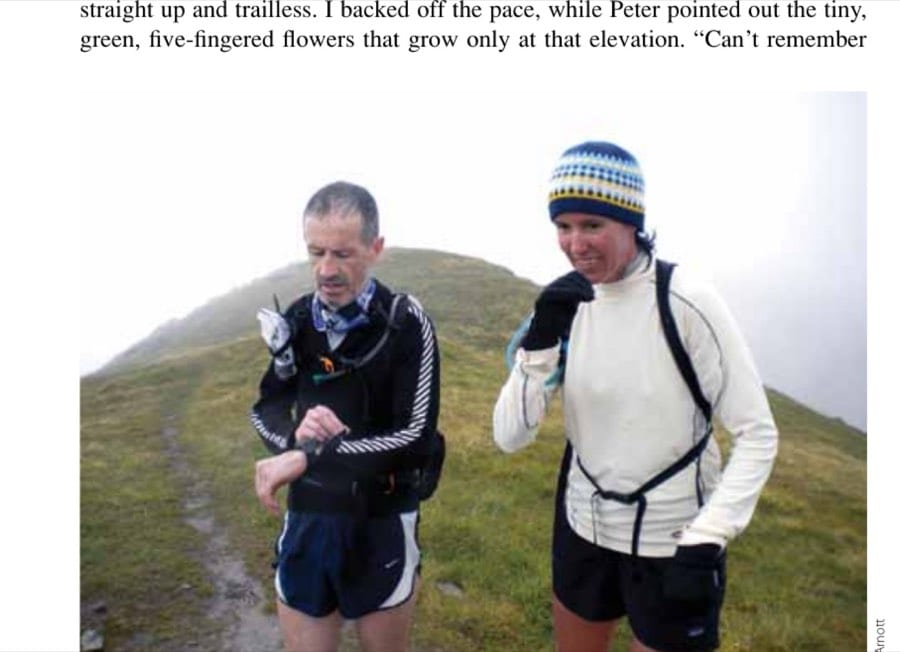
The next morning, we met at the youth hostel. The weather was calm but gray, with clouds covering the mountains. When we set off at 9:00 a.m., John, Neil, and I were all business. I admired the quartzite summit of Stob Ban and how quickly the guys could descend rough sections. Charlie had said the most technical climbing is The Devil’s Ridge, between the second and third peaks, which you have to out-and-back, but I have no recollection of it. We were gaining minutes on Charlie’s time. On the other out-and-back ridge to An Gearanach, the fog enclosed us, so that we had only occasional glimpses of our exposure high above the green slopes. There was a tense second when John slipped and caught himself.
We were on schedule and around 2:00 p.m. met Peter, who had hiked up 3,000 feet and waited on a ridge. The four of us climbed the next peak, energized by Peter’s humor. Then John and Neil set off to run six more miles down through the boggy glen to prepare a “kit” for us, pick up Jon Gay, and drive 45 minutes around to Fersit Dam to hike in a mile and meet us by 10:00 p.m. Peter maintained a running monologue the entire eight-plus hours we were together, of which I never tired. He admired the conical Binnein Beag, “a pretty mountain from every side,” but called the next one, Sgurr Eilde Mor, “a real swine.” As usual this climb was straight up and trailless. I backed off the pace, while Peter pointed out the tiny, green, five-fingered flowers that grow only at that elevation. “Can’t remember
▲ John Hepburn and Rhonda Claridge, on schedule in the Mamores.
why they’re called Alpine Lady’s Mantle, something to do with ladies’ things.” He warned me about ticks, as they carry Lyme disease, saying they were very small, and he found one once on his bum.
Out of the mist Coming off this last peak of the Mamores, we enjoyed clear views to the east: a maze of drainages with islands of purplish-orange boggy vegetation and a river channeling into the royal-blue isosceles of Loch Treig. Two red bucks trotted past, and Peter remembered we were supposed to get permission to cross there, since it was “stalking” (hunting) season. The slope was long and grassy, and we loped down it. The heather offered springy footing, though we had to watch for holes in the ground, and the bog was like wet cement. We bottomed out and crossed the river. Soon we joined an old road around the lake where I stepped up the pace, taking advantage of the easy footing. I had a 40-minute lead on Charlie and was having fun. Peter refueled on his Lucozade Sport and Jelly babies, I downed a turkey sandwich, and then we began the three Loch Treig peaks, which were hidden in clouds. The first was a long, easy ascent, but the back of it was almost a vertical wall. In the last light, I looked down into the next valley, with a silver stream snaking through it, and thought I was in the fantasy world of The Lord of the Rings. It was wilder and more remote, as Mark Hartell had said. In the moments that I stopped, however, Peter had somehow covered half the descent and was moving in time lapse, getting smaller every second. We both labored a bit on ascending Chno Dearg, where we were suddenly enveloped in rain, mist, and a shrill wind. Peter got out the compass and started reading numbers aloud. “Fuck, that’s not north. What was I thinking? That’s north!” From there, I knew we headed straight west for the third peak, but I was amazed to find that what I instinctively thought was west was actually east. Out of the mist and twilight we noticed a dark shape coming toward us, a lone hiker. He passed us wearing a big grin and said only, “Fine night for a walk.” Peter cracked up. “That was surreal,” I said.
Peter found a time-saving route off the next peak, although he wasn’t sure if it would go because of certain cliffs. Headlamps on and below the clouds, we picked our way between rock bands and soon were free and clear. By then, we could make out the three headlamps of John, Neil, and Jon, waiting at the dam. We ran for a mile in a train track, crossed the concrete of Fersit Dam, and climbed a rung ladder to join the other three.
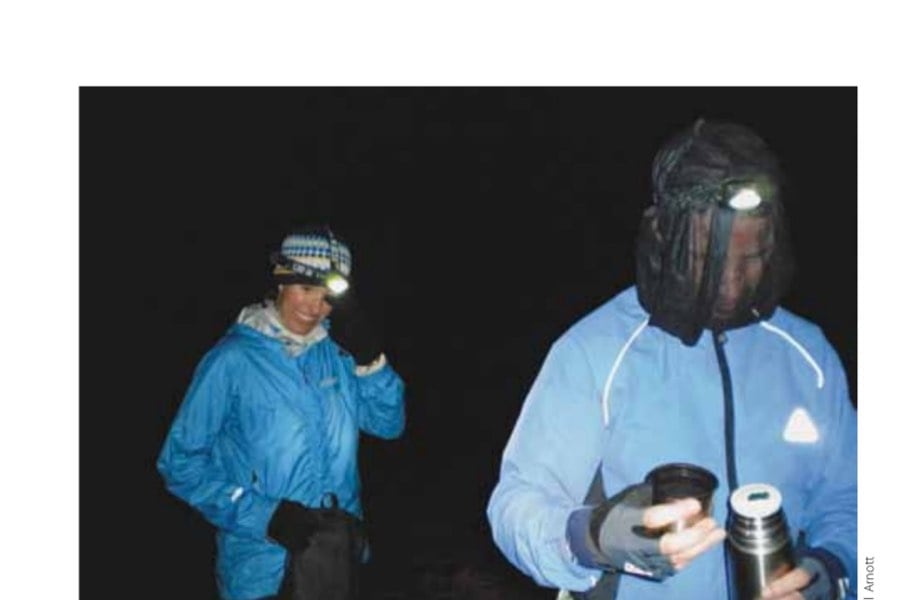
I had heard about the midges or no-see-ums, but nothing could prepare me for their intensity at my one-and-only “aid station.” The guys wore head nets, with mesh so fine that their faces were barely recognizable. The midges were thick enough that my arms parted them like curtains. I still had a 30-minute lead on
Neil Arnott
▲ After 15 hours of mountain running, the author takes a 10-minute tea break at Fersit Dam; John Hepburn wears a head net because of formidable midges.
Charlie but lost about 10 changing and preparing for the last leg with Jon. “Keep on the way you’re going and you’ll get it” were Peter’s last words as we started up the Easains.
The full Highland experience Jon and I had met for the first time that morning, and between my fatigue and his focus on navigating, we exchanged few words. It was calm and even warm at first. I mentioned the rough patch of weather Peter and I had been through after Chno Dearg. He replied, “Really?” About 15 minutes later, we were back in it: slanting mist and wind. It was nearly midnight, I had been going for 15 hours, and suddenly I was stumbling over rocks, trying to keep up with Jon, who was preoccupied himself. One time I looked up and saw total white mist and darkness, no Jon. I hollered over the wind, and it turned out he was not far in front at all.
The first peak of the Easains has a football-field summit with no features, occasional weak trails, and a small cairn marking the indistinct top, which Jon had to find. He was monitoring our distance traveled, elevation, bearings, the GPS, map, and compass. “Can you count off paces?” he asked. “Every right step. Tell me when you get to 550.” This simple task was beyond me. We were running and hiking sporadically, and occasionally he would drop down on his
knees to get a bearing. “That’s 500 . . . more or less,” I said. Finally, we stopped at a cairn. “I’m 99 percent sure this is the summit,” Jon said. (The GPS later showed he was right.) Both Jon and Peter are sailors and have at times competed at sea, so they know navigating well beyond the classes most hill runners take. In Scotland, there are even combined sailing-running endurance races in which participants sail to an island, run up a peak, sail to the next, run around it, and so forth, nonstop for three days.
We had to run down scree leaving the Easains and then find the right drainage over to the Grey Corries. Sheep and sheep shit were everywhere, and I was sure I would get giardia from taking water out of the streams (I didn’t). Jon could see I was slowing down, so at the foot of the second Stob Ban, he offered me some coffee: powdered instant in a baggy. I knocked some into my mouth and gagged it down. The next two climbs were steep, long, and arduous. I was doing the drunkensailor walk, clinging onto clumps of grass to stop myself from falling backward.
The four Corries offer a runable ridge. On his round, Charlie got here on a clear, dry morning and made excellent time. One guidebook calls the Grey Corries “a glorious stravaig” (saunter), but this was not to be my experience of them. Jon and I, now in the middle of the night, were exposed to a constant 30-mile-an-hour wind on the ridge, with heavier gusts and driving mist. At one point it began fully raining, and I worried that my headlamp would fizzle out. My morale sank. “If you’re not comfortable with this, we can go down,” I shouted. “No, no, this is good fun,” Jon replied. The temperature dropped. Once, when Jon paused to study the map, I noticed that his eyelashes were coated in ice. The foam padding in my CamelBak had absorbed the moisture and was now freezing the muscles in my back.
Rocks there are like rocks in a riverbed at home: the mossy growth makes them grippy when dry but slick as snot when wet. The pretty, white quartzite that I had admired earlier that day on Stob Ban now became my nemesis: it was slipperiest. At one point, I went down hard on one butt cheek and struggled to get up. I couldn’t run; I trotted. Jon seemed unfazed by the conditions, moving along as though he wasn’t touching the ground, though he did say it was “getting cold up here, so dig deep and let’s go.” The peaks were black cones like gloomy ship prows. Sometimes on top the two green lights of a sheep’s eyes startled me. “Don’t step to your right. There’s a cliff there,” Jon warned. When we finally descended out of the Corries, a gray dawn was breaking, and I was behind Charlie.
No match for Ramsay In the dawn light, with the weather clearing, we stood at the base of Aonach Beag, and I had to smile when I looked up it: a green tower. It was so steep that I could only sidestep and switchback, but soon we were on top and fighting the
John Hepburn
wind over to Aonach Mor. Peter had said that from Aonach Mor, I should plan on three hours for the climb up Carn Mor Dearg, the arête to Ben Nevis, and the final descent. I had just two hours, 16 minutes left. “I’m not going to make it,” I told Jon and stopped to shake out the rocks that had been in my shoes for seven hours. “It’s possible,” Jon said, sharing some of his Pyrenees honey. We topped out on Carn Mor Dearg three minutes before Charlie. Peter had emphasized how exceptional Charlie’s 35-minute arête and 33-minute descent were. Never having seen the arête and feeling somewhat inebriated, I wasn’t about to try to emulate him. Now I took my time, enjoying climbing the arête and the finest weather of the whole round. Beyond my heels, I saw the vast, green valley a few thousand feet below. I had a few “whoa” moments, without three points of contact, but the rock was bomb-proof, unlike the unreliable rubble in Colorado. I remember sensing bands of energy coursing past me that curled and snapped like flags and finding that interesting. Coming off the arête, we encountered two figures in the clouds who, I was amazed to discover, were John and Neil. They had climbed the Ben, expecting to race down it with me to the finish. As far as they could tell, it had been a calm, clear night.
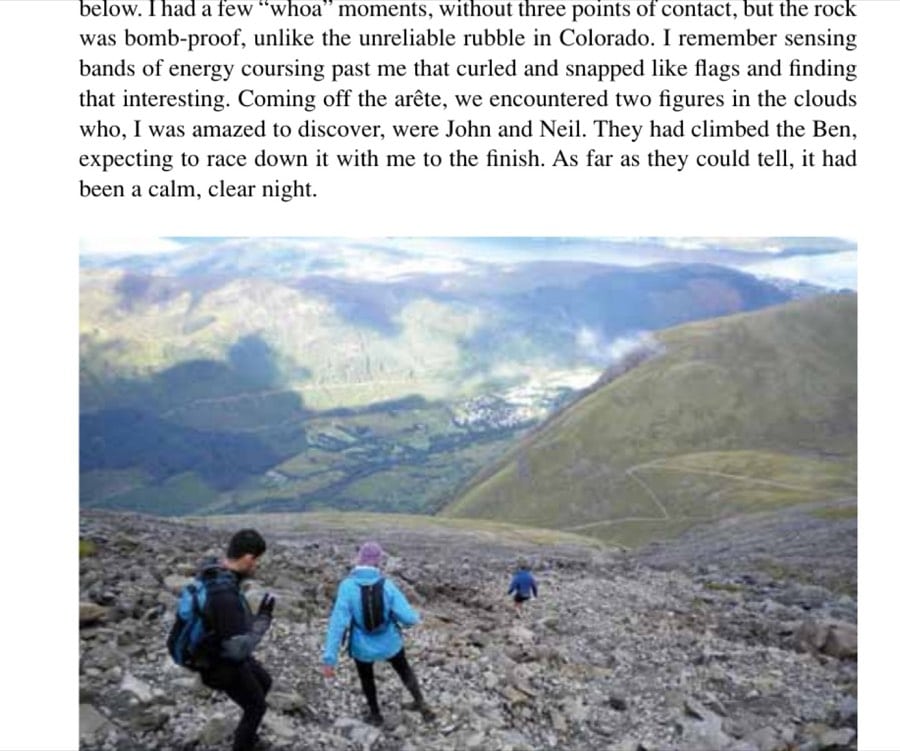
▲ Jon Gay, the author (center), and Neil Arnott, on a direct line down Ben Nevis, the highest mountain in the UK.
We summited the Ben at exactly 24 hours. I felt that I had let everybody down, and I was sorry that it was over. When we came out of the clag (clouds), the morning views of Loch Linnhe and mountains to the horizon were glorious, and I wanted to take them in, perhaps never having the chance to be there again. The guys absolutely eschewed the tourist path, leading the direct off-trail descent down the famous Red Burn and Green Wall, all the while discussing which lines were faster. Had I known Peter was waiting for us above the Red Burn or that my family had driven back to meet me at the finish, I might have moved along. Peter’s banter quickly dismissed my solemnity. Then we rejoined the path below, moving against the tide of people heading up, which Neil referred to as “the circus.” Two guys hefted bikes and one a unicycle up the trail, intending to ride them down.
I had finished the Ramsay, but it would only ever be an “attempt.” Charlie said he didn’t know how many people had attempted his round. Only the sub-24s go on the website. The guys were kind. Neil said it was a significant achievement and that I had seen more of Scotland’s hills in a day than most Scots see in a lifetime. In a later e-mail, Jon suggested that I had the women’s anticlockwise record: “Think the time aspect is academic—you achieved, and evidently enjoyed, Scotland’s most well-known round.”
For some perspective, the men’s record for the Ramsay is 18:23, and the women’s is 20:24, both set in 1989. Runners have expanded the Ramsay to 28 peaks and are vying for 30 in a day, and four have rounded it in the winter, though not under 24 hours, yet. Although I had long forgotten about the clock, Peter noted my finish at the youth hostel: 25:24. My inclination was to beat myself up, but part of me was happy. I had been extremely privileged to have a guided tour of the Ramsay with four excellent Scotsmen, and the experience had been unparalleled. A month later, Charlie e-mailed: “Mary and I were in Lochaber last weekend, wall to wall blue sky for three days. Where did you get it wrong?”
I continue to get the odd update from Charlie. In 2011, nine men successfully completed the Ramsay, including Jon Gay’s brother, Dan. This January, Jon and Dan attempted a winter round but were stymied by ice. Charlie recently wrote: “I was over in Western Isles (west of Scotland) looking at a new round on these islands. That said, they are not very high, 650 meters, but very exposed and very windy. But we are only in the initial planning stage at this time . . . .”
M&B Referral Program Did you know that we have a policy of adding an issue to your subscription when a friend subscribes to M&B because you turned him or her on to the magazine? Have your friend give us your name when he or she subscribes and we’ll tack on an extra issue to your current subscription. No limits on the number of referrals.
This article originally appeared in Marathon & Beyond, Vol. 16, No. 4 (2012).
← Browse the full M&B ArchiveMore like this
1,000+ stories from 19 years of Marathon & Beyond
The complete archive of the legendary long-distance journal — digitized and free to read.
