

Sleepless Intucson
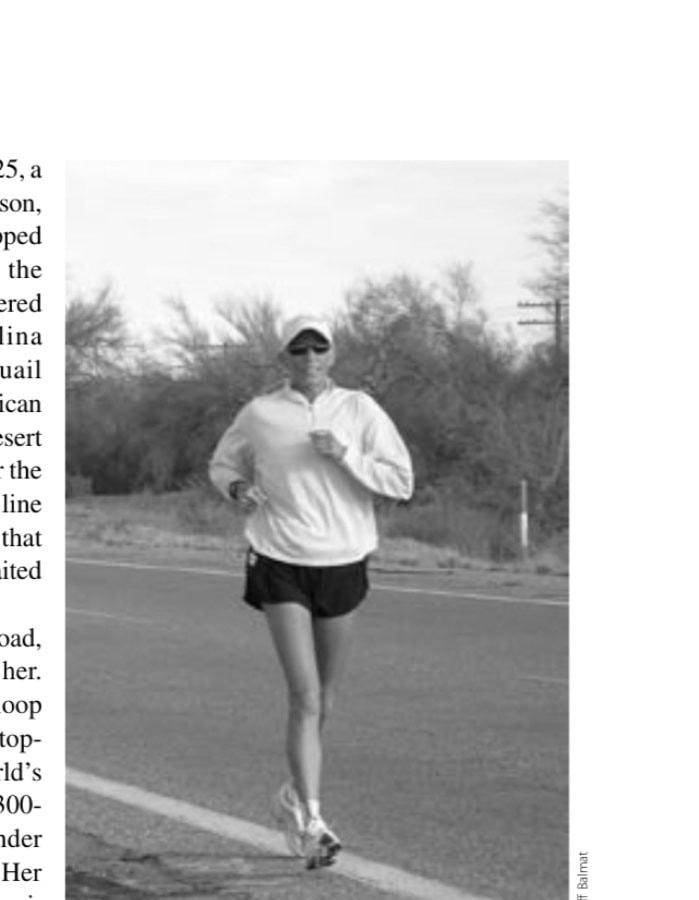
t 6:00 A.M. on March 25, a few miles north of Tucson, Arizona, the full moon slipped behind Picacho Peak. At the same time, the sun shimmered up over the Santa Catalina Mountains. Doves and quail rustled in the chaparral. Mexican poppies, fairy dusters, and desert marigolds began to open for the day. Pam Reed stood at a line drawn on the frontage road that parallels Interstate 10 and waited for the countdown to “Go.”
Her task, like the desert road, lay long and straight before her. She aimed to run a 25-mile loop course 12 times without stopping to sleep. If all the world’s a stage, this was to be a 300mile, one-woman show under the sun, moon, and stars. Her parents, Roy and Karen Saari; event organizer, Chuck Giles;
Pam Reed taking it one 25-mile loop at a time. and training partner, Susy Bacal, were all on hand for the start. “When I waited to start that first day, it felt like I had this huge thing ahead of me. I couldn’t think about it all at once. But I didn’t have any thought that I wouldn’t be able to make it,” Reed says. “I just knew I had to be patient.”
Reed and Chuck Giles picked Easter weekend because it was likely to be the last weekend of moderate temperatures in southern Arizona—the heat sets in
© Jeff Balmat
Ain April and stays until October in the Sonora Desert. It was also a weekend in which the full moon would provide illumination. And it didn’t conflict with other springtime events Reed would be running, including the London Marathon and the Boston Marathon back-to-back. Reed took her iPod to keep loneliness and boredom at bay. Headphone music has worked for her in a hundred other long runs, from Western States to the Badwater Ultramarathon. Her 16-year-old son Andrew had loaded the iPod with a variety of his favorite tunes to keep his mother moving. “I know U2 was on there, but I couldn’t really identify the other music,” Reed says. “But it was good, whatever it was.”
LAYING OUT THE PLAN With 300 miles as her goal, Reed envisioned a simple scenario. Go 12 1/2 miles south, check in with the timekeeper, come back 12 1/2 miles. Listen to iPod music. Drink Ensure. Try not to get blisters.
It was a grueling but comparatively straightforward agenda for Reed, who in addition to putting on the Tucson Marathon also oversees a household of five sons and stepsons ranging in age from 9 to 20 and also gives talks on the role of women in sports. Chuck Giles, who crewed for Reed in the last three Badwater ultramarathons, says, “I wasn’t worried that she wouldn’t make it, but I was kind of afraid I might be ready to retire before she came across the finish line. Pam has no major biomechanical problems, and she never considers the possibility that she can’t do something. I had no reservations about her ability to get the job done.”
Reed knows what’s involved, physically and mentally, in running extreme distances. In the past 13 years, she has run over 100 ultramarathons, including all the big ones in the mountainous West plus several in the East. She has run 120 marathons, several of them, such as Boston, twice in the same day. In 2002 and 2003, she was the outright winner of Badwater, training in the summer in Tucson to condition herself for Death Valley temperatures. She has run 139 miles in 24 hours and 210 miles in 48 hours, competing for the U.S. women’s ultramarathon team in France in the latter event.
But she hadn’t done 300 miles in one fell swoop. Nobody had. Even the pedestriennes of the 19th century took a week to accumulate that many miles. Chuck Giles said “Go,” and Reed took her show on the road, with Giles providing leapfrog support in his van.
Funny things happen in the desert. By mile 25, Reed’s simple scenario got complicated. The sportswriter for Tucson’s morning paper had done a column on the event, and people began to show up—people from all over southern Arizona and as far away as Wisconsin. Some knew Pam Reed well. Many didn’t but wanted to find out what this long-running woman was made of. To some she was
© Jeff Balmat
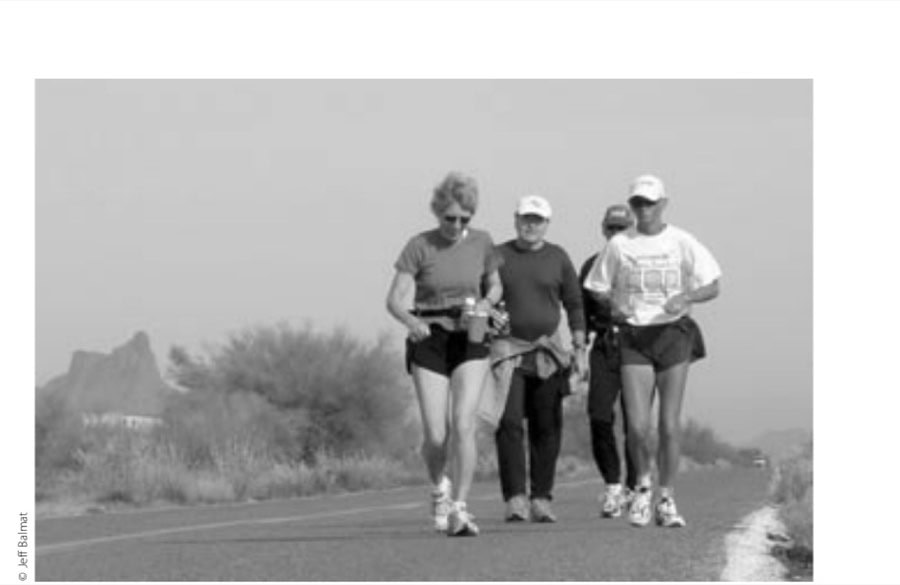
Melinda Bodell (front left) and friends converse with and around Reed (white shirt).
a curiosity, to others an inspiration, and to others, someone to be entertained by as they did their own weekend training run. Because of the public statement of her intent, some thought they might witness a full-tilt catastrophe. Others thought anybody could cover 300 miles with the right training.
IT ISN’T JUST ABOUT THE RUN Thus began the multitasking of the long-distance runner. Reed became a moving magnet around which social clusters formed and reformed. The cast of characters over the weekend included a Presbyterian minister, two nurses, a dermatologist,
a carpenter, an English professor, a judge, a medical secretary, a termite expert, a freelance writer, a mortgage consultant, a college administrator, two schoolteachers, an acupuncturist, a concert pianist, a graduate student in environmental
policy, a soccer coach, a soccer mom, an astronomer, a Moroccan runner from Flagstaff, friends of friends in Colorado, and Pam’s sons Timothy and Andrew Koski and Jackson Reed. Many of the fellow runners are veteran marathoners. Several are accomplished
ultrarunners themselves, achievers accustomed to pushing themselves mentally and physically, but virtually none of them had supported an athlete in an endurance event. Individually and collectively, they learned by doing, and at first the learning curve was steep.
“Pam, what can I give you?” Clay Mottaz asked on Friday morning. “I’d like some ice in a cup,” Reed said. Mottaz ran to the van, got a cup full of ice from the cooler, and ran to catch up with his runner, who by that time was half a mile ahead. By the time he caught her, most of the ice had bounced out and melted on the pavement. Next time he got only half a cup.
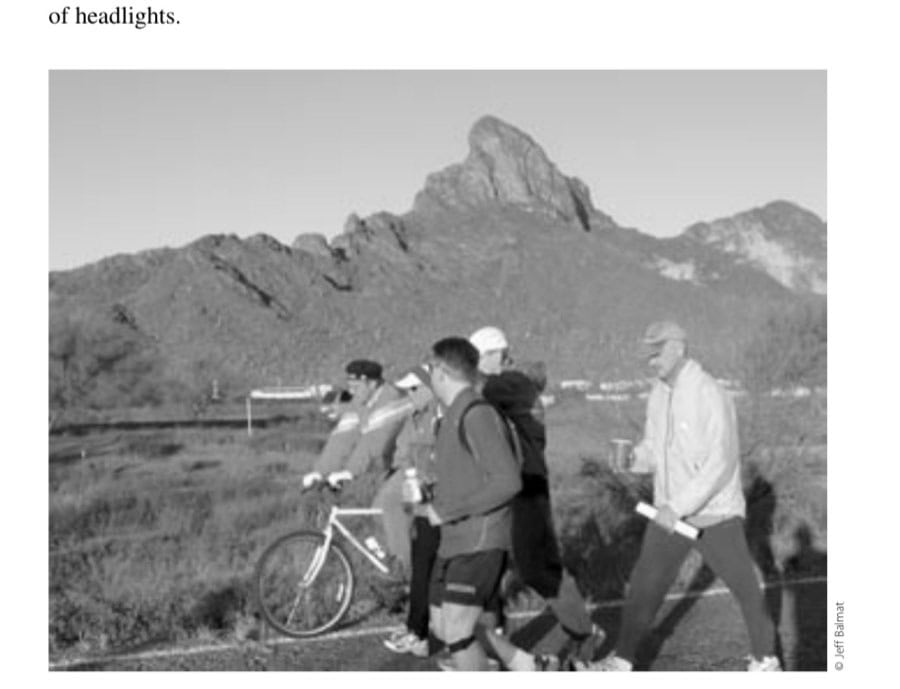
As the first day turned into night, a kind of oral tradition emerged as runners left and other runners took their place. The tribe’s password was “Ensure.” Meanwhile, Reed kept running. “The first night was tough. It was cold and I was afraid I’d gone out too fast during the first 50 miles,” Reed says. Her mother made her noodles at midnight, and her father took over driving the support van. Fellow runners carried Ensure, applesauce, and horchata, the almond milk drink popular in the Sonora desert. Runners also kept an eye out for cars on the frontage road. In the darkness, it was difficult to tell whether headlights were coming straight at them from frontage road traffic or merely glancing sideways from cars on I-10.
When the sun came up on Saturday, everyone felt better. Throughout the second day, various fellow travelers handed out samples of sunscreen, passed Pam cups of ice, did mountain-bike wheelies among the cactus, reminded Pam to drink her Ensure, made a homemade “You go, girl” sign on a piece of cardboard they found along the side of the road, honked rhythmically from the freeway, passed Pam cups of ice, and drove over to Marana to buy a turkey sandwich.
INTO THE SECOND NIGHT On Saturday, the temperatures approached 80 degrees. Sunburned but still gregarious, the pageant headed into the second dark and chilly night. Roy Saari and his grandson Tim Koski drove the support van while Karen Saari presided over noodles. A breeze came up and the temperature dropped to the low 40s. The nighttime contingent reminded Reed to drink Ensure, fetched a jacket and gloves from the van, passed Reed spoonfuls of applesauce without spilling it, and gave her papaya enzyme for stomach upsets. There was also some spontaneous singing of classic rock, at which point Reed reactivated her iPod.
On Sunday morning, Roy Saari got out the Windex and a paper towel and cleaned the windows of the motor home at the north end of the loop. Then he went back and wiped off the dust motes that had settled as he worked. He was tired after his two nights driving the van, but he found it difficult to rest with his daughter still on the road. His wife, dressed in a fresh outfit of green slacks and a striped blouse, chatted vivaciously with bystanders and kept an eye out for her daughter. “She’s thinking about doing Badwater again. I want her to rest after this and not do the Arizona Ironman—but when do kids ever listen to their mothers?” Karen Saari asked, as if she were having a conversation about an ordinary kid. [Reed subsequently decided to watch, not run, the Iron man.]
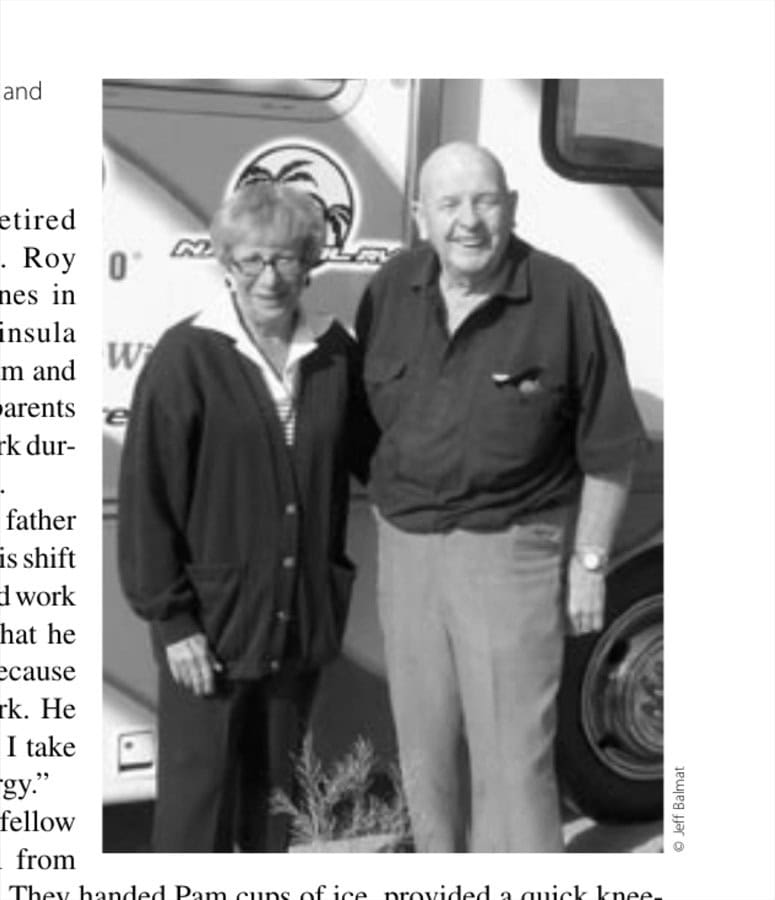
Karen Saari is a retired nursing home director. Roy Saari worked in the mines in Michigan’s Upper Peninsula where their daughters, Pam and Debbie, were born. Both parents set an example of hard work during their children’s youth.
Pam Reed says, “My father used to come home from his shift at the mine and then do yard work for several hours. After that he would make us dinner, because my mom was still at work. He always kept busy. I think I take after him in terms of energy.” The Sunday group of fellow runners learned the drill from the Saturday night group. They handed Pam cups of ice, provided a quick kneepressure point massage, and planted not-so-subliminal messages about drinking Ensure. They handed Pam cups of grapefruit juice and Orangina. Again, someone was sent off to Marana to buy a turkey sandwich. Throughout the day, several of them pointed out aerobatic airplanes looping smoke rings into the sky above the desert, but Reed, now focused solely on the road, didn’t look up. Runners who came and went fetched cups of ice. They waved to the crew of a passing train and discussed the demise of passenger trains. On Sunday afternoon, several of them took a vote and decided Reed’s favorite flavor is ice. A bicyclist who had come out to see the show got a flat tire and ended up running a couple of miles. Meanwhile, Reed kept running.
THE RUNNER IS INCIDENTAL TO THE CONVERSATION Strangers running on either side of Reed introduced themselves to each other. The running conversation ran from living wills to classical women composers to the Resurrection to the identification of various wildflowers along the route to the various charms of Cleveland versus Tucson. People discovered they had gone to the same college, or their children had, or they had run in the same marathon in Seattle 20 years earlier.
© Jeff Balmat
Pam Reed’s parents, Karen and Roy Saari, at mile 200.
© Jeff Balmat
As the conversation swirled around her, Reed said, “Thanks for coming out,” and “Yes, please,” and “It’s good to meet you,” and listened or maybe didn’t, but in any case kept running. Throughout the weekend, Stacy Weisner kept busy in the RV at the north end of the loop. Weisner counted laps and kept the snack table stocked. She also sewed several basket covers for her husband’s gift-basket business and brushed up on her knitting. Weisner works for Chuck Giles in his other career as a Tucson attorney. “She’s great at sitting still,” he says, by which he means Weisner has been his office mainstay for 20 years. But Weisner is also a cancer survivor, and her story of courage made its way into the collective conversation.
On Sunday night, as Reed completed 250 miles and headed toward the south end of the course, the temperature dropped again. Thanks to the purposeful consumption of Ensure and Red Bull during the afternoon, she felt alert and chatty. With work to go to on Monday morning, the group of runners thinned. Beverly Schulz, a retired computer tech, ran with Pam in the wee hours. “She was more alert than I was,” Schulz says. Traffic on the frontage road again forced Reed and Schulz to run from one side to the other in an effort to avoid the blinding glare of headlights.
Sunrise at Picacho Peak, Arizona.
Doug Kelly, a telescope engineer, showed up to run the late-night/early-morning shift. Kelly says, “You might think, with a pace that slowed to 3 miles per hour on Monday morning, that she did a lot of walking, but that wasn’t true. She kept rising up on her toes in a running stride with a cadence that was quite brisk, although her stride length got really short.” “
From mile 250 to mile 275, I learned the most important lesson about eating enough,” Reed says. “My legs weren’t tired, but I felt low overall when I didn’t take in enough fuel. Ensure worked the best, and the instant oatmeal went down easy, too. I drank so many different things, it got hard to find something that still tasted good.”
WITH AN END IN SIGHT
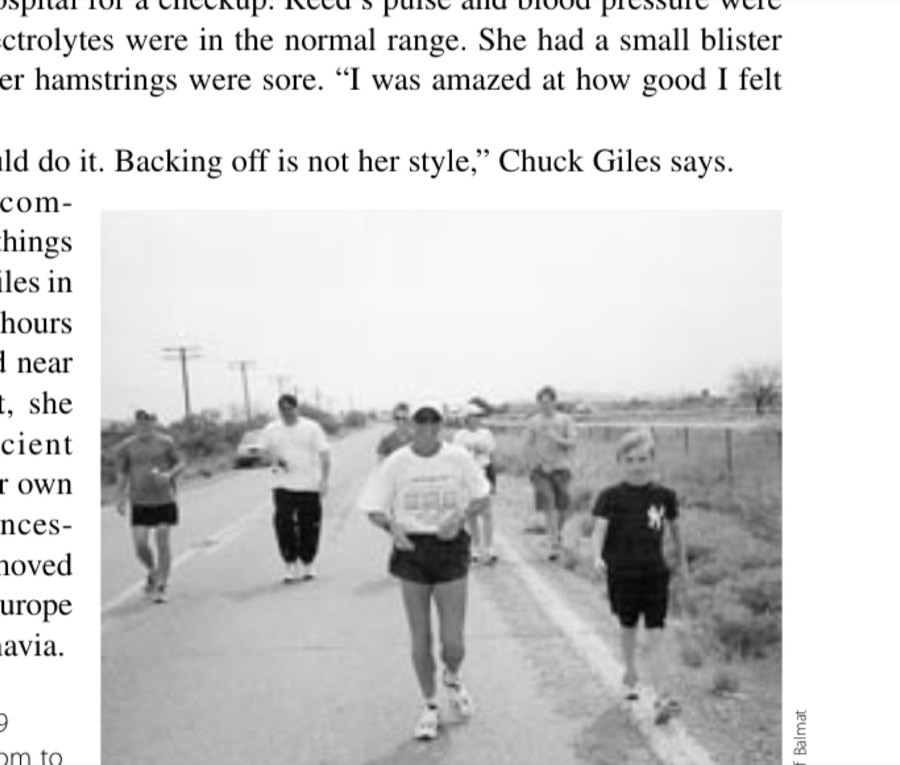
Reed’s son Jackson, 9 (right), accompanies mom to the finish line.
© Jeff Balmat
On Monday morning, Reed leaned up against a car and got a one-minute hip massage as commuters on the freeway honked encouragement. “This is hard, but it’s doable,” she said. She turned around at the south end of the loop for the final time and headed back to the barn. After nearly 80 hours, with 300 miles done, she ran one more, just to make sure.
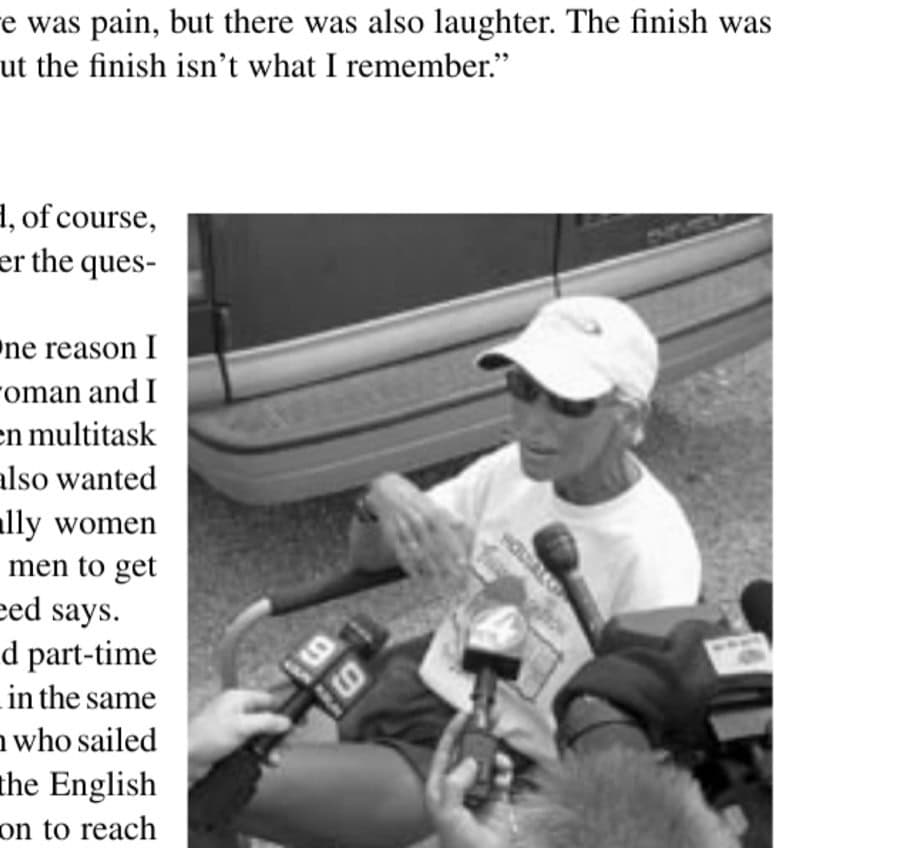
At last, with parents and media waiting and her sons beside her, Reed crossed the finish line. She sat down in a lawn chair beside her parents’ RV and answered questions about her weekend activities. An hour later, her friend Elisa Kinder took her to Northwest Hospital for a checkup. Reed’s pulse and blood pressure were low/normal. Her electrolytes were in the normal range. She had a small blister on her right foot. Her hamstrings were sore. “I was amazed at how good I felt overall,” she says. “
I knew she would do it. Backing off is not her style,” Chuck Giles says. Pam Reed accomplished at least two things when she ran 301 miles in a little less than 80 hours on the frontage road near Picacho Peak. First, she performed an ancient migratory act, as her own Finnish-Swedish ancestors did when they moved northward through Europe to the tip of Scandinavia.
Second, she brought people out of the woodwork. Mostly they were good people, concerned not to be annoying, resolved to assist if something went wrong, and eager to share in the adventure themselves, to wonder, “Could I do this?” Virtually all of them came away saying, “No.” “
This is the highlight of all the running I’ve done,” Reed says. “To see this community of runners and various people come together and run with me and with each other. I met so many neat people I probably wouldn’t have otherwise. This is the hardest run I’ve ever done, but it is the best experience.”
Jeff Balmat, who ran and took photos, says, “The entire weekend I kept thinking of all these people who are just ordinary people who love to run and want to support their friend. There was pain, but there was also laughter. The finish was an exciting 10 minutes, but the finish isn’t what I remember.”
At the finish and afterward, of course, Reed kept having to answer the question, “Why?” “First, I love to run. One reason I did this is because I’m a woman and I wanted to show how women multitask every day of their lives. I also wanted to reinforce that historically women have had to do more than men to get the same recognition,” Reed says.
Dave H., carpenter and part-time van driver, says, “I put Pam in the same category as the first woman who sailed around the world, swam the English Channel, or the first person to reach the top of Everest without oxygen. Their events were not prudent or reasonable things to do. I feel it is an injustice to Pam to analyze her motive, With running out of the way, Reed talks to as people typically try to do!”
Pam Reed traveled 301 miles on the media. foot in nearly 80 hours without stopping to sleep. She attracted a moving, changing band of fellow travelers who got to know each other and themselves and the desert in a way they would not otherwise have done. Maybe, despite our need to attribute motive in phenomena like this, the fact that it happened at all is the point.
© Jeff Balmat
SUMMING UP
This article originally appeared in Marathon & Beyond, Vol. 9, No. 4 (2005).
← Browse the full M&B ArchiveMore like this
1,000+ stories from 19 years of Marathon & Beyond
The complete archive of the legendary long-distance journal — digitized and free to read.
