

The Art Of Media Coverage
Ever hear of Hopkinton? Heartbreak Hill? Kenmore Square? Chances are you have. And whether you live in Arizona, Oklahoma, or the Carolinas, these Boston Marathon landmarks are more familiar to runners thanks in large part to the increasing national and international coverage of the oldest annually contested marathon, first run in 1897.
Watching live coverage of Boston from the other side of the planet has become as normal as, well, watching regular monthly programming of road races on TV. The popularity and broadcasting of footraces of varying distances have grown tremendously over the years to the point where the sport’s athletes and commentators, and even its cities and courses, have become famous. “
Because of the interest in this event, and it’s unlike any other,” notes Guy Morse, executive director of the Boston Athletic Association (B.A.A.), the governing body of the Boston Marathon, “there’s more media that cover the Boston Marathon than any other [running] event. It’s actually the largest single-day sporting event for media credentials in the world, annually, except for the Super Bowl.”
TV COVERAGE ON THREE FRONTS Such media attention reflects the level of viewership, participation, and general interest in the marquee event, so much so that it warrants live start-to-finish coverage from two of the city’s network-affiliated stations and national cable’s Outdoor Life Network (OLN), which also covers the Tour de France. “
Acquiring best-in-class events is an integral part of OLN’s programming strategy,” says OLN President Gavin Harvey. “The Boston Marathon definitely qualifies as one of those events, which is why we felt it belonged on our air.”
Proof that the local and national TV media consider this to be a key event is seen in the stellar list of guest on-air personalities, among them Bill Rodgers and Joan Benoit Samuelson on WCVB-TV (ABC); Kathrine Switzer, Toni Reavis,
Jean Driscoll, Tim Kilduff, and Uta Pippig on WBZ-TV (CBS); and Al Trautwig, Larry Rawson, and Dwight Stones on OLN. “We thought for our first year covering the event, our telecast went very smoothly thanks to our experienced programming and production team working in conjunction with Clear Channel and the B.A.A.,” notes OLN Senior Vice President of Programming and Production Marc Fein. “Between the three of us, we had the proper personnel and knowledge to pull it off. Luckily, there were no major obstacles to overcome.” Television coverage wasn’t always as fluid a process as has been the case in recent years. Sure, there are always bumps along the way, but there was a time, and it wasn’t too long ago, when archaic means of coverage were accepted as the norm.
PREHISTORIC ELECTRONIC COVERAGE Coverage seemed to follow the natural progression of technological advancement from print to radio to television, all the while overlapping along the way. Footage from television in its infancy, and still within its first few decades, was scarce. And that scarcity unfortunately translated into minimal archival resources in later years. Ambrose “Amby” Burfoot did not benefit from TV coverage when he won in 1968. As with previous Bostons, there were the usual snippets and clips for the newscasts but no wire-to-wire viewing. “
I don’t remember any video coverage, honestly,” he says. “I was running the race, not watching it. But it certainly was not national or anything like that. I do know a couple of years ago [at the B.A.A. media breakfast where previous winners are honored] when it was my anniversary, they couldn’t find any video of me running. I think I provided six seconds that we had stolen from a cable station or something like that. But there was not a lot of video. Certainly not easy to find.”
Rodgers also recalls the lack of coverage from his standpoint leading a marathon where there were no bunches of vehicles crowding around him and no television trucks to look at for 26.2 miles. “When I won New York, it wasn’t covered by national TV. It wasn’t on TV in the ’70s,” he says. “In ’79, I think there was one camera at the finish or something. In Boston, they’d have a media truck and they had cameras, I think, stationed at certain points along the course.” When Reavis first covered Boston in 1977, it was for radio, and enlisted along the course were spotters who would feed back information via pay phones and walkie-talkies. “It just sort of evolved from there,” he says. Morse remembers those spotters from when he first joined the B.A.A. as an administrator in 1983.
“The spotters network exists today in a different form than it did then,” he says. “From those days when everything was recorded, at best, over a hard-line telephone that might have been there—or radio, walkie-talkie, even at the official checkpoints—the officials would write down the bib numbers and the times, and they’d be brought in to the finish line, physically, and tabulated there. There was always a huge time delay. But of course, no one knew any different in those days. That was the norm. Imagine doing that now.”
Switzer, who registered to run Boston in 1967 as “K. V. Switzer” and thus became the first female entrant with a number when no one checked her initials on the application, first covered it in 1979 and 1980 for WGBH-TV, Boston’s main public broadcasting station. “The first two years that I did the broadcast, it was the first time that it had been broadcast nationally—nationwide that night,” she recalls. “We did it off of battery-powered golf carts, and the carts couldn’t even make it up the hills. We had these great big three-quarter-inch tapes and we would come alongside at these points [along the course], and we’d throw it over the crowd, and there’s a guy on a bike, and he would motorbike it back to WGBH, and they were racking them up and editing the show as we were commentating. And then we went into the show [afterward] and closed it live. It was unbelievable!”
YOU HAD TO BE AN EXPERT In addition, all too often the monitors were never as clear as those the viewers enjoyed at home. So it was fortunate that some commentators working the marathon possessed enough experience to adapt on the spot. “
When we started going live, there was so much breakup, and the monitors were never good. It was always very fuzzy stuff,” notes Switzer. “As a runner, you identify people by their walk and their run, their body type, long before you can see their face. You just don’t lose that technique. So that’s how we’d have to call the race often because we couldn’t see the numbers, couldn’t see their faces, or anything. We’d just call by body type. I remember calling the [Alberto] Salazar-[Dick] Beardsley race. Couldn’t even see their numbers or face, but we knew, of course, who they were. You could tell what was happening just because of their body type.”
And before pool coverage—multiple media outlets utilizing the coverage from one camera—stations were on their own and would vie for the best angles throughout the race. The result was often a comical sight but all too often hazardous. “
Before it became really coordinated, there were competing stations with competing vehicles on the course, so there were way too many vehicles on the course,” Morse describes. “Each entity in the old days did their own thing, and that became dangerous. It really wasn’t an issue in the sport, because most other
races didn’t have that number of people covering it, televisionwise or otherwise. But we did here, so at some point, say there were three or four networks all with their own vehicles, it became very dangerous and congested, and then everyone suffered because it wasn’t good-quality video. “
And I remember the press bus, as they called it, was actually, one year, a bus with 45 press [people] on it, hanging out the windows, backwards, to see what’s going on,” continues Morse. “Imagine a lumbering bus in front of the course, blowing black smoke and the whole bit.”
Samuelson can. “It used to be pretty bad, the exhaust,” she says. “Now, the distances are adequate enough between the runners and the vans. And the exhaust systems have improved. It’s a lot better. It really isn’t a factor now. There were . . . other marathons and other road races where you wanted to hold back because you didn’t want to be breathing that belched air.”
MARATHON KNOWLEDGE Along with the low-tech aspect of coverage back then, a number of commentators and reporters simply didn’t understand the sport. And with that lack of running knowledge, some either didn’t care to learn or were totally unaware of a problem. “
The difference between respect and disrespect was knowledge of what we were doing and empathy with what we were doing,” says 1957 Boston winner Johnny “The Younger” Kelley. “Those guys like Jerry Nason were knowledgeable and empathetic. There were others that I could name who were not knowledgeable and didn’t want to be knowledgeable, and their shtick was really being unempathetic.”
After Rodgers won Boston in 1975 with an American record 2:09:55, he was being interviewed on a radio show and subject to that very lack of respect. “I just set the American record—it was the fastest time in the world that year—and I went on a local radio show, and this very well-known sports guy said, literally said to my face, ‘Well, you’re not an athlete,’ because I didn’t throw a ball or something like that,” he recalls. “I threw a few here and there, now come on [laughs]! But you know what I’m saying. I think it was because it was an amateur sport, and it was kind of below the line of vision in a certain sense, communication-wise.”
Switzer understood that and has always made a point to spend time with anyone in the media who may not fully grasp the sport. As an activist, organizer, commentator, and especially as a runner, she also brings with her the unique perspective of a female athlete in that male-dominated arena.
EDUCATING THE REPORTERS
Paul Clerici
“I felt very, very sorry for a lot of reporters because clearly—you know, every time we ran a marathon, and we did it, and we were running better than anybody could ever imagine—they were lacking knowledge,” she says. “So I pride myself in taking an enormous amount of time, sitting down and explaining the rationale, and what my feelings were.”
Not all commentators were bad, of course. A number of them at the beginning, and some who are still shining today, understood the sport and appreciated its value. “There are always wonderful people, special people, who are great commentators who know the names, and they were good from the beginning on,” notes Pippig. “But I think more and more people are aware of the sport, and more and more people know [enough] to talk about it and to feel what’s going on out there in the field, to see what’s going on, and also to know the background.”
Adds Rodgers, “The media always knew about Boston because there weren’t a lot of marathons then. This race had been around so long that when you heard the name marathon, it was the Boston Marathon, so the media paid attention to it. But they didn’t understand it athletically, I don’t think.”
U.S. Olympian Alan Culpepper, who was fourth at Boston in 2005, appreciates the fact that knowledge in road racing coverage has improved, “especially
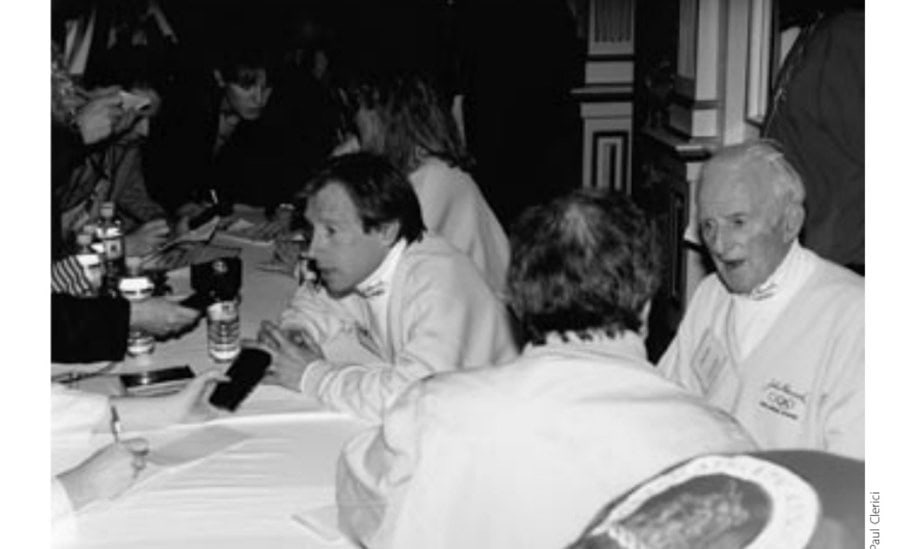
▲ Bill Rodgers (center), Kim Jones (next to him), and Johnny A. Kelley at a press conference.
surrounding this type of race, a marathon,” he says. “A marathon is kind of its own deal, [and it’s] nice to have people who understand what you’re doing and understand what you’re trying to accomplish.”
“RUNNING” COMMENTARY One way to fill that knowledge gap is to provide the viewing audience commentators who are runners. And as evident from the Hall of Fame lineups at Boston, this influx of former and current runners is a major boost. No matter in which decade they excelled, nothing beats pavement experience. “
It is an easy transition,” notes Pippig. “Unfortunately for me, it was a little bit of a language barrier because I obviously came from East Germany, and from Germany, languagewise, it was tough. Sometimes the picture was going so fast, and I had all my ideas, and the picture was gone, and obviously you can’t talk about it anymore. “
One major thing is there is a huge amount of work behind TV coverage production—research; the whole technique; all the cameras along the way; the leading vehicle; to have people on the press truck; and to coordinate us all in the studio,” she continues. “Maybe one advantage we [runners] have compared to, let’s say now I’m a sportscaster, [is] when you come from running, you can tell a story behind the scene. You can sneak into the runner’s mind. You can feel what’s going on for the runner who’s out there. So you cannot just see the picture, you can feel the picture, too. And it comes natural. You don’t have to think about it.”
Samuelson, whose on-air experience began in the ’80s, also possesses a unique perspective of how her sport has evolved. “I think it’s very similar [now], with the exception of the first time I ran Boston,” she says. “Nobody knew who I was, and I just sort of came down the night before, slept with some friends [at their house], got up and went to the stating line. I wasn’t prepared to deal with the onslaught of the press afterward, nor did I know the course. So ignorance is bliss that way. Now, it’s pretty standard. The press conferences the couple of days before the event; all the psyche that the runners go through; all the psychological preparations the runners go through; the press discussing the players, the day, the weather.”
GROWTH Did television generate interest in marathons on TV or did the interest itself generate the television coverage? It’s an easy enough question to ask, yet complicated to answer because of so many factors involved. The growth spurt from ’72 to ’84 contained numerous breakthrough moments that continually built upon each other in the sport of marathoning, from the Jim Fixx running books and the local champions to the health and fitness boom in
running. And it was bookended by American Olympic Marathon gold medals from Frank Shorter in ’72 and Samuelson in ’84. “An American being number one in the world helped,” Reavis notes. “Joan [Benoit] winning the Olympic gold medal in Los Angeles was an enormous watershed moment. What we didn’t realize was with Joannie in ’84 in the Olympics, and then Joannie in ’85 in Chicago with the American record against Ingrid Kristiansen and Rosa Mota, that was maybe the apogee of the American distancerunning experience. We thought it was the norm, and we all got involved with the Americans being on top. That was the aberration. That was the aberrant stage. With Americans and Alberto and Greg [Meyer], we were on this roll. And people wanted to get on board. And fitness and a healthy lifestyle were taking root, and the running boom was on the leading edge of that. So there was a sociological component to it as well as a sporting element to it—just people running, people getting fit.”
Like what Bobby Orr of the Boston Bruins did for the growth surge of hockey in the ’70s when the number of rinks and overall interest in ice hockey skyrocketed because of the defenseman, so did the interest in running and watching races reflect a similar increase due to these numerous marathon moments.
And with Boston being the father—or grandfather, for that matter—of U.S. marathons, the lure to the Hub was natural. As more people joined the sport of running, the natural epicenter of that was found in this Bay State city. The last year Boston had under a thousand entrants was in 1967 with 741. The field continued to grow in the ’70s and ’80s, with a peak then of nearly 8,000 in 1979 and 1982. “
The race [was] growing too big for the organizers to handle it, the amateurism days and all of that, but I think the running boom of the late ’70s is what created the Boston Marathon even though the Boston Marathon predated the late ’70s,” Burfoot opines. “It was just a Boston phenomenon then. The rest of the country, if you weren’t a runner, people didn’t know that much. But after the running boom, all of a sudden instead of having 50 or 100 runners in every state, there were thousands and tens of thousands everywhere across the country. They were all inflamed with this newfound passion for running. They had to latch onto something, and the Boston Marathon was what you latched onto because it was the oldest historic race. And suddenly everybody wanted to be in the Boston Marathon.”
Kelley even pays some homage to Love Story author, Harvard professor, Yale grad, and Boston Marathon veteran Erich Segal, who, as it serendipitously turned out, was a commentator at the 1972 Olympic Marathon. “
He had fallen in love with the marathon in the ’50s,” Kelley notes. “That was just his soft spot. And it just so happened that he was the guy, describing in the most dramatic way imaginable, every footfall of Frank Shorter’s as he ran through Munich. But it was a very dramatic moment in the history of the marathon, and it
just made people sit up and take notice that this is really a classic, heroic event. It’s not a ham-and-egger thing, necessarily. So the put-downs kind of started to recede after that.”
AMERICAN INTEREST As of the 2005 edition, the last American man to win Boston was Meyer in 1983, which capped off a remarkable stretch of eight American wins in the men’s race from 1973 to ’83. The last American woman to win was Lisa Larsen Weidenbach in 1985.
While there’s a direct correlation between American wins and American interest, the race is global enough to not have its coverage suffer because of its international winner’s circle. But when foreign runners consistently win, hometown rooting interest wanes in light of the lack of a U.S. connection between the viewers and athletes. “
It’s part of the American culture, both from a societal standpoint and from a wellness standpoint, and it’s been that way ever since,” Reavis notes. “It’s become a little bit more wellness oriented as the Kenyans have dominated the sport in the last 15 years, because I think the Kenyans, and the Ethiopians, too, they represent speed but they don’t represent rooting interest. So we’ve [the media] been talking about the Leukemia Team in Training, the Susan G. Komen Breast Cancer Race for the Cure—those have been the stories. I refer to those as ancillary stories that lack the fervor of athletic passion and its cornerstone on the marathon as an athletic competition. And I want to get back to that being the drive. That’s what interested me, the competition. It’s not just the element of speed; it’s the element of personality.”
But as Americans shine on the international stage, and especially in Boston and marathons nationwide, so too do the interest and coverage. During the boom, the average runner and spectator could relate to the top runners because they were from the same area. They could be your neighbors. “
During those glory years, I guess, the late ’70s and early ’80s, when Bill [Rodgers] was the guy, and Joannie was here, and Alberto and Greg Meyer,” says Reavis, “I go back, and those were incredibly special days. The intensity and fan interest were extraordinary. They were not only Americans, but hometown guys. People you knew. They used to say you used to know the top hundred finishers of the Boston Marathon by their first name.”
A CULT OF PERSONALITY “It was Billy winning Boston and winning New York,” adds Reavis. “I mean, Billy Rodgers was the Pied Piper. His personality, really. Shorter started it, but Bill was the personality, and he just won so relentlessly and in such a boyish, charming
way that his personality drove the sport. I’ve said that everyone who makes any money in running ought to give Bill a kickback because he’s really the guy. Frank didn’t do it by himself. Frank didn’t have quite the same personality, the engaging personality that Bill had. Bill brought the sport into the mainstream.”
That hometown lure has begun to return to Boston in greater waves as runners like Abbie Hickman, Marla Runyan, Josh Cox, and Culpepper have decided to take on the grande dame in recent years. And that inclusion of top American talent has also reattracted the interest not only of viewers but of sponsors and television as well. “
That’s why Alan Culpepper was an important consideration in the 2005 Boston Marathon race if he could do well here,” Reavis notes. “Meb Keflezighi winning the silver medal and getting second in New York City, Deena [Kastor] winning the bronze medal—those are very important moments to help bring back the interest, because after the 1993 New York City Marathon, ABC pulled the plug. That was sort of shocking to [race director] Fred [Lebow], even back then. They were on the verge of their 25th anniversary, and ABC said, ‘We can’t be made whole financially by doing this anymore’ because people aren’t watching because there’s no one in there to root for. You can’t just be a fast parade. You need to have a rooting interest in whatever form that takes.”
SNOWBALL EFFECT On the heels of a succession of American triumphs in the ’70s and ’80s followed several moments of interest that, in their totality, advanced marathoning to yet another level with which television was forced to catch up. “
Bill Rodgers, the running boom, Jim Fixx, Frank Shorter—for whatever reason, whichever you think was the most important—all of these things more or less happened at the same time,” Burfoot notes. “Women running—Joannie and Patti [Lyons/Catalano]—were just a couple of years after that. And there were the Kathrine Switzers before. So the late ’70s were clearly the volcanic period of the marathon with just everything happening all at once.” The explosion of women in the Boston field was extremely beneficial to several areas of advancement, most notably equal rights and athletic competitiveness, which also attracted increased TV coverage.
In the latter ’60s, when women were not allowed as official entrants, Boston became the theater in which the lightning struck the lightning rod. Roberta Gibb decided to run the 1966 Boston after being informed women were not allowed and that they “were not able to run 26 miles”; photographers the following year captured race official Jock Semple attempting to rip off Switzer’s bib when he realized she was a woman; and in 1972, the Amateur Athletic Union (AAU) allowed races, including Boston, to include women as official entrants.
The celebration seemingly ended quickly at Boston eight years later when Rosie Ruiz was caught cheating as she crossed the finish line first in the women’s race in 1980. But much as the popularity of Olympic figure skating soared in the wake of the Nancy Kerrigan-Tonya Harding incident, so, too, Switzer feels, did women’s marathoning after Ruiz, which included the first separate start at Boston in 2004. “
The tide began to turn, in a funny way, after Rosie Ruiz because people were shamefaced,” says Switzer. “The reason Rosie Ruiz got away with it was because people weren’t monitoring the women’s race. They weren’t monitoring a lot of cheats. And afterward, Fred Lebow called me and said, ‘Oh, my God! She’s ruined running for all you women.’ I said, ‘No, Fred. There are millions of people who never knew women could run marathons who now know because of Rosie Ruiz.’ There’s a positive in this very negative story. “
So after that, they had to start monitoring the course,” Switzer continues. “Well, when they started monitoring the course and they started paying attention to who was running and running really well, then they started getting more serious about [women as] athletes. And then, of course, incredible performances from the Benoits, Kristiansens, Waitzes, Motas. And so, suddenly, then it became the phenomena. Then also because we got the women’s marathon into the Olympics—and that’s the thing I take most pride in.”
EVOLVING The mid-’80s married renewed interest with corporate involvement, a relationship which Boston learned to embrace and from which it continually benefited. When John Hancock Financial Services in 1986 became the marathon’s main sponsor, the course changed, the finish line moved, the field swelled, prize money was awarded, and the number of international elite athletes grew. “
We didn’t change the nature or the spirit of the event, but we did take it to a new level in terms of corporate support, which led to prize money and a much better media operations support for the press,” Morse notes. “So it was in the mid’80s when it really took off in terms of coverage and press. It was pretty quick. “
It was always covered internationally,” he continues. “It used to be called America’s Marathon years and years ago, but it’s always been the most international of marathons. New York certainly has more international competitors in terms of volume because the race itself is so much larger. But in terms of international interest, Boston has always been at the forefront because it used to be the only game in town 20, 30, 40 years ago. So the heritage and the tradition were there, and it continues to bring the world’s best here year after year.” As the interest and field continued to expand, so did the need for expanded coverage. And top-quality, wire-to-wire coverage met with technological and physical limits.
Paul Clerici
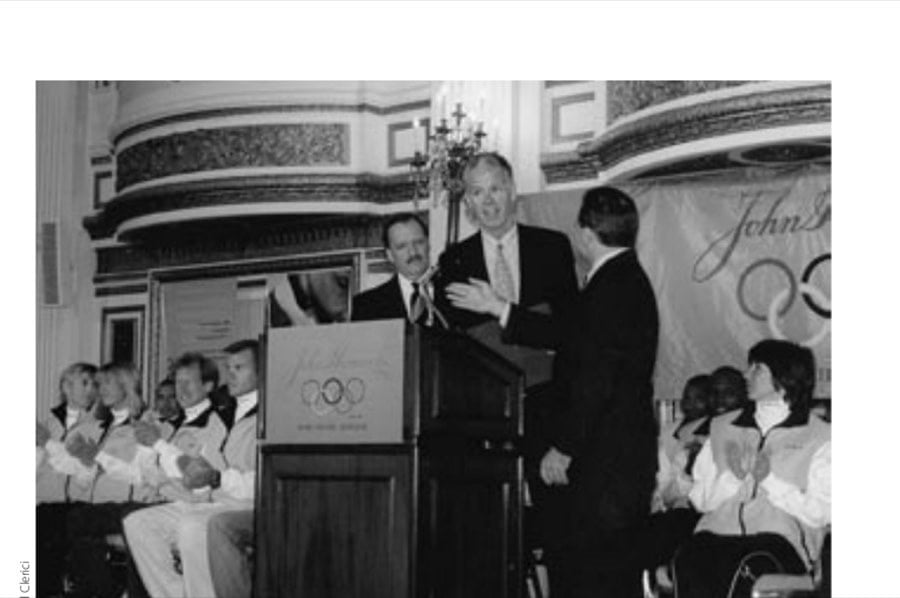
▲ From left, B.A.A. Executive Director Guy Morse, B.A.A. President Thomas Grilk, and John Hancock Sports & Event Marketing Asst. VP Robert Friedman at press conference with elite athletes sitting.
The fog was so dense at the start of one Boston, for example, that the helicopters were grounded, and the only television coverage for the early stages of the race was provided by the few cameramen who were standing along the course. The reason? “It used to be you’d have a motorcycle with a transponder on it. That would send a signal, the helicopter would hit the line of sight and beam it back to the station,” Reavis explains. “If you went under a bridge, the signal would be broken and your picture would go fuzzy.”
THE AGE OF CHIPS AND DIGITAL In 1996, when Boston celebrated its 100th anniversary, drastic measures were required not only to accommodate the ambitious field of nearly 39,000 runners—a massive jump from the 9,416 entrants the year before—but also to provide the media with superior services and the viewing audience with an equally highquality product. To that end, a number of technological advances were incorporated and several changes instituted, including the replacement of the chute system of controlling the runners to have them remain in line when they finish in order to record their bib numbers and places.
Frank Clerici, Sr.
“I’m a firm believer in fate, and I know this event is under some sort of special star because of our successes, et cetera,” notes Morse. “But to that point, speaking of the chute systems, I recall in 1994 or 1995, prior to the 100th, when we would have such a much greater participation, we had a real concern as to how are we going to process that many runners with that chute system. At that time, that was still the norm. The chip technology was just beginning to appear. “[The chip] saved us because we were able to officially process 38,000 finishers, which had never been done before,” he adds. “The numbers, even for the majors, the big-city marathons at that time, weren’t that large. That remains the largest marathon ever. Talk about throwing it all in there. But it worked out well. And that’s allowed the media to do a much better job covering the event, providing accurate and timely information to the viewers and to the public in general.”
Spanning miles and miles of road, thousands of runners, and a plethora of continuous data, it was only a matter of time before digital technology made its way to marathon coverage. “They had this new digital equipment where it doesn’t require this line-of-sight technology—it’s not that old analog,” notes Reavis. “It’s much more clear. It’s a better signal, a tighter signal, it’s a stronger signal. It’s like more bandwidth, and you can put more information through it. They’re not dependent on helicopters anymore.”
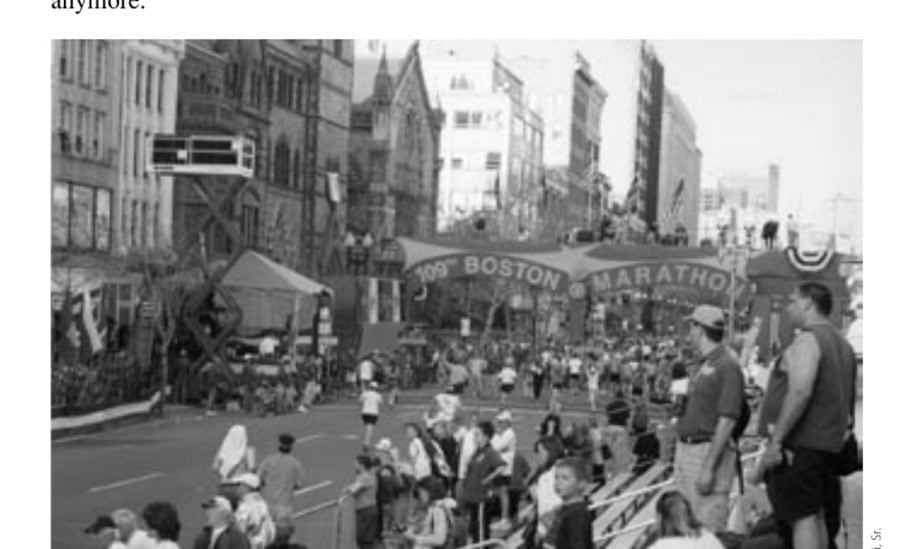
▲ The Boston Marathon is “the largest single-day sporting event for media credentials in the world, annually, except for the Super Bowl,” notes the B.A.A.’s Guy Morse.
Last year’s Boston for the first time benefited from complete digital technology. “The new thing at Boston [in 2005] is we’re not using helicopters with microwave capabilities. Now it’s digital,” says Morse. “That technology is sufficient now that it can be done reasonably inexpensively, although it’s still very expensive. But it’s worth it because you can get a much better quality signal, and you get a more reliable signal.”
PUTTING IT ALL TOGETHER With an amalgamation of better knowledge, greater technology, separate starts, and an overall symbiosis of additions and improvements, television coverage of Boston has continued and will continue to reach new heights. “
It’s always been covered in a variety of ways,” notes Morse. “But the technology has really allowed the coverage to mature, along with the organization, frankly. Everything from the wireless opportunities now—the cell phones for tracking, for helping reporters out along the course, and just within the race itself—this is a benefit to all marathons, the whole chip technology and the tracking as well, which carries on the wireless system. The chip technology has allowed the media and the spectators to really understand what’s going on [along] the course and to track it, almost immediately, from start to finish.”
Adds Samuelson, “I think as science and technology advance, so do other factors that come into play for the marathon and become more important, more recognized by the press and the people following the marathon.”
Putting all of this together has also cleaned up the roads, so to speak. You can’t help but recall all those police motorcycles and official vehicles alongside the leaders. Pool coverage, in particular, has enhanced the running, organizing, and viewing pleasure of Boston. “
Our pool television process now is accepted by everybody, so all three networks, for example, aren’t vying for space on the truck, and they’re not vying for vehicles on the course. It’s just one set for sanity and safety,” Morse notes. “But the technology allows them to get the information accurately and at the same time, so they can cooperate because it works for them. So that’s helped us immensely as well. And they all supplement the on-course visuals with their own camera locations elsewhere and commentators as well for those broadcasting live.”
Coverage on the Boston course includes a photo truck with a layered platform for print photographers and a press truck preceding each race. “The closest vehicle to the runners is the television truck. Only one,” explains Morse, “with some motorcycle support, state police, et cetera, for security purposes. But those are burning natural gas. We have done a great job of eliminating the
smog and the smoke and things of that nature. On the trucks, there’re probably eight [people]. It’s the representatives of all the live coverage of the race. Two of the three national networks in the Boston market, live, and also the Outdoor Life Network, nationally. It’s purely press, purely media, and it’s purely work. And then we have about 60 to 70 countries carrying it as well, and they all feed off the pool feed—the world feed, as we call it. It’s all mixed in our trucks, which are in the corner of Boylston and Exeter [streets] in the television alley there. It’s just a huge operation.”
NOWADAYS
Paul Clerici
With this televised advancement comes greater demand on the athletes. The younger runners have become accustomed to the ever-present media attention. Along with their fartleks, long runs, and massages, the elite runners of today include in their training the media requirements as well. It has become part of their training.
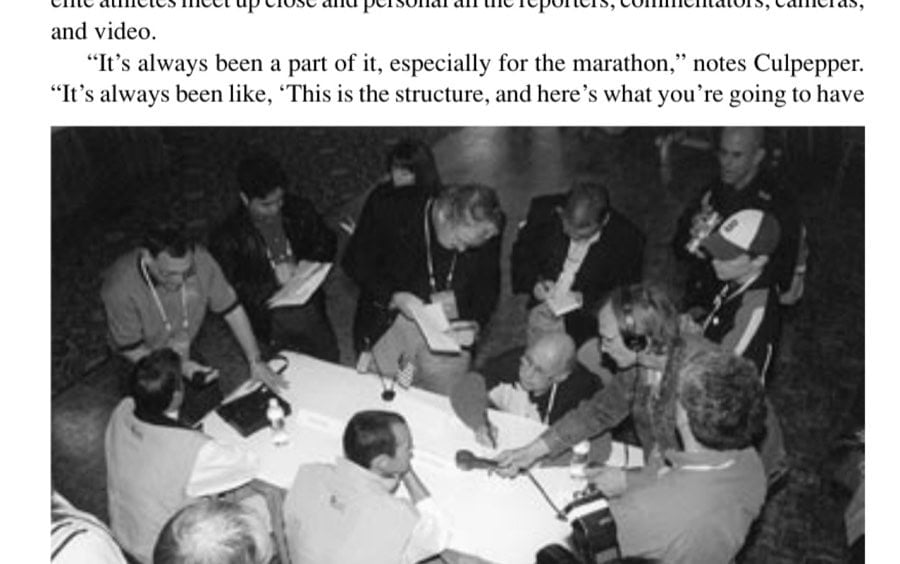
During marathon week at Boston, in addition to several scheduled mediarelated events, two separate days are designed entirely for the media where the elite athletes meet up close and personal all the reporters, commentators, cameras, and video. “
It’s always been a part of it, especially for the marathon,” notes Culpepper. “It’s always been like, ‘This is the structure, and here’s what you’re going to have
▲ Ryan Shay (left) and Alan Culpepper at press conference.
to do, and this is the reason that we’re able to have prize money and we’re able to have the support.’ [It’s] because of these other aspects, the media outlets and the other aspects, that build up the event. I’m used to it. “It’s a positive thing, for sure, but it is a balance,” he continues. “It can certainly become a distraction, and it can diminish what you’re trying to really do, which is run the race. For me, like now [at the Saturday press conference], this is appropriate because we still have a few more days till the race. The closer we get, the less I want to talk about it with the guy walking down the street or with a reporter. For me, it’s just a balance of that.” An example of that media interest for Culpepper was when he had just finished the marathon at the Athens Games and was still on the track, sweating in the July heat, when cameras were immediately upon him for a live on-air interview. “They just grabbed me,” he recalls. “I think it was partially because Meb had already gone in the back to do the drug testing, so they were like, ‘Yeah, might as well get Alan. He’s good.’ In some ways, you want to talk about it. You want to talk about your experience. For me, growing up where I did in El Paso [Texas], there weren’t any professional sports, so they followed high school–level athletics a lot. So, for me, I’ve always had to do a lot of interview-type things even at an early age. So getting off the plane when I was 16 years old, the news [reporters] would be at the airport. Things like that. You get used to it, and you get better at it. That’s never really bothered me.” Television coverage of marathons is unique. As with any sport, it poses certain challenges to provide a top-
quality product. “What we have is nonlinear,” Reavis explains. “American sport is episodic. Every 30 seconds, something happens. Well, this isn’t. This is nonlinear; this just goes. What you have is time, distance, and the correlation between the two. That’s what we deal with. That’s the sport. That’s the essence of it—time, distance, and the correlation.”
Marathon coverage has survived the seeming Dark Ages to the high-tech digital age of today. But even with such advancements and leaps, Rodgers feels this sport has yet to reach its peak. “I think there’s going to be a national running channel like the way there is for golf, because running is big and the demographics are the same as those highincome sports,” he says. “Runners cut across all demographics. And the fact that it’s global, we can kind of be like the U.S. Open in tennis. We’re a global sport, so that’s going to get bigger.”
This article originally appeared in Marathon & Beyond, Vol. 10, No. 2 (2006).
← Browse the full M&B ArchiveMore like this
1,000+ stories from 19 years of Marathon & Beyond
The complete archive of the legendary long-distance journal — digitized and free to read.
