

The Bermuda Triangle Challenge
The Bermuda International Race Weekend provides an inexplicable attraction. by Patrice Malloy
“Come quick! It’s like a dagger! We cannot escape!” —Frantic cries from the Japanese freighter Raifuku Maru that, according to the legend of the Bermuda Triangle, disappeared in the tranquil sea.
Nothing has ever been heard from the Raifuku Maru and its 38-member crew since that fateful day on April 21, 1925. According to the legend of the Bermuda Triangle, a disproportionately large number of ships and aircraft have inexplicably vanished without a trace in the vicinity of the triangle—a triangular-shaped area of the Atlantic Ocean that lies roughly between Bermuda, Florida, and Puerto Rico. Explanations for these deadly anomalies range from the area having supernatural qualities to paranormal laws of physics to unusual magnetic pulls possibly caused by signals from the lost continent of Atlantis. Tales of the area being occupied by extraterrestrial beings have even been tossed about. Legend naysayers have argued that many of the alleged ship and aircraft disappearances have been inaccurately reported and that so-called Bermuda Triangle facts are fictional at best. Is the Bermuda Triangle a paranormal magnetic attraction? Has the area experienced an extraterrestrial invasion? And what do “paranormal activity” and “daggerlike pain” have to do with a marathon weekend? The mystery of the Bermuda Triangle lives on and has found its way to dry ground by way of
the Bermuda International Race Weekend, held annually in January during the Martin Luther King Jr. holiday weekend. The Bermuda Triangle Challenge—an opportunity to run a one-mile race on Friday, the
Bermuda International 10K Run/Walk on Saturday, and either the Bermuda International Marathon or the Bermuda International Half-Marathon on Sunday—was introduced in 2008.
▲
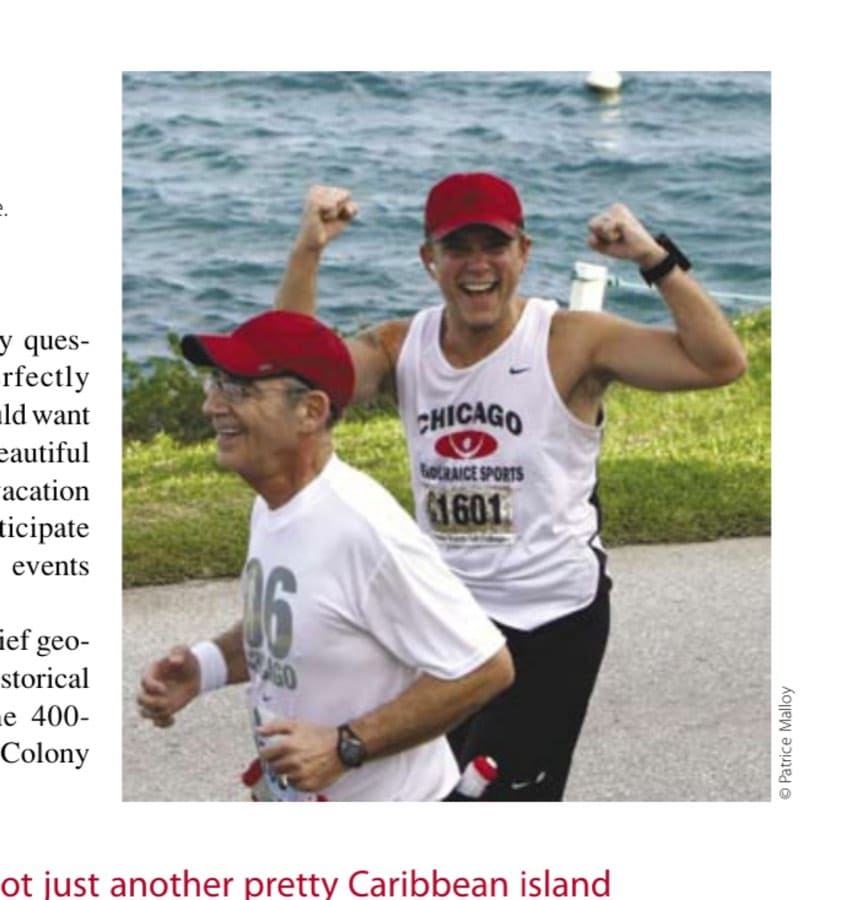
The Bermuda International Race Weekend offers runners a triple running experience.
© Patrice Malloy
Now the only question is why perfectly sane runners would want to travel to a beautiful island during a vacation weekend to participate in three running events over three days. But first, a brief geographical and historical lesson about the 400year-old British Colony is in order.
Bermuda—not just another pretty Caribbean island If you would like to watch a Bermudian’s blood boil over, just mistakenly mention that Bermuda is located in the Caribbean. That common geographical gaffe has been a royal thorn in Bermuda’s side for years, perpetuated by travel agencies and magazines that apparently have found it more convenient to cluster a cross section of islands into one neat, but inaccurate, travel category.
Located about 570 miles east of North Carolina, Bermuda is not, for the record, part of the Caribbean, thank you. In fact, Bermuda lies closer to Nova Scotia than to any Caribbean island and is less than a two-hour flight from most U.S. East Coast cities.
Bermuda was formed almost 100 million years ago by volcanic eruptions along the Mid-Atlantic Ridge. The 150 or so islands (the number depends on your definition of “island”) that make up the nation of Bermuda are actually limestone caps on top of submerged volcanic rocks. Given Bermuda’s jagged topography and the area’s occasionally tempestuous maritime conditions, it should be no surprise that the 22-square-mile nation was first settled by survivors of a shipwreck. Bound for Virginia in 1609, the English flagship Sea Venture deliberately wrecked on the island’s easternmost reefs after floundering in a raging storm, thus saving the lives of the 150 people on board. It has been a self-governing British colony since the
© Joseph Seeley
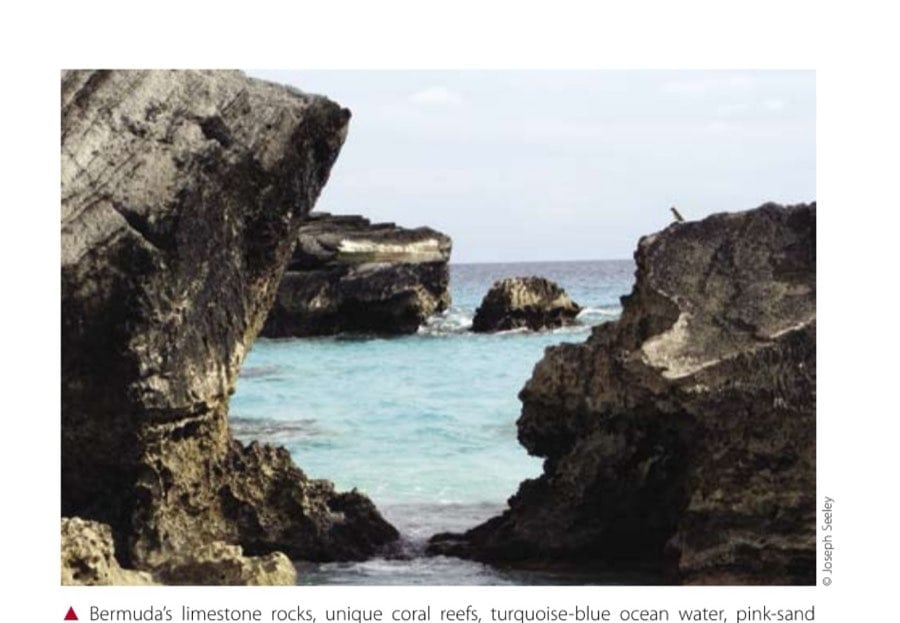
▲ Bermuda’s limestone rocks, unique coral reefs, turquoise-blue ocean water, pink-sand beaches, and year-round colorful flora create a natural multisensory feast.
1600s. Bermuda’s capital is the city of Hamilton, located on Great Bermuda, the largest of the country’s 20 inhabited islands. The country’s limestone rocks, unique coral reefs, turquoise-blue ocean water, pink-sand beaches, and year-round colorful flora create a natural multisensory feast. Adding to Bermuda’s unique kaleidoscopic landscape are its pastel-colored buildings, painted mostly in soothing hues of pink, blue, and green.
The Bermuda International Race Weekend The excitement surrounding the running boom of the 1970s made its way solidly onto Bermuda’s petrous soil and was the catalyst for the creation of the inaugural Bermuda Marathon in 1975. The marathon benefited, and continues to benefit, the Bermuda Track and Field Association (BTFA), which is the governing body of the country’s track and field and road running programs and also promotes amateur athletics in the country. A 10K run/walk, an invitational mile, and a half-marathon were added to the marathon weekend in 1978, 1989, and 1994, respectively, and the weekend evolved into the Bermuda International Race Weekend (BIRW), as it is known today.
The BIRW has attracted an international world-class field over the years, most notably the indomitable Joan Benoit Samuelson, who won the Bermuda
International 10K in 1979, and Norway’s Grete Waitz, who won the 6.2-mile competition a record eight times between 1980 and 1989. But it has not always been smooth sailing for the three-day, four-race running weekend. Numerous challenges in the marketplace caused a gradual dip in entrant numbers. “Race weekend participation grew during the 1980s and 1990s, but then numbers started to decline around 2004,” said Thom Gilligan, founder and president of Boston-based Marathon Tours & Travel, a running-niche travel agency that has brought groups of runners to the BIRW since 1979. According to Gilligan, one reason for the decline was a dramatic increase in competition from new destination marathons and half-marathons that had much larger marketing budgets. “The ©
Patrice Malloy destination-event landscape has changed dramatically in the past decade,” said Gilligan. “Events must constantly innovate and market themselves aggressively or suffer the consequences, especially in
these economic times.” In 2007 Gilligan proposed the threeday, three-event Bermuda Triangle Challenge to the BIRW race committee. It was proposed that runners who entered the Challenge would have the opportunity
to participate in a special division of the Invitational Mile on Friday, the 10K on Saturday, and either the full or half-marathon on Sunday—and, of course, receive special amenities for their effort.
The race-weekend committee agreed, and the Bermuda Triangle Challenge has been held successfully since 2008. “The legend of the Bermuda Triangle is synonymous with Bermuda, so branding the challenge as the Bermuda Triangle
▲
The Bermuda Triangle Challenge is the brainchild of Thom Gilligan (1701), founder and president of Boston-based Marathon Tours & Travel. Thom has been bringing groups to BIRW since 1979 and has run the weekend’s events every year but one.
Challenge made sense,” said Gilligan, who has run in the weekend’s events in 31 of the past 32 years. But why? Why run three events in three days? Kathrine Switzer, the first woman to officially run the Boston Marathon, winner of the 1974 New York City Marathon, veteran of 35 marathons and, most recently, a two-time survivor of the Bermuda Triangle Challenge, sums it up this way: “I discovered that I need not only a goal to motivate me to train, I need an attractive and doable goal. The Bermuda Triangle Challenge was the goal for the job, and training for it reenergized my running.”
Others simply like the challenge. Steve Kipisz of Plano, Texas, ran the marathon challenge for that reason and for a more personal one. “It was my birthday and I wanted a running-related weekend,” said Kipisz, a finisher of 44 marathons and 10 ultramarathons, who turned 47 during the second day of the challenge. “I also enjoy running challenges, and since I started running marathons, I hadn’t run a mile event and had not run a 10K in several years.”
Steve’s advice for BTC entrants? “It’s Bermuda . . . enjoy it! Don’t run so hard that you hurt yourself in any race. The weekend is a great way to run and relax and have a fun time after the holidays.”
2011 Bermuda International Race Weekend Fast Facts Bermuda Triangle Challenge Mile Friday, January 14—6:30 p.m. start (approximately) Flat, looped course on Front Street in downtown Hamilton, Bermuda’s capital (same course as the invitational event). Multiple heats of those participating in the Bermuda Triangle Challenge.
KPMG Bermuda Invitational Mile Friday, January 14—7:00 p.m. start Flat, looped course on Front Street in downtown Hamilton, Bermuda’s capital. An invitation-only event where the fastest local and international milers compete for prizes.
Bermuda International 10K Run/Walk Saturday, January 15—10:00 a.m. start Hilly, looped course that starts and finishes at the National Sports Centre.
Bermuda International Marathon and Half-Marathon Sunday, January 16—8:00 a.m. start The looped courses start and finish in downtown Hamilton, a short walk from the Fairmont Hamilton Princess, which is race headquarters. The half- and full marathons start together and follow the same course, with half-marathon runners completing one loop, and marathon entrants navigating the loop twice. The courses feature breathtaking vistas of both the north and south coasts of the island as well as colorful and unique buildings.
Bermuda Triangle Challenge (BTC) Run the KPMG Bermuda Invitational Mile, the Bermuda International 10K, and your choice of either the Bermuda International Marathon or the Bermuda International Half-Marathon (also known as the Bermuda Triangle Marathon Challenge and the Bermuda Triangle Half-Marathon Challenge, respectively). Swag: All finishers of all races receive a medal and an event T-shirt. All finishers of the BTC receive a special T-shirt and medal (four medals and four shirts total). Web site: www.bermudaraceweekend.com
▲
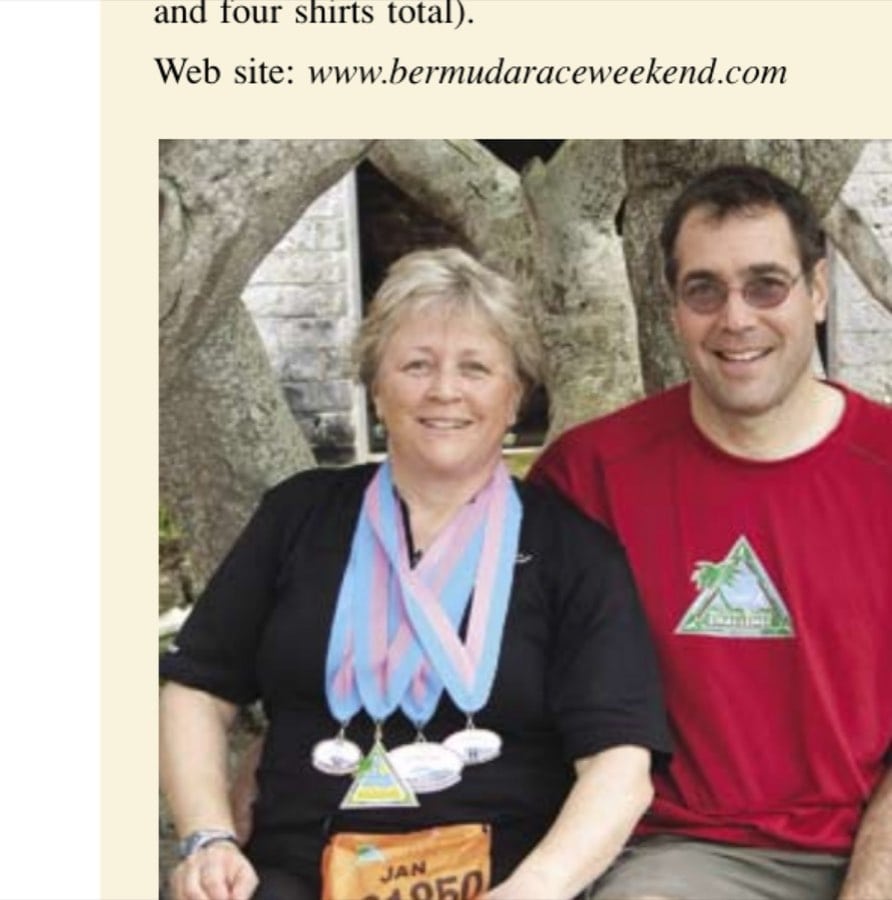
M&B publisher Jan Seeley, with her husband, Joe, shows off her participant medal haul from the 2010 Bermuda Triangle Challenge weekend.
If you go Have your affairs in order. (Just a little Bermuda Triangle humor.) At the very least, have a current passport ready to go. Although it’s allowable to run just the 26.2-, 13.1-, or 6.2-mile events, enter the marathon or half marathon challenge, or you will regret it later. Bermuda may be a British colony, but it has many of the creature comforts of the United States. No need to pack electrical adapters or exchange money. Bermuda’s electrical outlets are identical to those in the United States and the U.S. dollar, equal to the Bermuda dollar, is accepted everywhere. Bring a swimsuit. The ocean is too cold even for the hardiest of souls, but the hotel pools and spas are toasty and a great place to meet fellow runners. Bring rain gear and a jacket. The average rainfall in January is 4.9 inches, and the average low and high temperatures are 61 and 69 degrees. Bring sunscreen—a welcome addition to any trip in January. Bermuda has a distinct British flavor to it, and that includes attire generally accepted at restaurants and the like. No, you will not be expected to wear Bermuda shorts, but pack something a bit more formal than your favorite race T-shirt and running shorts. (Hint: business casual.) Bring along a camera on the run. OK, you may want to limit your number of shots during your mile race. But you will pass by some of the most beautiful scenery in the world during the other events. Check out Marathon Tours & Travel’s packages (www.marathontours.com), which include group rates at the elegant Fairmont Hamilton Princess. Meet other Triangle Challenge wannabes at their welcome reception on Thursday evening.
Sucked Into the Bermuda Triangle by Kathrine Switzer
“We’ve been friends for 35 years, and I’ve never asked you a favor,” he said. Thom Gilligan had just told me of his idea to revitalize the Bermuda International Race weekend by putting all three days of races together to create a multievent dubbed “The Bermuda Triangle Challenge.” “It’s a great idea! We runners are weird; once we run something, we want to make it harder the next time,” I laughed. I was already going to Bermuda as a guest speaker for the legendary Fairmont Hamilton Princess Hotel, a race sponsor. “So I want you to run it,” Thom said.
I had no idea when I last ran a half-marathon; this event alone might take me three hours! I had only eight weeks before the Challenge. Every weekend, muttering profanities, I upped my hour run by 10 percent. I would come home afterward and face-plant into bed, too whipped-out to eat. Sometimes I would fall asleep on my feet in the last mile of the long run. Let’s say getting ready for this was an educational experience.
© Patrice Malloy
It was a crazy idea 35 years ago when I was training 100 miles a week, and it’s crazier now when I’m 61 and jogging 25. I screamed, I whined, and then I said OK, sure. Why not? I’m as nuts as the next runner.
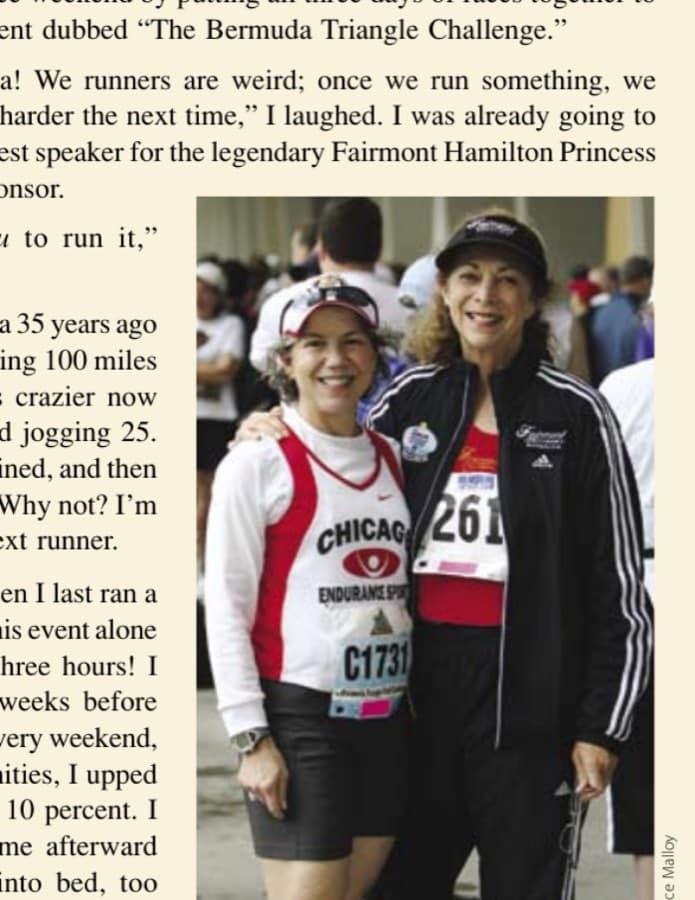
▲ For Kathrine Switzer (right, with Gayle McMurray), participating in the Bermuda Triangle Challenge races “reignited my running and my spirit and beckoned me back into races long forgotten, never experienced, or given away.”
Having only one speed, I didn’t worry about the flat-out street mile but fought down the image of thousands of merrymakers lining the gaily lighted historic Front Street making merry over a 61-year-old with cellulite. The 10K would be a warm-up, and for the half-marathon I would gut it out. What a race plan! It worked! I did it! At the awards presentation, I was astonished to hear my name called as an age-group winner of the 10K. I had won $100! One hundred dollars! Honestly, it was as if I had won an emerald necklace, I was so excited. I grabbed the microphone: “I’ve been running for 50 years, and this is the first prize money I’ve ever won. I’ve lost my amateur status! So I’m slamming this $100 on the bar, and for however long it lasts, drinks are on me!” For the record, it lasted 32 seconds. Thirty-two seconds that reignited my running and my spirit and beckoned me back into races long forgotten, never experienced, or given away.

This article originally appeared in Marathon & Beyond, Vol. 14, No. 2 (2010).
← Browse the full M&B ArchiveMore like this
1,000+ stories from 19 years of Marathon & Beyond
The complete archive of the legendary long-distance journal — digitized and free to read.
