

The Hells Of The Bunion Derby
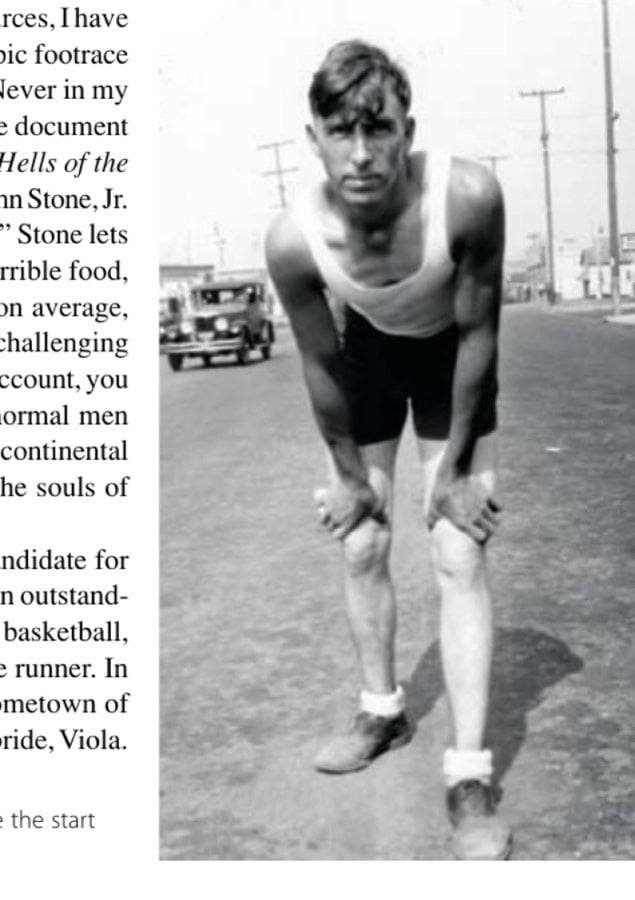
John Stone, Jr.’s account of running in the first footrace across America. by Charles Kastner
Ihave written about the 1928 Bunion Derby for the past 10 years. From thousands of sources, I have pieced together the history of this epic footrace from Los Angeles to New York City. Never in my long years of study have I read a single document that captures its spirit better than The Hells of the Bunion Derby—the short memoir by John Stone, Jr. of his 84-day odyssey as a “bunioneer.” Stone lets you feel the misery of surviving on horrible food, sleeping in leaky tents, and running, on average, 40 miles a day over some of the most challenging terrain on the planet. After reading his account, you begin to understand how seemingly normal men could overcome the challenges of transcontinental racing. He gives you a window into the souls of the 55 men who finished the race.
Stone seemed to be an unlikely candidate for transcontinental racing. He had been an outstanding high school athlete in football and basketball, but he had no experience as a distance runner. In 1926, he married at 21 and left his hometown of Marion, Indiana, with his 18-year-old bride, Viola. ▲
John Stone, Jr. Photo taken shortly before the start of the 1928 Bunion Derby.
Photo collection, Charley Stone
El Reno Carnegie Public Library
They settled in Los Angeles, where he found work in a paper mill. Late in 1927, Viola became pregnant. John looked as though he had found his path in life until he heard about the Bunion Derby. Race organizer Charles C. Pyle had advertised the event in newspapers across the country, with a promise to feed and house any man bold enough to take up the challenge of racing across America. He offered a $25,000 first prize, a small fortune to a working man when the average family survived on $2,000 a year.
Pyle’s offer lured 199 men to toe the line at Ascot Park Speedway in Los Angeles for the start of the race. Most left disapproving wives and families to follow this call for adventure. John’s wife could not understand the logic behind what she saw as a crazy, half-baked idea with a baby on the way and little money in the bank. He went anyway, leaving her with $100 to live on for the next three months. She boarded a train for Marion and stayed with her parents for the duration of the race.
Most of the other men faced similar reactions. Andy Payne’s father, an Oklahoma hill farmer, called his son’s idea of racing across America “not even good foolishness.” Mike Joyce, an Irish immigrant and Cleveland factory worker, left his unhappy wife with four small children and took most of the family savings with him.
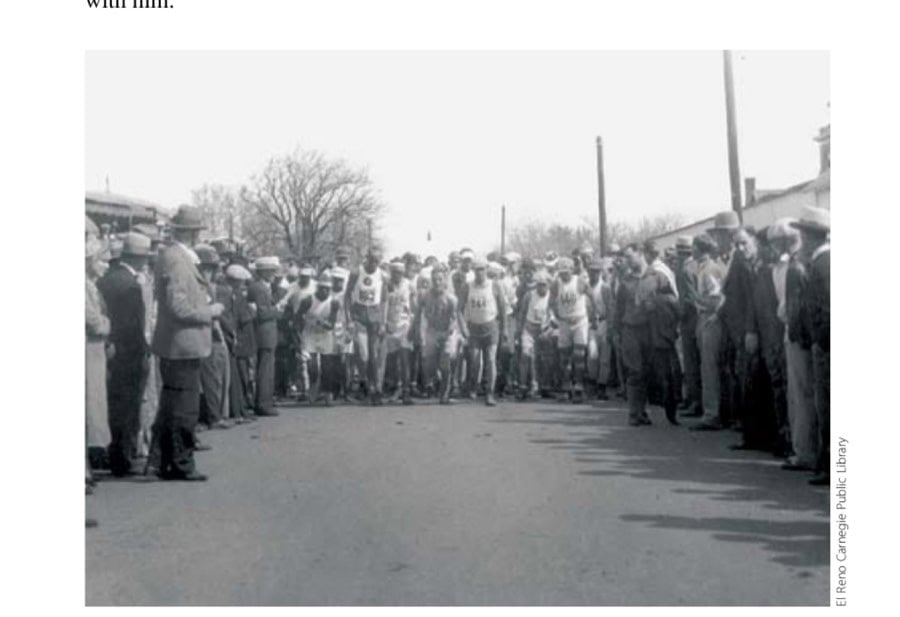
▲ A publicity shot taken before the start of the Bunion Derby.
What they had in common Most of these bunioneers were very much like John: they were blue-collar men who held jobs in factories or shipyards or on farms. Few had any experience running ultramarathons except for a handful of international stars whom Charley Pyle had recruited for the contest. What these no-name runners did have was an uncanny, or some might call irrational, belief in themselves, a naive confidence that they had the guts and ability to tackle the impossible—the notion that they could run on average 40 miles a day for almost three months.
Despite the long odds, Stone managed to persuade a number of people in Marion to support him: a group of local businessmen raised funds to buy him food and supplies; the Marion Shoe Company provided him with free running shoes; and a trainer, Mr. Davis, agreed to follow him across the country in a 1923 Model T Ford.
The bunioneers would need every ounce of confidence and support they could muster. The Bunion Derby was a brutal contest of endurance that tested the men’s commitment to their transcontinental dream. The first 2,400 miles of the 3,422-mile course took them across the length of Route 66 to Chicago. In 1928, most of the road was unpaved, potholed, and dangerous. During the first month, the men faced the 95-degree heat of the Mojave Desert; late winter storms in the high country of Arizona and New Mexico; and the muddy, tendon-ripping roads of the Texas Panhandle. In addition to the sheer physical demands of daily racing, they had to contend with the substandard food and deplorable housing provided by Pyle.
At the end of the “long trail to New York,” 10 men won prize money, including Andy Payne in first with $25,000 and Mike Joyce in fourth with $2,500. The other 45, including Stone (who finished in 33rd place), left with a lifetime of memories but little else.
He returned to Marion to greet his new infant son, John Charles Stone, born in the last days of the race. He was also probably something of a town hero. He had brought Marion a lot of favorable publicity in national and regional newspapers, especially when he tied for first place in the 64th segment, from Chicago to Gary, Indiana. That summer, Stone promoted and raced in a local 26-mile road race that was part of the celebrations for Marion’s newly opened airport.
John probably published his memoir shortly after the Bunion Derby. At 50 cents a copy, it may have enjoyed brisk sales among his local admirers, but public fascination with the race would soon fade as the country began its spiral into the Great Depression the next year. For decades, the Bunion Derby was seen as an aberration from the late 1920s—like marathon dance contests and flagpole sitting—instead of one of the greatest tests of endurance in modern times. In 1966, legendary Seattle sports columnist Royal Brougham dismissed the Bunion Derby out of hand as “the weirdest, most ridiculous and confused athletic event in the annals of sports.” Only in this era, with the rise in the popularity of ultramarathoning, can we begin to appreciate what Stone went through.
At the end of John’s memoir (see pages 88 to 91), I have provided a primer that should fill in the knowledge gaps for the reader new to the Bunion Derby. You may want to read it first, before reading The Hells of the Bunion Derby, a piece of our running history that should challenge us to dig a little deeper when we pursue our training goals. I want to express a special thank you to John Stone’s son, John Charles (better known as Charley to his friends), who sent me an original copy of his dad’s story and was a crucial source of information for this article. Note: We did not edit John’s memoir for grammar, spelling, or punctuation. What follows is his exact text, verbatim.
The First International Trans-continental Foot Race was a foot race directed by Charles C. Pyle, one of the world’s greatest sports promoters, from Los Angeles, California, to New York, New York. It was open to any physically fit male athlete in the world. It started from Ascot Speedway at Los Angeles on March 4, and ended in Madison Square Garden at New York City on May 26, 1928. There were ten prizes given. The winners and their prizes may be found listed on the back page of this booklet [see page 87 of the magazine].
Inasmuch as the general public have been entertaining so many varied opinions of the runners, and the conditions under which the race was ran, it is the desire of the author to put in brief, just a few incidents which actually occurred, and sketch over the trip in such a way that anyone interested may be enlightened on this subject.
It is not my desire to say anything harmful about anyone or anything, but I do wish to emphasize the fact that every statement herein is true, and if necessary I can produce proof to verify them. This writing is fully for the purpose of letting the public know just what we boys came through, how we came through, and why we came through.
▲
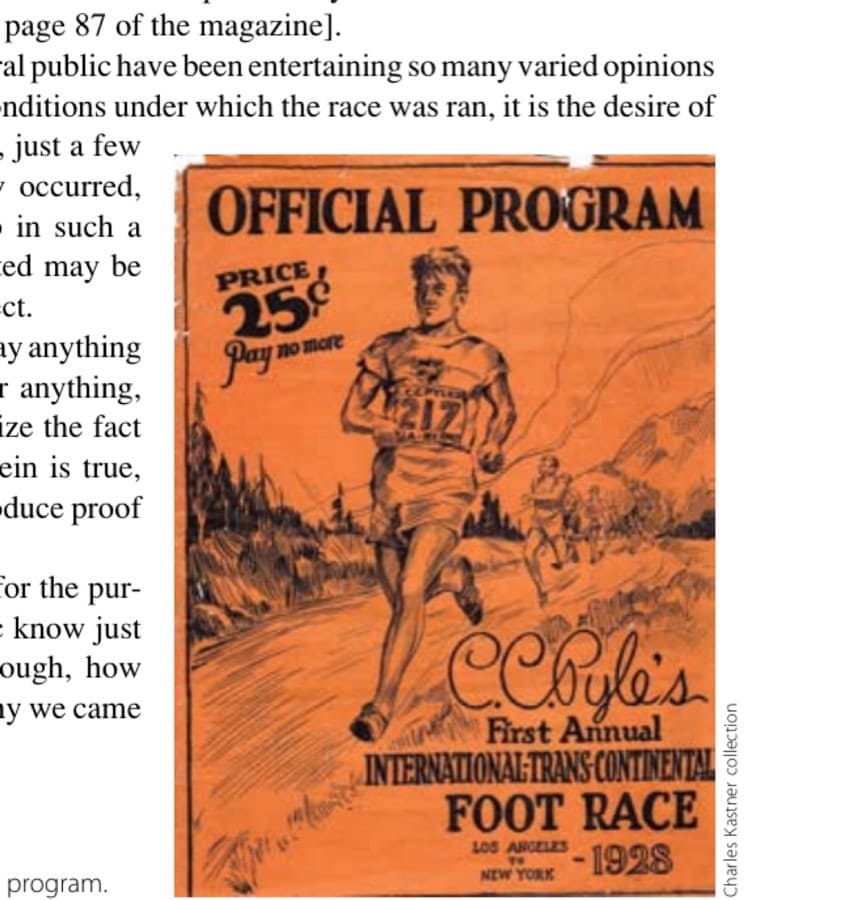
Cover of the official 1928 program.
Charles Kastner collection
The Hells of the Bunion Derby
It is hoped by the author, that these few pages will answer most of the many hundreds of questions that are asked daily concerning this First International Trans-continental Foot Race or more commonly known as the Bunion Derby.
As the casual reader may be mislead to believing that we boys were purposely treated mean and inhuman by the management it is only fair to Mr. Pyle and all the officials connected with the race, that it be made clear that this race was a very costly experiment, and because of the lack of knowledge, fortunes were spent in trying to do the right thing by we boys. We cannot deny that in the view of all this, we went through unspeakable misery in order to reach New York.
The International Trans-continental Foot Race was started from Ascot Speedway at Los Angeles, California, Sunday, March 4, 1928. The first days control was Puente, California, some seventeen and one-half miles distant.
The throngs, which lined the boulevard that first day, were estimated to be close to 500,000 people. We ran in heavy traffic the entire distance, and were glad to reach camp as the gas from the automobile engines was beginning to weaken us some.
The carnival (which was part of the entourage) did a good business, and continued to do so far into the night. Our sleeping tents were near the carnival, so that the incessant beating of drums, and the many other noises which belonged to the carnival, did much to make it a very restless night for the boys.
Our morning and evening meals were served in a commissary. You had to eat just what they gave you, regardless of what you wanted. The same rule stood for quantity. It was but a short while until the “chef” came to the conclusion that he didn’t know how to feed the runners.
The second morning we started a trek of some thirty-four miles in a slight rain which proved to be much more than slight in the next few hours. Several of the boys gave it up as a bad job. Many reached camp with blisters galore, because of the rain all day.
This was the evening as I recollect, that one very interesting character dropped out of the race. When I think of this fellow, I always think of a very humorous excuse he gave as to why he was not in any better condition for the race than he was. He said inasmuch as the state he represented permitted only two deer to be obtained by any one person was the reason he was not trained better; because he had ran down his allotment of deer, and therefore was out of shape. He intimated that had they allowed him permission to catch more, he would be more prepared. He was hauled into our second control at Bloomington.
That night we got our first touch of real hell, if I may call it that. What few medical men we had were very effective in their capacity, but with upwards of two hundred men to care for, it was very difficult to handle the situation, especially when no provisions had been made beforehand to accommodate anyone who needed attention.
There was no place for the doctor, or doctors to locate. Each runner was obliged to wait in their wringing wet bed with rain coming right through those leaky tents, until the doctor could get to them to administer aid.
The problem of shower baths was just one terrible experience. They had what they called showers, which they made a slight attempt to keep from public view with an abbreviated piece of canvas. A runner had no place to dress or undress there, or even boards to stand upon. All was mud around these showers, and the cold night winds added to the misery. The embarrassment of seeing the public watch us was surely not a pleasure. Such was the showers, which at many places during the trip did not have enough water in to wash a persons hands with.
The next morning, most of us crawled out from under the pools of water, which had accumulated on the beds during the night. We were stiff and sore from the rain, and those accommodations. Our lineup that morning was vacant in a few places, but was doomed for the heaviest toll of the race that day I believe.
Many noticeable limps were in evidence that morning as we started on the forty-four mile jump into Victorville. Our route was through Cajon Pass, which was the Waterloo of many a contestant. The official road patrol passed the day with a seating capacity filled and some were even upon the roof. Many were hauled into camp in private cars as well.
That day, the same as many following, we were given two jam sandwiches, a cup of coffee or milk, and a very small orange. This kind of a noonday meal did not occur just this once, but nearly every day, for the first two months of the race. The food question was a vital factor, and because of economy being exercised too much; it was necessary that many a good man gave up the chase because of starvation. It was almost impossible to go out and cover the mileages each day on your feet unless you had the means of getting more food than the management prescribed.
This is just one of the many questions, that the participants in the transcontinental races which will surely follow, should profit by our experiences. We are convinced that the management tried at least to do the best they could, as we had three distinctly different systems of being fed on the trip.
Some of the boys had to actually beg for something to eat at times because of the inexperience in feeding foot racers for such an extended period. On reaching Victorville we found conditions much the same except for the rain. By this time they lost enough entrants to allow the doctors a tent for the cripples. I think it held about one-third that night.
From Victorville on for the next few hundred miles we had some real desert. Here again the inefficiency of the management because of lack of knowledge took its toll. They did not have one-half enough official road patrols to give water, etc. to the needy ones. They tried to place water stations along the route from five to fifteen miles apart. When a man is only able to walk two or three miles an hour you can readily see his predicament.
The desert took a heavy toll and put the most of the remaining ones in a pitiful condition. Some were badly sunburned, others had parched lips that cracked open and bled; still others had their foot problems in abundance.
One morning (the day we left Barstow) on the desert, I did not get started with the bunch, and when I did get started, I saw vivid pictures, which no human can comprehend without really experiencing it. I saw fellows that morning, scores of them, which apparently had no chance in the world of reaching their destination on foot. Actually, they were hardly able to drag one foot after another, but they were just too game to give up. Most of them made it.
It is my one desire to emphasize this all important point in this writing, and that is the true fact that there were just as many real he-men in this race that never even got to Chicago as there were that reached New York.
Many of the world’s best distance runners were out of the race before we got halfway, just because they could not stand the inhuman conditions under which we were forced to live. The sleeping conditions alone were enough to upset any human.
Our blankets and pillows were so filthy it was a disgrace to the race. We did not even have our own. We got different ones each night. We undoubtedly slept with our heads on one end of a blanket, where some other unfortunate had his sore bleeding feet the previous night. Some of the boys wore their blankets for shawls and dragged the ends of them over the filthy ground through spit, etc. Then the next night it was given to someone else to sleep on. Our pillows were the same way. Many a time have I seen some of the boys put a pillow on the ground and stand on it to dress. If the management had made them use it continually it would have only been fair, but someone else probably got it next. And too, there were the fellows in the race whose lips were just a mass of sores too horrible to mention that lay on the pillows that we all had to use. God knows that it is all-true, and so does every man that was there, but that is the price of experience.
Aside from our other experiences while crossing this section of the country, stands one very eminently. It was the day of the most furious sandstorm we encountered. There were several days though here where the heavy winds blew sand and dust into the air and along our course so as to make it very unpleasant to run in but this oneday in particular, it was extraordinarily bad. The wind started blowing early in the day, and as the day progressed, the velocity of the wind increased, until by nightfall it was coming with such force so as to pick up large pebbles and hurl them at us. This was surely not very pleasant for those of us who only had a light running suit on. You could not see the road ten feet ahead of you at times, because of so much sand and dust. We were forced to be very vigilant because of the automobiles. The wind was so strong at times it was all we could do to keep our footing, and stay on the road. Large tufts of dried prairie grass were being carried swiftly along by the high wind, so it was doubly hazardous, as they sting and cut if they strike you.
Photo collection, Charley Stone
When we reached the control that evening we were completely covered with sand and dust. Our hair was stiff with white sand, our eyes were full, and it was fully one-half inch thick on the back of our necks and shoulders. Not much water was available, so you can easily imagine our plight.
Even though we underwent all these hardships, we cannot deny the fact that we had our pleasures at times. We were fortunate in that we had some talent in the crowd who could sing, dance, play the harmonica, ukulele, etc., then too, we had our radio, which entertained occasionally. Some nights out on the desert we had campfires, and on a few occasions the native Indians would sing and dance for us. It was quite an interesting experience the day we went from Needles, California, to Oatman, Arizona, when the Indians in rowboats ferried us across the muddy Colorado River. They used long poles in preference to oars. It was very interesting especially after coming right out of the desert.
Across Arizona and New Mexico, we faced another hazard. For some reason, mostly financial I have reasons to believe, the management could not, or at least did not furnish us with the same quality of pure drinking water, which we were to have. Consequently, some of the fellows got stomach trouble, and other sickness, due to the water they had to drink. Alkali was prevalent in many sections of the country in the water. We got the best of what was available in these places, but the best was far from good water.
The medical profession was puzzled on at least one injury. Which as I understand it, was the outcome of the race. This is what’s known as “shin-splints.” They form a knot in the muscle that develops on the front of the shins, anywhere between the ankle and the knee, and which are extremely painful when the ankle is worked. They, also, helped put many of the boys out of the race. This direct cause was attributed mostly to attempting too long a stride, or, one longer than you were trained for. This was especially so going down hills.
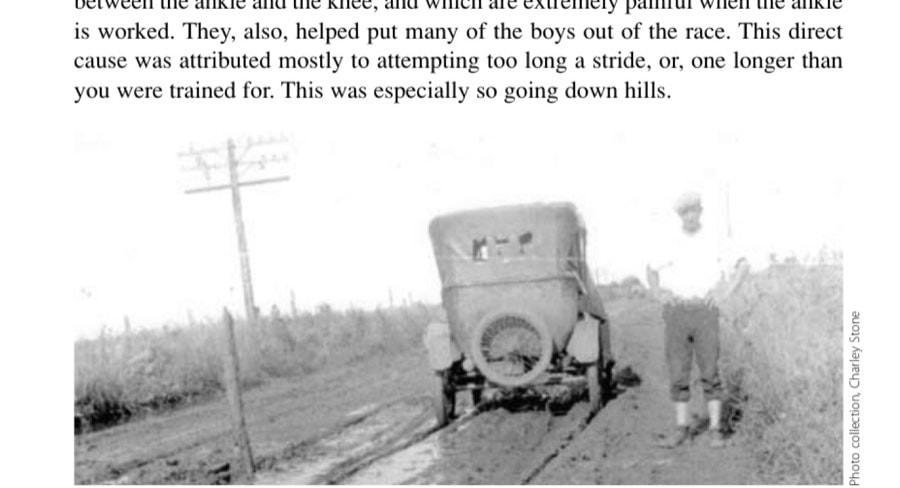
▲ John Stone, Jr. and car stuck in the mud on Route 66 outside Amarillo, Texas.
In the mountains of Arizona, and across New Mexico and Texas, we occasionally encountered snow, sleet, rain, and what have you. Our worst day as regards to weather, in my opinion, was the day that we went to Amarillo, Texas. Over half the way was over dirt roads that when soaked with rain as they were that day, formed a heavy gumbo mud, which is very sticky and slick. It would pack on our shoes until it got so big we would have to stop along a fence or something, and clean them off. We mostly used the sod shoulders at the sides of the road, but they were very rough as well as muddy also. It rained, hailed, and snowed all day long, and to add to the inconvenience, a very strong wind kept blowing right in our faces all day long. It was too bad weather for a dog to be in, but we had to like it.
There were several of the boys hauled into camp that day, but as had been custom, but not the rule, those who cared to go were taken back to where they had been picked up the following day, and permitted to make up their distances. That practice, like many others, originated after we left Ascot Speedway. If we had been held to the rules stipulated in our original contracts, and compelled to make the distances, etc., as we had expected to, the few men to finish in New York could be counted on one hand I really believe.
About the only rule in our contracts, which was enforced to the limit, was the one forbidding us to accept rides on vehicles. This was broken a few times but whenever a fellow was caught accepting a ride he was disqualified without hesitation, which was only fair. In the next trans-continental races yet to come the contracts will be altogether different, or at least be carried out in more accurate form.
There was an understanding between Mr. Pyle and we boys before we started, that there was to be local prizes given by some of the towns to the first five runners to reach there, regardless of position in the race. This caused considerable controversy among the fellows when the prizes failed to materialize, and eventually a few of the boys quit the race, and others lost interest, as they depended on these prizes as their rewards. It was intimated that after the race got under way, management concluded that such rivalry for local prizes would endanger the welfare of the coast-to-coast runners to such an extent, that no effort was made by management to secure such prizes.
Another important question of considerable comment was the reasons for our detouring cities, which lay on our route, such as Albuquerque, New Mexico. I cannot state with precise authority, but I have very good reasons to believe, that it was nearly always the case where these cities did not see fit to meet the terms of the management, so therefore we boys had to bear the burden, and in some instances go many miles over very rough roads to get to our controls. This applies vice versa too, as we were occasionally led off the direct course to pass through a town, which had paid for it. We boys have no come back here though, as our contracts gave the management their rights to choose the route.
El Reno Carnegie Public Library
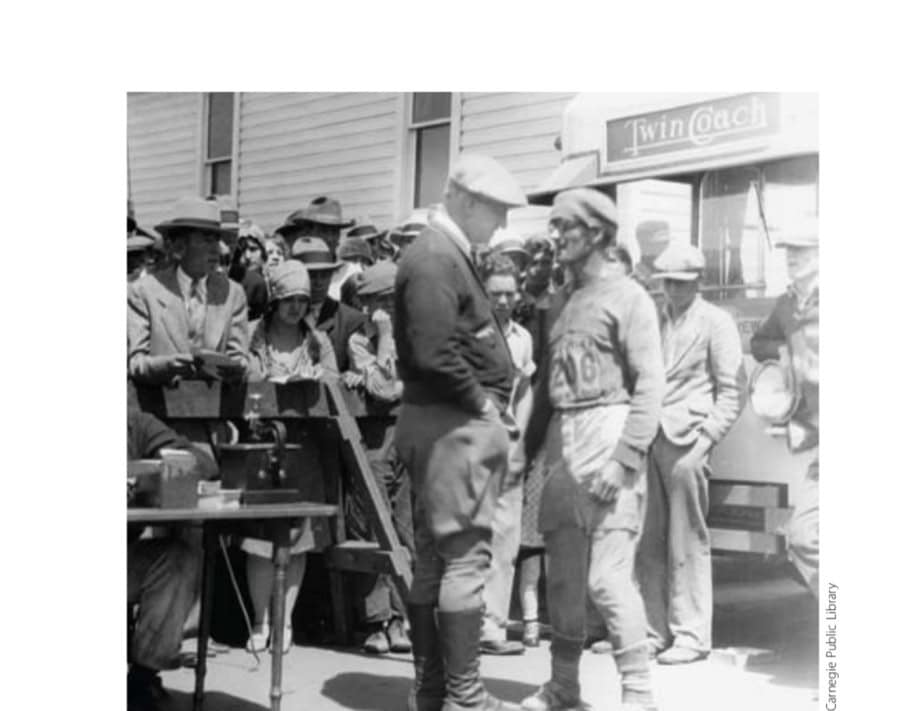
▲ Charley Pyle talking to a bunioneer somewhere in Oklahoma.
After leaving Texas the weather became more suitable to a foot race. All through the South and Middle West we went along fairly smooth. Now and then rumors were spread that the race was going to end because of financial crisis, which faced the management, but with such a man as Charles Pyle with his wonderful foresight, at the controls, we still kept going regardless of the rumors. I must not deny that had it not been for such splendid gentlemen as Mr. Freemont F. Gunn offering their succor to the management, things possibly may have not turned out as well as they did.
There was one mistake some of we boys made, I believe, and that was by insisting that we have more mileage. We were told that after passing Chicago we would get all the mileage we cared for, and to our sorrow, we did.
We got fifty, sixty, and seventy miles a day nearly all the way from Gary, Indiana to Liberty, New York. The last few days of those mileages surely told on the boys. On a seventy-five mile jump one day after we had just completed about six hundred and fifty miles in the preceding ten days some of us who were not in condition to make very good time, did not get into camp until two-thirty or
three o’clock in the morning. No more pitiful sights did I ever behold than those that morning along the road. We were completely exhausted after three thousand miles, but it made no difference. As we went along that morning, I could recollect seeing some of those poor boys laying along side the road with their faces in the grass which was wet with dew, waiting until they could get strength enough to get into camp. We had to pick some up and shake them to get them started off down the road again. Even then some would collapse with exhaustion right in the road and we had to hold each other up to get to the control point.
I was very grateful to Harold “Red” Grange who was official referee of the race at this time, for coming out on the road that night and telling us we could have until daylight to get in if we wanted it. It saved many of us from being disqualified, as we could not reach camp by mid-night, as had been our limit. Some of us got to camp very late, and there no accommodations for us so we had to sleep on marble tables in the cafeteria. After three hours of sleep we were awakened and started on a sixty-five mile run. Luckily this was our last long distance, but it nearly took a heavy toll because we had all had to be in by three o’clock or be disqualified. Some of us could hardly make it at all, and to add to the misery a terrible rainstorm came up which lasted all night. Strange things happened that
Letter collection, Charley Stone; personal collection, Charley Stone
▲
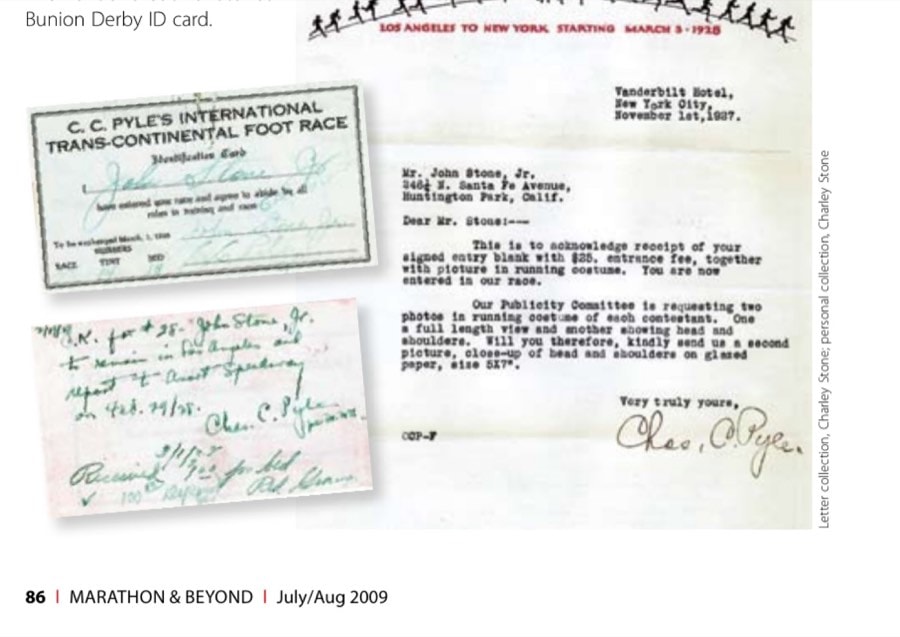
Letter from Charley Pyle to John Stone, Jr., November 1, 1927, regarding his entry in the Bunion Derby. Inset: The front and back of Stone’s Bunion Derby ID card.
night, but I am thankful to God that every man of us was able to make it regardless of the price we paid. As we were only four days from our destination, the mileage decreased greatly as the management desired to have us looking at least a bit respectable when we entered New York City. Those few easy days were a big relief, and each of us recuperated considerably from our exhaustion.
On Saturday evening, May 26, we left the stadium in Passaic, New Jersey, on our last run. We were checked in at the Weehawken Ferry and all were ferried across the Hudson River together. On the New York side of the river we were all started en masse, the same as of a morning. It was just a mile to go to Madison Square Garden, which was our last stop. At the Garden we were required to run two hundred times around a marble track, or approximately twenty miles.
As we finished our laps, we ended the coast-to coast marathon, which started eighty-four days previous. We were all glad that it was over, and each man that finished whether a winner or not realized that he had completed one of the severest tests that any bunch of athletes has ever been put to.
Because of the opinion the general public entertained toward the management, the race was financially a failure, both for the boys who were not fortunate enough to finish in the prize money, and the management too.
In the view of the fact that fifty-five of the one hundred and ninety nine starters finished the race, it was an undisputed success, and with the knowledge gleaned by our experiences, it can and will be run at a later date much more successful, financially, as well as physically.
The Prize Winners and the Prizes Which They Received in Madison Square Garden, Friday Evening, June 1, 1928 First
Andrew Payne
Claremore, Oklahoma
$25,000
Second
John Salo
Passaic, New Jersey
10,000
Third
Phillip Granville
Hamilton, Ontario, Canada
5,000
Fourth
Mike Joyce Ireland
2,500
Fifth
Guisto Umek
Trieste, Italy
1,000
Sixth
William Kerr
Minneapolis, Minnesota
1,000
Albany, New York
1,000
Seventh Louis Perella Eighth
Ed Gardner Seattle, Washington
Ninth Frank Von Flue Tenth
Kerman, California
John Cronick Saskatoon, Sask., Canada
1,000 1,000 1,000
They Earned It All
A Primer on Hells of the Bunion Derby The management of the Bunion Derby Charles C. Pyle, director general of the First International Trans-continental (Los Angeles to New York) Footrace. Pyle gave himself this grand title
after agreeing to stage the race for the Route 66 Highway Association—a group of businessmen from towns and cities along the newly designated but mostly unpaved U.S. Highway Route 66. The association hoped the
race would bring national attention to this newly opened “gateway to the Golden West.” Pyle agreed to organize the race, with the understanding that major cities along the route would make a cash contribution when
he brought the derby to their town. The 48-year-old Pyle seemed unfazed by the prospect of organizing a transcontinental race. He had pulled off the impossible before. In 1925, he signed Harold “Red” Grange to a professional contract. In 1926, he
founded the American Football League and his own AFL team, the New York Yankees. Though his league only lasted a year, his team survived and was incorporated into the NFL in 1927. In 1928, Pyle hoped to
cap his success with the Bunion Derby. Grange became Pyle’s second in command and the star attraction in Charley’s traveling carnival road show that set up near the finish line after each day’s race. After Chicago,
Grange also assumed the role of head referee of the Bunion Derby. Freemont F. Gunn. Millionaire businessman and father of bunioneer Harry Gunn. F. F. Gunn and his daughter followed Harry across the country
as his support team. Gunn assumed de facto control of day-to-day business operations of the race after it reached Chicago. By then, the derby teetered near bankruptcy after most of the cities failed to make their
promised contributions and Pyle’s inattention to detail left bills unpaid and creditors on his trail. Hemorrhaging money, Gunn tried to stem the flow of red ink by ending the race as soon as possible. He increased the
mileage by about 15 miles a day after Chicago, forcing the men to run 50 to 75 miles a day for the next two weeks of the derby. The contract. Each man who entered the race signed a contract with C.C.
Pyle that gave Charley the right to manage the top 10 finishers for two years after the race and listed rules of conduct during the race. In return, Pyle promised to feed and house any man who paid the $125 entry fee, $
100 of which was returned to the runner at the end of the race.
The carnival. It included such novelties as the Turtle Boy, an embalmed Oklahoma outlaw, the world’s most powerful portable radio, a 20-piece jazz band, and a troupe of “artistic” female dancers who seemed to spend most of their time locked in the embrace of the local farm boys who visited their steamy sideshow. The carnival often went on past midnight. The constant noise kept many exhausted runners up far into the night. The control. The finish line for the daily stage race, where timers logged in each runner’s daily time and added it to the cumulative total.
Place names Stone writes about the three-week training camp and 10 of the 84 daily, town-to-town stage races held during the 3,422-mile Bunion Derby. Ascot Park Training Camp: Three weeks before the race, 275 men set up tents inside the oval of Ascot Park, a dirt race-car track that Pyle had rented in Los Angeles. By the end of the three-week session, 76 men had a change of heart and dropped out of the derby.
ad
Day 1, March 4, 1928: 199 men raced from Ascot Park to Puente, California, 16 miles to the east; huge crowds lined the streets; the race was a cakewalk compared with what awaited them. Day 2, March 5, 1928: 198 men lined up at the start line in a driving
rain for the 35-mile run to Bloomington. Wet and exhausted, the 183 survivors slept in unwashed sheets under leaking tents next to Pyle’s noisy carnival. Day 3, March 6, 1928: 183 battered men began a 20-mile, gut-busting
climb to Cajon Pass at 4,200 feet above sea level before making a 1,500-foot descent on spent legs to Victorville, California, 15 miles east of the summit. Day 4, March 7, 1928: 167 men ran 36 miles to Barstow on dusty and
potholed Route 66. Ahead lay the blast furnace of the Mojave Desert. Day 9, March 12, 1928: After surviving the Mojave Desert, 130 men crossed the Colorado River in Indian canoes before making the 2,000
foot climb to Oatman, Arizona, in the Black Mountains. By now, Pyle’s system for sustaining the runners was coming apart at the seams. Bedding went unwashed, the tents leaked, the meals were miserable and served
in insufficient quantities, and water was provided infrequently during the race. Those runners with a trainer and a support car and the money to buy their own food and sleep in hotels had a huge advantage over those
forced to live on Pyle’s dole. Day 24, March 27, 1928: In New Mexico, the bunioneers battled a series of sandstorms on a 40-mile race to Los Lunas, near the Rio Grande River. Day 25, March 28, 1928: After Albuquerque’s Chamber of Commerce
refused to make a cash contribution, an irate C.C. Pyle bypassed the city. He forced his 96 men to run up a winding canyon road for the finish at Seven Springs, a cold, wind-blasted place, while Charley escaped to the
comfort of Albuquerque’s finest hotel. Day 33, April 5, 1928: A freezing rainstorm turned the dirt roads between Vega and Amarillo, Texas, into ankle-deep, tendon-ripping mud. Most of the 88 finishers called it the worst day of the entire derby.
Day 79, May 21, 1928: The 75-mile run from Waverly to Deposit, New York, was the longest leg of the race. The combination of heat, hills,
and nagging injuries turned the road into a torture for most of the 55 men still in the race. Day 84, May 26, 1928: 55 men left Passaic, New Jersey, in the early evening, caught the ferry across the Hudson River, and reached Madison Square Garden after 3,422 miles of running.
Life after hells Despite all that Stone had gone through in the Bunion Derby, he wanted to give transcontinental racing another try. He entered Pyle’s second and last Bunion Derby in 1929. He had shown real talent in the first derby, winning the 28-mile Chicago to Gary, Indiana, stage race in seven-minute pace and taking third place in a 41-mile race two days later. He knew that he could finish in the prize money this time. His wife was not convinced. With an infant child to care for, she bluntly refused to let him go. He left anyway, joining many 1928 veterans.
In 1929, Pyle reversed course, leaving New York City on March 31 and arriving in Los Angeles on June 16. An injury apparently forced Stone to drop out in Philadelphia, after only three days of racing. In a way, it was a blessing. The second Bunion Derby left Pyle bankrupt. None of the 10 prizewinners received any money after 3,555 miles and 78 days of racing.
John returned to Marion and began to raise a family. The Stones had two more children and eventually settled in Louisville, Kentucky, where John ran J. J. Stone Supply Company for many years. He seldom spoke of his days as a bunioneer. He died of pneumonia in 1994, and his wife died in 2002. Few among his friends and neighbors realized that John had accomplished something extraordinary—he had helped break the bonds of human potential when he bested Route 66 when it was young and wild. He will forever be an ironman and bunioneer, one of the godfathers of modern ultramarathoning.
Are You Moving? Please let us know when you move so there is no interruption in your subscription. Send address changes to Marathon & Beyond, 206 N. Randolph St., Suite 400, Champaign, IL 61820; or via e-mail to jan@marathonandbeyond.com. Put “Address Change” in the subject line.
This article originally appeared in Marathon & Beyond, Vol. 13, No. 4 (2009).
← Browse the full M&B ArchiveMore like this
1,000+ stories from 19 years of Marathon & Beyond
The complete archive of the legendary long-distance journal — digitized and free to read.
