

Time Out For A Running Holiday
The Cayman Islands Marathon delivers small-town charm in an exotic paradise. by Jan and Joe Seeley
Is this a trick question? That was my first thought when Jan asked me, “Do you want to go to the Cayman Islands in December?” In central Illinois, December is when you start to get some really cold days, along with that first 1-inch snowfall that makes you think that all the other drivers must have just moved here from Florida, because nobody appears to be able to drive in snow. And then some more cold. And wind.
So, despite knowing nothing about the Cayman Islands, I gambled that “yes” was the right response. Turns out, there are occasional perks to being married to the publisher of Marathon & Beyond. The plan was for us to fly to Grand Cayman, visit the sights, run the race, visit some more of the island, and then write an article for the magazine. Worked for me. And we couldn’t have left Illinois at a better time. It was snowing and 17 degrees on our drive to O’Hare in early December.
Three islands The Cayman Islands are three peaks of a submerged mountain range running west into the ocean from the eastern end of Cuba. This British territory consists of a small island called Grand Cayman and two much smaller islands called Little Cayman and Cayman Brac.
If the ocean level were a little higher, the Cayman Islands would barely exist. Much of Grand Cayman is less than 12 feet above sea level, and its highest point reaches 80 feet. The Bluff on Cayman Brac, at 140 feet, is the highest point among the three islands. So, good news—we would not have to face the double whammy of hills and heat in the race. Unlike other Caribbean islands, Grand Cayman is completely flat.
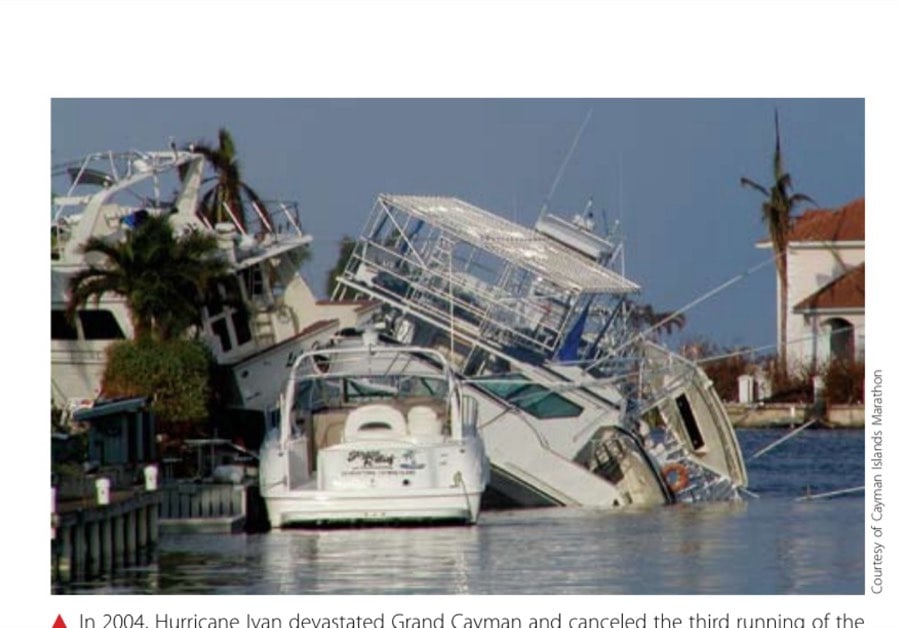
It’s also a sitting duck for hurricanes. On September 12, 2004, the category 5 Hurricane Ivan gave Grand Cayman a taste of higher sea levels. A storm surge
Courtesy of Cayman Islands Marathon
▲ In 2004, Hurricane Ivan devastated Grand Cayman and canceled the third running of the marathon.
estimated at 8 feet and waves of 10 to 15 feet put much of the western half of the island, where most of the businesses and residences are, under water. Unusually strong building codes limited the damage, which was still catastrophic. Cayman Islands Marathon race director Rhonda Kelly, whose company, Kelly Holding, took over the race in its second year, 2003, explained how the “seas met across the island. Ten thousand vehicles were lost, almost every light pole was down, and electricity was out for five or six weeks.” With many hotels closed and parts of the racecourse along the South Sound torn up by the waves, understandably, the third annual Cayman Islands Marathon was canceled.
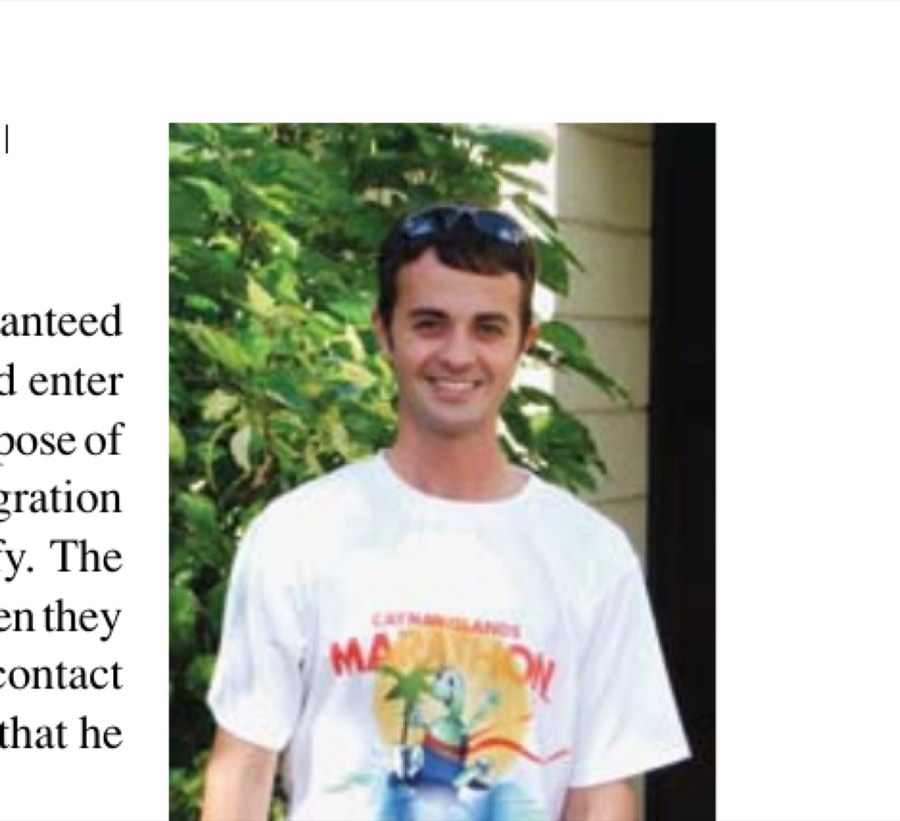
Getting there We couldn’t wait to get there. Boarding the plane in Miami to Grand Cayman, we struck up a conversation with a young man waiting for the same plane. Like us, Will Perez was heading to the race. Will was coming from Haiti, where he was spending a year between college and medical school running a medical clinic at an orphanage called Pwoje Espwa in Les Cayes, in rural Haiti. He was a little nervous about running his first marathon and very nervous about whether his Haitian friend Fritz would be waiting for him at the airport on Grand Cayman. As a Haitian, Fritz could not fly through the United States and had to go through Cuba. As a U.S. citizen, Will could not fly through Cuba. So they had to split up and meet at the airport, which is in George Town.
The race arranged an expedited customs line at the airport, which looked like it might have saved us about an hour of waiting. This was a lovely, welcoming gesture. After clearing customs, we received a goody bag with a miniature local rum cake, sunscreen, luggage tag, running light, and more. Smooth sailing for us. Will’s plan, however, was starting to unravel. Fritz was not at the airport.
We checked into the host hotel, the Grand Cayman Marriott Beach Resort, enjoying a complimentary refreshing (nonalcoholic) tropical punch. It was too dark to see much from the balcony, but we could smell that there were palm trees out there. It was enough to confirm that we were a long way from the Illinois winter.
The next day, before we headed downstairs for our first breakfast on the island, we put a few items in the room safe—passports, laptop, cash, and Jan’s watch. It’s a basic running watch, without expensive features like GPS or computer interface or Wi-Fi. It wasn’t given to her by a dearly departed friend or signed by a running celebrity or believed to be a good luck charm. But the watch is valuable, because Jan always wants to know what time it is, how long things take, and how much time is left. Although many runners are kind of neurotic about timing their runs, Jan also starts her watch at the moment any flight she is on takes off, which I have never seen anyone else do. (Jan says that’s not true. Just ask Michelle LeBrun from New England Runner magazine.) Jan’s explanation is that it helps her deal with her fear of flying, but I think she’s just a full-throttle split nerd. Anyway, the watch got locked away as a bold, symbolic emancipation from the tyranny of time, to more fully embrace the relaxed tropical spirit of the islands. And, she noted, she could always ask me what time it was.
Exploring the island After picking up our race packets and using some of our morning to plan what sights to see, we ran into Will just outside the hotel. He told us he was freaking out. Fritz, 24 and a former resident of the orphanage who had become Will’s right-hand man in his public health clinic, had not arrived in George Town the previous night. Will was going back to the airport later that afternoon to meet the next flight from Cuba, hoping that Fritz would be on it. If Fritz wasn’t on that flight, Will didn’t know if he would be able to run the marathon the next morning. Will had put nearly three months and $4,000 (raised through donations) to cover visas, passport, and flights to get Fritz to Grand Cayman. Fritz knew no Spanish and had little money and no way to communicate with Will or with home.
Will was carrying a small package of cookies and a container of chocolate milk. These snacks, he told us a little sheepishly, were a dispensation he was granting himself. We didn’t understand quite what he meant until we asked if he was going to the pasta feed.
Oh, no, he told us. His college buddies, who were runners, had told him to fast the day before the marathon. Jan and I exchanged concerned glances. Fasting
was, we told him tactfully, unconventional prerace preparation. However, after determining that he had fasted before his long training runs, we told him it was good to race the way you have trained and not to change things at the last minute. Besides, Will had enough to worry about without having us undermining his faith in his training the day before his first marathon.
After wishing Will well on his afternoon return to the airport, we wandered in search of lunch along West Bay Road, the main road running up the western arm of the island, packed with hotels, excellent restaurants, and quaint shops. Most of the hotels and other tourist accommodations on the island are along this magnificent soft white beach. Scanning both ways, we could see large, familiar signs: Wendy’s, Burger King, Subway. . . .There were also plenty of fancy local restaurants, but we were looking for something less formal (and cheaper). Fortunately, we found a great and reasonably priced place called Chicken Chicken. It serves—surprise!— chicken, slow roasted over hardwood and full of spicy Caribbean flavor. There were also some great side dishes. If you’re going to travel out of the country, it doesn’t make sense to eat the same food you would eat at home.
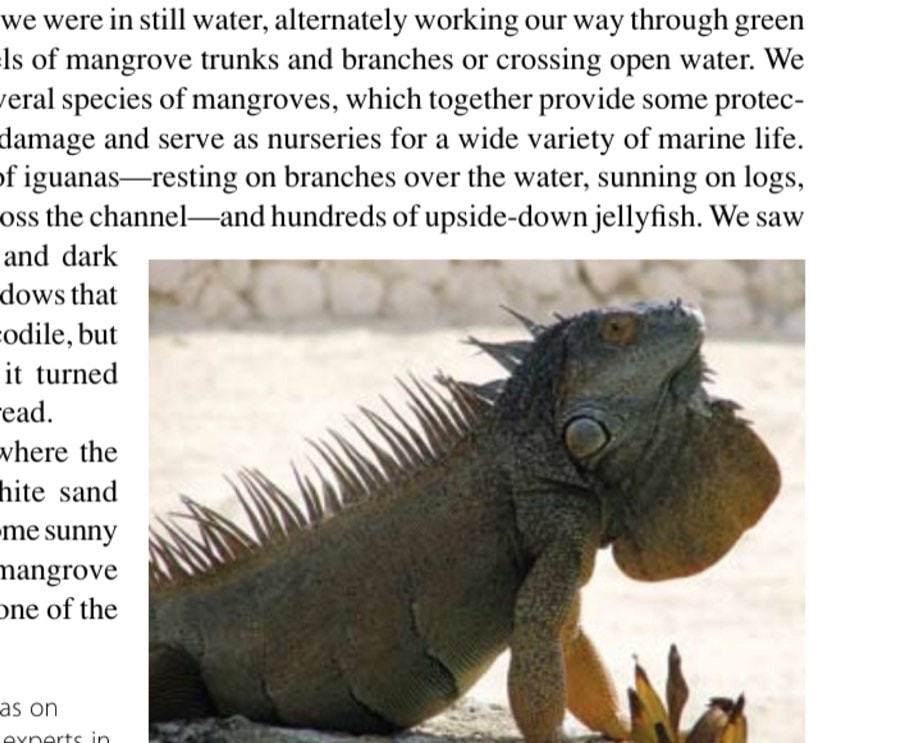
After lunch, we took a kayaking tour (www.caymankayaks.com) to get a closer look at the mangrove swamps that cloak much of the shoreline. Our guide, Tom, picked us up at the hotel and drove us to his secret launch point, where he had kayaks locked up and hiding in some brush. Once in the water, we paddled down the breezy, choppy, mangrove-lined coast toward a hidden channel. Once we turned into the channel, we were in still water, alternately working our way through green and brown tunnels of mangrove trunks and branches or crossing open water. We learned about several species of mangroves, which together provide some protection from storm damage and serve as nurseries for a wide variety of marine life. We saw dozens of iguanas—resting on branches over the water, sunning on logs, or swimming across the channel—and hundreds of upside-down jellyfish. We saw something long and dark lurking in the shadows that looked like a crocodile, but disappointingly it turned out to be a tire tread.
We learned where the famous local white sand comes from. In some sunny shallows of the mangrove swamp, we saw one of the ▲
The many iguanas on Grand Cayman are experts in basking in the sun.
main producers of that sand. A species of algae called Halimeda accumulates calcium carbonate as it grows. As parts of the plant die off, what formerly looked like little green leaves turn into hard, white, crumbly flakes, which fall to the ocean floor. Wave action breaks up these flakes into smaller and smaller grains, yielding a soft white sand. One square yard of this little plant, which grows in mats throughout the shallows, produces 5 to 10 pounds of sand per year.
On a later snorkeling trip, we saw the other main producer of Caymanian sand. The parrotfish is a large fish that scrapes off chunks of coral with its large front teeth. The fish uses other teeth to grind the coral and extract the algae that colonizes the coral polyps, then excretes the finely crushed coral sand. One large parrotfish can produce a ton of sand a year. (Note: This is trivia you might want to keep to yourself as you enjoy a romantic sunset, strolling barefoot through soft drifts of dead algae and parrotfish poop.)
In the evening, we walked the mile and a half from the hotel to the prerace pasta feed, held at the Breezes by the Bay restaurant in the center of George Town. It was a nice walk down the coast, taking us past the site of the Cayman Jazz Fest that is held the same weekend as the race. The food was your basic pasta variety, plus fresh fruit and bread, and drinks. The price was right—free to racers.
We had dinner with Michal Kapral, editor-in-chief of Canadian Running, who was also in town to cover the race. He is a Guinness world record holder for joggling (running while juggling three balls). His records include joggling a marathon in 2:50:12 and joggling a 10K in 36:27. His personal marathon best (not joggling) is 2:30:40. He was entered in the half, and he was going to joggle the race.
Since we had to wake up at 3:30 to catch a shuttle the next morning, we went to sleep early.
A dark beginning On race morning, Jan got her watch back, but just for the race. Since the full marathon was a double loop of the half-marathon course, and because we were not in marathon shape, we opted for the half. We weren’t the only ones with this idea. Seventy-three runners signed up for the full, with almost 500 doing the half, and an additional 200-plus in the four-person relay. Of these, 135 runners were from off the island, and many of them brought family members. The race is one of the most successful events in terms of bringing people to Grand Cayman.
The race starts at 5:00 a.m. in George Town. In the light of day, you see countless bars, restaurants, and gift shops. But at 5:00 in the morning, you don’t see much at all. We did see Will, though. He still had had no word from Fritz, he was still freaking out, and he hadn’t slept. Will feared that Fritz was hurt or even dead. Clearly, Will was in a far from optimal prerace state. We talked about
people being basically good and how chances were that Fritz was not in danger and that things would work out, but Will was, understandably, shaken. We won’t say they were a highlight of the race, because that would be weird, but we do have to praise the poshest porta-potties we have ever seen at a race. They were trailers equipped with bathrooms, with sinks and mirrors and fake wood paneling. Very classy. There weren’t very many of them, but there were enough for the number of race entrants. If the race ever reaches its goal of 2,000 runners, the organizers may have to go with something less upscale.
From the starting line, the race heads south on South Church, and the course quickly gets very dark once you leave the commercial part of George Town. If all of us runners had put on the running lights we got in our goody bags, we would have made an intriguing sight in those dark early miles. One large yard had a spectacular Christmas lights display, which stood out even more in the dark and also felt a little out of place with all the palm trees. The stars were bright, the ocean was visible or nearby, and the temperature was pleasant.
In the dark, the slap of running shoes was joined by a constant crowing from unseen roosters. At first, we thought they were just getting an early start on announcing the dawn. Later, once the sun had come up and the roosters continued their cheering, we realized that they just never stop crowing. On the positive side,
ad
at least there was some vocal support during less populated stretches, even if it was from birds. We later learned that the locals call the chicken the national bird.
Runners we talked with after the race uniformly loved running in the cool, predawn darkness. One runner, however, found the dark extra challenging. Michal Kapral, the joggler, ran so fast that he finished before sunrise and dropped his juggling balls 15 times (well above the two drops during his record-setting marathon run). Despite the drops, he covered the half-marathon course in 1:27 and finished third.
The course runs to the east to a turnaround at roughly 6.5 miles and then folds back on itself. So you get to see the runners who are ahead of you as they head back toward George Town. As we ran, we calculated when we would see Will, if he were on his Boston-qualifying goal pace. Since we were running pretty slowly, we figured he needed to reach the turnaround well ahead of us. As we got closer and closer to the turnaround without seeing him, we knew either we had somehow missed him or he was well behind his goal pace. Unfortunately, we hadn’t missed him—when we saw him, he was barely past the quarter mark of the race, and he already knew he was not going to reach his goal. Fortunately, he seemed to be in good spirits.
We have never run a race past so many cemeteries, many of them seemingly in people’s front yards. Some contained only a few plots, and some had dozens. Since the course covers the same ground four times, there are many chances to make a lame joke about dying.
The last few miles of the course loop are the least appealing. You’re away from the coast, running down city streets with a lot of turns and ▲
Michal Kapral juggled three balls the whole way and finished third in the half-marathon.
Courtesy of Cayman Islands Marathon
Small-town race charm
not much crowd support. A couple of these turns could have used a road guide or a sign, but we were always able to see what the people ahead of us were doing. A marathoner hitting these final miles for the second time would have fewer fellow runners to follow, and adding in the addled state one often enters at the end of a marathon, it wouldn’t be surprising if people got lost. In fact, we heard that one local runner did get lost and ran an extra 25 minutes.
The finish line was back at the starting area. Since we were running the half, we got to stop. Marathoners headed out for a second tour. Race director Kelly sells the two-loop course by saying, “People who run the full marathon get two different courses. It’s dark when they run the first loop, and it’s nice and bright the second time around.” On that second loop, they see a mix of beautiful, large new homes and cozy older bungalows lining the road that is often a block or less from the ocean. When you get a good view of the ocean, you see that bright, stunning mix of blue and turquoise waters that makes its way into every advertisement for Caribbean destinations.
Announcers James and Max worked the microphones at the finish line, and it seemed that just about all the runners got their names announced as they crossed the line. If you were a visitor, they announced where you were from, and if you were a local runner, they seemed to know you personally. The running commentary gave the event a warm, small-town race feel.
The postrace treats were refreshing—fresh tropical fruit, cold beer, water, Gatorade, and granola bars. As slow half-marathoners, we were not that far ahead of the winning marathoners—the men’s winning time was 2:42 and the women’s winning time was 3:12. Most runners, even the local ones, found the heat of the second loop taxing.
Courtesy of Cayman Islands Marathon
▲
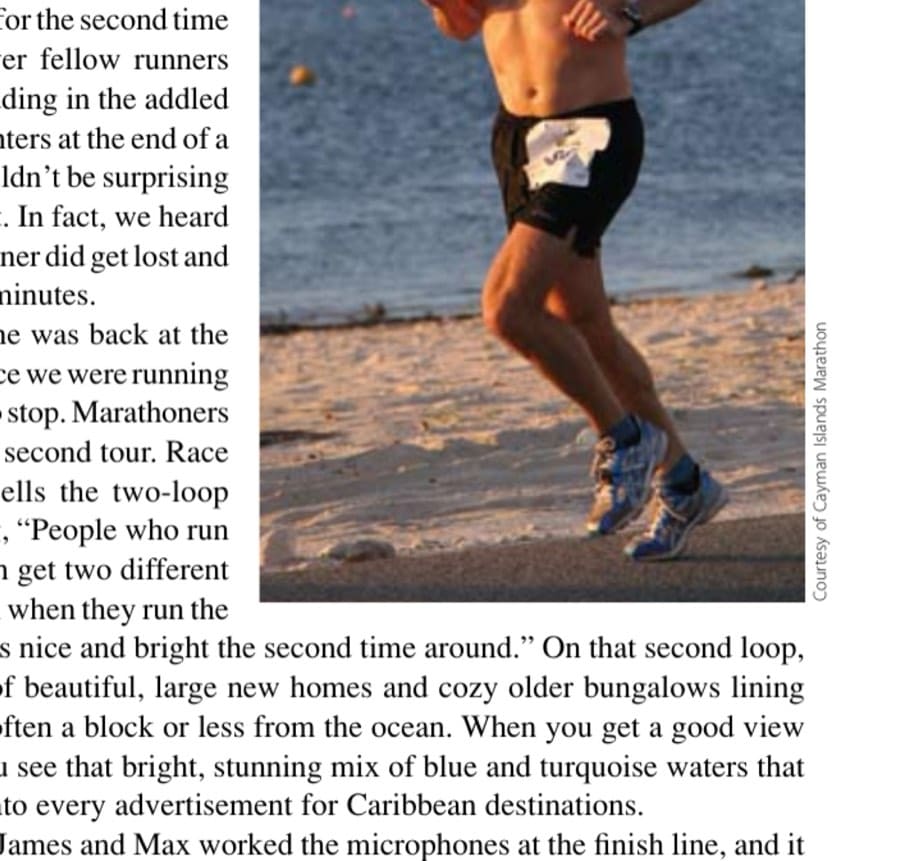
Much of the course is within earshot of, if not within sight of, the inviting blue waters of the Caribbean.
Courtesy of Cayman Islands Marathon
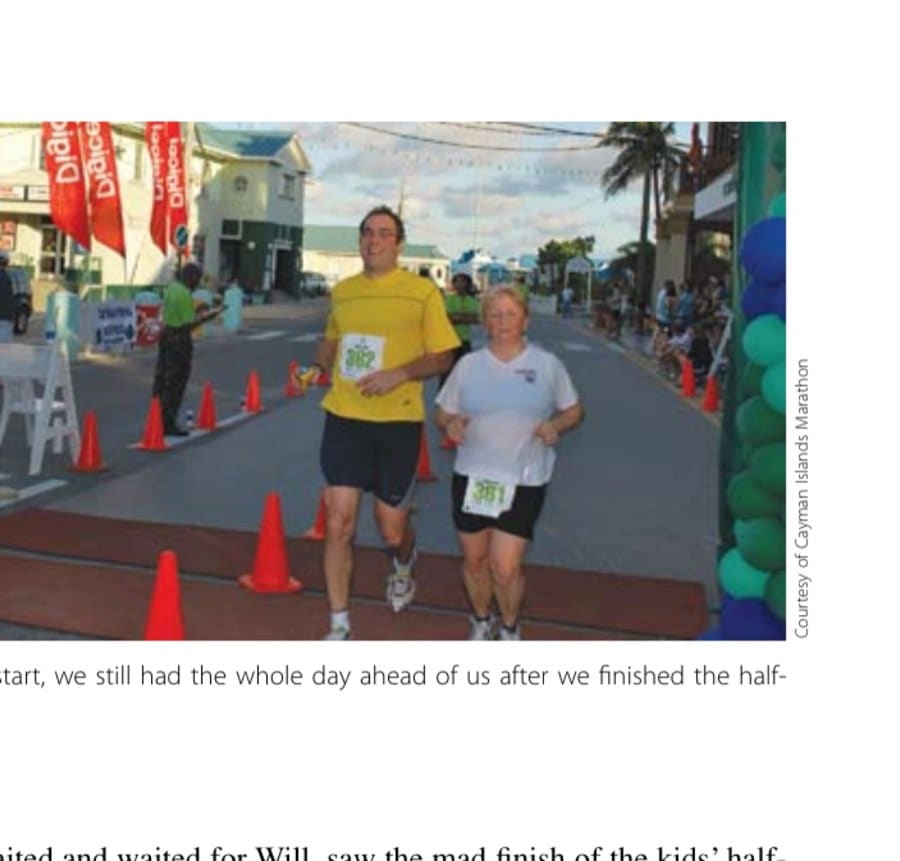
▲ With a 5:00 a.m. start, we still had the whole day ahead of us after we finished the halfmarathon.
Where is Will? We waited and waited and waited for Will, saw the mad finish of the kids’ halfmile run, and finally decided that Will probably had dropped out and that we should catch a shuttle back to the hotel. Now we were a bit freaked about Will’s whereabouts.
We finally reached him by phone, back at his hotel room. He had finished shortly after we left the finish line, just shy of five hours. The second loop had been “gruesome.” Continuing with his unorthodox training ideas, he was about to soothe his aches with a long soak in a hot tub. This time, we decided intervention was warranted. Explaining that soaking in a hot tub after a marathon would multiply the muscle damage already incurred, we talked him into taking an ice bath instead.
Postrace fun Our postrace plans also involved getting into the water, but cooler than a hot tub and warmer than an ice bath. The geography of the Cayman Islands blesses them with some of the world’s best snorkeling and diving. Because they have virtually no elevation above sea level, they have no streams or rivers, which means there is no silt flowing off the islands into the surrounding water, leading to underwater visibility that is often 100 feet or greater. Because the islands are in the Caribbean Sea, the water temperature is both very comfortable for people and also right for the development of coral reefs, which provide the foundation for diverse underwater ecosystems. Since the islands are the peaks of submerged mountains, they
are surrounded by relatively deep water, which provides dramatic underwater walls popular with divers. If you wanted to design an ideal snorkeling and diving environment, you would come up with something like the Cayman Islands.
We had booked an afternoon trip with one of several companies that take you to one of Grand Cayman’s unique features, Stingray City. For years, local fishermen would clean up after fishing trips at a sandbar and toss fishy leftovers overboard. Stingrays figured out that boats parking near the sandbar meant easy meals and began to gather whenever boats showed up, like kids swarming to an ice cream truck. Now, tour boats bring dozens of people to wade on that sandbar, surrounded by stingrays that are rewarded for their prompt attendance with scraps of seafood provided by the crew. The rays seem to fly past your legs, sometimes brushing against them. The guides claim that kissing a stingray brings seven years of good luck. Although that seems like an unusually high return from such a small investment, we both gave a smooch, just in case.
After visiting the stingrays, the boat stopped at a couple of prime snorkeling sites. Drifting over a reef of coral and plants that look like brains and fans, swimming with impossibly colorful fish, it was easy to imagine yourself floating through the pages of a Dr. Seuss book or flying over an imaginary planet. It was definitely an outstanding way to soothe the legs after a long race and an option you have after very few marathons.
The morning after the race, we had breakfast with Will. By this time, Will knew that Fritz was in Cuba, stranded by a breakdown in communication. The Cayman
▲ The clock starts ticking on the seven years of good luck Joe supposedly earns with this kiss.
▲
Running his first marathon was the least of Will Perez’s adventures.
Islands Immigration Department had guaranteed Will and the race organizers that Fritz could enter the Cayman Islands without a visa for the purpose of running the marathon, and that Cuban Immigration could call the Cayman department to verify. The Cubans attempted to call three times, and when they received no answer from the Immigration contact on the side of the Caymans, they told Fritz that he could not board the plane.
It wasn’t until three weeks later that Will learned the rest of the story. By the time Fritz was prevented from flying to Grand Cayman, he had already spent all the money Will had given him for lodging and taxis and had nowhere to go and no way of contacting Will or anyone else. His taxi driver took him in and fed him for the next several days until he could find a flight back to Haiti. He met a woman in the airport who couldn’t afford to buy him a ticket all the way back to Haiti but could get him as far as the Dominican Republic. On the flight to Santiago, he met a young man who offered to buy Fritz a plane ticket back to Haiti. As Will put it, “Here I am, thinking the absolute worst and believing that Fritz ran into horrible people, when in reality, he was blessed with the kindest and most caring people, one after another.”
So Fritz’s story, while disappointing, had a reasonably happy ending. Will’s story, on the other hand, defied belief. His family had been homeless for most of his childhood, drifting from state to state. He earned a full scholarship to Northfield Mount Hermon, a prestigious private school in north-central Massachusetts, won all its top academic prizes, and then earned a full scholarship to Brown. While at Brown, he became the sole breadwinner for his family when his mother was diagnosed with cancer, so he worked full time while holding down a full load of classes. Inspired by the work of Dr. Paul Farmer, first brought to his attention in the book Mountains Beyond Mountains, Will entered Brown’s eight-year program that combines an undergraduate degree with medical school. Before starting med school he was spending a year running a clinic at the Haitian orphanage. Oh, and he is also a Gold-level ballroom dancer. While Will did not meet his goal of qualifying for Boston in this, his first marathon, it’s pretty clear that he will accomplish that and just about anything else he sets his mind to.
After breakfast, we rented a car and took in a few of Grand Cayman’s other sights. Driving the car was itself an adventure, between driving on the left and having the driver’s seat on the right and half of the controls on the opposite side of
the steering column from where we expected them. It took most of the afternoon to stop turning on the windshield wipers when trying to signal a turn. Our first stop, and a popular destination for the daily tide of cruise ship passengers, was the Cayman Turtle Farm at Boatswain’s Beach on the northwest tip of the island. Much of the attraction consists of many tanks with a lot of green sea turtles in a full range of sizes and ages and several other varieties of sea turtle. Another part of the attraction lets you snorkel with tropical fish in a man-made lagoon, but this experience is very tame compared with the many reasonably priced snorkel trips that take you to a real reef.
The turtle farm provides a chance to sample a uniquely Caymanian food, turtle soup. You often hear that various exotic animals taste like chicken, which is meant to be reassuring but is somewhat disappointing. If you’re going to eat something scary or rare or wild, it would seem more satisfying if it were somehow distinguishable from the shrink-wrapped output of our agroindustrial food factories. Fortunately, the chunks of turtle meat in our bowls of soup tasted nothing like chicken. Unfortunately, they looked and tasted like beef. Another local delicacy, conch fritters, was also on the menu at the turtle farm’s restaurant. They tasted like fritters.
From the turtle farm on the northwest tip of the island, we drove to the much less populous and less developed eastern half of the island. We drove through Bodden Town, the original capital, and got as far as the Blow Holes, where waves rush into small caverns at the waterline and force geyserlike eruptions of spray up from openings in the rock. We had hoped to hike in one of the reserves maintained by the National Trust for the Cayman Islands (www.nationaltrust.org. ky), but we ran out of time.
Worth it The next day, we had to fly back to the cold. We wished we could have stayed another day or two, and not just because a tropical island compares quite favorably to central Illinois in early December. We did not get to see as much of the eastern half of the island as we would have liked, and we could have stood another snorkeling trip. As short as the trip was, it was definitely worth it. Grand Cayman is warm, at a time of year when most of us appreciate the warmth. The race is well organized, with frequent e-mail updates from the ever-friendly Bev Sinclair from Kelly Holding in the months and days leading up to race day. The race and the island are slightly exotic, but with a comfortable, familiar, small-town feel. You get to recover from the race in the company of sergeant majors, French grunts, blue tangs, and other reef fish. You will probably meet some very interesting people, though maybe not as interesting as a record-setting joggler or a ballroom dance champion who runs a health clinic in a Haitian orphanage.
In short, if you’re asked if you want to go to the Cayman Islands in December to run a marathon, the right answer is, “Yes.”
This article originally appeared in Marathon & Beyond, Vol. 13, No. 3 (2009).
← Browse the full M&B ArchiveMore like this
1,000+ stories from 19 years of Marathon & Beyond
The complete archive of the legendary long-distance journal — digitized and free to read.
