

Townsmen Of A Stillertown
Townsman of a Stiller Town1 On the Death of Ryan Shay. by Jason Friedman, m.d.
H 1
© Victah / www.PhotoRun.net
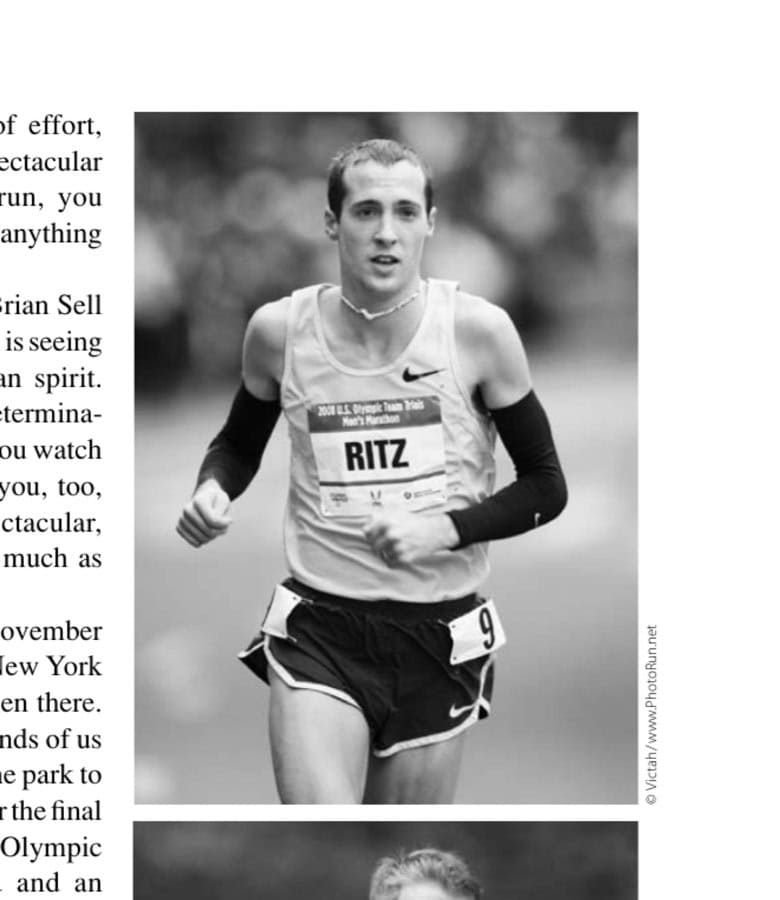
ave you ever seen Ryan Hall run? No? You’re missing out. Seeing Ryan Hall run is like seeing Michelangelo’s David, a pure expression of human perfection. Ryan Hall running is smooth, effortless motion suffused with light. If you took Miles Davis’s “Birth of the Cool” and transformed it into solid matter, it would look like Ryan Hall running. Have you ever seen Dathan Ritzenhein run? Seeing Ritz run is like seeing LeBron James play basketball or Tiger Woods hit a four-iron—watching someone do exactly what he was born to do. It’s not effortless, not exactly; it’s Ryan Hall.
“Townsman of a stiller town” is taken from the eighth line of the A.E. Housman poem “To an Athlete Dying Young.”
© Victah / www.PhotoRun.net © Victah / www.PhotoRun.net
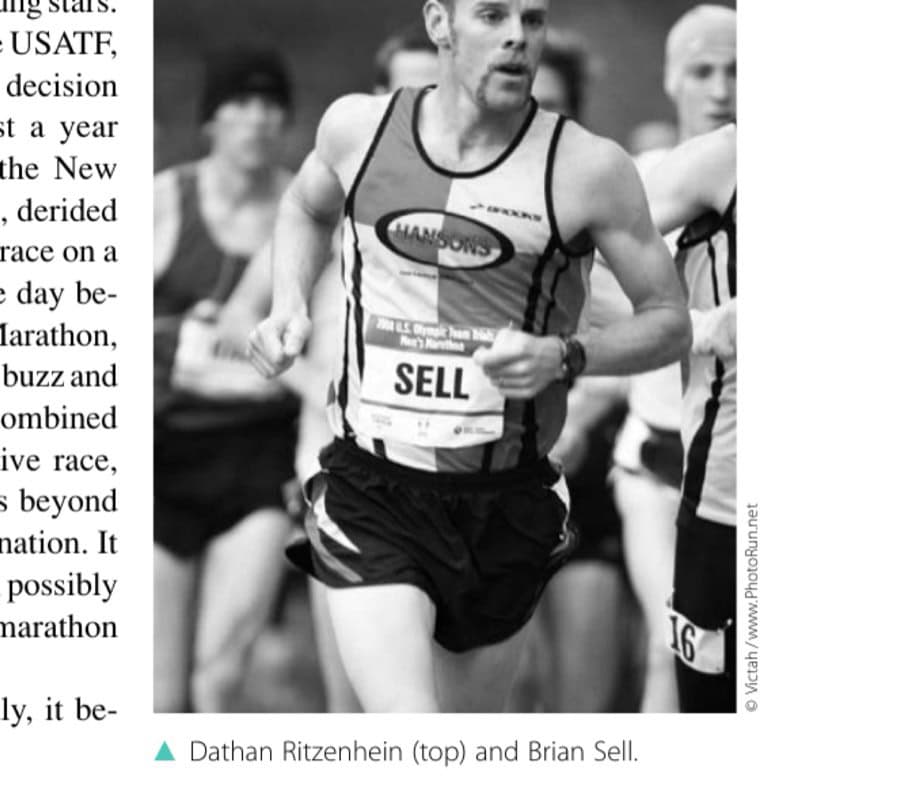
a single-minded focus of effort, an intensity that yields spectacular results. Watching Ritz run, you cannot picture him doing anything else, ever. Have you ever seen Brian Sell run? Seeing Brian Sell run is seeing an embodiment of human spirit. Brian Sell running is determination and purpose. When you watch Brian run, you feel that you, too, could do something spectacular, if only you wanted it as much as he does.
I saw them all run in November 2007 in Central Park in New York City. You should have been there. Maybe you were. Thousands of us were, sprinting through the park to follow the race unfold over the final 10 miles, producing an Olympic Marathon Trials record and an Olympic team of three young stars. Man, it was beautiful. The USATF, roundly criticized for its decision to hold the Trials almost a year before the Games, and the New York Road Runners Club, derided for its decision to run the race on a criterium-style course the day before the New York City Marathon, were both vindicated. The buzz and the energy at the event, combined with a fast and competitive race, made the Trials a success beyond everyone’s wildest imagination. It was, all things considered, possibly the best day in American marathon history. And then, very quickly, it became the worst.
Dathan Ritzenhein (top) and Brian Sell.
Ryan Shay has been memorialized and eulogized in print countless times in the months since his tragic death five miles into that race, and with good reason. He was a former national champion who embodied everything good about the sport, everything we look for in our athletic heroes—hardworking, determined, focused, virtuous; a family man, a great teammate, a loyal friend. I’m not here to eulogize; I didn’t know Ryan any more than I know you, and why pretend otherwise? This isn’t a story about whom, and it isn’t a story about why, either; I don’t know why, and neither do you. There is no why for something like this, not in any meaningful sense, anyway. This is simply a story about what. It’s a what that has grabbed more attention recently, in the aftermath of Central Park and similar stories in Utica (Boilermaker), D.C. (Marine Corps), and Chicago, but it has been a part of the sport ever since the beginning, and if Ryan Shay brings it into our conversation now, well, now is as good a time as any.
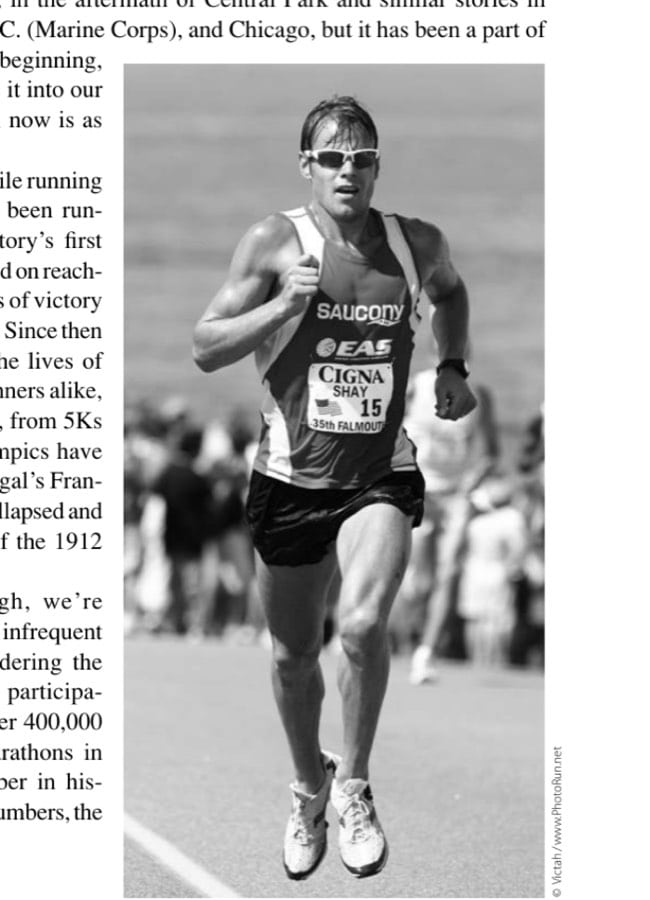
People have died while running ever since people have been running. Pheidippides, history’s first marathoner, dropped dead on reaching Athens with his news of victory (if you believe the story). Since then the sport has claimed the lives of elite and recreational runners alike, in races large and small, from 5Ks to ultras. Even the Olympics have not been immune; Portugal’s Francisco Lazaro, only 21, collapsed and died at the 30K mark of the 1912 Olympic marathon.
For all that, though, we’re looking at a relatively infrequent event, especially considering the explosion in marathon participation in recent years. Over 400,000 Americans finished marathons in 2006, the highest number in history; considering these numbers, the
Ryan Shay.
© Victah / www.PhotoRun.net
The Case of Ryan Shay
incidence of death during competition is actually quite low. Studies from Marine Corps and Twin Cities suggest a rate of about one death per 50,000 competitors. The Honolulu Marathon reports an even lower rate during its 35 years of existence, with four deaths among nearly 500,000 finishers; Chicago and London report death rates of about 1 in 80,000.
So why the publicity, why the concern? Partly because it is so rare, lending it an air of the exotic; partly because we’re talking about death, which any Hollywood executive will tell you sells just as reliably as sex. But there is something else. We runners see ourselves as a privileged lot, blessed with mental and physical strength of which couch-dwelling mortals can only dream. Running, by its very nature, promotes health. When one of us is struck down at our shared, appointed task, our reaction goes beyond simple grief, curiosity, or surprise. Those who die while running cut through the immortality that we feel running lends to us; death violates the unwritten contract we have with our sport. On every level, it resonates: that could be us.
The Matter of “Marathoning Death” I’m trying to find out more about all this, not necessarily about Ryan Shay but about what may underlie this phenomenon of “marathoning death.” Jack Scaff may know as much about it as anyone. A cardiologist in Honolulu, Dr. Scaff has been collecting data on sudden death among distance runners for years. As the director of the Honolulu Sports Foundation, he has overseen medical care at the Honolulu Marathon for the last 25 years. More than anyone else, he may be able to attach a “why” to this puzzle, at least in the narrowest, physiological sense.
Even on the phone, from six time zones away, Dr. Scaff is engaging. He speaks with the confidence of a man who is secure in his convictions, even zealous. I tell him who I am, what I’m looking for. He seems interested. “Do you run marathons?” he asks. I tell him I do. “What’s your best time?” he asks. I tell him. “That’s very good,” he says. “You’re not a vegan, are you?”
Dr. Scaff is a True Believer, and what he believes in is fat. He thinks that may hold the key to the puzzle of young athletes dying while running. First of all, he tells me, while sudden death among runners is certainly not an everyday occurrence, it is definitely more prevalent than the well-reported incidents that occur during competition. He estimates that between three and 10 times as many people die in training as in races. This rings true to me; both of the friends whom I have lost through running—Andy Palmer and Travis Landreth—died on training runs, as did running guru Jim Fixx and world-class Ethiopian miler Alem Techale. Clearly, this is partly because we spend more time training than racing. But Dr. Scaff believes that there is something else at work that has previously gone unrecognized. The proximate cause of death in all these cases is ventricular
fibrillation (v-fib), a terminal cardiac arrhythmia. However, v-fib does not occur in a vacuum; there must be an underlying cause. Might there be a common factor that links these disparate cases?
How Common Is V-Fib? The most common cause of v-fib arrest in the general population is coronary atherosclerosis—garden-variety heart disease. Runners can have heart disease too, of course; Fixx’s autopsy revealed severe atherosclerosis, attributed to his elevated cholesterol and family history of heart disease. But Dr. Scaff thinks that the traditional medical model has overestimated the role that atherosclerosis plays in sudden cardiac death, at least among runners. First of all, v-fib from underlying coronary disease is due to myocardial ischemia—reduced blood flow to the heart muscle because of the narrowing of the coronary arteries. But such deaths should be more common during periods of high cardiac demand (races) than during easy training runs. Furthermore, Dr. Scaff argues, runners should be less susceptible to such attacks, since their coronary arteries and heart muscle have adapted to meet the higher oxygen demands required by the sport.
All these factors aside, the traditional cardiovascular model does not account for young runners who die with normal coronary arteries, like Shay and Chad Schieber, who died in the 2007 Chicago Marathon. Shay’s autopsy revealed only an “enlarged heart,” a common finding in healthy athletes, as well as “patchy fibrosis,” a scarring of the heart muscle whose significance in this case is unclear. Schieber’s diagnosis was reported as mitral valve prolapse, another common condition that is unrelated to coronary disease (though has been implicated in causing certain cardiac arrythmias).
Death in young exercising people is also frequently attributed to congenital, genetic cardiac abnormalities, most prominently hypertrophic cardiomyopathy (HCM). These cases are often high-profile, well-publicized events, inasmuch as they are sudden and rarely predictable. Whenever I hear of a young athlete who dies while competing or training, I immediately think of HCM. For hemodynamic reasons, however, death from HCM is much more common in sports where the action occurs in brief, interrupted, high-intensity bouts interspersed with periods of rest (like basketball), as opposed to those where exertion is continuous (like distance running). Regardless, HCM is detectable by autopsy and was not found in any of the cases mentioned here.
To be sure, there are a multitude of other possible causes of death in marathoners during racing or training—such as heat-related illness, electrolyte abnormalities, or respiratory issues—but a significant percentage of these deaths remains unexplained. These other causes, too, generally have a greater impact as people age. If these were the only contributing factors, then the population of athletes
dying should be skewed toward an older demographic. In fact, Dr. Scaff says, the majority of sudden deaths in marathoners occurs among young people, “usually within six months of a PR.” He believes another factor is at work, which he thinks is primarily a nutritional issue.
The theory is that young, fit athletes with low body fat, especially those in heavy training, run into a substrate deficiency—in plain terms, there simply isn’t enough fuel for the heart to draw on. “When we’re young,” Dr. Scaff says, “we’re striving to be thin; this is healthy from a cardiovascular standpoint. But when people are older and very thin, we call it ‘failure to thrive.’ We recognize that their bodies need some extra fat to subsist on. Many young, competitive marathoners simply don’t have enough fat in their diets, and this can lead to a sort of chronic malnourishment, which ultimately places the heart under a lot of strain.”
Just How Much Fat Is Needed? It’s an intriguing theory, one with plenty of nutritional studies to support it, though whether this played a role in the deaths of Shay, Schieber, Techale, or anyone else is difficult, if not impossible, to prove. Beyond that, however, the idea strikes in me a discomfiting chord. We search for the “why” in these cases in the name of prevention, so that we might recognize when other runners are at risk for similar problems; but we also search for the “why” as a means of reassurance. When we identify a proximate, definitive cause—hyponatremia, genetic heart conditions, drug use—we are able to feel better about our own chances of avoiding such a fate. We search for those “whys” that mitigate our own risk, that allow us to dismiss that nagging feeling that we might be next.
This is not one of those “whys.” Those of us out there on the edge, training 80 or 90 or 100 miles a week, searching for a few seconds here or a few minutes there—this does not reassure us. Quenton Cassidy (in the novel Once a Runner) told us that “Gaunt is beautiful,” and we agreed. We don’t want to consider the possibility that gaunt might kill us.
A Time for Contemplation Even so, I’m not running less these days, or eating more. I ran the day after the Trials, and the day after that, and the day after that, too. I ran easy days and hard days and generally didn’t change much of anything. Is that sad, or unfeeling, or disrespectful, or heedless?
Everything in life involves risk. The hour I spent driving to and from work yesterday was much riskier, statistically, than the hour I spent running. We mitigate these risks by eating right, by wearing seatbelts, by looking both ways before we cross the street. How do we mitigate the risks of our sport? Ultimately, we each decide what risks we are willing to accept for ourselves and whether our lives
will be as meaningful or fulfilling if we allow those risks to prevent us from doing the things that bring us joy. What can those of us who didn’t know Ryan Shay take from all this? Is there a lesson? A meaning? There may be a medical “why,” a scientific “why,” and that will have to be puzzled out over the coming weeks and months. But is there another “why” ? Can Ryan’s death mean something to me? Can Andy’s or Travis’s death mean something to you? Maybe. I ran 15 miles today and thought about them. Try it. Run tomorrow, and enjoy it, and think about it for a bit. For now, maybe that meaning will be enough.

This article originally appeared in Marathon & Beyond, Vol. 12, No. 6 (2008).
← Browse the full M&B ArchiveMore like this
1,000+ stories from 19 years of Marathon & Beyond
The complete archive of the legendary long-distance journal — digitized and free to read.
