

Where Have All The Sumos Gone?
Afew minutes before 7:00 A.M. every Saturday, a group of a dozen or so runners congregates beneath the carvings of Stonewall Jackson, Robert E. Lee, and Jefferson Davis. In the shadow of the world’s largest hunk of granite, at Stone Mountain, Georgia, the runners slowly set out precisely at 7:00. Not at 6:59, not at 7:01. These are the Stone Mountain Sumos, and from 1982 to 1987, I ran with them.
For 25 years, the Sumos have trudged out in all sorts of weather, usually heading out of the Stone Mountain Park to Ponce de Leon Avenue. The rare times they veered from this direction, they ran up the Fish Pond Hill on the other side of Stone Mountain.
The name came from a chance remark. One of the guys observed, “We look more like a bunch of Sumos than we look like runners!” The name stuck. All of the Sumos were male, though later a few summettes would break the sex barrier.
I was 32 when introduced to the Sumos by Jim Meehan, a friend from another running group, the speed workout group coached by Lee Fidler, a road racing speedster who took 11th at Boston in 1975 (2:16:51) and 14th in ’78 (2:16:14).
It was convenient to go to the mountain, 10 minutes from where I lived, while working on my doctorate at Georgia State University. I was the youngest and usually the fastest sumo. Most of the Sumos were already in their 40s with kids approaching college. Not one of them was born in Georgia, hailing instead from the Midwest, East, Florida, and Kentucky.
THE DEMOGRAPHICS OF THE SUMOS Work was the reason everyone found themselves in Atlanta in the early ’80s, except for me. They were politically conservative, and everyone had families and 3.2 kids to provide for. They were mainstream Americans. They told dirty jokes on the run. Mike Graham, a member of the Toastmasters, sometimes practiced his speeches, and week in, week out, a male bond formed within the group that was
Courtesy of Scott Young
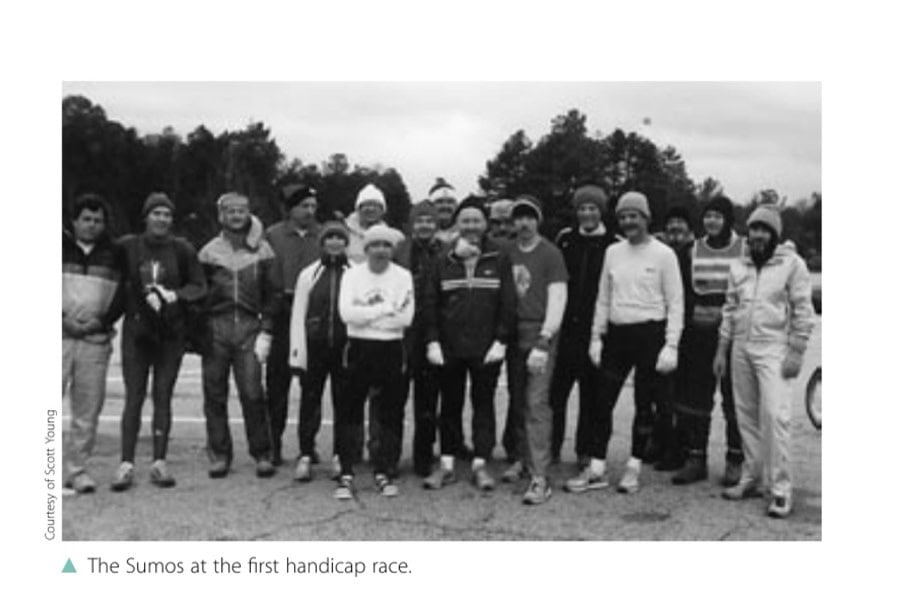
▲ The Sumos at the first handicap race.
akin to a squad of soldiers. Our “wars” were marathons, from which we returned with our war stories, usually of defeat by a variety of means: dehydration, sore calves, drinking too much beer the night before, and so forth.
Back then it took 2:50 to qualify for Boston if you were under 40 and 3:10 if you were a masters runner. Only one sumo qualified under those rules: Bill McManus. After several attempts to break 3:10, Bill qualified at the Columbus (Ohio) Marathon. The morning of the race, I saw him staring at himself in the mirror, repeating a mantra: “I am strong. I am strong. I am strong.” He made it to Boston but quit running soon after. I guess he had no more mountains to conquer.
We had a newsletter and an annual handicap race, which is now in its 19th year. We came up with a logo and T-shirts. But the Sumos resisted change. Several times, I brought members of my speed group to run: Lucia Geraci, an Olympic Trials competitor, and Sue Parker, a 2:50 marathoner. Some Sumos complained that it wasn’t that the women were fast that bothered them, it was that they felt they could no longer burp and fart.
The Sumos were mostly in managerial-type positions: a trucking supervisor, real-estate agency owner, an information systems analyst, a hazardous waste engineer, a school administrator, and three professional managers in assorted industries. No one was involved in politics, and we were indictment-free. Life was uneventful for all of us, until one guy went through a divorce. When he remarried, his new wife convinced him that the only reason he ran was to get away from his first wife and that if he was truly happy, he would have no need to run at all. So he quit the group. The last person to see him said he had gained so much
weight that he was hardly recognizable. Next, McManus moved to Alpharetta, out of commuting range to Stone Mountain. Ron Lawson, one of the founders, followed soon after, with a job move to South Carolina. When I graduated and moved to Utah, most of the group was intact, but year by year it dwindled. Three more guys got divorced, including me. Two of us remarried; the other embraced chastity. Several Sumos retired and moved away to Florida or the Georgia mountains. Each time someone moved, a new sumo appeared, someone who fit in with the burping, farting culture of middle-aged men.
THE FACES CHANGE, BUT THE SUMOS REMAIN THE SAME Thus, the core size of a dozen to 20 Sumos continues on to this day. The handicap is still run every December. The runs grew slower, shorter, and the breakfasts grew bigger, longer. A long run is now five miles and takes 50 minutes. Breakfasts last two hours, and everyone talks about the days when they were faster and could run marathons.
It is 17 years since I left that Saturday running entourage in Georgia. In Utah, I found the need to affiliate with a similar group, but the only similarity was that it was a group. This group was coed. It was faster than the Sumos—so fast that if someone did fart, it was faster than the speed of sound, so you couldn’t hear it. The members ran on Sundays and were a mix of professionals: a professor, academic dean, chief financial officer, pilot, and housewives.
Kim Clark and Pat Bagley had run 2:40 marathons and Brad Hardy a 2:23. One of the women, Celsa Bowman, ran the 10,000 meters in the 1996 Olympic Trials. Ken Jameson won his age group at the Marine Corps Marathon. Lisa Schneider, Cindy Clark, Linda Mulkey, Cindy Jackson, and Cecilia Mulroy usually swept the local women’s masters category. David Bjorkman had run 55 marathons. It was, indeed, a fast, fast Sunday morning.
Each of us had to run through one personal crisis after another; whether it was finding the meaning of life, marital problems, financial, health, or family, someone always had a monster to deal with. Running became a way to drown your sorrows, and a long run was much like huddling together over a couple pitchers of beer. We did our share of both activities.
The group set off every Sunday morning at 7:00 A.M. (like the Sumos) from Einstein’s on 15th and 15th. It will be there, in Salt Lake City, this Sunday. The Sumos will be there, in Stone Mountain, on Saturday. Bank on it.
It is not easy to awake at six o’clock, chug two cups of coffee, and get going out the door. But if you know your running companions are there, you show up. Pouring rain? Snow? Frigid winds? Bad weather is when running companions count. In these two groups, I learned the value of a group of friends who shared more than running.
This article originally appeared in Marathon & Beyond, Vol. 10, No. 1 (2006).
← Browse the full M&B ArchiveMore like this
1,000+ stories from 19 years of Marathon & Beyond
The complete archive of the legendary long-distance journal — digitized and free to read.
