

Will The Real World Record For 50 Miles Please Stand?
“You’ve got to be small, light, [have] strong legs, good heart, good lungs, and no brain cells—[because] it’s a stupid thing to do.” —Bruce Fordyce (50-mile world record holder)
▲
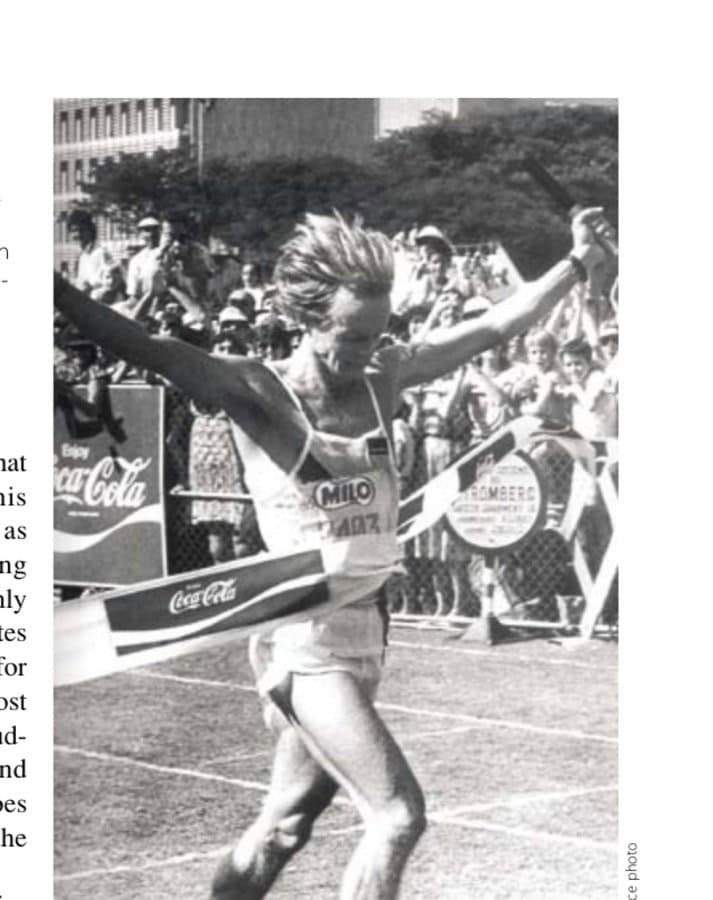
Bruce Fordyce en route to a new 50-mile world record in Chicago on October 14, 1984.
Stan Wagon photo. Courtesy of Dr. Noel Nequin
Without much notice or fanfare, and certainly with no hype from the media, a silver anniversary of sorts took place on October 14, 2009. It was on that date in 1984 that the world record for running 50 miles was set. The man who did it is quoted above, while answering an interviewer’s question about what it takes to be a good runner. Bruce Fordyce, a South African, set the record at 4:50:51 in winning the 50-mile race of the AMJA Ultramarathons in Chicago over 25 years ago. No other runner has broken it since. That acronym AMJA stands for the American Medical Joggers As-
sociation, and each fall from 1979 through 1990 AMJA Race Director Dr. Noel Nequin, a cardiologist at Swedish Covenant Hospital in Chicago (now retired), would host at least two ultramarathon races on the same day along the city’s lakefront parkland. Usually a 50-mile race (50M) would be combined with a 100-kilometer race (100K) through the convenience of running multiple loops (although now they would be called “out-and-backs”). Each “loop” would consist of a 10-mile round trip, so five trips made the 50M and six-and-a-partial made the 100K (62.5 miles). Once, however, a 100-mile race was added, and toward the end 50K races were included. A distinctive feature of the AMJA runs was that any runner could stop at the shorter distance or continue on to the longer distance, after having beaten the first cutoff, of course. And those cutoffs weren’t easy (9 1/2 hours for the 50M).
For many (or most) of the years of its existence, the AMJA Ultramarathons were also designated by the Road Runners Club of America (RRCA) as the national championship for one or more of its races. In 1984, for example, the AMJA 50M was so designated, whereas in 1982 both the 50M and the 100K were national championships. This is one reason why Bruce Fordyce, for years afterward, reported that in 1984 he won the USA 50-Mile Championship. He did not say he had just set the 50M world record—mainly because he didn’t believe it himself!
The history and the hysteria For one thing, Bruce had thought he already had the world record before ever running the AMJA and, for another, the Guinness Book of Records still has it wrong! This gets complicated. It all goes back, really, to when Bruce himself got started. He was born December 3, 1955, in a British military hospital in Hong Kong (then a British crown colony), the son of a (Scot) British Army officer and Scottish mother who had met in South Africa. Thus Bruce started life as a British subject. The family then began, or continued, the nomadic army lifestyle, and it was in Singapore that Bruce’s year-younger sister, Oonagh, was born. Since the families of both parents lived in the British Dominion of South Africa, Bruce and his sister often visited there. That is how Bruce first fell in love with the country.
From East Asia, the Fordyces moved to England in 1963, where Bruce and Oonagh were early educated; then in 1968, the family finally moved to be near their grandparents in South Africa, which by then had become the RSA (Republic of South Africa). Bruce has lived there ever since, while his sister now resides mainly in London. The significance of all this is how Bruce can thus claim dual citizenship (UK and RSA) and thereby possess two passports, and that has figured largely in his ability to make world records.
Why? Because of politics, the root of all international sporting evil. The reader may recall that the U.S. decided to boycott the Moscow Summer Olympics in
1980 because of politics (and President Jimmy Carter’s disapproval of the USSR’s military activities in Afghanistan). The situation in South Africa was even worse. Precisely because of the early RSA’s chosen way of governance—apartheid— vast numbers of international hosts banned South African athletes from competing in their countries. And that included England, where the annual Londonto-Brighton ultramarathon took place, which varied over the years in distance but was always longer than 50 miles.
So after Bruce had begun cutting his teeth—and soon thereafter earning his chops—at the Comrades Marathon, he began entertaining the idea of competing internationally but was stopped cold in his tracks. Almost all other countries, appalled at apartheid, had joined in a massive sports boycott and refused to send their athletes to South Africa, to receive any from South Africa, or even to recognize any South African records or achievements whatsoever. But Bruce was also British, and that’s how he got into London-to-Brighton.
Fordyce was able to run that famous race three years in a row prior to Chicago, and it was in England, on September 25, 1983, while en route to Brighton, that he happened to pass the 50-mile-split timed mark in world record time: 4:50:21. At least that’s what he and everybody else thought—including the Guinness Book of Records people! However, this presumed world-best performance could not be ratified by the IAAF (International Association of Athletics Federations), TAC (The Athletics Congress, later the USATF), or any other formal ultrarunning governing body. So it was good (for many reasons) that he came to Chicago.
Years afterward the Englishman Andy Milroy, a most authoritative ultrarunning statistician, explained it this way: “According to the Ultra Marathon Race Handbook, which is the accepted rule book for the sport, World Best Performances
Gill Fordyce photo
▲
This framed certificate from the Guinness Book of Records now hangs in the Fordyce home. Guinness, however, got it wrong! Bruce’s 50-mile split during the longer one-way, possibly wind-assisted race was not accorded by ultramarathon rules to be a World Best Performance, even though it was slightly faster. His full 50-mile time on the looped course at Chicago remains the correct and ratified world record.
on the road can only be set on courses that have less than 30 percent separation between start and finish. Other marks are regarded as point-topoint and if superior to the best listed mark on an eligible course are listed as a Noteworthy Performance. Therefore, Fordyce’s Chicago mark is the World Best Performance, and the Brighton mark is accorded Noteworthy Performance status.” [Editor’s note: An investigation into Fordyce’s world record determinations was published in Marathon & Beyond for September/October 2001 on pages 166–69.]
Come to beat his own record In any event, before arriving in Chicago in 1984, Bruce and the world of ultrarunning had thought his 4:50:21 was the world best. In fact, Bruce’s avowed purpose in running the AMJA was to try to lower that time and break his own record. Stan Wagon, a coeditor of Ultrarunning magazine at the time, interviewed Bruce in Chicago the night before his AMJA race and wrote: “By virtue of his British citizenship, the South African has been able to compete in both the Comrades and London-to-Brighton races, the two most competitive 50+ mile races in the world.”
Problems involved with determining world records were minuscule, however, compared with the problems facing South African athletes in trying to compete outside their county or in being globally recognized within their country, as well as the problems facing some outside international athletes trying to compete
Red Daniells/Studio 3
▲
Bruce Fordyce running London-to-Brighton in 1982 with his sister Oonagh “seconding” (pacing) him. “The most athletic picture I ever saw,” according to Don Winkley.
inside the RSA—foreign black runners at Comrades, for example. The ban worked both ways. During Wagon’s interview with Fordyce, the most famous then-known banning example was brought up: Zola Budd. She was a native of South Africa, a teenage (barefoot) track sensation who set the then-world record for the women’s 5,000 meters—which the international track and field community refused to recognize. Wagon and Fordyce discussed Budd’s performance at the 1984 Los Angeles Summer Olympics. It wasn’t just Budd’s on-track tangle with America’s Mary Decker that made headlines; it was the fact that Budd was a South African and therefore banned by the IOC. But through an interestingly arranged last-minute move—and her grandfather’s birthright—Budd became a British citizen, flew to America with a British passport, and competed in Los Angeles on the British team. So there was Bruce Fordyce, fresh from visiting those Olympics earlier that summer, talking with Stan Wagon the very night before his next big 50-mile race, discussing the problems of a banned athlete from South Africa, after having just been very nearly banned from running the AMJA himself! This is how it happened. Part of the politics of a race being put on by the American Medical Joggers Association is having a prerace medical seminar (the academic version of today’s expo). Guest speakers would speak, medical researchers would report findings of studies on long-distance running, and reputable athletes like Bruce Fordyce would be expected to be panelists on panels taking questions from the audience. The official program for that Saturday, October 13, called for a 3:00 p.m. “Ultramarathoners’ Panel—Learning from the Best . . . featuring
BRUCE FORDYCE (50-mile world record holder),” and others. The scene is described in his biography, Bruce Fordyce: Comrades King: “The attendants and officials of the AMJA 50-miler were nearly all medical students and most of them were black. When they heard that the favourite to win the race was a visiting white South African, they were appalled. ‘Either withdraw his invitation or we’ll have nothing to do with the event,’ was their message.” (Call it rather a threat!) But Bruce had vindicated himself beforehand as an antiapartheid protester, so cooler heads prevailed.
When becoming a “hippie protester” pays off “Race organizer Dr. Nequin,” the biography continues, “told them about Fordyce’s black armband in the 1981 Comrades and asked them to give him a chance to explain his views. . . . When Fordyce stood before [the] highly charged audience, the first question asked of him was, ‘How do you feel about Archbishop Tutu winning the Nobel Peace Prize?’ He answered, ‘It’s a great honour for South Africa.’ Further probing elicited frank and forthright responses from the South African. Afterwards, a carbo-meal and a few beers were shared. Fordyce was made to feel at home,
the students happily assisted on race day, and the Comrades Marathon champion romped home by a record margin of over half an hour.” [Actually, the published race results for October 14 show a lesser margin: “1. Bruce Fordyce, 28, SA— 4:50:50/World record for loop course/ U.S. All-comers record” and “2. Don Helfer, 24, MO—5:16:53*” (the asterisk meant a U.S. single-age record).]
So it was after that afternoon’s grilling by black American medical students that the great white African sat down with Stan Wagon for the evening’s grilling for the magazine. Stan wanted clarification of Bruce’s armband protest. “
A couple of years ago you were the center of some controversy in South Africa when the Comrades race was held on a national holiday and you and others wore black armbands. Can you describe the situation?” Stan asked. “
Yes, that was a tough time for me,” Bruce answered. “There was some hostility then, and in some quarters there probably still is now. But I’ve never hidden my views: I really hate apartheid and I think it’s been terribly damaging to the country which I love very much. I just think it’s an evil thing.”
The Comrades referred to happened in 1981 when the race date was changed to June 1 and become part of the festivities of Republic Day—noting the change from USA (Union of South Africa) to RSA (Republic of South Africa) that occurred on May 31, 1961, and completed the separation from Great Britain. Not quite the same as America’s Fourth of July, South Africa’s 31st of May merely ended the Dominion and established the Republic, and hence the ’81 Comrades was moved to celebrate the RSA’s 20th anniversary.
Bruce told Stan, “It was really a celebration of apartheid. When the race was incorporated into this celebration, there was a lot of pressure on a lot of us not to run it at all. I had put in a lot of training for it, though, and a compromise reached in university circles was to show displeasure by wearing these black armbands. So a lot of people accused us of bringing politics into sport. But really it was our reply to the people who first introduced politics into the Comrades.” And many of those people weren’t pleased. They booed the black-banded runners. “Things were chucked at me,” said Bruce.
Stan Wagon photo. Courtesy of Dr. Noel Nequin
▲
Bruce Fordyce being interviewed following his 50-mile national championship finish in Chicago on October 14, 1984. At the time neither he nor anyone else thought he had just set a new world record.
By the way, the Comrades Marathon was started by returning World War I veterans who wanted to do something as a living memorial to honor their fallen, yes, comrades. As conceived by veteran Vic Clapham, a race of approximately 89 kilometers from Pietermaritzburg (the “up”) to Durban (the “down”) would honor quite nicely the pain and suffering experienced in war. The first Comrades took place on Empire Day, May 24, 1921. Runners have 12 hours to complete the 56-mile course.
When Bruce alluded during his Stan Wagon interview to “university circles” deciding on the black armband protest in 1981, he was referring to his time as a graduate student in Johannesburg at Witwatersrand University (nicknamed “Wits”). The protest movement—fast movement though it was, since Bruce won Comrades that year—consisted of at least 40 runners from Wits and the University of Durban, and the armband idea came from Bruce’s dying of his then-girlfriend’s yellow hair band black.
Saved by a black armband Perhaps because that fast protest during his university days earned him a stay in Chicago, Bruce remembered, “I ran AMJA in my University colours, not S.A. colours.” And he added, “Even then it was a close call and I was nearly thrown out. Luckily my very public antiapartheid stance (1981 black armband) kept me in the race. Interestingly, the Nobel Peace Prize was awarded to South African Desmond Tutu in 1984. Archbishop Tutu runs 5 km every day!”
Something else is noted in his biography that is probably not well known today. It just so happened that the then-titled “America’s Marathon/Chicago” was to take place on the following Sunday, exactly one week after Bruce’s world record run. The book says about Bruce: “He was also sorry to miss, by a couple of days, the Chicago Marathon in which Steve Jones set a new world best. It was noteworthy that South African Ewald Bonzet, in marked contrast to Fordyce, had to compete under an assumed name in order to disguise his nationality.” So it wasn’t just the Olympics that banned South Africans, but big-city marathons also.
Amazing historical coincidences don’t stop there, either. As it happened, the AMJA race director had also been one of the city’s marathon organizers. As reported on the now Bank of America Chicago Marathon’s own Web site, planning for the marathon was begun in November 1976 with a meeting of five key founders at a Loop YMCA, one of whom was Dr. Noel Nequin.
Interestingly for the 26.2-mile race just seven days after Bruce Fordyce’s 50-mile world record, at the 1984 America’s Marathon/Chicago, the previously mentioned Englishman Steve Jones set a marathon world record as well, in 2:08:05.
One last historical irony: Fordyce, an otherwise banned runner who happened to live in a predominantly black country governed by a small white minority
(apartheid), came to a predominantly white state (Illinois) whose biggest city had recently elected its first black mayor, Harold Washington. His photo is in the AMJA prerace booklet, just underneath his mayoral proclamation for “October 13 and 14, 1984, to be CHICAGO ULTRAMARATHON DAYS IN CHICAGO.”
How to run a world’s-best 50-miler in Chicago First of all, it had already been done. Minnesota’s own Barney Klecker did it during the 1980 AMJA run. Barney, an amazing runner and father (of six), happens to be married to Janis, an amazing mother and runner herself. This writer once met Janis when she won a now-defunct 10-miler in Chicago’s far south suburbs. Together, Barney and Janis still hold several American ultradistance records, mostly on track, but Barney’s world record 50M in Chicago before Bruce arrived is also a still-unbroken American best.
Barney was contacted by e-mail and writes this about that now American record. “You are correct that my time was in fact 4:51:25 (about 5:49/mile).” About that race: “I was out very quickly (about 56 minutes the first 10 miles). The second, third, and fourth 10-mile splits, as I recall, were about 57-58-& 59 minutes. I did not take fluids the first 42 miles as I had a history of cramping badly after taking on any kind of fluid. The race director [Dr. Noel Nequin] as you might expect was extremely concerned and arranged to have an ambulance available in case of the unexpected. As I have run over 100 marathons and some 25 ultras, I was quite comfortable with what I was doing on this fall cool day.”
By the way, Barney Klecker finished the second Chicago Marathon (1978) in second place overall in just a little over 2:19:20 (the winning time).
Barney’s painful final miles “At 42 miles,” Barney continued, regarding his own WR run two years later, “I tried taking two swallows of water and immediately cramped in my side. Now into my last 10 miles, I knew I had a very good cushion on the world record and allowed myself to slow to a jog—then a walk to try and work out the stitch. At 48 miles I knew I was in trouble of not breaking the record and decided to run as hard as I possibly could. This resulted in getting a stitch on both sides of my rib cage. I was also having trouble focusing. I remember going by the 49-mile mark and from my watch and fuzzy thinking I determined that I needed to run about a 5-minute mile to break the world record. I very distinctly remember thinking that I did not want to get across that finish line knowing there was more I could have done to go faster. I remember running past my biker who was leading the way for me. I’m sure I must have sounded terrible as my sides were pulling so bad, I found myself running crouched over pinching my sides.
“My last mile as I had timed myself on my watch was between 5:02 and 5:04.” In a prior interview, Barney had said that his last 10mile split was around 68 minutes. “I left that race knowing that I could run five minutes faster if I started slower and trained taking fluids. I was in better shape than in the mid-’80s but never had the ‘ideal’ running conditions.”
Then came a surprising revelation from Barney Klecker: “In the early 1990s I trained to break Bruce’s world record for 50 miles. In February, I ran a 40-mile training run at record pace in training shoes. I knew I was ready. As I began my jog home about two miles from where I finished, I slipped on a small patch of black ice and broke my ankle in three places. That is the day my world-class running ended.”
Bruce and Barney actually did meet once, in South Africa—during an honestto-goodness clandestine footrace in which, because of that both-ways apartheid ban, secrecy had to be sworn to, memberships in international sporting associations had to be denied, and appearance and prize money had to be paid. Again, it was the evil of politics that Bruce and other South African racing aficionados had to avoid in order to pull off an all-comers’ competition within their own country. It was truly the stuff of international intrigue. And the kicker was: Bruce set another world record (6:25 for the 100K) there at Stellenbosch and basically couldn’t tell anybody!
Photo attributed to Jim Ferstle. Courtesy of Dr. Noel Nequin
▲
Barney Klecker, shown here at the AMJAs in 1981, set the previous 50-mile world record of 4:51:25 during this same event on October 5, 1980.
Bruce recalled his rival this way: “I remember Barney Klecker well. I met him and raced against him in a 100K race in Stellenbosch in 1989. Unfortunately, when I raced Barney then, his best days were past. It would have been interesting to have raced Barney when we were both at the peak of our prime in Chicago in the early to mid-eighties. Ours was more a rivalry on paper. We were never given the opportunity to race each other while both at our best. . . . It would have been a fascinating race. The frontrunner against the late charger.” What about having such a race now? Bruce e-mailed, “I would only agree if Barney is also a social jogger now, and is at least 5–10 kgs heavier—like me.”
On to the actual race Bruce was, of course, urged via e-mail to describe his own 50-miler in Chicago, some four years after Barney’s WR race. “The Chicago AMJA ultra was the best and most important race apart from the Western States 100-miler in the United States,” he wrote. “It is a great pity it faded away. I held the race in high esteem and was proud to be a United States champion and All Comers record holder.”
Notice how even a quarter century later, Bruce does not say “world record” in reference to his 1984 race. To this day, the man holds to his 1983 Londonto-Brighton mark and refers to Chicago’s 4:50:51 as “the world’s second-fastest time.” He still chides himself for not being able to lower his 1983 mark. He was gunning for 4:45. “
I definitely could have run 5 minutes quicker,” he wrote about Chicago, “if conditions had been kinder and I had started more conservatively. My first 20 miles were too fast and I found myself hanging in at the end.”
Bruce wrote, “The race itself was run in humid conditions,” then later confirmed that it also rained during the race. “There were also a lot of puddles to slosh through or to skip around, so that might have slowed me up a bit,” he said. Ultrarunning’s account, written by Stan Wagon, stated, “Perhaps the downpour at the start [7:00 a.m.] was partially responsible for the pace, as runners tried to warm up.” Continuing, Stan wrote, “In any event, Fordyce’s steady cruising speed of 5:42 per mile took him through 30 miles well clear of the field.” “
I went out hard,” Bruce remembered, adding, “very unusual for me, as I am normally very conservative in pacing in ultra.” Wagon reported that Jim King (a Western States winner) went out with Bruce “for the first mile or so,” but Bruce remembered Jack Clayton Bristol. “Clayton accompanied me for a while,” Bruce wrote, “full of his usual humour (I was very saddened to hear of his recent death). After that I ran on my own and it was very hard keeping the effort going when I already knew I would win the race. I lost the record in the last 10-mile stretch when I could not break 60 minutes—but at least I beat Barney’s time. That madman Ray Krolewicz tried to persuade me to carry on for a 100 kilometer world
record (he even abandoned his own race for a while to run with me to sell the idea). ‘Come on, Bruce, it’s only 20 more kilometers!’ But at 80 I had had enough and was content with the win and the fast time.”
Veteran U.S. ultrarunner Ray Krolewicz, a still-competitive champion in his own right (having won more ultras than any other American, by his count 85 so far), was contacted about this. He writes: “Yeah, I was there. Ran my ass off all day trying to catch that Bruce dude, and just when I was reeling him in, he went and quit at 50 miles like no one told him there was a 100K going on. Well, I told him, but he said something about being tired after 50 miles and watched me run the final 12.”
The published results show that Krolewicz did indeed win the 100K that day in 7:37:52. Later Ray wrote, “Yeah, I was there with Bristol and the South African at AMJA all those years ago. That wimp had an easy WR for 100K and stopped ’cause he was a little tired or something. I told him I’d race him in, but noooo! He wanted to sit on his butt after 50 miles like Roger [Rouiller], Jim [King], Barney [Klecker], and so many others. Oh well, no skin off’n my nose. I’ll take a cheap win any day.”
Further explanation from “the Madman” Thus spake “the madman” in citing his jocular brand of encouragement, which this writer himself has experienced. In another e-mail, Ray had this observation about the longevity of Bruce’s world record: “If I’d known Barney wasn’t going to come snatch it back, I might not have rooted for Bruce so hard. Sorta like rooting for [Hank] Aaron for the HR [Major League Baseball homerun] record, then seeing the steroid guy get it, and it will stay there unless some other steroid guy gets it. But Bruce was clean. Road races in this country gave way to trails (slow run excuses) and the international scene focuses on 100K (which is why I tried to push Bruce to 100K that day) with its slightly different pacing which leaves runners short of the 50-mile record. I mean how many European races have a certified 50-mile split and the necessary mechanisms in place to record a WR even if one were set? And, as pointed out, there are few WR potential 50-mile races, or runners with the inclination to go after that WR.”
Again the confusion about Chicago versus London-to-Brighton was discussed with Krolewicz (and many others), and Ray was asked if, on October 14, 1984, people knew what was at stake. “Damn right I knew a WR was being set,” Ray replied, although most other witnesses—certainly in the relevant published records—believed the London mark was the WR and that Bruce in fact had fallen short in his bid to break it. Ray added, “I was with Barney when he set his, too. I was cheering that Bruce fellow on (till he got lazy and quit). “
Barney,” he said, “was a thoroughbred or antelope or something and I was a camel. I liked running with Barney and Janis. They had great careers, and it is nice to see they still have their hard-earned [American] records.”
Stan Wagon wrote: “Despite his failure to improve his own 50-mile record, Fordyce’s performance was a remarkable effort. By attacking Klecker’s time on the same course that Klecker ran—a course 10,000 miles from home—Fordyce showed his willingness to meet any challenge to his supremacy at the 50-mile distance.”
Wagon also wrote this about Fordyce’s usual racing method (later confirmed by Bruce himself): “Running from the front was a new experience for Fordyce who, in the highly competitive London-Brighton and Comrades races, prefers to run behind the leaders for the first half and then run a strong second half. Nevertheless, he seemed to have no problem pushing himself to world-record pace: at 30 miles he was on pace for a 4:45:00 50-mile time. He began to slow in the fourth loop, though not by much, and a 60-minute 10-mile was needed for a sub-4:50. Fordyce couldn’t quite manage it, as he finished in 4:50:50.”
Years later, Bruce still believes that London was his best and should be the WR. He writes: “My run in Chicago was specially aimed at trying to break that record. Since the Brighton is a hilly course, I thought I could go below 4:45 on Chicago’s flat course. I nearly broke the record but I ran on my own from 3 miles and my early splits drained me (57m, 56m). I agree with Andy’s [Milroy] sentiments but there was no following [wind] in the ’83 Brighton. Given the nature
ad
of the course and competition (Don Ritchie, Cavin Woodward, and the top South Africans), my win there was the greater athletics performance.”
On training, inspiration, wisdom, and influence Bruce’s sister Oonagh e-mailed a few of her older brother’s biggest secrets, and among them was something about his record keeping: “Something no one realises about Bruce is that he is incredibly disciplined,” she wrote. “He has kept a diary of his life, writing a page every day since he was 7 years old! That is part of his success. You should ask to see his running journals; they are incredible. Everything is noted, all the smallest details. Strangely, I once had the honour of sitting next to Sir Roger Bannister at a dinner party and got talking to him about how he broke the 4-minute mile. Poor man must be sick to death of that conversation, but he was so charming and told me he did it differently from others because he recorded all the details of his training, etc. So maybe they have that in common.”
She added, “I know a lot of runners now do that, but I think it was a lot more haphazard back then.” So Bruce was asked about his training, and sure enough, first he had to go digging around to find his 25-year-old running journals. “
I have found my training diary from 1984,” he wrote after several days. “So as not to bore you, I will summarise my training: “After winning the Comrades ‘Down’ run that year in a new record 5:27, I took about a week’s rest; then started running about 60 miles a week and up to 70 in July. From July 16th onwards I ran about 90 to 110 miles a week, except for a travelling week of 70 miles. I travelled with a party of South Africans to the L.A. Olympics, but we toured a lot of the U.S. So I had runs in Central Park [New York City], Las Vegas (hot and dry), Golden Gate Bridge, Monterey, Santa Barbara, Hollywood Hills, and a run down the L.A. canal flood channel (till an angry guard chased me out). I remember running hill repeats up and down Coldwater Canyon Road in L.A.”
After the Olympics (July 28–August 12) Bruce returned to Johannesburg. His e-mail about training continued: “Back home I really got going and [began] 110 to 115 miles a week from 17th August. These weeks included a long run 40 to 60 kms each weekend and a lot of quality. Quality running included 1,200-metre repeats in 2:55 to 3 minutes, hill-repetition sprints on my favourite 410-metre monster (Sweethooghte hill—Afrikaans for ‘sweat heights’), and a few shortdistance time trials and races to sharpen up. “
In the last week of September,” he wrote, “I cut back to 90 miles, then 75 miles [first week of October], and then I travelled to Chicago. I used to follow the strict depletion/loading regime of the Saltin diet. I did not run at all for three
days before the race.” That diet is described in his Comrades King book as (following the last long run prior to a race): mainly proteins, no carbohydrates at all for three days, then for the next three days almost all carbohydrates, including cakes, potatoes, and beer! The race then goes off early on the next (the seventh) day. Bruce’s e-mail continued: “About three weeks before Chicago I ran a 10K race in Johannesburg (at altitude) in 31:20. In a field loaded with the top 10K runners in S.A., I was 19th. So I knew I was in good shape.” Then for the race itself, he said, “My 10-mile splits in Chicago were 56:55, 57:14, 56:46, 59:00, and 60:55. So I cracked with 20 miles to go!”
“Cracked” loses world records—maybe Thus, if world records “aren’t as cracked up as they used to be,” then that must be the reason. The world record holder cracked. Of course it is not yet as long-lasting as the crack in the Liberty Bell at Philadelphia, but Bruce Fordyce’s crack has held, so far, for over a quarter of a century. Finally, regarding the quotation at the front of this piece, Bruce claims to have made great use of those words. This writer first heard them, actually, during a February 17, 2009, television interview conducted with Bruce in his home by “Zoopy,” which is apparently South Africa’s equivalent to YouTube.
Gill Fordyce photo
▲
Fordyce is widely known for winning South Africa’s annual Comrades Marathon (89K) a record 9 times. Here, Bruce sets the “down” direction record of 5:24:07 in 1986, beating his own previous such record by over 3 minutes.
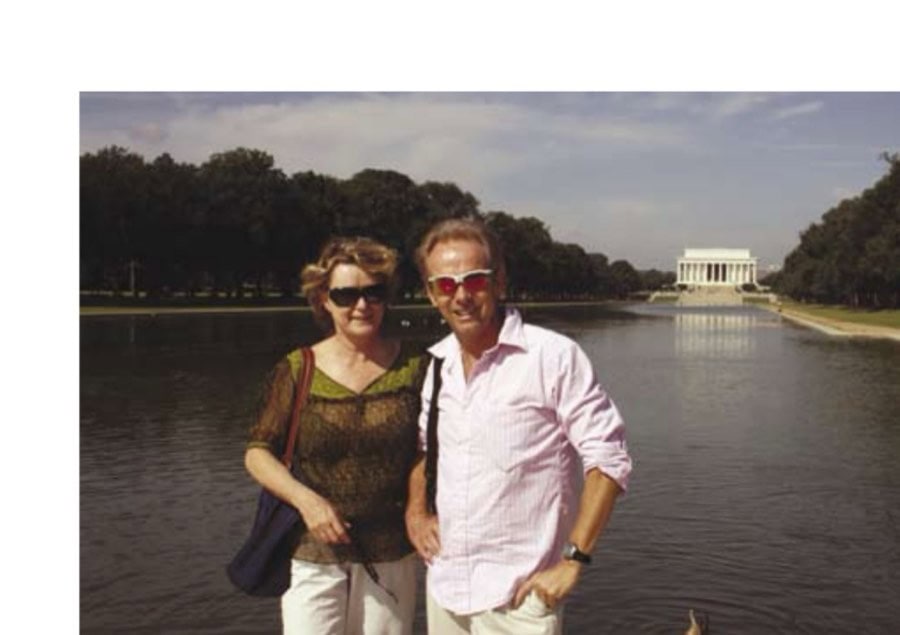
Photo courtesy of Gill Fordyce
▲ Revisiting America 25 years later, Gill and Bruce Fordyce pose by the Lincoln Memorial in Washington, D.C., during August 2009, the summer of Bruce’s 53rd year.
The more complete quotation goes like this: “You’ve got to have tremendous passion for the sport, but at the end of the day, unfortunately, it’s genetic—so it depends on how cleverly you’ve selected your parents. That’s it! And you’ve got to be just like me.
You’ve got to be small, light, [have] strong legs, good heart, good lungs, and no brain cells—[because] it’s a stupid thing to do.” “I have used that quote often,” Bruce wrote, “including to the Queen, and I mean Elizabeth II. I met the Queen at a drinks function at the British Embassy in Pretoria and her words to me were: ‘I hope you will forgive me, Mr. Fordyce, but I always believed marathon runners had to be big and powerful, and you appear to be anything but . . . ’ “
I replied, ‘No, your Majesty, you have to be just like me—small, light, etc.’ It is quite a stupid thing to do to run 50 miles for a trophy when some guys become millionaires hitting a little white ball into a small hole!”
So that explains the photo of Bruce in his Comrades King book—posing with Gary Player, South Africa’s most famous golfer! Or perhaps it explains his nephew Robbie, the 22-year-old son of his sister, Oonagh, who she said, “is mad about golf but doesn’t really run. He’s more of a hippie musician!” He also must not, apparently, wish to follow in the nonlucrative footsteps of his uncle.
This article originally appeared in Marathon & Beyond, Vol. 14, No. 3 (2010).
← Browse the full M&B ArchiveMore like this
1,000+ stories from 19 years of Marathon & Beyond
The complete archive of the legendary long-distance journal — digitized and free to read.
