


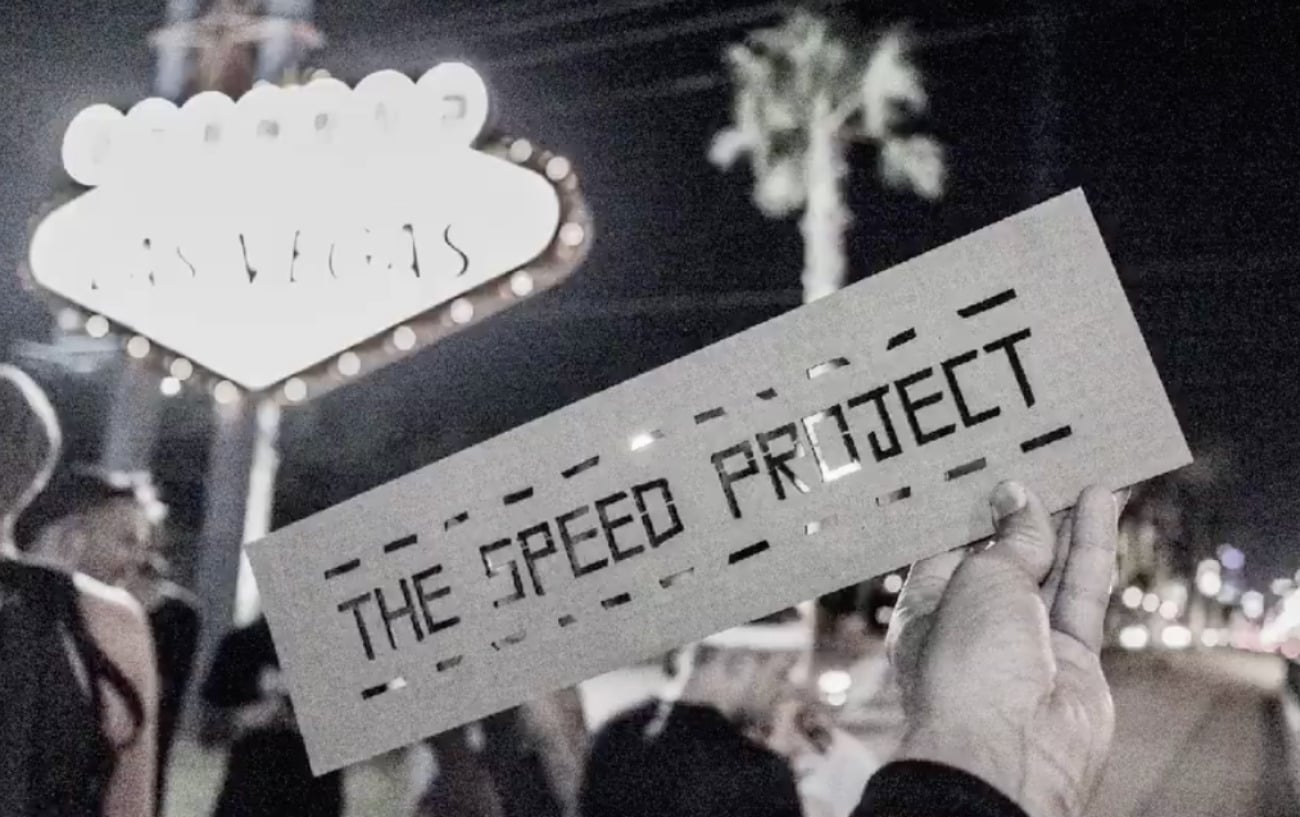
The 2026 edition of The Speed Project delivered two solo records and a landmark expansion, as runners from around the world descended on the Mojave Desert for the annual unsanctioned run from Los Angeles to Las Vegas.
Brazilian artist and ultra-runner Biel — known in the running world as “Biel” — claimed the overall solo LALV record, arriving at the iconic “Welcome to Fabulous Las Vegas” sign in 67 hours and 15 minutes. He completed the roughly 340-mile journey in just three days. Hours later, British ultra-runner Imogen Boddy crossed the same finish line to set a new solo women’s record of 77 hours and 54 minutes.
The Speed Project posted the men’s record alongside a quote: “To live is to suffer, to survive is to find some meaning in the suffering.” For the women’s record, they chose: “One must still have chaos in oneself to be able to give birth to a dancing star.”
The Race That Has No Rules
For the uninitiated, The Speed Project is unlike any other event in ultra running. There is no official course, no entry form, no aid stations, no prize money, and no spectators. The only rule, loosely observed, is to avoid running on the freeway.
The race was founded by German-born Nils Arend, who conceived the idea over drinks in 2013 and ran it for the first time in 2014 alongside five friends, including renowned coach Blue Benadum. The group ran from the Santa Monica Pier to the Las Vegas Strip — roughly 340 miles through the Mojave Desert — completing it in just over 46 hours.
For years, the only way to enter was through Arend’s WhatsApp. The single screening question: What motivates you to participate in this race?
The event grew entirely by word of mouth and became one of the most talked-about spectacles in endurance running — not despite its lack of structure, but because of it. Solo entries were added in 2020, opening the door to runners willing to cover the full distance alone, supported only by a crew vehicle. Teams compete in a relay format, trading off legs around the clock with no scheduled breaks.
Who Set the Records
Biel is no stranger to pushing limits. Born in Brazil and based in Berlin, Biel was signed last October as The Speed Project’s first-ever official athlete — a significant moment for an event that has historically operated outside the structures of professional sport. His path to that signing involved sleeping on hotel floors at the World Championships in India and cleaning bathrooms at Berlin nightclub Berghain to fund his training.
“Some things don’t need a pitch or a handshake,” Biel said at the time of his signing. “Me and TSP share the same obsession with the art and pure act of running. No noise, no bullshit.”
Imogen Boddy, 24, from Malton in Yorkshire, England, is one of British ultra-running’s most compelling figures. She already holds the world record for the fastest female completion of the UK’s National Three Peaks Challenge on foot, and in 2022 became the youngest woman to run the length of Britain — 1,340 km from John o’Groats to Land’s End in 22 days. Her Speed Project solo women’s record adds another chapter to a rapidly growing résumé. She’s part of a broader wave of women dominating ultra running at the highest level.
A New Route: Tijuana to Las Vegas
This year’s edition also marked the debut of the TJ Outpost, a new extension of the LALV route that starts in Tijuana, Mexico rather than Los Angeles. All teams crossed the US-Mexico border together at 4am PST on April 2nd, moving as a single group before spreading out into the desert. The Speed Project described the moment simply: “The journey began in community.”
The event carried its familiar Spanish-language motto: SIN ESPECTADORES. SIN REGLAS. No spectators. No rules.
The addition of the TJ Outpost makes the route one of the longest continuous running efforts in the world — stretching from Baja California, across the border, through the Mojave, and into Las Vegas. It joins a growing list of iconic ultra-distance events in the US that test runners across extreme terrain. The Speed Project has also previously expanded internationally with a route through Chile’s Atacama Desert, one of the driest places on earth.
Why Runners Keep Coming Back
The Speed Project’s appeal lies precisely in what it lacks. No corrals, no timing chips, no finisher medals. What runners get instead is three to five days of desert running, sleep deprivation, and a support crew crammed into a van.
For relay teams, it’s a nonstop handoff — runners swapping legs around the clock. For solo entrants like Biel and Boddy, it’s an entirely different ordeal: managing distance, heat, and recovery across multiple days with minimal sleep. To put the solo times in context, the fastest known road ultra performances in the world cover far shorter distances — making a 340-mile solo effort through the desert in under four days a genuinely exceptional feat.
As The Speed Project put it this weekend: “Gentle lives tell no stories.”
RunClub
Get more running stories — join RunClub
Daily running news, a community of 300,000+ runners, free training plans for every distance, and a daily running game. Free to join — no card.
Already a member? Log in →


Start the conversation