


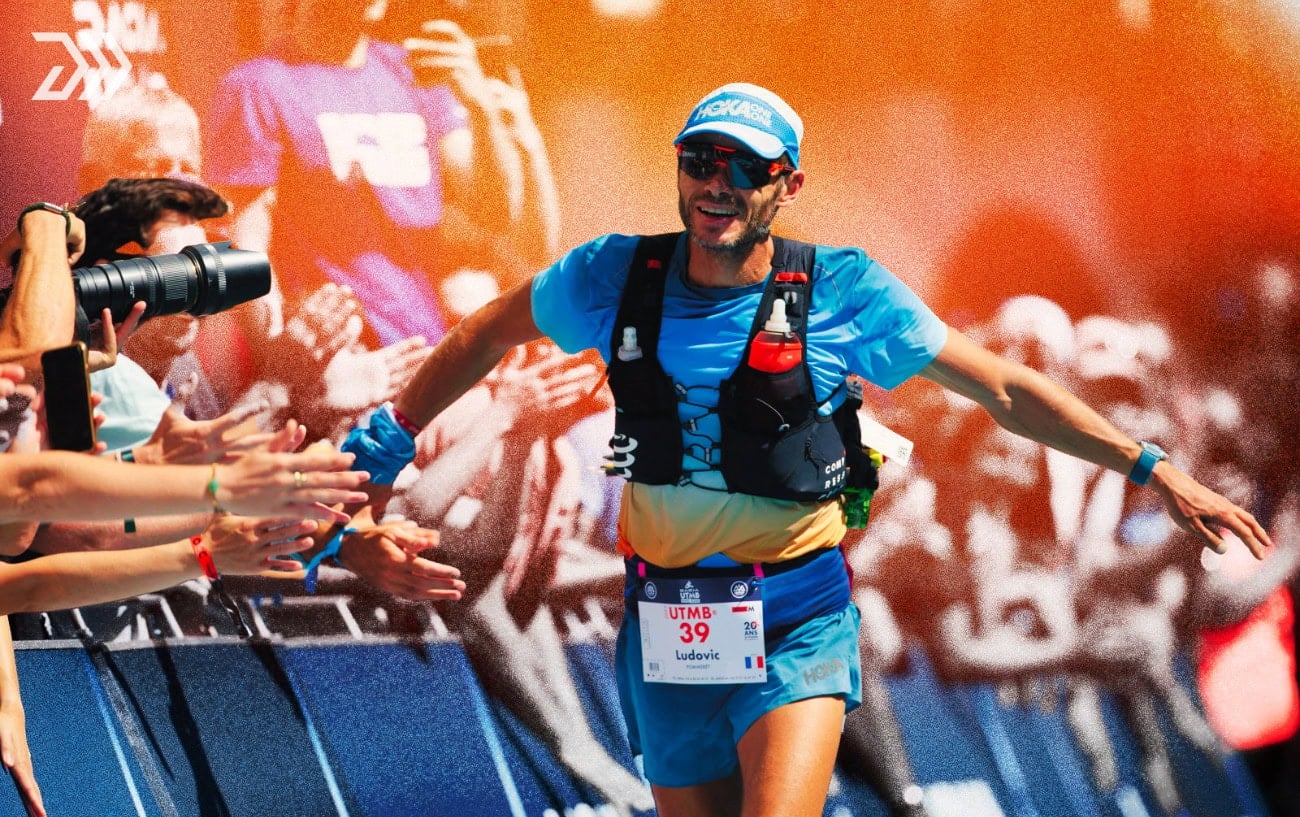
Ludovic Pommeret won the Hardrock 100 in a course-record 21:11:36 on July 11 at age 50, the latest and most extreme data point in a pattern researchers have been measuring for years: the longer and harder the race, the older the fastest runners.
Pommeret’s win in Silverton, Colo., reported in detail by iRunFar, was his third in a row, and he arrived at the finish 12 days before turning 51. His 21:11:36 took more than 21 minutes from the 21:33:06 he ran in 2024, which had itself broken Kilian Jornet’s overall course record.
Courtney Dauwalter, 41, won the women’s race in 26:03:10, improving her own clockwise record of 26:11:49 for a fourth Hardrock title in four starts.
Three weeks earlier, the sport’s other marquee 100-miler told the opposite story. At the Western States 100 on June 27, Vincent Bouillard, 32, and Jenn Lichter, 30, broke both course records, Lichter in her first 100-mile race.

Records fell at every age this summer, which raises the question the research has been working on for two decades: when do ultrarunners actually peak?
The answer starts with the marathon, where the science is settled and the peak is young. An analysis of elite marathoners by Lara and colleagues put the fastest race times at 27 years old in men and 29 in women.
Ultramarathons bend that curve upward. A 2018 study in the Open Access Journal of Sports Medicine analyzed 494,414 finishers of 50K races between 1975 and 2016 and found that when the top 10 finishers in each one-year age group were modeled, peak running speed came at 41 years old for both men and women. In 100-mile (161K) races, earlier work by Martin Hoffman found the fastest times came from men aged 30 to 39 and women aged 40 to 49. Across the literature, the age of peak performance climbs as races get longer.
The researchers are candid about what that number does and does not mean. The 50K study’s own authors note that the peak shifts depending on the method (considering all finishers instead of top performers drops it to 31 in men) and that it is “possibly due to the age of participants,” because ultra fields skew old to begin with: the largest group of 50K finishers is aged 40 to 44.

Selection and physiology are tangled together, and no study has fully separated them. But the physiology that can be measured points the same direction. Aerobic capacity peaks in the 20s, and the 50K data shows peak performance arriving more than a decade later, which the authors read as evidence that aerobic capacity alone does not decide ultra results.
Experience appears to matter more. One comparative study cited in the same paper found ultramarathoners had finished an average of 34 marathons before the race studied; marathoners had finished 12.
On a course like Hardrock, with 100.5 miles, roughly 33,000 feet of climb, and an average elevation above 11,000 feet, that accumulated knowledge of pacing, fueling, and suffering is worth more than leg speed. Pommeret’s three straight wins, each faster than the last, are what that advantage looks like compounded.
Western States is the honest counterpoint. It is the most runnable of the major 100s, the race most transformed by trail super shoes, and its records now belong to runners in their early 30s.
Peak age in ultrarunning depends on what the course measures as well as how long it is. Hardrock sits at the far end of that scale, and so do the ages of its champions.
For the amateur field, the same numbers carry a practical message. The most common 50K finisher is in his or her early 40s, and the fastest ones are too. A first ultra at 45 is not a late start by the sport’s own data.
Pommeret turns 51 on Wednesday. Hardrock reverses direction next July, and the counterclockwise record, François D’Haene’s 21:45:50 from 2021, is the one mark on that course Pommeret does not yet own.
RunClub
Get more running stories — join RunClub
Daily running news, a community of 300,000+ runners, free training plans for every distance, and a daily running game. Free to join — no card.
Already a member? Log in →











Start the conversation