


This past weekend’s World Athletics Relays in Guangzhou wasn’t just about baton passes and photo finishes, it was also about one of the boldest, most precarious camera angles the sport has ever seen.
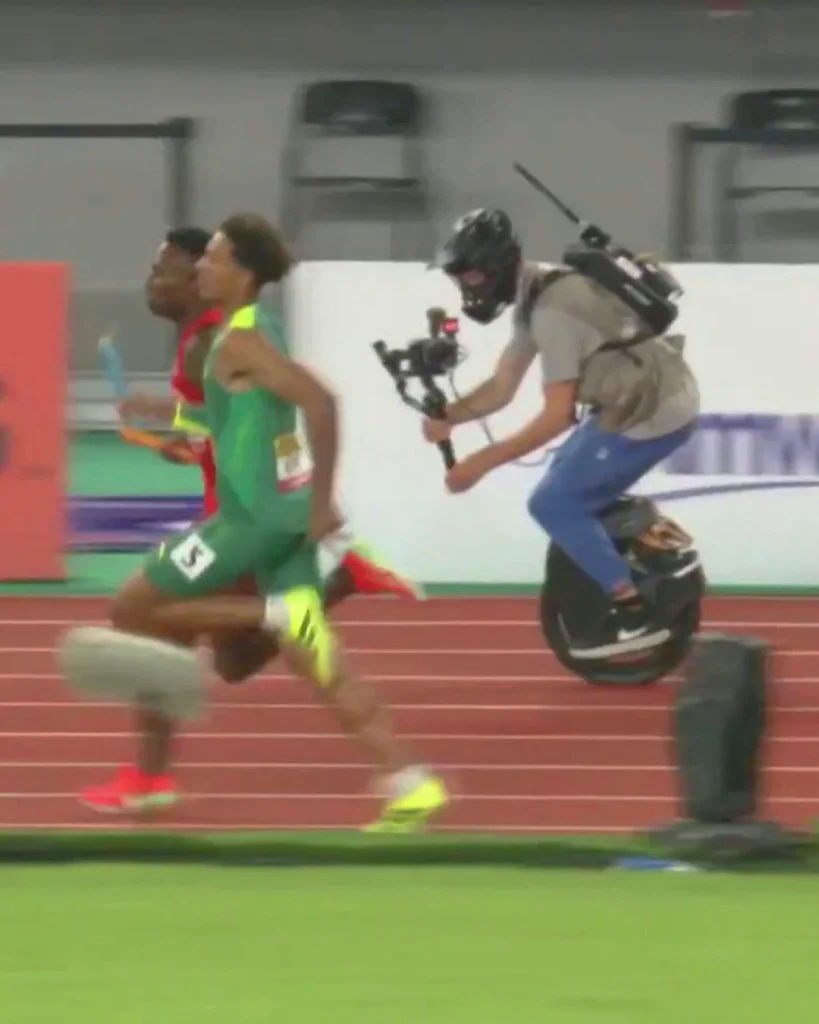
As 4x100m runners blazed down the straightaway at breakneck speed, a man in joggers, a black tee, and a full-face motorcycle helmet chased them…on an electric unicycle.
With one hand gripping a stabilized handheld camera, he weaved just meters behind the athletes, capturing fluid, eye-level shots that instantly went viral.
It wasn’t CGI. It wasn’t a drone. And it definitely wasn’t a track-mounted railcam.
It was a lone cameraman balancing on a single wheel, tailing Olympic-level sprinters hitting average speeds of 38 km/h (24 mph)—a pace most humans can’t even match on a bicycle.
The resulting footage was stunning: every stride, facial twitch, and baton swing captured in cinematic slow-motion from an angle so close, it felt like you were racing alongside them.
But the stunt has also sparked heated debate within track circles—because what happens if that cameraman falls?
Risk vs. Reward
For all its cinematic brilliance, this type of filming is inherently risky.
One slight veer off course, and it’s not hard to imagine a sprinter colliding with a 200-pound mass of metal and limbs; one wrong move could mean disaster.
It wouldn’t be the first time either.
- In 2015, a Segway-riding cameraman accidentally clipped Usain Bolt’s heel during his victory lap at the Beijing World Championships, sending the Jamaican icon sprawling to the ground in a viral moment that led to a formal apology from the broadcaster.
- At the 2024 Paris Olympics, a cameraman wandered onto the track mid-race with a shoulder rig, nearly causing a pile-up during the men’s 5,000m heats. Norway’s Jakob Ingebrigtsen was visibly shaken as he dodged the obstacle mid-stride.
These incidents highlight just how little margin for error there is when athletes and media occupy the same physical space—especially during competition.
The Tech We Usually Trust
Modern track broadcasting has evolved to give us a buffet of immersive angles without putting people in harm’s way. Overhead wirecams glide silently across stadiums.
Trackside railcams zoom along fixed routes. Even FPV drones are now used to tail athletes from above, like at the 2023 Diamond League Final in Eugene, offering dynamic shots without disrupting the race.
The electric unicycle, however, is something different. It’s agile, silent, and clearly fast enough—but it’s also human-operated and subject to human error. There’s no fixed rail, no safety tether, and no room for do-overs if something goes wrong.
The cameraman’s identity hasn’t been publicly revealed, but his skills (and nerves) are already being compared to professional FPV drone pilots—or Formula 1 camera operators.
RunClub
Get more running stories — join RunClub
Daily running news, a community of 300,000+ runners, free training plans for every distance, and a daily running game. Free to join — no card.
Already a member? Log in →



Join the conversation
I was just watching the European (walking?!!) race from Birmingham where I didn\'t believe my eyes, I watch cycle racing and am used to seeing camera operators standing on the footrests backwards but this person was just belting along on one wheel!