


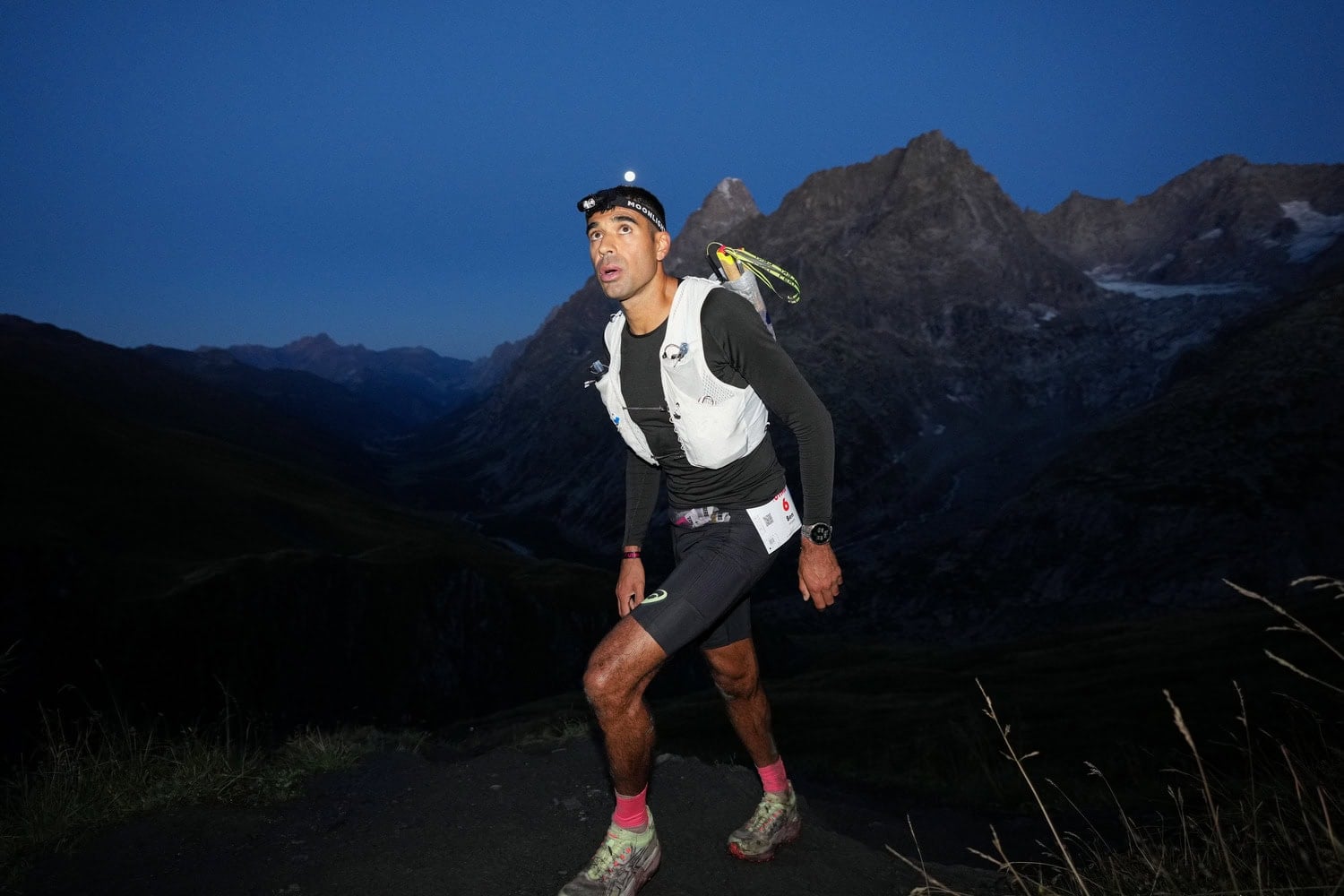
Getting into UTMB has always been difficult. Starting in 2026, how you travel to Chamonix could improve your chances.
UTMB has announced that runners who commit to using lower-carbon, car-free transport to reach the Mont-Blanc valleys will receive a 30 percent boost in the lottery for its flagship races. The change applies to UTMB, CCC, OCC, and the ETC, which joins the lottery system that year. The MCC is excluded.
The move is part of UTMB’s goal of cutting its carbon emissions by 20 percent by 2030, using 2024 as a reference point. It also targets the single largest source of those emissions: runner travel.
According to UTMB’s own carbon footprint assessment, nearly 86 percent of the event’s total emissions come from travel to and from the race. Race operations, logistics, and infrastructure make up a much smaller share.

UTMB has invested in transport solutions for years.
Its shuttle network in the Mont-Blanc valleys dates back to 2004 and now includes more than 120 buses serving dozens of stops during race week. But those efforts do little to address the long-haul flights and car journeys that bring tens of thousands of people into the region.
From 2026, runners will be asked to opt in to a set of responsible mobility rules during pre-registration. Those who do receive a 30 percent increase in their lottery odds. The Running Stones system stays in place, but a higher coefficient is applied when stones are converted into lottery entries. Ten stones become 130 chances instead of 100.
To qualify, runners must commit to reaching the Mont-Blanc valleys without using a private car. What that looks like depends on where they’re coming from.

Within Europe, runners are expected to take the train or bus whenever possible. Flying is only permitted if no ground journey under 12 hours exists, and then only a single flight. For runners coming from outside Europe, flying is allowed, but short-haul flights under two hours are not. In all cases, the final leg into the valleys must be car-free.
After the draw, selected runners must submit proof of travel and residence. If the documentation doesn’t match what they committed to, the entry is cancelled without a refund, though Running Stones are returned. UTMB says cases of force majeure, such as cancelled transport, will be reviewed rather than automatically penalised.
Local runners receive the bonus automatically if they apply for UTMB, CCC, OCC, or ETC, based on a published list of eligible municipalities. Group entries follow the same rules as individual ones, but the lowest individual lottery chance applies to the entire group.
Runners who don’t want to commit can still enter the lottery. They just do so without the boost.

Alongside the lottery change, UTMB will also introduce a mandatory carbon contribution for all participants in 2026. The contribution will be calculated based on the emissions generated by each runner’s round-trip travel to the event, again verified using proof of residence.
UTMB has been clear that this is not about offsetting and moving on. The stated aim is to reduce emissions first, then collectively contribute to climate transition efforts. Partners, volunteers, and service providers will also contribute proportionally, while UTMB Group says it will cover emissions linked to event organisation and staff travel.
For a race as oversubscribed as UTMB, linking lottery odds to travel choices is a pretty big deal. The organisation has avoided banning flights or excluding international runners, but it is clearly trying to influence behaviour at scale.
In 2026, earning a place on the UTMB start line will still depend on stones and luck. For the first time, it will also depend on how you get there.
RunClub
Get more running stories — join RunClub
Daily running news, a community of 300,000+ runners, free training plans for every distance, and a daily running game. Free to join — no card.
Already a member? Log in →








Start the conversation