Most retired special operators ease into their fifties. Podcast tours. Speaking gigs. Maybe a fitness app with their face on it.
David Goggins chose a different path. He went back to basic training.
At 51, the former Navy SEAL has reenlisted in the U.S. Air Force at the rank of Master Sergeant, assigned to the Special Warfare Training Wing — the same ecosystem that produces pararescue jumpers, and the same career path Goggins quietly walked away from 25 years ago.
The Air Force confirmed his assignment through spokeswoman Ann Stefanek, who told Military Times: “It’s worth noting that the Air Force has welcomed special operators from other services to cross train into Special Warfare for decades.” She declined to release details about his current training status, citing policy on trainees.
An age waiver was required to make any of this happen. The Air Force caps pararescue enlistment at 42. Goggins is nine years past that.
The Thread He Walked Away From
To understand why this is a bigger deal than another reenlistment story, you need to go back to 1994.
Goggins joined the Air Force at 19, fixed on one goal: become a pararescueman. He dropped out of training after being diagnosed with sickle cell trait. That’s the official version. Goggins himself has been more honest about it. He was afraid of the water, and the diagnosis gave him a door to walk through. He walked through it.
He finished his Air Force contract as a Tactical Air Control Party operator and left in 1999. At that point, he weighed around 300 pounds and was working as an exterminator. Not exactly the trajectory most people had in mind for him.
What happened next is the story his books are built on. He saw a documentary on SEAL training, decided to try for BUD/S, and proceeded to fail it spectacularly — twice — before finally making it on his third attempt. The first run ended with stress fractures and pneumonia. The second ended when he fractured his kneecap before Hell Week, muscled through Hell Week anyway, and then got rolled back two weeks later when his body refused to cooperate any further. Third time, he graduated with BUD/S Class 235.
After the Teams, he completed Army Ranger School and was named Enlisted Honor Man. He deployed to Iraq. He retired from active duty in 2016 after 20 years of service. He remains the only known person to have completed Navy SEAL training, Ranger School, and Air Force TACP.
One more detail that puts all of this in perspective: doctors later found that Goggins had been living with a congenital heart defect — a hole in his heart — that required two surgeries to fix. For much of his military career and most of his running, his body was working with significantly reduced oxygen efficiency, and he had no idea.
The Running Record (Which Is Its Own Story)
Marathon Handbook readers will know Goggins for a different résumé: the man who keeps showing up at races that most people read about once and then quietly close the tab on.
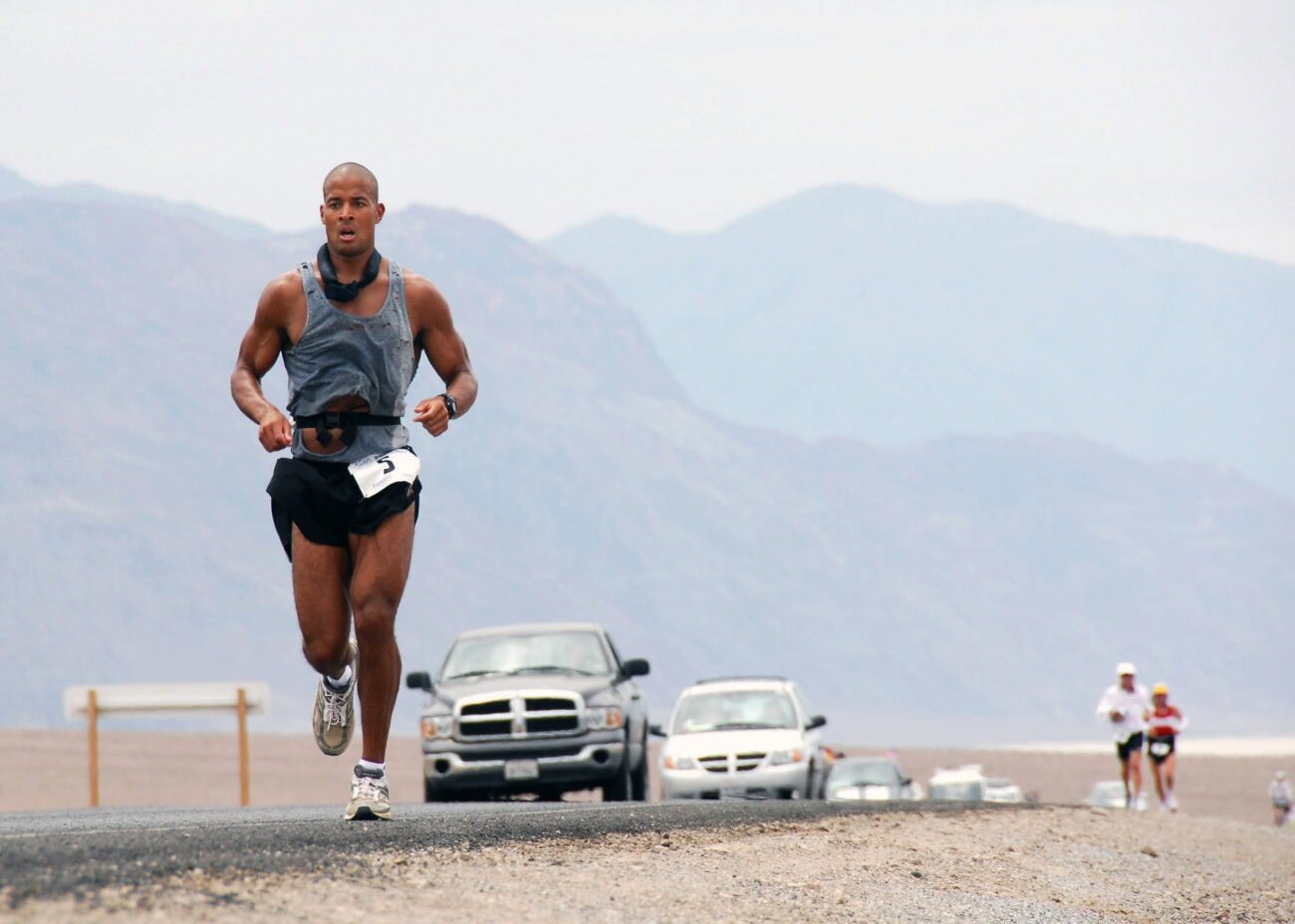
Over 60-plus ultramarathons, he ran Badwater 135 three times — 135 miles through Death Valley in temperatures that routinely push past 120°F. He placed 5th in 2006 and 3rd in 2007, with a finishing time of 25:49:40. He has finished the HURT 100 four times. He completed the Ultra-Trail du Mont-Blanc. He ran the Bigfoot 200 in 2025, finishing in 66 hours and 4 minutes. He placed 2nd overall at the 2020 Moab 240, finishing 241 miles in 63 hours and 21 minutes, roughly 95 minutes behind the winner.
That 2020 Moab result is worth slowing down on. The year before, he had dropped out of the same race and been hospitalized with pulmonary edema. He came back twelve months later and nearly won the whole thing.
He ran the 2026 Barkley Marathons, a race famous for the fact that most years nobody finishes it. He ran the Across Florida 200 with a torn hamstring — his wife confirmed that one. In 2013, he set a Guinness World Record for pull-ups — 4,030 in 17 hours. He’s raised more than $2 million for the Special Operations Warrior Foundation through endurance events. In 2019, he was inducted into the International Sports Hall of Fame.
His last Instagram post, to 14 million followers, went up in November 2025. The caption: “Time is running out… you better stop thinking and start… doing.” Then nothing. Turns out he was busy.
What He’s Walking Back Into
The pararescue pipeline runs close to two years. It includes EMT and paramedic certification, Army Airborne School, combat dive qualification, military freefall, and SERE school. The Air Force’s listed attrition rate sits around 90 percent. It was built for people in their twenties.
Whether Goggins is running the full pipeline or serving in another capacity within the training command hasn’t been publicly confirmed — the Air Force cited policy on releasing trainee information. But the Air Force also didn’t hand him a desk.