


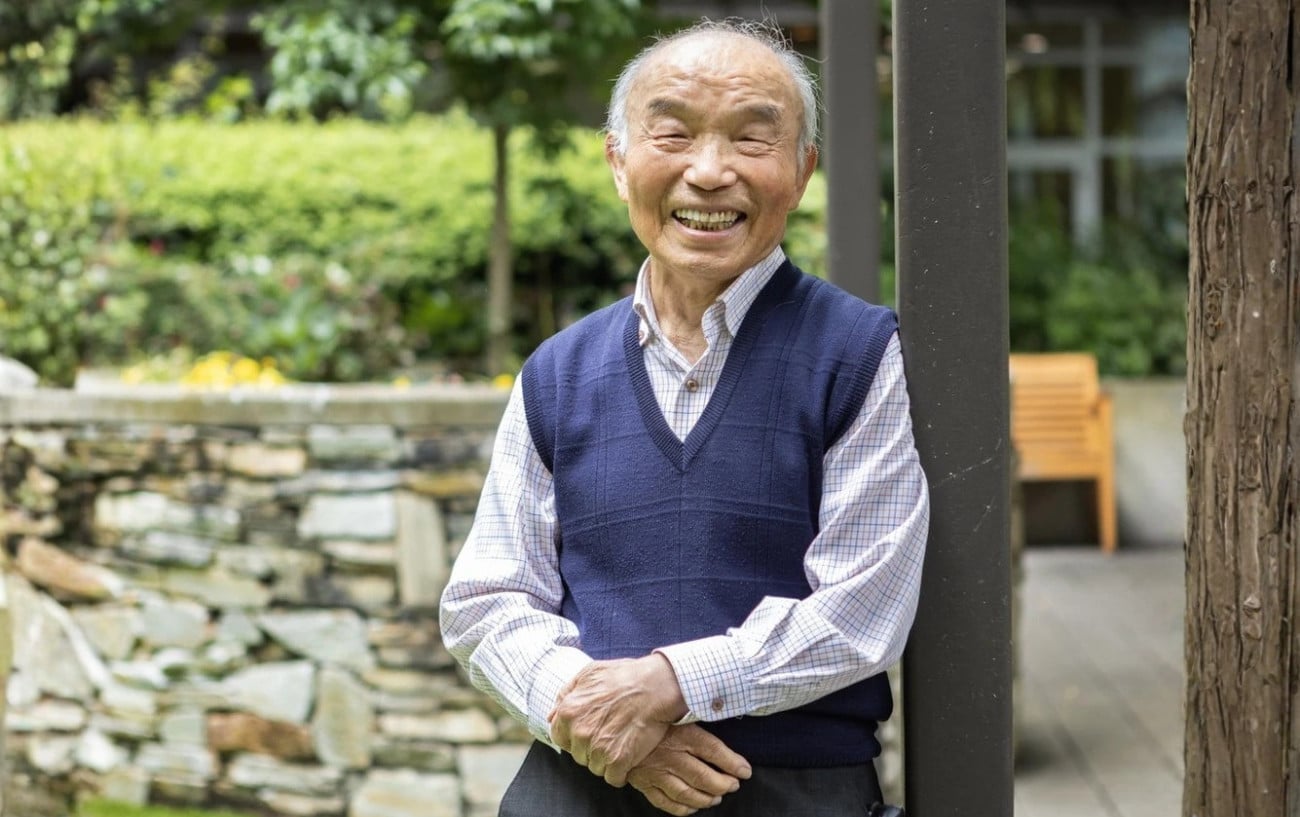
Yul Kwon won his age category at the BMO Vancouver Half-Marathon in May with a time of 3 hours, 50 minutes and 33 seconds. He also came in last. He was the only runner in the 90-plus division, a bracket that did not exist until Kwon, who is 90, wrote to organizers and asked for it.
Until this year, the brackets stopped at 85 to 89. Kwon, a retired economics professor in Vancouver, thought that was unfair. “It would be unfair for someone in their 90s to race against someone in their 80s,” he told reporter Denise Ryan of the Vancouver Sun in a profile published over the weekend. Organizers agreed, added the new bracket, and opened a 100-plus category as well. Kwon said he plans to write back in 10 years and ask for another extension.
A late start, and a long one
Kwon did not take up running until he was 60. At 80, he won his age group at the Boston Marathon. He now runs four to five marathons a year out of Seasons Wesbrook Village, a retirement community near the University of British Columbia, where the Sun reports he is something of a local celebrity.
He earned a PhD in economics from McMaster University and spent 18 years as Korean Foundation Chair in Korean studies at Griffith University in Australia, then took an adjunct post at Simon Fraser University’s Beedie School of Business after retiring.
He runs, he said, because he can. “Running is hard,” Kwon told the Sun, and moving through that difficulty brings its own reward. “Happiness is my priority now. At my age, I can see the end of my life. It’s important to cherish every moment.”
From rice-straw shoes to New Balance
The discipline behind a sub-four-hour half at 90 was forged a long way from any start line.
Kwon was born to farmers on the southern peninsula of Korea, one of nine children. Three siblings did not survive infancy. The family’s rice harvest went to the Japanese colonial occupiers, and Kwon told the Sun he felt shame about a distended belly, swollen from starvation and parasites. He had no shoes until he learned to weave his own from rice straw. “Somehow I survived,” he said.
The North Korean invasion on June 25, 1950, ended his schooling. “I was too young to be drafted,” he said. His mother was killed during months of bombardment. After the war, his father had no money for tuition, so Kwon ran away. His sister-in-law packed him a backpack of textbooks and dry rice, and he walked roughly 20 kilometres back to Masan through burned-out villages. “There was nothing left. All the villages were burned.” He sold newspapers to pay for school.
A turning point came when a distant relative, a professor, visited the family tombs. “He looked almost like an angel, in these beautiful clothes,” Kwon said. “I decided then that was what I could be.”
54 acceptances, one ticket
Kwon placed third on the national exam and later passed the entrance exam to Seoul National University. His father sold his plot of land to cover the fee. After graduation, Kwon took a job at the Bank of Korea, then applied to 54 American universities and was accepted to all of them. None offered a scholarship. A fully funded Canadian award to the University of Saskatchewan came through instead.
The catch was the airfare. “The airfare was $540. It was impossible,” he told the Sun. The Rotary Club covered it. He flew to Canada on Sept. 4, 1964. His fiancée, Joanne, followed soon after. She died in 2017.
Running for the next student, and the next patient
Kwon has tied his running to two causes. He created the Kwon Family Scholarship through the Vancouver Korean-Canadian Scholarship Foundation, and he has raised $20,000 for the B.C. Cancer Foundation over the past two years through his races. “I had such difficulty getting tuition,” he told the Sun. “I want to help others.”
His retirement home has nominated him for its “remarkable residents” honour, which comes with a $6,250 donation to the winner’s chosen charity. If Kwon wins, the money goes to the cancer foundation. “By extending my running to fundraising, that gave me a bigger purpose,” he said. Or, as he put it to Ryan: “Out of poverty, and the struggle, I learned diligence, perseverance and frugality.”






0 Comments