


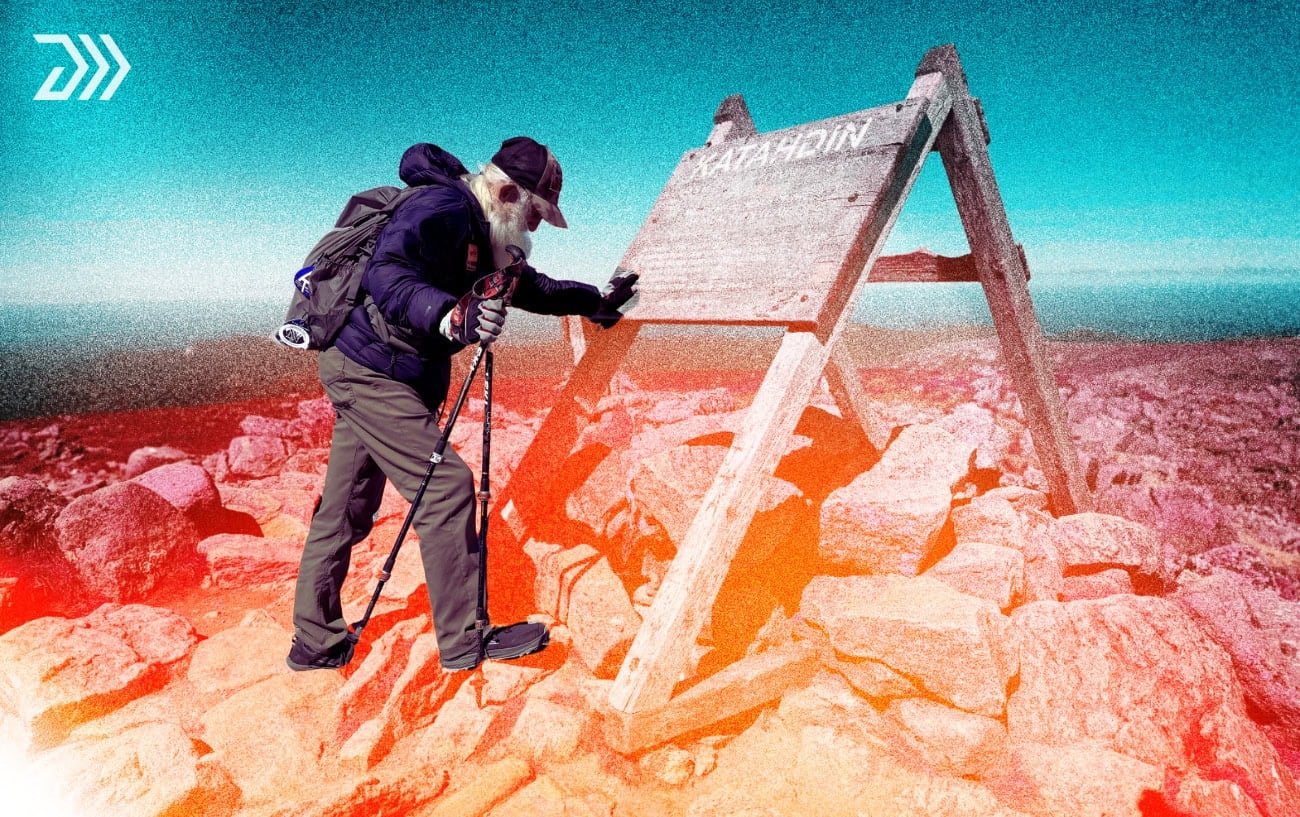
Dale Sanders, 91, who hikes under the trail name Grey Beard, reached the summit of Mount Katahdin in Maine on Monday and became the oldest person to cover the full length of the Appalachian Trail, a record he first set nine years ago and then lost to a friend he had encouraged.
He did not walk it in a single line. The Appalachian Trail Conservancy counts a hike as a thru-hike as long as every mile is covered within 365 days; the sections can be taken out of sequence, in either direction, with stops in between. Sanders began on Sept. 6 last year in West Virginia and worked outward from there, planning on roughly 12 miles a day and sleeping in a camper fitted to his truck. He finished on Aug. 31, 359 days after he set out and six days before his clock expired.
The trail covers 2,193 miles (3,530 kilometers) from Springer Mountain in Georgia to Katahdin. It was not finished until 1937, two years after Sanders was born in Kentucky, and very few people take it on late in life. By the conservancy’s own count, about half of all thru-hikers are in their 20s, roughly 750 have been in their 60s, and only about 50 have been 70 or older. Sanders belongs to that last group twice over. He first completed the trail in October 2017 at 82, taking a mark that had stood at 81 since 2004, and lost it in November 2021 to M.J. Eberhart, who hikes as Nimblewill Nomad and was 83.
How the Record Nearly Slipped Away
The second attempt went far worse than the first. Sanders counted 71 falls over the year, six of them hard. In June he went down in a boulder field descending Killington Mountain in Vermont and tore up his hands, arms and legs. “Thank God nothing got broken, but I was banged up,” he told the Associated Press. “I didn’t rub the blood off, I just kept hiking.” Later in the summer his left arm lost feeling, and a hospital in Maine checked him for a stroke before diagnosing a pinched nerve. His wife’s mother died around the same time. About 140 miles were still unwalked, split between the Southeast and Maine. He came off the trail and gave up on the deadline. “I accepted it, but I wasn’t happy about it,” he told the New York Times, which reported on the attempt through the summer.
At home in Tennessee, his wife talked him into going back. Two of the volunteers who had been shuttling him between trailheads drew up a schedule that still fit inside the 365 days, and he returned on Aug. 16. When Eberhart learned Sanders was back out, he came up from Alabama, tracked him down in Great Smoky Mountains National Park and spent his evenings helping at the campsites. “This is not a competitive thing at all,” Eberhart told the Times after the finish. “He helped me and encouraged me when I took the record away from him. You have no idea how happy I am to have this relieved from me, and to have it go on.”

The Trail’s Other Record
The Appalachian Trail keeps two very different sets of records, and Sanders now sits at the far end of one of them. The fastest known time for the route belongs to Tara Dower, who ran it southbound in 40 days, 18 hours and 6 minutes in September 2024, close to 54 miles a day, taking the record from Karel Sabbe’s 2018 mark of 41 days, 7 hours and 39 minutes. Sanders averaged a little over six miles a day across his 359.
Sanders retired from a parks and recreation career in 2002, and his record collection extends beyond the trail. Guinness World Records lists him as the oldest man to paddle the length of the Mississippi River, 2,350 miles in 87 days, begun on the day he turned 87 in June 2022. Running keeps a similarly short list at that age. The nearest comparisons in masters running are Antonio Rao, who ran his 31st Rome Marathon at 93, and Bill Schwarz, who finished his first marathon at 90.
He fell once more a few hundred feet below the summit, then got himself upright and finished the climb. At the summit sign he prayed. “I had to thank God, and I had to thank my support team and everybody that got me here,” he told the Associated Press. He told the Times he was already weighing a long walk through the Grand Canyon.
One step is left, and it is administrative. The conservancy adds finishers to its official 2,000-miler roster on the strength of an application the hiker submits reporting the journey.
RunClub
Get more running stories — join RunClub
Daily running news, a community of 300,000+ runners, free training plans for every distance, and a daily running game. Free to join — no card.
Already a member? Log in →









Start the conversation