


The Edmonton Marathon said Tuesday that its marathon and half-marathon courses had each run 674.7 meters past their certified distance. That is 1.6 percent of a marathon and 3.2 percent of a half-marathon, twice the share on the shorter race. The half was the Canadian Half Marathon Championships.
The race reviewed its physical measurement after runners, elites included, said the course “ran longer than its certified distance.” The error was in the calculation meant to cancel out the Wellington Bridge detour: moving the west end turnaround was supposed to take the added distance back out, and it took out only some. Race director Tom Keogh apologized for the miscalculation. “The event owns this error, and we take full responsibility,” he wrote in the statement, which Marathon Handbook reviewed.
A day earlier, the race had stood behind the certification. Speaking to reporters Monday, Keogh attributed the runners’ watch readings to lane changes at work zones, satellite drift, and a variance of up to 1 percent he ascribed to World Athletics and Athletics Canada. That previous statement, Keogh wrote Tuesday, “was issued with the best information [the race] had at the time.”
Marathon Handbook could not find the 1 percent allowance in the World Athletics and AIMS measurement standards or in Athletics Canada’s policy. The standards set three limits on distance: uncertainty no greater than 0.1 percent, a course no shorter than the official distance, and a prevention factor adding 0.1 percent. By the race’s own figure, both courses ran 674.7 meters over their certificate. The Boston Athletic Association will not recognize a qualifying time run on a course without certification from USA Track and Field, AIMS or a national federation, and Athletics Canada’s policy conditions records and qualification on a valid certificate for that year. Neither document, as reviewed by Marathon Handbook, addresses results from a course later found inaccurate, and neither sets out an appeal route. Keogh said the race is “working directly with Athletics Canada and other relevant partners” on recognizing the results.
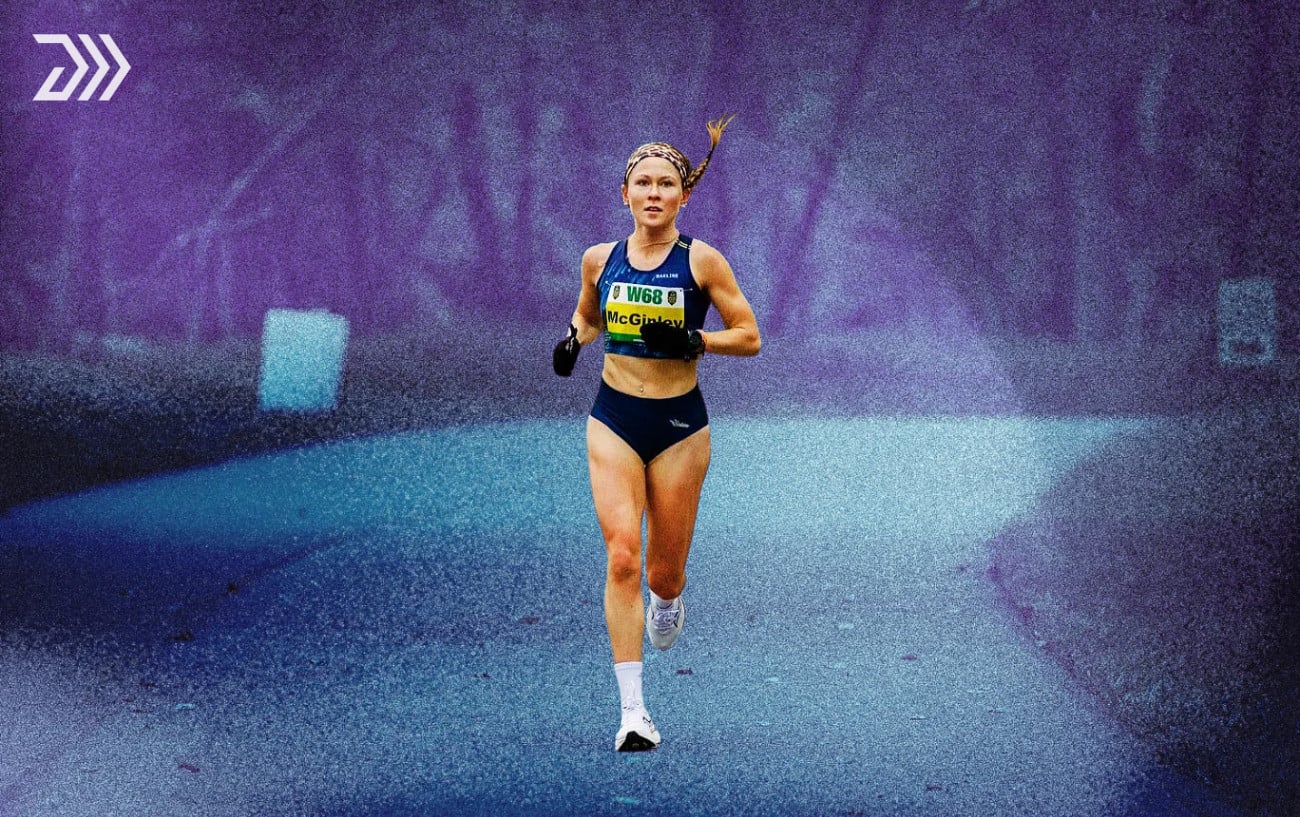
Rory Linkletter won the men’s half in 1:04:34, which scales to about 1:02:34 over the certified distance, quicker than the 1:03:00 he ran to win it last year. Jadyn Keeler took the women’s national title in 1:12:11, worth roughly 1:09:57 adjusted. “If the course was accurate, [Keeler] may have been pretty close to the Canadian record,” Linkletter told the Edmonton Journal. The fastest half-marathon by a Canadian woman is the 1:09:38 Andrea Seccafien ran in 2020, 19 seconds quicker.
Those scaled times are Marathon Handbook’s arithmetic at even pace. No governing body recognizes them. The added distance also cost time in proportion to pace: a runner moving at five-hour marathon pace needed an extra 4:48, and one holding the 3:05:00 that qualifies men 40 to 44 for Boston an extra 2:57.
Mitch Walz trained a year for a 2:59 marathon in Edmonton, a target picked for the margin it would leave if Boston drew more qualifiers than it could take, he told CBC News. His chip time came back as 3:03, which CBC gave only to the minute. Scaled to the certified distance, a 3:03 finish lands between about 3:00:07 and 3:01:05, so 3:55 to 4:53 inside the standard. The 2026 cutoff fell 4:34 below it and 8,887 qualified runners missed that race, so the correction does not settle whether he would have got in. “Not only did I kind of achieve one of my goals and run as good of a race as I could have imagined or dreamed, it just feels as if it was all pulled out from underneath me,” Walz told CBC News.
“I think me and a lot of the other runners felt almost gaslit by the organisation,” Robbie Yamada, who ran the half, told CTV News Edmonton. Tuesday’s statement covers only the marathon and half. A closing footnote excludes the 10K, which it says “was not professionally certified with physical measurement.” The 5K fun run and the children’s 1K go unmentioned.
Athletics Canada backed the measurement Monday and had published nothing on the error as of Wednesday morning; its most recent item is an Aug. 17 recap of Linkletter’s title. Boston closes applications at 5 p.m. ET on Sept. 18.
RunClub
Get more running stories — join RunClub
Daily running news, a community of 300,000+ runners, free training plans for every distance, and a daily running game. Free to join — no card.
Already a member? Log in →





Join the conversation
That\'s not really gaslighting ... it\'s just ineptitude