


Runners hoping to line up at next year’s Valencia Half Marathon have until Monday, Nov. 16, to get their names into the draw. The race, which holds its 36th edition on Oct. 24, 2027, opened its ballot on Nov. 10 with 11,405 places on offer, about a thousand fewer than it had a year ago.
The missing thousand went to runners who were already in. Anyone holding a valid entry for this year’s race on Oct. 25 could sign up for 2027 between Nov. 5 and 9 without going near the ballot, and 13,595 of them did, out of 25,000 bibs in total. The same loyalty window took 12,598 places last year and left 12,402 for the draw.
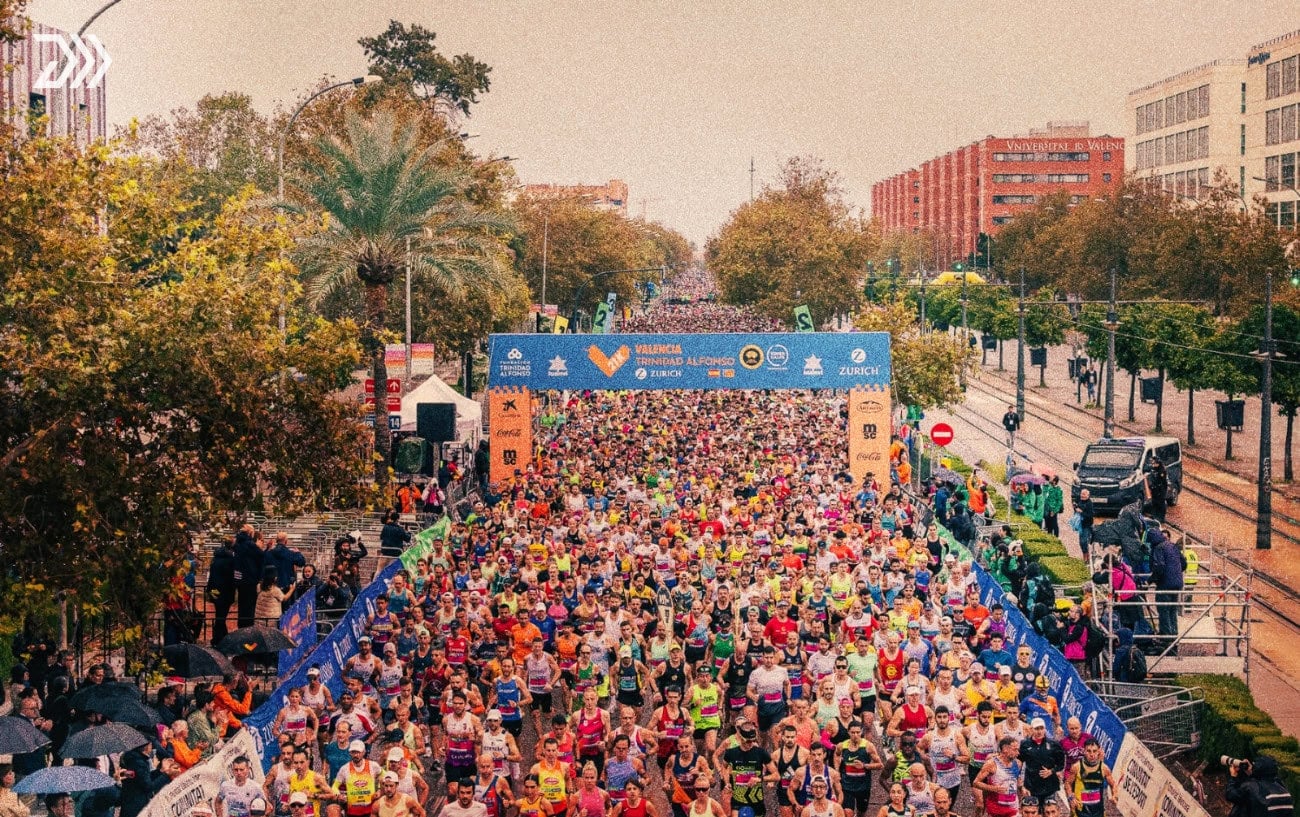
Valencia only switched to a ballot for the 2026 race. Before that, places went to whoever got through the online queue first, and for the 2025 edition the 12,000 general-entry bibs were gone in less than three hours, with as many as 36,000 people sitting in the virtual waiting room, according to the organizers. Their first ballot, which closed in November 2025, drew 50,766 entries for 12,402 places, so a little under one in four got in. Only about a third of those applicants were Spanish.
If the same number apply this time, the odds slip to roughly one in four and a half. Big European halves are heading the same way: Prague’s first ballot drew 70,000 applications, Copenhagen has moved to a lottery for 2027, and the Valencia Marathon put its 2026 entries into a draw as well. For anyone who misses out, there are still some big races you can enter without a lottery.
This year’s race on Oct. 25 had 25,733 finishers, and the front of it was as quick as ever: Rodrigue Kwizera won in 58:03 for a Spanish record, Sheila Chepkirui took the women’s race in a world-leading 1:03:51, and Yaseen Abdalla ran faster than the U.S. record while racing for Sudan. Valencia is also one of the six original SuperHalfs races, and runners holding a SuperHalfs SuperVoucher skip the ballot altogether.

How the Ballot Works
Entering costs nothing, although the organizers place a €5 ($6) hold on the entrant’s bank card, which is released afterward. Runners can apply alone or in a group of two or three, each person with their own email address. A group goes into the draw as a single entry, at the same odds as an individual, so everyone in it gets a place or nobody does. Each runner can enter only once, and the name, date of birth and ID number given cannot be changed later.
The draw takes place before a notary on Nov. 17, and every applicant hears by email from Nov. 18. Those selected then have until 11 a.m. Spanish time on Nov. 25 to register and pay, otherwise the place passes to the waiting list.
Prices are the same as for 2026. The first 10,000 bibs sold at €40 ($45), and with the loyalty phase alone taking more than that, ballot winners pay €80 ($90). Places handed out later through the waiting list cost €100 ($112), and runners without a Spanish athletics federation license or the local Carnet del Corredor Plus pay an extra €4 ($4) for a one-day license. The course closes two hours and 45 minutes after each runner crosses the start line.
Key Dates
- Nov. 16, 10:59 a.m. Spanish time: ballot closes
- Nov. 17: draw before a notary
- Nov. 18: results emailed to all applicants
- Nov. 25, 11 a.m. Spanish time: deadline for winners to register and pay
- Oct. 24, 2027: race day
RunClub
Get more running stories — join RunClub
Daily running news, a community of 300,000+ runners, free training plans for every distance, and a daily running game. Free to join — no card.
Already a member? Log in →



Start the conversation