


Running one marathon is hard. Running eight, across eight different countries, in pursuit of a medal that builds itself piece by piece? That’s either the best idea you’ve heard all year or the most expensive one. Possibly both.
The European Marathon Classics — EMC for short — made its debut on Wednesday at Schönbrunn Palace in Vienna. The organizers could have chosen a conference room. They didn’t. The 18th-century imperial palace was probably the right call.
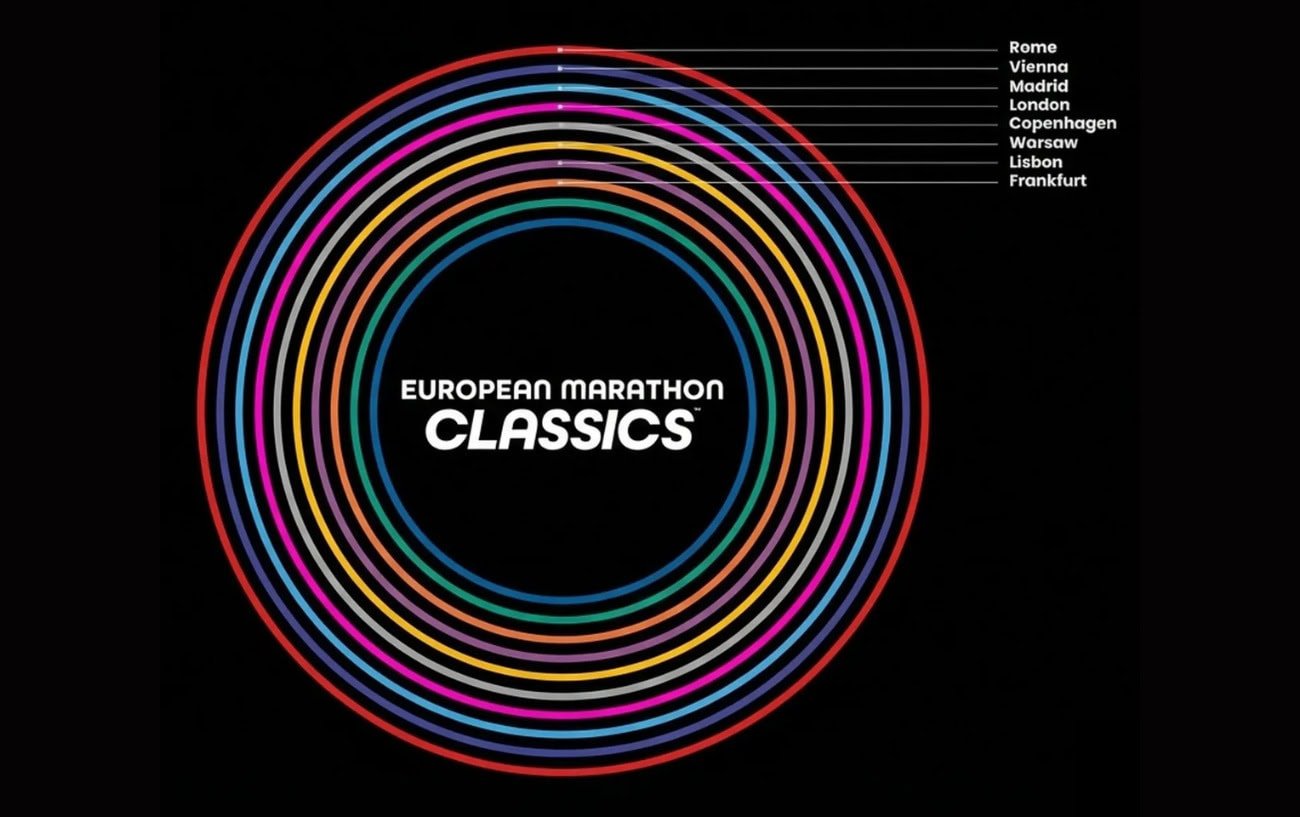
The series brings together eight of Europe’s most established marathons: the Acea Run Rome The Marathon, Vienna City Marathon, TCS London Marathon, Zurich Rock’n’Roll Running Series Madrid, Copenhagen Marathon, Warsaw Marathon, EDP Lisbon Marathon, and Mainova Frankfurt Marathon. It’s a serious lineup. These aren’t second-tier races bolted together to sell medals — they’re events that runners already travel across the world to enter.
What You Actually Have to Do
Complete five of the eight races — each in a different city — and you earn the title of “European Marathon Classics Finisher” along with a commemorative medal. That’s the bar. No time limit, no minimum pace, no pressure to do it in a single year. Knock out five races over two years, five years, or fifteen. The series doesn’t care.
Joining is free. You still pay entry fees for each individual race, as you normally would — but signing up to track your progress costs nothing.
The medal is a nice touch. It has a concentric design with room for magnetic collectible badges, one per race completed. Each marathon you finish snaps another piece into place. By the time you hit race five, you’ve got something that actually represents where you’ve been, rather than a generic finisher medal gathering dust on your wall.
The People Behind It
Hugh Brasher, Event Director of the TCS London Marathon and one of the main architects of EMC, was direct about what he wants the series to stand for.
“European Marathon Classics embodies our ambition to explore Europe together while pushing boundaries — both geographically and philosophically. I’m confident this series will show that across Europe we are better together than we are apart and that we are more similar than we are different,” he said.
Kathrin Widu, CEO of the Vienna City Marathon, put it more simply: “By bringing together leading European marathons, we aim to inspire even more people to embrace marathon running. We are united by shared values like a passion for sport, community, health, and sustainability.”
Dorte Vibjerg, CEO of Sparta Athletics & Running — the organizer behind Copenhagen Marathon — made a point that should interest anyone who’s run a race and thought, this could be better. “This will undoubtedly mean that participants can look forward to races with even more energy, quality, and atmosphere — not just in Copenhagen, but also with our friends across Europe.”
When race directors from competing events start talking about making each other’s races better, something genuinely different might be happening.
Your Old Finishes Count — Yes, Really
This is the part that will catch a lot of veteran runners off guard. EMC isn’t just for future races. Historical results are being recognized, dating back to the very first editions of each event — as far back as Madrid’s inaugural 1978 race and Lisbon’s first in 1986.
Through a partnership with LetsDoThis.com, runners will be able to upload verified past results to their EMC profiles. That feature is expected to launch in the second half of 2026.
Marek Tronina, Race Director of the Warsaw Marathon, explained why they’re doing it: “We value everyone who has ever completed the marathon distance at our races, whether this year or forty years ago. It is a major operational undertaking and a significant organizational challenge, but we will make it possible to recognize results dating back to the very first editions. We see this as a sign of respect for marathon history and for the people who created it.”
So if you ran Lisbon in 2008 or London in 1995, dig out those old bibs. You might already be partway there.
The 2026 Race Calendar
- Rome — March 22
- Vienna — April 19
- London — April 26
- Madrid — April 26
- Copenhagen — May 10
- Warsaw — September 27
- Lisbon — October 10
- Frankfurt — October 25
One scheduling note: London and Madrid fall on the same day this year. You’ll need to pick one — unless you’ve figured out how to be in two places at once, in which case you have bigger things to worry about than a marathon series.
Is It Worth Your Time?
Multi-race series exist across the running world, and the track record is mixed. Some become genuine communities. Others are just a way to sell extra merchandise. The World Marathon Majors set the gold standard — a notoriously hard-to-enter club that takes most runners years to complete. EMC is a different beast: more accessible, more geographically focused, and built around the idea that the journey matters as much as the finish line.
There’s also precedent at the half marathon level — the SuperHalfs series has carved out a loyal following by connecting top European half marathons in a similar format. EMC is essentially that concept scaled up to the full distance, with some of the best marathons in the world in the mix.
EMC has a few things going for it. The races are legitimate — not curated unknowns, but events that runners already spend real money to enter. The structure is flexible enough that it doesn’t feel like a cash grab. And the historical results policy suggests the organizers are thinking long-term, not just chasing a launch headline.
Whether it builds into something meaningful depends on whether runners actually embrace it. The early signs are encouraging.
Registration is open now at europeanmarathonclassics.eu. Free to join. The marathons themselves, of course, are another matter.

