


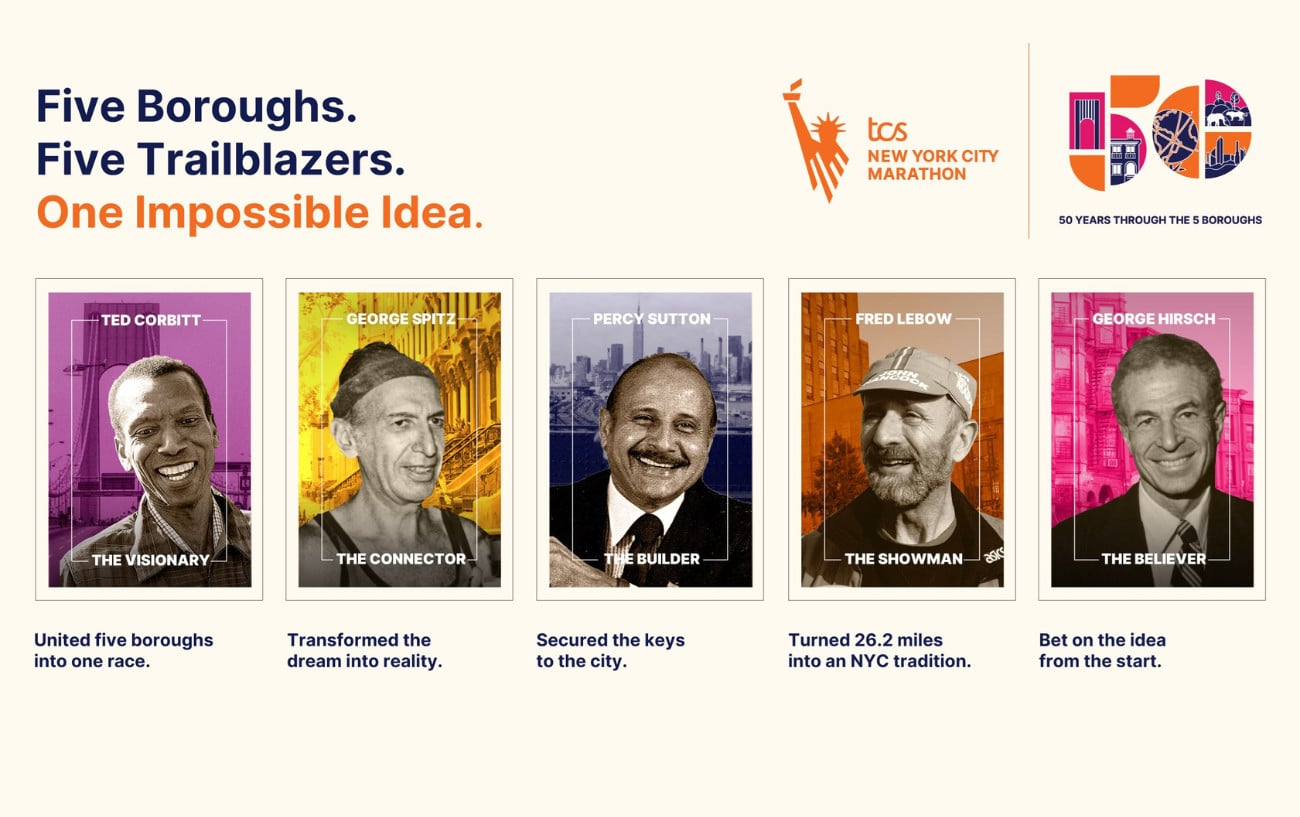
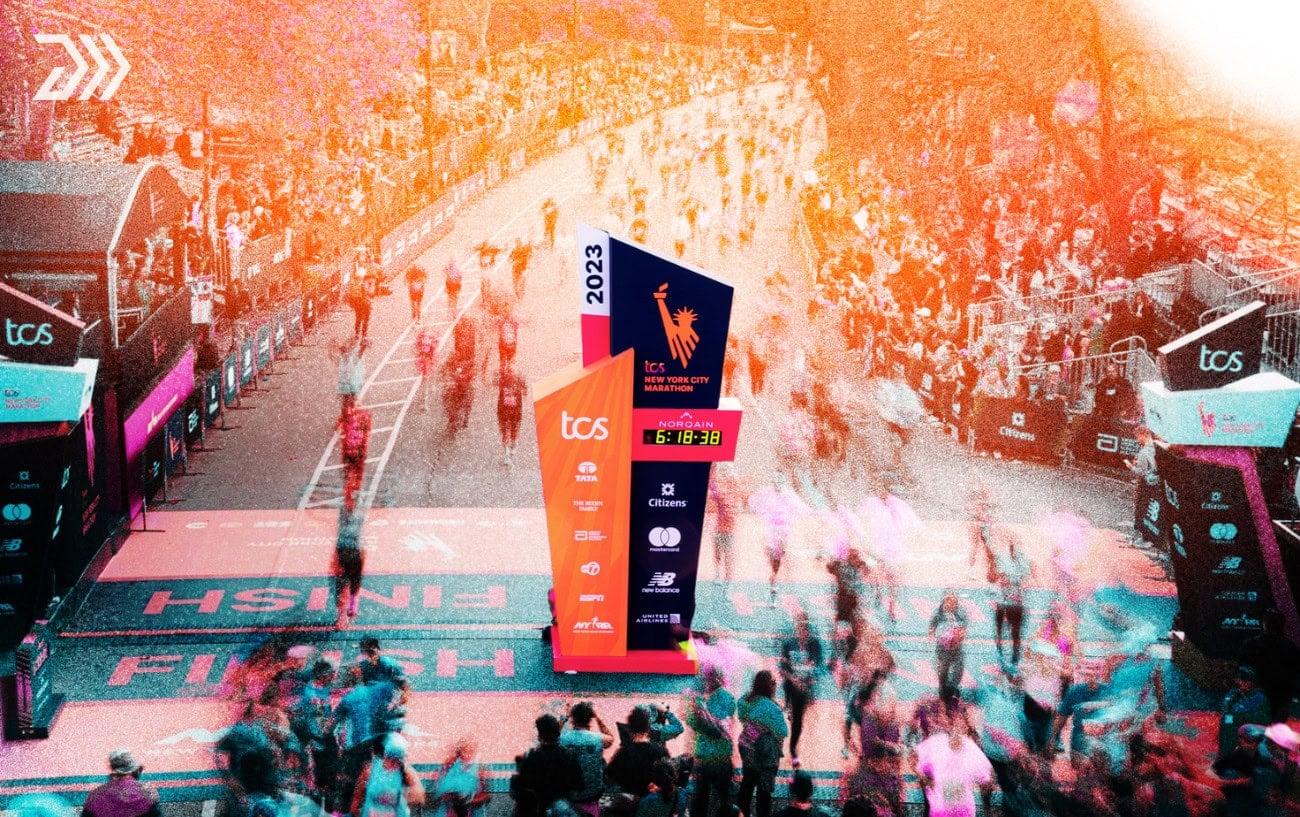
New York Road Runners on Thursday introduced a campaign called “The Trailblazers,” recognizing the five people it credits with creating the five-borough New York City Marathon course that first ran on Oct. 24, 1976.
The campaign honors Ted Corbitt, George Hirsch, Fred Lebow, George Spitz, and Percy Sutton. Each played a different role in moving the race out of Central Park and across the bridges and avenues of the city. Their stories will appear in race signage, the official broadcast, the race program, social channels, and the TCS New York City Marathon Expo Presented by New Balance ahead of the 2026 race on Sunday, Nov. 1.
The announcement, detailed in a press release issued by NYRR, falls 50 years to the week after Percy Sutton, then Manhattan borough president, told the city on June 21, 1976, that the marathon would expand beyond Central Park.
“This milestone anniversary is an opportunity to celebrate one of the most iconic events in sports and to honor the people who made it possible,” said Rob Simmelkjaer, chief executive of New York Road Runners. “The 5-boro marathon elevated New York City, transformed the sport of running, and created the blueprint for big-city marathons around the world.”
What the research found
To support the campaign, New York Road Runners commissioned independent researchers from the College of Staten Island to conduct oral history interviews, review archives, and examine public records tied to the 1976 race.
The researchers concluded that Corbitt was the first person inside the organization to propose taking the marathon through all five boroughs. Corbitt served as New York Road Runners’ founding president from 1958 to 1960. He was a pioneering long-distance runner and the first African American to compete in the Olympic marathon.
Corbitt brought the idea to Spitz, a political activist and runner, who saw the Bicentennial year as the right moment to stage a grand event. Spitz set up a meeting with Sutton. Sutton suggested using the Verrazzano-Narrows Bridge to link Staten Island to Brooklyn, the foundation of the course still used today. He also secured the support of Mayor Abraham Beame, his fellow borough presidents, and city agencies, along with a $25,000 contribution from the Rudin family that helped fund the race.
Fred Lebow, the race director in 1976, was initially skeptical that an event of that scale could be pulled off. He then recruited elite athletes and promoted the race internationally. Hirsch, then publisher of New Times magazine, contributed his own money, used media relationships to host a press conference at Tavern on the Green on Sept. 16, 1976, and paid Frank Shorter and Bill Rodgers to run.
Honorary Grand Marshals for 2026
New York Road Runners has named four honorary grand marshals for the 2026 race: Gary Corbitt, representing his father Ted Corbitt; George Hirsch; Keisha Sutton-James, representing her grandfather Percy Sutton; and Estee Stimler, representing her uncle Fred Lebow. George Spitz, who died in 2015, left no close surviving relatives, according to NYRR’s announcement.
“I’m happy to see my father finally getting the proper recognition for conceiving a New York City Marathon covering the five boroughs,” Gary Corbitt said. “He contacted Harry Murphy to recommend the route. George Spitz took the idea to Percy Sutton. My father served the sport in many ways, and he would tell me how he’d get awards for doing the work nobody else wanted to do.”
Hirsch, recalling the morning of the first five-borough race, said: “I remember the excitement of that day in 1976 as we waited for the gun to go off at the start of the race. We knew it was something big. But how big it would become, we simply couldn’t imagine!”
Estee Stimler said the recognition mattered to her family. “Fred’s legacy has always meant a great deal to me, and I’m honored to contribute to commemorating this special milestone,” she said.
The four marshals will take part in race-week events including the ceremonial Blue Line Painting, the Night of Champions benefit, the Expo, the Opening Ceremony Presented by United Airlines, and race day.
From 55 finishers to a global event
The numbers tell the rest of the story. The first New York City Marathon was held in 1970 as four loops of Central Park and produced just 55 finishers. The 1976 race remade the event by pushing the course through Staten Island, Brooklyn, Queens, the Bronx, and Manhattan to mark the U.S. Bicentennial and lift a city in financial crisis.
The race now draws more than 55,000 participants and more than two million spectators each November, cementing its place among the World Marathon Majors. New York Road Runners produces over 60 adult and youth races a year and serves more than half a million people through community programs across the five boroughs.
The organization has also set a goal of raising $100 million in 2026 for its Official Charity Partner Program, which is marking its 20th anniversary. Demand for entry is at an all-time high: just 1 percent of applicants got in through the 2026 lottery, a record low.
The campaign also lands at an unusual moment for the race. Discussion about future course changes has stirred runners this year, making the celebration of the five-borough route feel less like nostalgia and more like a reminder of what the city built.
For runners and fans who will line the course on Nov. 1, the campaign is a reminder that the route they know was not inevitable. Five people argued for it, paid for it, sold it, and ran it, and the city agreed to close its streets for a road race that had never been tried at that scale before. Runners eyeing a spot on the start line or studying the broader history of the marathon have those five trailblazers to thank.
RunClub
Get more running stories — join RunClub
Daily running news, a community of 300,000+ runners, free training plans for every distance, and a daily running game. Free to join — no card.
Already a member? Log in →



Join the conversation
I Ran NYC Marathon in 1980 - Time 4:20;32 (under name Beverly Hicks - age 40) Friend- Now husband...Husband Dennis Mulvey age 41 - Time 3:47.21 (we met training for NYC Marathon and married in 1985). I ran in 1983 (14,445 runners --Time: 3:59.11; and ran NYC in 1985 - 4:20:32.....Also ran Philadelphia twice and JerseyShore . At 86 still running races... 5k\'s and winning first in age group--by default...no competitors! Fun!