As reported by the Guardian, Ken Rideout was taking up to 30 oxycodone tablets a day when he passed out cold on his bathroom floor, cracking his head on the way down. He came to lying in a pool of his own urine, his wife Shelby cradling his head and crying. That night in 2010, he finally told her the truth.
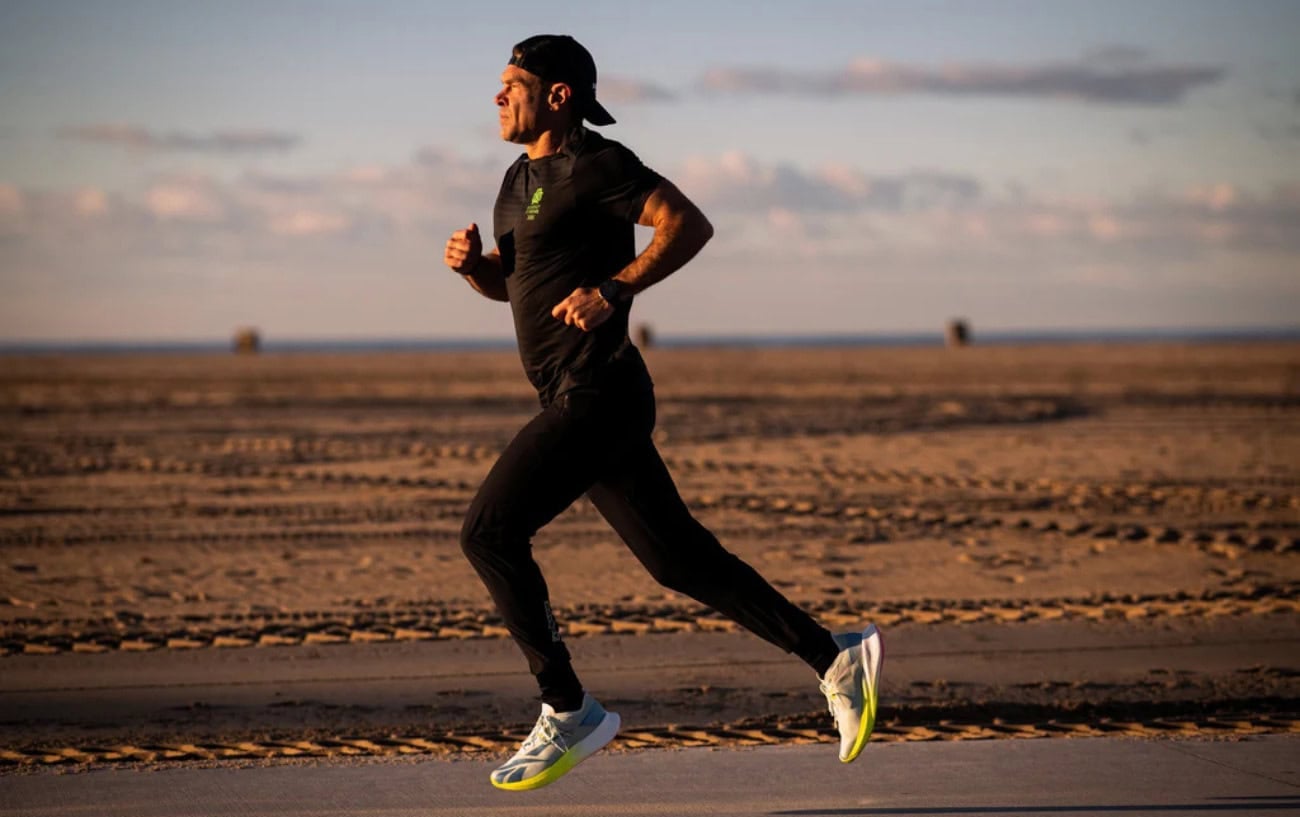
Today, at 54, he runs a 2:28 marathon.
The arc of Rideout’s life — from an abusive childhood in working-class Boston, through a high-flying career on Wall Street, through a decade of opioid addiction he hid from nearly everyone who loved him, and out the other side into elite masters running — is the subject of his recently published memoir, Everything You Want Is on the Other Side of Hard. Last month, he topped both the 40-plus and 50-plus age categories at the Austin Half Marathon, finishing in 1 hour 15 minutes.
“Getting sober is my greatest accomplishment in life,” Rideout said in an interview. “None of the running achievements are even close.”
It Started With an Ankle
In 1998, a podiatrist prescribed Rideout seven Percocet tablets for foot pain. He was 27, living in New York, and outwardly thriving as a commodity trader. Inside, he was consumed by impostor syndrome and anxiety. The Percocet didn’t just kill the pain in his ankle. It killed the noise in his head.
He went back for more. Then more again. He began altering prescriptions by hand — changing a “7” into a “27” — and targeting small pharmacies unlikely to run verification checks. Within a year, he was dependent.
A job offer took him to London in 1999. He thought the move might force a clean break. Within a week, he was in severe withdrawal: drenched in sweat, unable to sleep, barely functional. He called his brother and asked him to FedEx a supply of OxyContin — a drug that delivers a significantly higher dose of oxycodone per pill than Percocet. It arrived. The relief was immediate.
“I wasn’t even happiest when I took the drugs,” Rideout said. “I was happiest knowing that they were coming.”
He found a private doctor in London willing to prescribe. The addiction deepened. At his worst, he was consuming 20 to 30 tablets a day. When Florida “pill mill” pharmacies came to his attention — operations dispensing opioids in massive quantities — he placed orders at 10 of them within days.
The Confession That Changed Everything
Rideout met his future wife Shelby on a night out in Manhattan in the early 2000s. They stayed up all night talking, fell hard, and married in 2007. She knew he struggled with substances but had no idea how deep the addiction ran.
In August 2010, an adoption agency called with news of a four-week-old girl in Ethiopia who needed a family. Rideout and Shelby were approved. They were due to travel in November.
Thirty days before the trip, Rideout checked himself into an outpatient detox facility. He didn’t want to show up in Ethiopia as a father “erratic, unpredictable and severely depressed.” The withdrawal hit brutally. On the third day, he couldn’t leave his bedroom. Three days after that, he passed out in the bathroom. When he came to, Shelby was on the floor beside him.
He told her everything.
“She had started to catch small glimpses, throughout our relationship, that I was struggling with substance abuse issues but didn’t realise the extent,” Rideout said. “But she also loved me and quickly went into saviour mode.”
The hiding, he said, had been its own kind of torture. The shame. The lying. The thoughts of suicide. “The lowest moment of my life was definitely when my wife found me unconscious in the bathroom trying to detox.”
Finding Running — and an Athlete’s Identity
After adopting their daughter, the couple had three biological sons and relocated to Nashville. Rideout, who had played hockey and football growing up in Somerville, Massachusetts, had kept exercising even through his worst years of addiction. With sobriety, exercise became something more.
“When I found running and endurance sports, I got my athlete identity back and also found an area to focus attention that was previously going to self-destructive behaviours,” he said.
Research has long pointed to running as a powerful tool for mental health — and Rideout’s story is a vivid example. He started running 10 miles a day, as hard as he could. He entered marathons and triathlons. In 2012, he competed at the Ironman World Championship in Kona, Hawaii, and quit mid-race after the 112-mile bike leg left him feeling destroyed. He regretted it immediately and vowed never to quit again. When he got home, he hired a coach for the first time.
The results, even to him, have been hard to believe. He has set a personal best marathon time of 2:28:25 — a time that would qualify most runners for the Boston Marathon, regardless of age. He is now recognised as one of the fastest marathon runners in the 50-plus division at World Marathon Majors events. Last year, he completed all six World Marathon Majors within 18 months.
“Everything that has happened in my life since I got sober has been shocking to me, not just surprising,” he said.