

Ask Coach Katelyn
Bring your training questions — form, fueling, pacing, taper, race-day nerves. Coach Katelyn drops in to answer.
Hi Coach Katelyn! I just finished my fall marathon (4 hours 8 minutes), and I am looking at working on speed work right now with training for a 5k. My last 5k was in April and I ran it in 22 min 19 seconds. I was looking at MH's free training plans, and I noticed both a sub-22 5k plan and an advanced 5k plan. Is there a big difference between them and would one of them be more appropriate for my level? Thanks!! Good luck at CIM 🙂
Sorry for posting this in your space, but I just read and played with this information and found it brilliant. Please let Michael and everyone on the MH team know how much we appreciate all of your efforts and hard work. Finding MH Handbook and podcasts has brought tremendous joy and excitement to my running and a much better understanding of the sport of running. I've even learned to look forward to and like conversations about running shoes.
Special thanks to Alex for his review on the Asics Superblast 3. I left behind my NV 1080's and at 66 years old I am breaking PR's that were set decades before. After years struggling getting runs done I have now found joy running and always looking forward to the next run.
Thank you all.
Coach Katelyn, Marathon Handbook Community,
What training plan can you recommend or have used to prepare for the Boston Marathon? For context, I am a 59 year old female, just ran a 10k with a time of 50:33, last marathon was a flat corse with a time of 4:02 which I finished feeling strong. Any suggestions will be greatly appreciated. Also not looking for any crazy time. Want to finish feeling good in less than 4:26 which was time from 2022.

Hi Darla!
First of all, congratulations on your recent 10K and your 4:02 marathon! Those are fantastic results, especially finishing your marathon feeling strong!
If your last marathon was right around 4 hours, have you thought about going for a sub-4 at Boston? Of course, your goal of finishing strong and feeling good is the priority, but it could be a fun goal to work toward! We actually have a sub-4-hour training plan (https://marathonhandbook.com/4-hour-marathon-pace/) on the Marathon Handbook website that could be a great starting point.
The biggest thing I'd recommend specifically for Boston is incorporating plenty of rolling hills into your long runs. Boston is a challenging course with lots of ups and downs, so preparing your legs for both the climbs and the downhills is really important. Also adding strength training in a couple times a week is a necessity to develop muscle endurance and strength of the course.
I'd also encourage you to focus more on running by effort (RPE) rather than trying to hit exact paces, especially on hilly terrain. Your pace will naturally fluctuate depending on the elevation, and learning to maintain a consistent effort will be incredibly helpful on race day.
With your recent results and a smart, consistent training block, I think you're in a great position to have a strong Boston Marathon! How exciting!!

Thank you!
Hi Ms Katelyn, I am a 60-year-old healthy runner with a BQ (3:24:14) in 2018, after which there's been a gradual decline due to recurrent injuries. With easier training and targets, kept injuries at bay before a 3:35:15 finish in Feb 2024. Started this year easy and built up to 90-100K weekly volume of 30K run:walk, 30K pure walk and 60K ride with 2 strength training days. Do I have time for a 3:30 finish in 3.5 months, how should I assess my fitness with 5K and 10K time trials, and how should I plan my training weeks and taper. Thank you
Hi! Congrats on your previous BQ and your 3:35 marathon! It's great to hear you've kept injuries at bay by adjusting your training.
I think 3:30 could be a realistic goal with 3.5 months to prepare, but it will depend on your current running fitness and how well your body handles the training progression.
A great way to assess where you stand would be to run a 5K or 10K time trial. As a general benchmark, I'd look for approximately 22:00 for 5K or 45:00 for 10K to indicate that you're moving toward the fitness needed for a 3:30 marathon. These aren't guarantees, of course, since marathon performance depends heavily on endurance, fueling, and race-day execution, but they'll give us a useful starting point.
One thing I'd be careful about is that although you're doing a great amount of overall aerobic training, walking and cycling don't provide quite the same running-specific adaptations as running. I'd gradually work toward increasing your actual running volume, if your body tolerates it, rather than making any sudden jumps. Given your injury history, consistency will matter more than chasing a particular weekly mileage number.
If you need to keep more cross-training in your schedule to stay healthy, I'd also consider swapping some of your walking or cycling sessions for the elliptical. It's one of my favorite cross-training options for runners because it closely mimics the running motion and allows you to build aerobic fitness with significantly less impact. You can even incorporate structured workouts on the elliptical to supplement your running without adding more pounding to your legs.
For your training, I'd focus on building your running endurance gradually, incorporating one quality workout per week (alternating between threshold work and marathon-specific efforts), and progressively extending your long runs. I'd also keep your two strength sessions, as long as you're recovering well.
Most importantly, with your history of recurrent injuries, I wouldn't sacrifice staying healthy just to hit a specific time. If your time trials and longer workouts suggest 3:30 is within reach, fantastic! If not, there's absolutely nothing wrong with adjusting your goal.
Wishing you the very best with your training!!
Superb response, sobering yet encouraging. Thank you Katelyn for a detailed discussion. Will try out the suggestions gradually, keeping health and recovery as priorities. And I confess a 22min 5k or 45min 10k looks difficult at present. Will try out both in coming months though. Will keep you posted. Best regards!
Hi,
I live in a moderately hilly area in Ky and in my previous 2 marathons I incorporated hill work to prepare for the course. My next marathon is the Every Woman's Marathon in New Orleans. This course is completely flat and I don't know if hill work needs to be part of my training plan as just a way to increase overall strength or should I have a different type of speed work instead?
Hi!!
Great question! And yes, I would absolutely still incorporate some hill work into your training, even though New Orleans is a flat course!
Hill workouts are fantastic for building strength, power, and running economy, so they can be really beneficial regardless of the terrain you're racing on.
What I would suggest is incorporating more hill-focused workouts earlier in your training cycle to build that strength and power, and then gradually transitioning toward more race-specific workouts as you get closer to race day.
Since your marathon is flat, I'd prioritize threshold runs, marathon-pace workouts, and longer intervals on flatter terrain during the later stages of your training. This will help your body get comfortable maintaining a consistent pace and effort without the natural variation that comes with hills.
And since you live in a hilly area, there's no need to avoid hills completely! You can absolutely continue running your regular routes. I'd just try to incorporate some flatter long runs and marathon-pace segments as race day approaches.
The goal is to use hills to build strength early on, then focus on the specific demands of your race as you get closer. Best of luck with your training!!
Hi Coach Katelyn,
I’m 54 and started running about 13 years ago. My first marathon was over 4:30 9 years ago and I ran my first Sub 3 marathon last year. This spring, I ran my 10th marathon at Boston but missed my goal (sub 255) by 20 seconds. I trained quite hard during the summer for Chicago and this time the weather didn’t help. With about 4 minute positive splits, I finished a little over 2:58. My question is, if weather is perfect at below 45F, do you think it is realistic to try sub 255 again at NYC, which is only 3 weeks after Chicago. My original plan was to run hard in Chicago and run easy in NYC. But now I’m more impatient now lol.
Hi!
First of all, congratulations on some incredible progress over the years! Going from a 4:30+ marathon to sub-3 is a huge accomplishment, and coming within 20 seconds of 2:55 at Boston is seriously impressive!
I completely understand the temptation to go after that goal again, especially when you know you're capable of it and the weather didn't cooperate in Chicago. But I'm going to give you my conservative coaching perspective here: I really wouldn't recommend turning NYC into what we call a revenge race.
You gave Chicago your all, and your body needs at least three weeks just to recover from that marathon effort, if not longer. Even if you're feeling good on the outside, there's still a lot of muscular damage and accumulated fatigue that takes time to resolve.
Plus, NYC is a challenging, hilly course! Even with perfect weather, it's not exactly the ideal place to chase a PR, especially just three weeks after another all-out marathon.
My concern is that pushing for sub-2:55 so soon could increase your risk of injury or leave you even more discouraged if things don't go according to plan. And I would hate for that to happen after all the hard work you've put in!
My advice would be to stick with your original plan for NYC, keep it easy, enjoy the experience, and save that sub-2:55 attempt for another marathon further down the road. Give yourself time to properly recover, rebuild, and line up feeling fresh and ready to race.
I know that's probably not the exciting answer you were hoping for, haha! But you've already proven you're right there. You don't need to rush another attempt to prove anything. That sub-2:55 is absolutely worth chasing, just not at the expense of your health or long-term progress!
Haha! That's exactly what I expected you to advise, but I didn't want you to. Thanks for your advice!!
Hey Katelyn. Greetings from London! I’m a 60 year old relative newbie to running, having only started at 50. I ran my first ever marathon in London this year, having followed a formal training plan and all my runnning metrics (VO2 Max (47), LTHR (164bpm/5:10 min/km) indicating sub-4 should be possible. Race day was hot, well considerably hotter than anything I had trained in for the entire program - around 70 Fahrenheit and 75% humidity. I finished in 4 hours 31, which I was pretty disappointed with, although just getting to run it, experience the incredible crowds and make a small difference to the prostrate cancer charity I ran for made it worthwhile anyway. The thing I struggle with is that I was able to maintain a cadence of around 175/180 the whole race and my heart rate was around 145 the whole race, but my stride length collapsed from around 1m to around 0.7 - declining rapidly from 30km through to the end. My two-part question is: a) what do you think went wrong? (I’ve had some advice that it was probably structural failure of tendons rather than lack of aerobic fitness but I would appreciate your thoughts) and b) what should I do differently in my upcoming training block for next years London Marathon to give myself the best chance of breaking that 4 hour barrier before I really do get too old? (Increase training pace to get fitter at higher speeds, increase volume, focus on specific weight training, all of the above?!). I have your excellent sub-4 plan and it looks very similar to the plan I followed for this years race, but I’m nervous about ‘doing the same thing and expecting a different outcome’ 🙂 Any perspective you can give will be gratefully received. I’m racing for the MIND mental health charity this year and completing and contributing to their important work will always be the priority, but that 4 hour itch just won’t go away….. Huge thanks in advance of your reply. Giles (PS If you ever plan on racing on this side of the pond be sure to let us know as it would be great to be able to thank you in person one day)
Hi Giles!! First of all, thank you so much for your message and for following along with the podcast! And congratulations on completing your marathon!! Running your first marathon at 60 is an incredible accomplishment!
I always tell my athletes that your first marathon shouldn't be about chasing a time goal. It should be about finishing healthy, strong, and enjoying the experience! You've now accomplished that, gained invaluable experience, and can focus on chasing that sub-4 goal next year!
As for what happened during your race, my suspicion is a combination of muscular fatigue, reduced running economy, and the warmer conditions.
The fact that your cadence remained consistent while your stride length shortened suggests that your legs were no longer able to produce the same force with each step as fatigue accumulated. Do you currently incorporate strength training into your routine?
The heat and humidity likely played a significant role as well, especially if you'd trained in cooler conditions. Even with a relatively controlled heart rate, the additional stress of regulating body temperature can accelerate fatigue.
For your next training block, I'd focus on improving marathon-specific durability. Here are my recommendations:
1. Gradually increase your weekly mileage, if your schedule and recovery allow. Consistency is more important than hitting a huge peak week.
2. Strength train twice per week, focusing on your glutes, quads, hamstrings, and calves. This can help improve running economy and maintain your mechanics when fatigue sets in.
3. Incorporate marathon-pace work into some of your long runs. For example, a 24–28K run a few of 2-3k blocks at marathon pace, ideally toward the end of the run. You could also do fast-finish long runs.
4. Continue speed and threshold training, but keep your easy runs truly easy! We want to improve your fitness without accumulating unnecessary fatigue.
5. Practice your fueling and hydration. Aim to gradually build toward 60–90g of carbohydrates per hour during long runs, depending on your tolerance.
I'd also love to know what your average weekly mileage was during your last training block, how many long runs you completed, and what your fueling strategy looked like on race day. Those details could help us identify where there's the most room for improvement.
And remember, following a similar training plan doesn't mean you'll get the same result! You're going into this next cycle with another year of experience, a stronger foundation, and a much better understanding of the marathon distance.
Most importantly, please don't feel like you're running out of time! Recovery may require a little more attention as we get older, but that certainly doesn't mean we can't continue improving. I absolutely wouldn't give up on that sub-4 dream. I also love that you're running for MIND this year. What a wonderful cause to support!
Keep up the great work, and I'll be cheering you on as you chase that sub-4!!
Wow - thank you so much for taking the time for such a considered reply! If I am honest with myself I neglected strength training to focus on getting in 4/5 days of running each week. Maybe I am a case study of the need to maintain balance and not neglect strength work 🙂 I was averaging around 50/55km per week - do you think I need to up that to more like 60/65, or higher? I think I got my hydration and fuelling sorted - I take a Maurten 160 gel every 40 mins, which equates to about 60g of carbohydrate per hour, and I use the P1500 hydration mix in two 500ml flasks in a running vest. It adds some weight, but it allows me to pretty much avoid overly busy water stations and the time penalty that can come with them. The one area I see quite a lot of variation between marathon plans is around the length and number of long runs. Some seem to insist on at least 32km and ideally 35km, with around 5 runs beyond 28km. Others seem to say run for no more that 3 hours as recovery needs increase exponentially beyond that, and long runs around 25k, but weekly volume higher. Do you have a particular view on that? I will keep you posted on how training is progressing. I have several half marathons planned and I would like to do at least one at marathon pace, just for the psychological reinforcement. If you, or any of your members, are interested in unique/bucket-list events, you might want to check the “ Mezza Maratona d’Italia” - you get to run right through the Ferrari factory, around their test track, and then through the Italian countryside to the beautiful town of Modena. I think that might be my ‘test event’ - where better than the home of Ferrari for a speed test 🙂 Thanks again for your insight and support. Giles
Hi coach Katelyn. A somewhat recent listener and runner coming back to the sport after 6 years off for IVF and then back to back pregnancies. I have been back to running for 2 years now and have gained significant fitness through that time. I want to continue to find out how much I can push myself and improve. I had a half marathon on October 10th, and due to warmer temps than I was used to as well as a 15-20mph headwind, I blew up in the last few miles and missed my sub 2 hour time goal by 6 minutes. I was at exactly 1 hour at the halfway mark but just could not hold on. Last two miles had leg cramps and was concerned I wouldn’t even be able to finish. This was still a 3 minute PR but much slower than what I was training for. Threshold pace is about 8:30min/mile with a 5k time trial mid block at 25:20. I had several 12-13 mile runs in my training block with some race pace intervals and peaked at ~40mpw. I want to try again in April to get sub 2 hours and am wondering if I should focus on building speed or if I should I work on building volume in the “off season” before going into the next block.
Thank you so much for always being so awesome and positive!!! I love your takes on the pod.
Hi!! First of all, thank you so much for listening to the podcast and for your kind words! And congratulations on getting back into running, building up your fitness, and running a 3-minute half marathon PR!! That's a lot to be proud of! Also, please don't let that race discourage you. Warmer temperatures and a headwind can make quite a difference, especially in the later miles of a half. The fact that you still managed a PR under those conditions tells me you're making great progress!
As for your question, my recommendation would be to focus on building speed before jumping into your next half marathon training block. This is something that has worked really well for me personally and for many of the athletes I coach! Since you're targeting another half marathon in April, you have a great opportunity to spend 6–8 weeks focusing on 5K training before transitioning into your half marathon-specific block.
The idea is to improve your top-end speed and running economy first, essentially raising your speed ceiling, so that when you return to longer threshold workouts and half marathon pace efforts, those paces feel more comfortable and sustainable. During this 5K-focused block, I'd incorporate workouts like 400 and 800 meter repeats at 5k pace with jog recoveries, you could also do hill repeats, like 20–30 seconds uphill hard, focusing on power and good running form, with full recovery, and also strides.
I wouldn't neglect your aerobic base during this period, though! You already have a solid foundation. I'd focus on maintaining consistent, manageable mileage and a comfortable weekly long run rather than aggressively increasing volume right now. Then, when you transition into your half marathon block, you can shift the focus toward raising your ability to sustain those faster paces over longer distances through threshold intervals, longer tempo runs, and half marathon-specific workouts.
Keep up the amazing work, and thank you again for being part of our podcast community!!
Wow thank you that is so incredibly helpful what a thoughtful and detailed response! Thank you so much I will focus on speed this winter to prep for my next half marathon block. Good luck at CIM and as always, looking forward to Thursdays episode!
I need help choosing a training plan for my first 50k on January 15. I qualified and was accepted to run Boston Marathon this next April. I want to use the 50k to build endurance. I’m currently running 55-60 miles a week. I am doing threshold workouts and marathon pace workouts weekly. What plan would be best for me? I want to run a 3:20-3:30 at Boston but was thinking to use the 50k as more of endurance training.
Hi Cathy! Congratulations on qualifying for Boston! That's so exciting! And how awesome that you're taking on your first 50K in January, too!
As an ultra coach, I actually really like the idea of using the 50K as an endurance-building experience before Boston, especially since you're already running 55–60 miles per week. You have a fantastic aerobic foundation to work with.
My biggest recommendation would be to keep Boston as your primary goal and treat the 50K as a secondary race, rather than trying to peak for both.
For your training plan, I'd look for a 50K plan geared toward an experienced marathoner rather than a beginner ultra plan. Ideally, you'd maintain your current mileage, gradually build your long-run endurance, and incorporate some back-to-back longer runs if your recovery allows. You don't necessarily need to increase your weekly mileage significantly to prepare for this distance.
Since you're already doing threshold and marathon pace workouts every week, I'd make a few adjustments as you get closer to the 50K. I'd keep one quality session per week to maintain your speed and marathon fitness, but shift more of your focus toward easy aerobic volume, time on your feet, and practicing your fueling strategy. You don't want to overload yourself with big long runs and multiple demanding speed sessions.
I'd also consider the terrain of your 50K. If it's a trail race with significant elevation gain, you'll want to incorporate hills, technical terrain, and time-on-feet training. If it's a relatively flat road ultra, your current marathon training will transfer really well, and you may not need to change as much.
One thing I'd be careful about is racing the 50K all-out. Since Boston is your main goal, I'd approach the ultra as a controlled endurance effort, practice your fueling, enjoy the experience, and avoid digging yourself into a recovery hole.
With the 50K on January 15, you'll have roughly 13 weeks until Boston. That's enough time to recover and transition into marathon-specific training, but I'd allow approximately 2-3 weeks of reduced training after the ultra, adjusting based on how your body responds. If the course is especially demanding, you may need longer.
Then you can shift your focus back toward threshold workouts, marathon pace sessions, and the specific demands of Boston's course, including downhill conditioning and hills.
So my vote is a modified 50K training plan that maintains your marathon fitness, rather than a traditional ultra plan that prioritizes maximizing mileage and time on your feet. With your current training volume, you're already in a great position to prepare for your first ultra without sacrificing your Boston goals!
One question I'd love to know: Is your January 50K a road race or a trail race, and how much elevation gain does it have? That would make a big difference in how I'd structure your training!
Hi Coach! Thank you so much for making yourself available to answer questions from your listeners and viewers. I am a big MH fan and this forum makes it even more enjoyable and worthwhile.
My long term goal is to run a marathon in Jan or Feb 27 to earn a place in the Boston 28 race. I will be 65 in 2028 and the cutoff is 4:05 but I want to be able to run a 3:50 to be safe. I haven't run a marathon in decades but had qualified for Boston in the past and my ego is not letting me do the race except as a qualifier again.
I have been following a plan where I have built in checkpoint races to see if I am on track to train at the paces required for that 3:50. I had a 10 mile race at the end of April and another at the end of May and both finished with an 8:03 pace. Conditions were very nice -- decent temps, low humidity and dew point. I ran a 5 mile race on the 4th of July and finished at 8:25 pace wilting with temp around 80f, humidity of 80% and dew point of 70f. Today I ran a 10k and finished at an 8:09 pace -- conditions were also not great with temps of 75F, humidity of 90% and dew point of 69f.
My threshold pace in the last round of training which was geared toward this 10k was 7:51. That was based off those 10 mile races, and training has been going well.
My question is what to do about these two most recent races and how do I factor them in with the next training plan which will be for that half marathon in September. Do I continue to use the 7:51 threshold as the focal point or do I adjust downward. I really don't want to go below training at the 7:51 threshold as that would take me out of my long term goal hopes. But I also want to be realistic in my expectations.
What would Coach recommend?
Hi Jeff!
First of all, I love how methodical you've been with your training. Using checkpoint races throughout the year is exactly what I'd recommend because it gives you objective feedback on whether you're progressing toward your marathon goal.
Now, looking at your results, here's what stands out:
Your 10-mile races and your recent 10K actually predict a marathon of around 3:43.
That's quite a bit faster than your goal of 3:50.
So the first thing I'd say is: don't panic because of a couple of summer races. The heat and humidity absolutely affect performance, and when I look at the bigger picture, your fitness is still pointing well ahead of where you need to be.
The second thing is your threshold pace.
You mentioned you've been training around 7:51 per mile.
Interestingly, if I plug your race performances into my calculations, your threshold pace actually comes out to about 7:58 per mile.
So if anything, you've been training slightly faster than what your current fitness suggests, not slower.
And this is where I think a lot of runners get into trouble. They think, "Well, if I want to run faster, I should train faster." But threshold training only works if you're actually training at threshold.
Once you start pushing beyond that and creeping into the next zone, closer to VO2 max, you completely change the purpose of the workout. Instead of building your ability to clear and recycle lactate, you're creating much more fatigue, needing more recovery, and often accumulating less quality work overall.
I'd much rather see you run more minutes of excellent threshold work at the correct intensity than less that's just a little too hard.
The other thing I noticed is your predicted marathon pace.
Based on your current fitness, your marathon pace is about 8:30 per mile, which is right in line with a 3:43 marathon, comfortably ahead of your 3:50 goal.
So from a coaching perspective, I wouldn't change a thing. I wouldn't speed up your threshold and I wouldn't slow it down because of two hot races.
I'd keep following the plan, continue using your current threshold range, adjust by effort when it's especially hot and humid, and let your September half marathon be the next big fitness check.
Because right now, all of your data is telling me the same thing that you're testing faster than your goal.
Good luck and please let me know how it goes!
Hi Coach! I took your advice and kept to the training plan I was on for that half marathon which I ran on Sept 27th -- the Clarence Demar Half in Keane NH. Being a local girl to Ma, you might know or maybe even have run the Clarence Demar Marathon or half. Anyway, the day had a nor'easter blowing but it wasn't too bad -- steady rain, but not pouring, dew point around 59f, temp around 60 ... so besides being wet and a little windy, much better than the heat and humidity of my summer races. I finished in 1:52:05 so 8:33 pace. I was hoping for under 1:50 but this worked out ok.
You might remember from my earlier question that I was using this half as a checkpoint on whether I could run a 3:50-3:55 marathon to get a BIB for Boston. BQ time for me is 4:05 but I want a safe contingency.
So, give it to me straight, if I am able to put the effort in, is that 3:50 - 3:55 a reasonable expectation?
Thanks so much for your insight and perspective.
Looking forward to hearing you , Michael and Alex in Chicago!
Jeff
I need some tips on how to learn to breathe better during my run. I am 49 and have very weak lungs. I would love to run nonstop but can't seem to get past being out of breath. I have been a walk/run person for almost 6 years. I don't ever see myself being fast, but I would love to run without stopping. I have done probably 50 5ks and have done multiple half marathon. I have done all the way up to 22 miles. I am currently fixing to start training for a full and I need breathing advice and would love to figure out how to speed up some. Can you please help me with some advice?
Hi Kim!
First of all, with 50+ 5Ks, multiple half marathons, and distances all the way up to 22 miles, you have already built a lot of endurance! So I wouldn’t automatically assume that you have “weak lungs” simply because you struggle to run continuously.
One of the first things I would try is slowing your running pace down, probably more than you think you need to! Try running at an effort where you can comfortably speak in full sentences. (You can do the talk test to make sure you are in the right zone). If you notice yourself getting very out of breath, try slowing your run down first rather than immediately switching to a walk. Sometimes breathing hard is simply telling us that we’re running above the effort we can currently sustain continuously.
I also wouldn’t worry too much about trying to follow a specific breathing pattern. You don’t need to breathe in for a certain number of steps and out for another, and you definitely don’t need to breathe only through your nose. Let yourself breathe naturally through your nose and mouth, keep your shoulders and upper body relaxed, and focus more on controlling your overall effort.
Since you’ve been using run/walk for years, I also wouldn’t suddenly eliminate your walk breaks. Instead, you could gradually lengthen your running intervals. For example, if you normally run 5 minutes and walk 1, try 6:1, then 7:1, then 8:1, etc. There’s no rush! Over time, you may find that those walk breaks naturally become shorter and farther apart.
I’d also separate your goals of running continuously and getting faster for now. First work on becoming comfortable running continuously at an easy effort. Once that starts feeling natural, you can gradually introduce things like strides, short intervals, and hill sprints to help improve your speed.
And remember, there is absolutely nothing wrong with using a run/walk strategy! It has already allowed you to cover some impressive distances. You could practice continuous running during your shorter easy runs while continuing to use run/walk during your longer runs.
So, I’d start simple: slow down, relax, gradually extend those running intervals, and give your body time to adapt. You may be capable of running continuously already and you just need to find the effort at which your breathing allows you to do it!
Hi Coach Katelyn!
I've just completed my 3rd (and final) ultra for the year, Golden 60k (2500m elevation gain) in 6:14:39. I feel like my current weakness is my top end speed (I have a 5k PR of 19:36 and a half marathon of 1:29:29) so my plan for the winter is to try and improve that to carry over into faster ultras next summer. I'm also planning to incorporate strength training in the winter as this is something I've mostly neglected up to now. However, I don't know what I should actually do for training as I don't have a specific event I want to train for, just general speed increases. How would you suggest I structure my training between November and April until I'll be able to get back out into the mountains when the snow melts?
Thanks, Ian!
Hi Ian!
First of all, congrats on Golden 60K!! That’s a great way to wrap up your ultra season.
I actually really like your thinking for the winter season. It’s something I did not too long ago and it really helped my overall speed for future ultras.
If you don’t have another ultra until next summer, this is a great opportunity to temporarily shift the focus away from ultra-specific endurance and work on some of the things that can ultimately make you a faster ultra runner like speed, running economy, threshold, and strength.
I wouldn’t spend November through April doing one long “speed block,” though. I’d break it into phases. First, give yourself a proper recovery period after Golden.
Then I’d spend roughly 6 weeks building general strength and reintroducing faster running, with strides, short hills and relatively short intervals (track work) while maintaining your aerobic base.
From there, I’d do a more focused 5K/10K-style block for 8–10 weeks, with one faster interval/VO2-type session and one threshold session most weeks, plus an easy long run. This could be a really fun time to jump into a local 5K or 10K even if it isn’t an “A” race. Having a couple of shorter races gives you something to aim for and lets you see how the speed work is improving your fitness.
Then, as you get closer to spring, I’d start shifting the emphasis back toward endurance: keep some of that speed with strides/intervals, but gradually lengthen the long runs, introduce more sustained threshold work, and eventually start adding climbing and trail-specific strength back in as conditions allow. That way you’re not starting from scratch when you are ready to get back to the mountains.
If you listen to the pod, you probably already know I am a huge believer in strength training. If you’ve mostly neglected it until now, I’d start with two sessions per week. Exercises like lunges, split squats, deadlifts, unilateral work, steps ups, glute bridges, calf raises, planks, pull ups and push ups can be a good place to start.
Good luck and let me know how it goes!
Thanks Katelyn! That's super useful, can't wait to get at it and get strong this winter!
Love the podcast, great dynamic with you 3. It's what I listen to when I run. A little background: I started running 3 years ago at 53 when my son was in high school cross country - I was taking him to practice and decided since I was already up I'd start running too. After a few months of consistent running I thought I'd try some distance running. I did a 16 week half marathon training plan and ran my first half in March 2025. About a week after, I started a sub-20 5K training block and injured my foot. It took about 9 months for me to be able to run any amount of distance again.
When I started back consistently, I dropped from running 5 or 6 days a week to only 4 days a week, making sure I had plenty of recovery time, and I added some strength training in (especially calf and foot core exercises) as well. Now I'm training again for a half marathon in November, which is going well. I'm not back to where I was in speed, but I don't really care and think I went too hard to begin with anyway - I'm just happy to be running again.
So here's my question - I've basically only done training blocks and wonder how I should maintain half-marathon fitness after this race where I can just tune up a few weeks for a race all while working on my speed? Most of the training I see are training blocks - 12 to 16 week 0 to half training, but I'm not finding much about keeping that fitness. I'm assuming I'd keep up with a good portion of the weekly mileage and sprinkle in some speed workouts, but being old and having been injured, I'm not sure what the right amount would be.
I would love some advice if you feel so inclined.
Hi Paul!
First of all, thank you so much for listening to the podcast!! I'm so glad you enjoy it : )
I think you've learned something really valuable through the injury process: more isn't always better. If you're running four days per week, staying healthy, strength training, and enjoying your running again, I wouldn't feel any pressure to return to 5–6 days just because that's what you were doing before.
After your half marathon, I'd give yourself proper recovery, then move into a maintenance/base phase rather than immediately starting another formal training block.
You absolutely can maintain a lot of your half-marathon fitness year-round. I'd keep your four-day schedule and structure it something like this:
* 1 long run per week: You don't need to maintain your peak half-marathon long-run distance every weekend. Running 75–90 minutes most weeks can maintain a strong endurance base, with occasional longer runs when you feel good.
* 2 easy runs: Keep these genuinely easy, RPE 3-4, and use them to maintain your aerobic fitness without adding unnecessary stress and impact.
* 1 quality (speed) day: This is where you can have some fun working on speed! You could rotate between strides, intervals, hills, fartleks, threshold work, etc., instead of following a rigid, race-specific progression every week.
I'd also keep the strength work you've added, especially since it seems to be working well for you. Strength is so important to stay strong and healthy!!
Then, when you decide to race another half marathon, you don't necessarily need to start from scratch with another 12–16 week beginner-style plan. If you've maintained that base consistently, you can spend the final block (6-8 weeks) becoming more race-specific—gradually extending the long run again and incorporating more half-marathon-specific workouts.
And given your injury history, I'd be conservative with the speed work. You mentioned jumping into a sub-20 5K block right after your first half, and that's a BIG goal and a big change in training stimulus. This time around, I'd introduce faster running gradually and give yourself plenty of recovery between harder sessions.
The goal between races doesn't have to be maintaining peak half-marathon fitness all year. Think of it as maintaining a strong enough foundation that when you choose your next race, you're only a short training block away from being race-ready.
Good luck!!
Hi, I am running Indianapolis in just under 6 weeks, and I had some PFPS start developing. I am following pete pfitzingers 18 week, 85 mile plan and have a big week this week, a lighter week next week, and another big week the week after (peak week). I am probably going to cut my mileage this week, so would it be smart to move the lighter week to this week and switch the heavier week to next, i.e. having 2 back to back heavy weeks? The other option I would think of is to just drop this week all together and continue on. As an FYI, I am seeing a PT for it and getting it treated and still cleared to run up to pain tolerance (able to do 15 and 17 miles this past weekend).
Thanks!
Hi Gavin!
First, I'm glad you're already working with a PT and have been cleared to continue running within your pain tolerance. That's definitely who I'd defer to when it comes to the PFPS itself.
From a training perspective, I would not try to make up the mileage you're cutting this week by creating two big weeks back-to-back. Especially this close to the marathon and with some knee pain developing, I'd rather see you lose a little volume now than increase the overall stress and potentially turn a manageable issue into something that compromises the rest of your build or race day.
I would treat this week as a down week, but then rather than simply shifting everything and stacking two heavy weeks together, I'd return to the plan conservatively based on how your knee responds. You could potentially make next week a little bigger than originally scheduled if you're feeling good and your PT is happy with your progress, but I wouldn't feel obligated to replace the miles you missed.
Remember, you're already deep into an 18-week, high-mileage marathon build. The fitness you've accumulated over the previous months matters much more than one reduced week. You don't lose all of that fitness because you cut some mileage for a few days!
With just under six weeks to go, I'd prioritize getting the PFPS settled down so you can arrive at Indianapolis healthy. You can always adjust that final peak based on how things progress, but there's very little upside to forcing mileage now simply because it was written on the original schedule.
Good luck, and I hope that knee settles down quickly!
Hi Katelyn! I am also running CIM this year and am planning on running the Santa Cruz half marathon 6 weeks out on Oct 25th. My question is, how do I structure my training for that week? My training plan currently has me running an 18 mile long run that week and I think a total of around 36 miles. My original plan was to just hand my medal off to my partner and keep running for 5 miles, but I'm not sure how feasible that would be. If I can't do that what are my next best options?
Thanks!
Sarah
Hi Sarah!
First of all, I'll see you at CIM!! I'll be running it this year, too!
For the Santa Cruz Half, I think you have two good options, and it really comes down to what you want to get out of the race.
Option 1: Race the half marathon as a fitness test. If you want to run it hard at your current half marathon effort, I wouldn't worry about getting that 18-mile long run in that week. You're essentially swapping some of your usual long-run volume for intensity, which is completely fine six weeks out from CIM. You'll still have time afterward for another strong peak of marathon-specific mileage before tapering.
If you choose this option, I would adjust the week leading into the race a bit by reducing your volume somewhat and avoiding any big speed sessions or particularly hard workouts, so you go into the half with relatively fresh legs. Then, because a hard half marathon is a significant effort, give yourself a few days afterward to recover with rest/cross-training and easy running before jumping back into harder marathon training.
Option 2: Use the half as part of your 18-mile long run. Your original idea can absolutely work! You could add easy miles before and/or after the race to get close to your planned long-run volume. The BIG caveat is that you have to treat the half as an easy/steady long run and not get swept up in race-day excitement and start racing it! (I wouldn’t be able to do that haha). If you keep the effort controlled, you can essentially leave the rest of your training week as planned.
So I wouldn't try to do both. Race a hard half AND force yourself to hit 18 miles. Decide which stimulus you want that week: intensity and a great fitness check, or your normal long-run volume. Either can fit really nicely into your CIM build!
And if you do choose the long-run option, I'd probably get some of those extra miles in before the race rather than relying on yourself to hand over that medal and willingly head back out for another five miles afterward!
Good luck, and I'll see you at CIM!!
Hi, Katelyn. I am running the Chicago marathon on 10/11. Three weeks prior to this I am competing in a Donor Games competition. (Poor timing, I know!!) The Donor Games is 3 events: max bench press and two CrossFit style. Is it going to be an issue that my peak week will be following the Donor Games, putting my longest run two weeks out from the marathon?
Hi Courtney! I am so sorry! I’m just seeing this message now! For some reason, I didn’t get an alert that you had sent it. I hope I’m not too late, and I hope the Donor Games went really well!
The good news is that having your longest run two weeks before Chicago is absolutely okay. In fact, plenty of runners schedule their peak long run two weeks out from a marathon, so I’m not concerned about that timing. Given the Donor Games, I’d much rather you move the long run than try to cram it in while your body is still recovering from the competition.
The biggest thing now is making sure you’ve recovered well from the Games. The max bench press isn’t something I’m particularly concerned about from a running standpoint, but the two CrossFit-style events could have created quite a bit of muscular fatigue and soreness, especially if they involved squats, lunges, jumps, deadlifts, etc. Give yourself the recovery you need and don’t force the long run simply because it’s on the schedule.
Assuming your legs are feeling recovered and you’re moving normally, you can do your final long run two weeks out from the marathon and then begin your taper. I would keep that run controlled rather than turning it into a big speed workout. The fitness is already there from your marathon build. You’re not trying to squeeze in one last huge fitness gain at this point.
After that, the priority is absorbing all of the work you’ve done and arriving at Chicago with fresh legs. So I wouldn’t worry about the timing at all. Recover from the Donor Games, get that final long run in when your body is ready, and then enjoy the taper!
And again, I hope the Games went great!! Poor timing perhaps, but it sounds like a really cool event!
Thank you for such a thorough response. The Donor Games went so well, and the taper starts tomorrow!
Hi Katelyn
I’m asking this for my wife. She’s 45, started running in 2025, and has completed several 5Ks, a trail half marathon, and a 10K trail race. She’s currently training for a 15K road race on October 11, 2026, with a bigger goal of completing a 50K trail race in May 2027.
Her 50K is part of a trail race series, with events from 7K to 20 miles leading up to race day. The challenge is that we live near Houston and train in a very flat area, while the races include meaningful elevation gain.
She plans to use the Marathon Handbook 50K Ultra “Just Finish” plan starting in November 2026. Right now, she runs three days per week, strength trains twice per week, and uses run/walk intervals. For the 50K, she expects to walk steeper hills and use run/walk intervals on flatter sections.
Does this sound like a realistic training approach for a newer runner building toward a 50K, especially while training in a flat area? What would you suggest for hill training and run/walk intervals?
Thanks,
Scott
Hi Scott!
Yes, I do think this is a realistic goal, and I really like the progression you have planned. Having the shorter trail races throughout the build will be especially helpful because they'll give her opportunities to practice everything from fueling and hydration to pacing, run/walk strategy, and simply becoming more comfortable and efficient moving over trails before the 50K.
My biggest focus would be consistency and gradually building durability, rather than worrying about a certain pace or trying to run the entire 50K. Three days of running plus two strength sessions is a great place to start, and run/walk intervals are absolutely appropriate for both training and race day. In fact, for a trail 50K, I would encourage her to practice hiking the steeper climbs from the beginning rather than waiting until she's exhausted to start walking them.
The Houston terrain does make preparing for the elevation a little trickier, but there are definitely ways around it! If she has access to a treadmill, incline hiking is probably the easiest solution. She can gradually incorporate sustained uphill walking at different grades into her training. Bridges, parking garages, stadium stairs, or any small hills you can find can also be useful. I would also take a good look at the 50K's elevation profile so you know the length and steepness of the climbs she's actually preparing for. That can help you make her treadmill sessions much more race-specific as the event gets closer.
The downhills may actually be the bigger challenge to prepare for in Houston. Everyone worries about having enough climbing fitness, but repeated descents create a tremendous amount of eccentric loading, particularly through the quads. Essentially, the muscles are lengthening while producing force as they control and absorb the impact of each downhill step. The quads take the brunt of this, but the glutes, hamstrings, calves, and muscles around the hips and ankles are all involved. That's why someone can have plenty of aerobic fitness and still end up with completely trashed legs late in a hilly ultra!
Because she'll have limited opportunities to practice actual descending, I think her two weekly strength sessions will be indispensable. I'd include exercises that emphasize slow, controlled eccentric loading: step-downs from a box, reverse lunges, split squats/Bulgarian split squats, and slow eccentric calf raises.
For example, with a step-down, she can take 3–4 seconds to slowly lower herself toward the floor before stepping back up. The same idea can be applied to squats and split squats. Control the lowering phase rather than simply dropping into the movement. That won't perfectly replicate running down a technical trail for miles, but it can build a lot of the muscular strength and resilience she'll need.
If she has access to a treadmill with a negative incline, that's another tool. Some treadmills will go down to around -3%. Still, nothing completely replaces the real thing. If it's feasible to occasionally escape Houston and get onto genuinely hilly trails, particularly later in the build, I'd take advantage of those opportunities.
For the run/walk strategy, I wouldn't get too attached to an exact interval such as 9:1 or 4:1 for this particular race. I'd let the terrain dictate the strategy. She can run the flats and runnable downhills, potentially run the gentler climbs, and power hike the steeper climbs. During training, she can experiment with where that transition makes sense for her: at what incline does running become inefficient enough that a strong power hike produces a similar pace for considerably less effort? That's something she can practice really well on the treadmill. By race day, she should already know which grades she's comfortable running and which ones she's better off hiking.
Keep me posted on how the journey goes!
Thanks so much!
She ran a trail half that was the first lap of my 50k in February at Rocky Racoon in Huntsville. It was my first and we learned that lesson of walking early. We do have a treadmill and another strategy she is using is the stairmaster at the gym. We likely will make a couple of trips back up to Huntsville to get some downhill work in. We really appreciate your detailed response! We're regular listeners to the pod, love it!
Thanks again.
Hi Coach Katelyn,
I have signed up the Boulderthon half and it lands 2 weeks before Chicago. I usually do the full because it is my home town and as a volunteer I get half off 😀. I know the timing is not ideal. In the past I have run 19 miles 2 weeks out as my last hard run. How hard should I run this race? I don’t want to impact Chicago, my A race (marathon #16) Thanks!
Hi Derek!
Yes, you're right, the timing isn’t ideal, but I understand wanting to do your hometown race, especially when it’s an event you enjoy and are involved with! And choosing the half rather than the full definitely makes it much easier to work into the plan.
Since Chicago is the A race, though, I definitely wouldn't race Boulderthon all-out. At this point, you’re not trying to squeeze in any major new fitness, but you want one last solid marathon-specific stimulus without creating a bunch of fatigue or muscle damage that you would then need to recover from.
I actually think you can treat Boulderthon almost like a structured long-run workout rather than a race. You could put a couple of long, controlled marathon-effort blocks into it, similar to what you might normally do within a long run.
For example, you could do something along the lines of 3K easy, 5-7K at marathon effort, back off for a couple of kilometers, then another 5-7K at marathon effort, with a cool-down at the end. You can decide on the exact structure based on how you're feeling that week and what you are used to doing in your training. You'll be substituting some of that longer mileage for intensity.
Boulderthon can be a fun day and a useful training day. You just don't want it becoming race day. Chicago gets that! Good luck!
Thanks Coach Katelyn! Appreciate your insight!
Hi Katelyn,
I love the podcast and the dynamic between the three of you. I always wind up laughing out loud at some point (much appreciated) .I am a life-long athlete (now 51). I have always played tennis, softball and played D-III basketball. Running was always something to "stay in shape" for other sports...UNTIL it wasn't 😛 In the past 5 years, I have really gotten into running. I spend a lot of time and energy training happily to be a pretty average runner. I think as someone who always excelled at athletics, it has been humbling and I love it. As someone who has turned attention specifically to this sport later in life after abusing my body for 45 years in other sports :P, I'm trying to figure out if it realistic to continue to improve at this age/stage I am running Chicago in 3+M weeks, which will be my 4th marathon. More recently I ran London 2025 (4:20) and NYC 2022 (4:45- hot day! and first marathon in 20+ years). My peak weeks are around 42-45 miles. I do weightlifting 2x a week and include a speed workout, 2 easy runs and a long run. I usually play tennis 3-4x a week, but during final 6 weeks of training this time, I have cut it out to avoid burnout and injury. What would your advice be if I would like to continue to improve my pace for 1/2 and marathon distances. My fastest half was in Philly last year at 1:56:30. I want to be measured in improving, as I tend to do too much or go too hard, get injured and start all over (you think I would learn...I do, just slowly). Also trying to figure out post-marathon how to balance tennis with running load...
Hope to see you in Chicago! Love the pod and thanks for all your great advice! Hugs,
Amanda
Hi Amanda,
You are so sweet. I’m glad we make you laugh!
I love this question, and yes, I definitely think you can continue improving!
I think the biggest question is how much you want to prioritize running versus tennis. If getting significantly faster in the half and marathon is really the goal, I would consider taking a season where running gets to be the priority. Playing tennis three or four times a week is a pretty substantial training load, especially with all the stopping, starting, and lateral movement. If we simply pile more running on top of that, that's where I worry about you falling back into that cycle you mentioned of doing too much, getting injured, and having to start over.
So after Chicago and a good recovery, I might actually focus on the half marathon first and work on your speed. Maybe for one training block, cut tennis down to once a week. That would give you room to make the running more specific and potentially add a second quality session without just adding more total stress. You could have a threshold-focused workout, another faster session, your long run, easy mileage, and continue your strength training.
Then, once you've built some more speed at the shorter distances, you can take that fitness into another marathon cycle.
And I think the biggest thing for you is consistency. At this stage, improvement probably isn't going to come from cramming more and more into every week. It's going to come from stacking healthy training block after healthy training block. You may just have to decide that for one season, tennis takes a little bit of a back seat so you can find out what you're capable of when running gets to be the main event.
You don't have to break up with tennis. 😂 Maybe you two just need to see other people for a little while!
We will definitely see you in Chicago! I hope to meet you at our shake out run!
Thank you so much for your thoughtful and seriously helpful response, Coach Katelyn! Hope to see you in Chicago!!
Hey Coach Katelyn,
I appreciate you taking the time to answer my question regarding strength training during a half marathon block. I'm currently entering my 8th week of my 12 week plan and have been doing strength training 2-3x a week throughout the plan. When do you suggest stopping strength training? For context I'm 34 years old, have completed 7 half marathons and 2 marathons, with a PB this spring of 1:35:24 in Toronto. I'm averaging 55km a week, running 5 days a week, with a cross training day and the strength sessions. Aiming for sub 1:35 in a month.
Love the podcast, thanks again.
Hi!!
I’d keep the strength training going for now. You’ve been consistent with it throughout the block, so there’s no reason to suddenly pull it out with four weeks to go.
Generally, I like to stop the heavier strength work about 10–14 days before race day. Everyone recovers a little differently, but at that point, you’re not going to gain much additional strength before the race. The priority becomes reducing fatigue and making sure your legs feel fresh and snappy!!
You can still do some light mobility, activation, and core work the week before. I’d just avoid anything heavy or anything that could leave you sore leading up to the race.
So keep doing what you’re doing for another couple of weeks, then taper the strength along with the running. And good luck with that sub-1:35!
Awesome, that's what I figured but wanted to get the perspective of an expert. Thanks again!
Hi Katelyn!
Thank you so much for taking the time to read and reply to our questions... what an awesome benefit to being part of the MH Club!
I'm running my first marathon in almost two decades in November in Athens (22km of which are uphill) and am hoping to finish strong (ie. standing / smiling). I have a time (~5-5:30 hrs) in mind but I mostly just want to enjoy the experience. I'm running uphills/downhills once per week, including on alternate long runs, and am wondering if that kind of stimulus should be stopped in the taper period or if I should be doing uphill/downhill work all through to the week before the race?
Thank you for everything you do, Katelyn!
Argi
Hi Argi!
It is so exciting that you are running your first marathon in almost 20 years! It's great that you are training specifically for the race by training on hills, since you don't want any surprises or extra challenges on race day.
The week to ten days before the race, I like to cut out anything from my training that could fatigue me or make me sore, like strength training or intense speed work. Hill work would also work into that camp for me. I wouldn't want any hillwork to tire you out before race day after the hard work you have been putting into your prep. I would take the week before to get in some short easy runs, and perhaps some strides at the beginning of the week. After that, make sure you hydrate, fuel, and get plenty of sleep in the few days leading up to the race.
Good luck, and please let me know how it goes!
Thank you so much for your advice, and will do!
My 5 year old really likes to listen to the podcast. She also really likes For better or worse too, I think mostly because of the wedding talk.
Recently, she's recently asked when she can get super shoes. I'm pretty sure she heard that from the podcast. For now, I just tell her when she's older (I'm guessing late teenager?), but I don't think that answer will fly for long. For reference, her current wish list is car, cell phone, super shoes.
Hahaha, I love this! 😂 Car, cell phone, super shoes—she’s got her priorities! Tell her we’re very happy to have her as one of our youngest podcast listeners. ❤️ And yes, super shoes can definitely wait a little while! 😂
Hi Coach Katelyn!
I'm training for CIM using Pfitzinger's 18/55 plan, and I'm signed up for a half marathon (10 weeks out from the race) that doesn't quite fit neatly within the confines of the plan. I'm trying to figure out the best way to modify the plan to fit in the half. I'd ideally like to race it, but I'm not sure the best way to go about it. I've attached the excerpt of the program and marked where this race falls. It currently falls on a 20 mile long run day. This is the first of three 20 milers in the plan. My initial thought is to shift the week leading up to the half a bit so that I have a day of rest leading into it. Then I was thinking I could still cover 20 miles total that day with a warm-up and extended cooldown (or do all 7 miles as warm-up or all as cooldown). However, I know part of the purpose of the 20 mile run is to be a sustained effort, and if I did it this way, I would have a couple breaks between warm-up and the race and between the race and my cool down. Additionally, this changes the type of workout for that day, adding quality to the long run that wasn't originally in the plan. What do you think is the best way to fit in this tune-up race? Thank you!
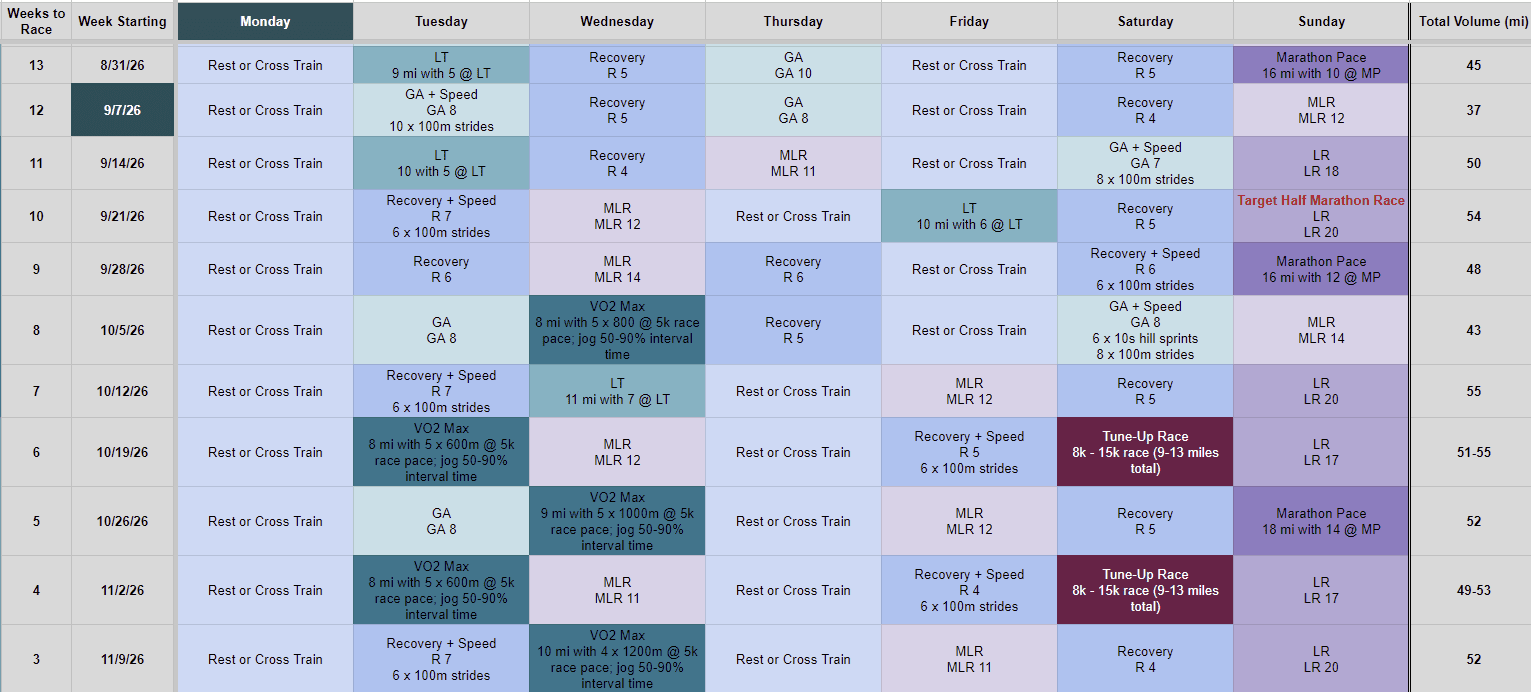
Hi Lia!
Great question!! Since this half falls on the first of your three 20-mile long runs and you’re still 10 weeks out from CIM, I actually think this is a good opportunity to race the half rather than trying to force both workouts into the same day.
I wouldn't recommend racing the half and then adding enough warm-up/cooldown mileage to reach 20 miles. You're right that it wouldn't provide quite the same stimulus as the sustained 20-mile run, and more importantly, we'd be turning it into a very big quality day that could require substantially more recovery.
Instead, I'd look at this week as trading some volume for intensity. You still have two 20-milers later in the plan, along with plenty of marathon-specific work, so I’d be comfortable sacrificing this first one.
I'd also adjust the days leading into the race. In particular, I'd take out the 6 miles at lactate threshold on Friday and make that an easy run. Saturday could be a very short shakeout with a few strides or a rest day, depending on what usually works best for you.
Then on Sunday, I'd do a normal short warm-up, race the half as a half marathon, cool down briefly, and call it a day. No need to chase 20 miles!
The half will give you a great quality stimulus and also a useful fitness check 10 weeks out from CIM. Then you’ll recover, get back into the plan, and use those remaining 20-milers for the marathon-specific endurance work you need.
I think this is one of those situations where trying to check every box in the plan would actually be less productive than deliberately changing the stimulus for that week.
I hope you can join me for a shakeout run in CIM! I’ll be there as well : )
Thank you, Katelyn! That makes a lot of sense!
Hi Coach Katelyn! This is going to be a long one:
My name is Bryan and I am 5 weeks away from my first marathon! I am running Chicago as a charity runner for Team Diabetes. I have a question mostly about shoes and kind of about a niggle. I have been having some peroneal tendinopathy in my left foot (I saw my orthopedist and he does not think it is a stress fracture, and said I can continue to train to my comfort level.) So - I have been testing race day shoes. I had intended to wear a super shoe, but the carbon-plated shoes have been really irritating my foot. When I run in non-plated shoes I have ZERO problems. So I have been holding back from the supers for a few weeks now. I have previously run in carbon plated shoes with no issues: I own the Takumi Sen 11 and the Puma Deviate Nitro Elite 4 and have run a few 5 & 10 k’s in them. My marathon day shoe options (I am still inside the return window) are:
My Pumas
On Cloudboom Strike 2
New Balance SC Elite v6
I also own and am strongly considering:
Superblast 3
Megablast
And finally, I own and LOVE the Cloudmonster 3 Hyper so I bought the LightSpray version because it is so much lighter and also non-plated.
I was hoping to take advantage of the assist from the plated shoe in the marathon, and that it would assist me in maintaining my target pace while expending less energy. But now that I am 5 weeks out - (sigh ) - do I call it and just choose one of my non-plated options and send all the super shoes back?
More context: I am 51 years old and a slower runner. I had a major health issue 2 years ago (massive PE and a T2D diagnosis) and running became my path back to good health, and I have been loving every minute of it. I lost a tremendous amount of weight and due to diet and exercise I don’t have to take any medication for my diabetes. Despite my slower pace (I am targeting a marathon pace of 11:30-12/mi) I do want not only to finish but to perform well, but at the same time I want to enjoy my first marathon and not provoke an injury. I’m hoping you can talk me off the ledge and provide some perspective and direction. Thank you (and your co-hosts on the pod) for the valuable insights and for the good times while listening to you on my runs!
Happy running,
Bryan
Hi Bryan!
First of all, congratulations on being just five weeks away from your first marathon, and on everything it took to get you here. Running Chicago for Team Diabetes after what you've been through over the last two years makes this one pretty special!
And I actually think your shoe question has a simpler answer than it probably feels like right now: if the carbon-plated shoes consistently irritate your foot and your non-plated shoes give you ZERO problems, I would choose the comfortable non-plated shoe.
Especially five weeks out, I wouldn't keep trying to force a super shoe to work because of what it might give you on race day. Yes, one of the advantages of modern super shoes is improved running economy, and that can absolutely be helpful over a marathon. But that benefit isn't worth much if the shoe is aggravating your foot and potentially compromising your training, or becomes increasingly painful at mile 18 on race day.
You've also done exactly the right thing by having the foot evaluated. Since your orthopedist has ruled out a suspected stress fracture and cleared you to continue training to your comfort level, I would continue following their guidance and keep monitoring how the foot responds. If symptoms worsen, change, or start appearing in shoes that currently feel fine, I'd check back in rather than trying to push through it.
Of the shoes you already own, I wouldn't choose based on which one looks fastest on paper. I'd choose based on which non-plated option has been the most comfortable and predictable during your longer runs and at marathon effort. If that's the Superblast, Megablast (I LOVE the Megablast), or Cloudmonster Hyper, great! You absolutely do NOT need a carbon plate to run a great marathon.
And I wouldn't introduce a bunch of additional shoe experiments over these final five weeks. You've got some important training left, and this is the time to start reducing variables rather than adding them. Pick the shoe your foot seems happiest in, get a couple of longer runs and/or marathon-pace work in it, make sure you know which socks work with it, and build confidence in that setup.
I'd also reframe what “performing well” means here. The biggest determinants of your marathon are going to be things like pacing appropriately, fueling consistently, managing your effort, and arriving at the start line healthy. The marginal benefit you might get from a carbon plate is way down the list compared with those things.
And perhaps most importantly, your first marathon is not the day to sacrifice comfort for a theoretical performance advantage. You want to be standing at the start line thinking, “I know this shoe works for me,” rather than wondering when your foot is going to start hurting.
You've already accomplished something much bigger than choosing the perfect race shoe. Now let's get you to that Chicago start line healthy, enjoy your first 26.2, and see what you can do! Let me know how it goes!
Thank you SO MUCH for your reply. Honestly, as I was typing out my question I feel like I knew the right answer. Just needed some reinforcement. Have stowed away the carbons until after Chicago. I feel better about it already! Superblast 3, Megablast or Cloudmonster Hyper LightSpray are the final 3. Did 15 in the LightSpray today and - they’re so light for such a generous stack - I feel like I’m leaning that way. Just have to figure out the sock thing; it’s a little weird not locking down with laces. One more build week and then my taper and then it’s Race Day. I’m so excited. Thank you again Coach for all your wisdom and inspiration!
Bryan
How do you accept it/get over it when a race just doesn’t go your way? Flat legs and an asthma attack kept me from performing today in a race I had a high expectations for, given my training leading up to it. It just wasn’t my day, and while I know that can happen, it’s so annoying when you’ve controlled all the controllables.
Hi!
I completely understand this one. I’ve had some absolutely terrible races after spending months and months training for them. My Boston Marathon in 2025 is a perfect example—I had trained for six months, I felt prepared, I controlled all the controllables…and I just had a really bad day. I was devastated afterward.
And I think that’s actually an important part of getting over it: give yourself permission to grieve the race you wanted to have. I think grieve is the word I’d use here. It might sound dramatic because we're talking about a race, but you invested months of time, energy, hope, and expectations into something that mattered to you. You don't have to immediately brush it off, pretend you're fine, or convince yourself it was secretly a great race. You're allowed to be frustrated and to wish it had gone differently.
Then, once you've had some time, try to separate the race result from the training that got you there. One bad race doesn't erase months of great workouts or suddenly make you less fit. Sometimes you can do everything right and race day still doesn't cooperate. Flat legs happen. Stomach issues happen. Weather happens. Earlier this year, I raced through a rainstorm with a relentless headwind the entire way. There was nothing I could do about it except adjust my expectations and keep going.
That's part of the deal we make when we race. We control everything we possibly can, knowing there will always be a few things we can't. That's what makes those magical race days when everything does come together so special.
Eventually, I try to come back to gratitude, too. I get to run. I get to train. And I get another shot. There will be another starting line, another training block, and another opportunity to see what all that fitness can do.
So don't force yourself to “get over it” today. Let yourself grieve this one a little. Take whatever lessons you can from it, remember that the fitness you built is still yours, and then, when you're ready, pick the next starting line.
What an amazing response! Thanks for taking the time to help put it into perspective for me. Truly helpful, thank you! ❤️
You're welcome! 🙂
Hi Coach Katelyn,!
I have the coolest coach ever and I'm wondering if you have any advice/recommendations for how to adequately express that to her? She's unfortunately too far away to send flowers. Any ideas?
Well this is a VERY difficult coaching question, haha. 😂
I’d say telling her she’s the coolest coach ever on a public board is probably a pretty solid start!! ❤️
But in all seriousness, getting to coach awesome athletes who work hard, trust the process, keep me laughing, and apparently occasionally use this board to embarrass me (in the BEST possible way) is more than enough. No flowers required!! 🌸🏃♀️❤️
You are so sweet, Erin!
Hi Coach Katelyn,
Experienced trail runner here curious about dipping a toe into the road world for a side project. I've never done speed training before, no track background, so I have little data to draw on what things like my threshold pace or pace for any given distance should be to start. My work held a 5K fun run recently so I decided to time trial it and ran 21:17. I plugged that into VDOT and it gave me a 3:24 marathon equivalent, and a 7:17 min/mi threshold pace. How should I interpret these numbers? Is that 3:24 what it thinks I could run a marathon right now (assume I'm rested and recovered), or is that what it thinks I can get to after a proper training block? Is that threshold pace one to start my training block with or one to build to? I know threshold is described as "all-out hour pace" but I've never gone anywhere close to all-out for an hour on roads, I've done almost all my training easy with lots of vert, that 5K time trial was my first time going hard for a 5K ever, so just looking for some direction to make some slightly more educated guesses moving forward. I've run 100Ks before so the marathon distance does not intimidate me but the speed does and I have no idea where to start. Thanks in advance!
Hi Ian!
First of all, I’m so happy to be chatting with a fellow ultrarunner! I actually do something very similar with my own training—I’ll go through trail ultra blocks and then jump back to the marathon and shorter road distances because I really enjoy working on my speed. I also find that the speed and running economy I develop on the roads translate really well back to the trails and help make me a faster runner overall.
As for that 21:17 5K and the VDOT predictions, I would use those numbers, but think of them as guidelines rather than guarantees.
I wouldn’t interpret the 3:24 marathon prediction as, “I could go out tomorrow, rested, and run 3:24.” Your 5K shows that you currently have the speed/fitness associated with roughly that marathon performance, but actually converting that into a marathon requires marathon-specific endurance, fueling practice, pacing, and the ability to maintain that effort for 26.2 miles. Your ultra background obviously gives you a fantastic endurance base, but running a road marathon at a relatively fast, steady pace is still a very different demand.
After a solid 14-, 16-, or even 18-week marathon-specific training block, though, that prediction becomes much more useful as a starting point for what you might be capable of. And you'll have much more information by then to determine whether 3:24 is too aggressive, too conservative, or right on target.
I'd approach the 7:17/mile threshold pace similarly. Give it a try! I wouldn't think of it as either a pace you must be able to hold immediately or one you have to gradually build toward. Instead, use it as a starting point and compare it with how the effort actually feels.
When I coach athletes, I use calculated training paces alongside RPE (rate of perceived exertion) rather than treating the pace on the watch as law. Threshold work should generally feel around RPE 6-ish out of 10: comfortably hard and controlled, around an effort you could theoretically sustain for roughly an hour if you absolutely had to. But you're right—that description isn't particularly easy to judge when you've never gone all-out for an hour!
And when you first start doing threshold workouts, don't be surprised if running that effort in intervals feels plenty challenging. You might begin with something like shorter threshold intervals with recovery between them rather than trying to run continuously at threshold pace. As you gain experience, you'll get much better at recognizing that sensation and controlling the effort.
So if VDOT gives you 7:17/mile, try running around that pace during a threshold workout and pay attention to what your body tells you. If 7:17 feels like you're racing a 5K and you're hanging on for dear life, slow it down! If it feels very controlled and you're barely approaching threshold effort, you may eventually nudge it faster. The same goes for your other calculated training paces.
That's actually one of the fun parts of this next training block. You're going to collect a TON of data about yourself because you haven't really explored this side of your running yet. As you do threshold sessions, intervals, marathon-pace work, long runs, and eventually perhaps another race or time trial, those pace ranges will become much more precise.
So I’d start with the VDOT numbers, pair them with RPE, and let the training refine the numbers rather than trying to nail down perfect paces before you begin.
And coming from 100Ks, I totally understand why you're saying the distance doesn't intimidate you but the speed does! Just remember that speed is trainable too. Introduce it progressively, give yourself enough recovery between harder sessions, and enjoy exploring a completely different gear of your running. I think you'll find that when you eventually head back to the trails, some of that newfound speed comes with you!
Hey Katelyn, I'd love to hear your opinion on my ambicious goal of qualifying for 2028 Boston. To give you some back story primarily I was a shorter distance runner that transitioned into running from a cycling background focusing on the 5 and 10 for the last couple years. This year I ran my first half marathon in May and finished with a time of just over 1:26. Since then Ive ran two other halfs with the most recent one breaking the 1:25 mark. Im signed up for my first full marathon the Niagara Falls Marathon on October 25th and am signed up for Mesa Marathon on Feb 13th. I hope to get a respectable time at my first but Im hoping to take what I learn from the first race and the base I develop for training for it to Mesa to get a better time. My worry is living in Canada and having to train in the winter months I am curious if you have any tips for building towards Mesa is it better to focus work on the treadmill for speed work and still get some quality long runs outside and bundle up? Thanks for your help 🙂
Hi Mike!
Sorry for the delayed response! We were covering Sydney last week and I am just catching up now
I think you do have an ambitious goal, but based on your progression so far, you’ve definitely given yourself a really exciting starting point. Going from primarily 5K/10K racing to a 1:26 half and then already breaking 1:25 shows you have some great speed to work with.
I’m not sure what your Boston qualifying time is since that will depend on your age on race day, and of course, simply hitting the qualifying standard doesn’t necessarily guarantee entry, you generally want a healthy buffer under that standard. But just as a reference point, your current half marathon time predicts roughly a 2:57:28 marathon. Now, a calculator prediction and actually running that time for your first marathon are two very different things, especially because you’re still developing the endurance and marathon-specific experience to match your shorter-distance speed, but it shows there’s a lot of potential there.
I really like your approach of using Niagara Falls on October 25 as your first experience with the marathon. You’ll learn a ton about how your body handles 42.2K, pacing, fueling, muscular endurance, and those final 10–12K. Then you can take those lessons forward rather than putting too much pressure on the first one.
The one thing I would flag is that the turnaround from Niagara to Mesa on February 13 isn't ideal for a full second marathon build. You have just under 16 weeks between the two races, but you’ll want to spend approximately 3–4 weeks properly recovering and rebuilding after Niagara, particularly because it’s your first marathon. Then you’ll also want a few weeks to taper before Mesa. That really only leaves you with roughly 6–8 weeks of solid training in the middle, rather than another complete marathon cycle.
That doesn't mean Mesa can't work. You’ll already have the fitness and aerobic base from Niagara, so we wouldn't be starting from scratch. But I’d look at Mesa more as a continuation of this overall training cycle: recover from Niagara, rebuild, address whatever Niagara tells us needs work, get in a focused block of quality training, and then taper again. How aggressively you race Mesa should also depend on how well you recover from Niagara.
As for training through a Canadian winter, I’d absolutely use a combination of outdoor running and treadmill running. Alex and Michael deal with this all the time. They tend to keep their easier runs outside when conditions are safe, while moving the harder workouts onto the treadmill when snow, ice, or poor footing would make hitting faster paces difficult or unsafe. I think that’s a great approach.
The treadmill can be fantastic for threshold work, marathon-pace sessions, intervals, etc., because you can control the pace and effort without worrying about slipping on ice or battling terrible footing. For your long runs, I’d try to do a good portion outside when conditions allow, especially as Mesa gets closer, but safety always comes first.
And with Boston as the bigger goal, you have time, which is important! I wouldn’t feel like you need to force the BQ attempt at either of these first two marathons. Think of Niagara as gathering experience, Mesa as an opportunity to apply what you learned and potentially take another step forward, and then we can decide what your next training cycle needs to look like.
Given the speed you already have at the half, I’d be really interested to see what happens once you develop the marathon-specific endurance to go with it!
Thank you so much for the valuable insights! For Boston 28 I’d be 41 so that sub 3 would be a good buffer to make it happen 🙂
Hi Katelyn, I left a voice message for the pod but I'm probably too late, my question is around strength work in taper. I'm running Sydney marathon on the back of long list of calf, Achilles, PHT issues and have really benefited from heavy leg work (calf, deadlifts, squats) even the day before my long runs. In Sydney I'm not aiming for a PB as I've barely been able to pick up pace beyond Marathon pace due to said injuries, but i dont want to completely take it easy on the run either. I feel like I don't want to drop the weights next week purely from a confidence perspective - am i crazy? Like I wrote most long runs have been on tired legs but I would like some freshness on the day. What should I do in the preceeding 3-7 days from strength perspective to try to get the benefits of the strength work in the marathon. For further context in my April marathon (my 3rd and I'm late 40's. Born in the 70's) I tapered the weights from 3/4 weeks out and had a terrible PHT / sciatic nerve impingement at 18km hence my reluctance to drop off the strength too much. TIA Nathan!
Hi Nathan! You weren’t too late. We did get to your question, and our full answer will be on the podcast tomorrow!
And I completely understand the hesitation to drop the strength work, especially after how much it has helped you manage your calf, Achilles, and PHT issues.
That said, I actually wouldn’t do any real strength training during race week. The strength work has already done its job, and there’s nothing meaningful to gain from a heavy session that close to Sydney. At this point, I’d rather remove as much residual fatigue as possible and let you finally experience running on fresh legs!
Stick with mobility and your normal activation work, and if you really feel like you need some strength work for confidence, you could do a few very easy bodyweight movements early in the week, but nothing heavy, nothing close to failure, and definitely nothing that could leave you sore.
You’ve done plenty of long runs on tired legs. Now we want to see what those strong legs can do when they’re actually rested!
Good luck and let me know how it goes!
Thanks so much for your time Katelyn, feeling nervous for next Sunday but I'll follow your advice, as of today my legs are still noticeably tired after Tuesday PM weights and a mixed 10km Tempo Wed PM run so do feel like I deserve a bit of a break next week ! Good luck with your monster trip over this way as well. I've found truth in less jetlag flying West than East so hopefully the jetlag gods are on your side too.
Hey Katelyn! I'd love some feedback on how to structure things over the long term. Although I'm a master's runner (48 years old), I have a relatively young running age. I just started training consistently in June 2025... and started my first structured training plan in September 2025.
I'm currently training for the Marine Corps Marathon (coming up October 25). I'm relatively high mileage (57 miles last week... peaking around 65 miles in my big week). I run 6 days a week, and each week includes a long run, a threshold run, and an interval/hill rep workout. About half my long runs have pace in them.
My current training paces project to somewhere near a 3:15 marathon (which would be a BQ, but no cushion!). That seems to make sense considering that I ran a 1:36 HM last December, and I didn't pace that one well (held 7:15 per mile for the first 10 miles and then hit the wall).
My goal is to build a long-term plan to get me into Boston for 2028 and maybe break 3 hours sometime in the next 5 years.
My main question is what to do after the Marine Corp Marathon. I'll need to run another marathon either next Spring or in early Fall to get a qualifying time. I had been looking at the Shamrock Marathon in Virginia Beach on March 21, 2027, but that would mean jumping right back into marathon training after recovering from Marine Corp. But I'm not sure that's the best way to go.
I'd love your thoughts!
Hi Bobby!
I actually think Shamrock could fit really well into your long-term plan. There are about 21 weeks between Marine Corps on October 25 and Shamrock on March 21, which gives you more breathing room than it might initially seem.
I’m generally comfortable with two marathons per year for most runners who recover well. In your case, I’d take roughly 3–4 weeks after Marine Corps to properly recover and gradually return to normal running. That still leaves you around 17 weeks until Shamrock which is plenty of time to rebuild and complete a solid marathon-specific block without rushing straight back into hard training.
I actually think racing twice a year could be really beneficial for your goals. Although you’re 48, your running age is still very young, so you likely have a lot of development ahead of you. Every marathon cycle gives you another opportunity to build aerobic strength and durability, but it also gives you experience. You’ll learn more about what mileage works for you, how you respond to marathon-pace training, fueling, pacing, tapering, and what those final 10K really feel like. All of that matters when you're chasing a BQ and eventually sub-3.
I also wouldn't spend the entire year marathon training. After Shamrock, I’d recover and then spend some time working on 5K/10K/half-marathon speed and threshold, which can raise your overall fitness ceiling before you eventually return to another marathon block for the fall.
So I’d keep Marine Corps as the only focus right now, see what you run and, equally importantly, what you learn from it. Then recover fully and reassess. If you're healthy and feeling good after those first few weeks, I see no reason why Shamrock couldn't be your next goal.
And I love the long-term targets. BQ first, then start chipping away toward sub-3. We actually share that sub-3 goal! With your relatively short history of structured training, consistency and experience are going to be two of your biggest assets over the next several years.
Thanks for the detailed reply! I'll pencil in Shamrock, but won't decide for sure until I see how Marine Corps goes and how I recover.
I'm an old guy looking to do my 2nd half marathon. I'm 56, ran my first last year in 2:11 but injured my foot a few weeks after and couldn't run until December. I've been running consistently again since February with a very different/more moderate approach, and I am now starting a 12 week 1/2 marathon training block with a Nov 8 race date.
My son (freshman in college) has invited me to run a 10K with him at his school on Oct 25. This is when I'm scheduled to run the longest run in the training block. Is it going to kill my training if I run this 10K instead of completing the 10-11 mile run? I feel like with warm-up, the 10K and cooldown, I'm going to be pretty close, but wanted to ask an expert what I might expect.
Hi Paul!
First of all, I would absolutely run the 10K with your son! This is one of those times when life and running line up perfectly, and missing one scheduled long run is not going to hurt your half-marathon fitness.
If getting that longest easy run under your belt is important for your confidence, I’d simply move your peak long run to the weekend before, three weeks out from your half marathon. Do your 10–11 easy miles then, which is actually great timing for your final big long run.
Then, two weeks out, use the 10K as part of your training day. You could run 2–3 easy miles beforehand, race the 10K, and add an easy cooldown afterward if you’re feeling good. If you race the 10K hard, though, don’t feel like you need to force extra miles just to hit a particular number. The race itself is a substantial training stimulus.
Then you’ve got two weeks to recover, taper, and get ready for your half.
Given that you've been much more moderate and consistent this time around, I’d keep that philosophy going. One workout doesn’t make or break a training block, but the consistency of the whole 12 weeks does.
So get your peak long run done three weeks out, go enjoy racing with your son, and then turn your attention toward November 8! Good luck and let me know how it goes!
Hi Katelyn, I found your podcast whilst training for Boston 2025 - I think because you were also training for it, it was more interesting and very relevant. So, this year I ran London in 3.33 after a good training block. I have a place for Berlin next month, but have had a bit of time out (3weeks) due to an ankle injury. I’m back on track now after supplementing some training with cycling. My dilemma is this - I am running The Great North Run half marathon (in Newcastle, UK) 2 weeks before Berlin. How should I race it? Should I use it as a chance to practice marathon pacing or treat it as a race? To add - my husband and 2 adult offspring are also running, so there’s a bit of family rivalry going on!!🤣 Would racing it have a detrimental effect on Berlin?
Thanks so much - loving the podcasts!
Jane (a just-turned 53 year old!)
Hi Jane!
First of all, congrats on that 3:33 in London! Awesome work!
With Berlin being just two weeks later, and especially after having three weeks out with the ankle injury, I wouldn’t race the half all-out. At this point, you’re not going to gain much additional fitness from racing it hard, but you could create fatigue, soreness, or potentially irritate the ankle right before your A race.
Instead, I’d use the Great North Run as your final marathon dress rehearsal. You could run the first 3–4 miles easy, then 7–8 miles around your planned Berlin marathon effort (or break it up into shorter intervals), and finish the last mile or two easy. Practice your Berlin shoes, fueling, hydration, breakfast, and kit and make it a really controlled confidence-building session.
The goal should be to finish thinking, “I could have kept going or raced that final 5K if I wanted to.” Then, you have two more weeks to taper really well for Berlin!
As for beating your husband and kids... I’m afraid the family championship may have to wait until after Berlin. 😂 Save that competitive energy for your marathon!
Good luck and please let me know how it goes!
Thank you! I thought you might say that! You’re right - I will try and run it at marathon pace rather than pushing it harder. I’m not sure I can run the last mile easy though 🙄🤣
Looking forward to hearing about Berlin on the podcast ☺️
Hi Coach Katelyn!
I love listening to you on the podcast and always appreciate your takes and advice. It sounds like others have requested a shakeout run for CIM...yes, please! Consider this another request/vote for an official MH CIM shakeout run. This will be my 3rd CIM, and it would be awesome to see you sometime before/after the race! (No chance I'll see you during the race since you'll be ~1 hour ahead of me by the finish 😅) A couple questions:
1. I'm a fellow heavy sweater. Do you have any sports bra recommendations? I need something that really wicks moisture. My bra will be pretty much soaking wet on a hot day for the entire run, so sometimes I'll get chafing, usually around the chest band area. I've used body glide, but that hasn't seemed to help much. I've heard you mention on the pod that you'll use diaper cream on your feet, would you recommend that for other areas too? Any brand recommendations that dry really quickly and wick moisture well would be appreciated!
2. Are you currently or in the future taking on any new virtual athletes for coaching?
Thank you in advance!
Hi Lia!
Thank you so much! 😊 And yes—that's another vote counted! I will definitely have to host a shakeout run at CIM. I'm really looking forward to meeting everyone in person before the race. Hopefully we'll get a great group together!
As for your questions:
1. Sports bras & chafing
As a fellow heavy sweater, I completely understand the struggle! My favorite sports bra is actually a very lightweight Nike sports bra that fits snugly without feeling restrictive. I've found that a good fit is just as important as the fabric. It’s similar to this one: https://www.nike.com/t/swift-womens-high-support-lightly-lined-sports-bra-dyvwqtK3
And yes—I absolutely use diaper cream under my sports bra, not just on my feet! It has made a huge difference for me. If I remember to apply it before a run, I almost never chafe. If I forget... I almost always do, even with a well-fitting sports bra. I use Desitin, but I’m sure any zinc oxide diaper cream works well. I just apply a thin layer anywhere I know tends to rub before longer or hotter runs.
2. Coaching
At the moment, my 1:1 coaching roster is full, so I'm not taking on any new virtual athletes right now.
However, I'd be more than happy to add you to my waiting list if you're interested! As athletes finish race cycles and spots open up, I always reach out to people on the waitlist first.
Feel free to send me an email at katelyn@marathonhandbook.com, and I'll make sure you're added.
Looking forward to meeting you at CIM! 😊🏃♀️
Thank you, Katelyn! It does actually make me feel better that without some intervention that the chafe is inevitable. I wasn't sure what I was doing wrong! I'll try out these suggestions!
Yay! Can't wait to see you at CIM!
Hi Katelyn,
Just joined Run Club and familiarising myself with the content. I’m 73 and have been in my senior running career for the past 7 years , running 5. 10k, 10 mile and half marathons. The aim in Autumn is to under 50 mins for 10k and 84 mins for 10 miles. One common theme for all distances is post race nausea from which I recover quite quickly. It is related to running at near maximal effort but I have tried different approaches to combat the post race nausea, eg running fasted , varying time of food intake. The nausea is not experienced in training eg in Tempo runs or speed workouts. Any suggestions to help control the post race nausea ( apart from Running slower😭). Run times this year are 23.45 mins for 5K , 50.54 for 10K and 1 hour 58 mins for Hslf marathon.
Many thanks for any advice
Malcolm
Hi Malcolm!
First off, welcome to Run Club! It's great to have you here, and those are fantastic times! Especially chasing sub-50 for the 10K and 84 minutes for 10 miles at 73. That's seriously impressive!
I can definitely relate to what you're describing because I almost always end up with a stomachache after really hard races or maximal workouts. I've experimented with fueling, timing meals, and hydration over the years, but I've never completely eliminated that feeling afterward. It seems that for some runners, pushing right to the limit just diverts so much blood away from the digestive system that the stomach lets you know it's not happy once you stop.
Since it only happens in races and not during tempo runs or speed workouts, I wonder if it's partly the extra intensity and adrenaline that comes with racing.
Unfortunately, I don't have a magic solution, but I'd recommend looking into resources from a sports nutritionist. You can discuss strategies around hydration, pre-race nutrition, and recovery that may help reduce the likelihood or severity of post-race nausea.
I'd also be curious whether anyone else in Run Club has experienced this and found something that works. It would make for a great discussion because I know you're definitely not alone!
Good luck with your fall races, and keep me posted on how that sub-50 attempt goes!
Hi Katelyn , firstly many thanks for your detailed response. Much appreciated! Good to know that it’s not an individual issue. Post race nausea can be embarrassing as you feel it’s a transitory effect and not a general reflection of overall fitness. Like you open to any suggestion that’s worked for fellow runners.
Many thanks
Malcolm
Hi Coach Katelyn-
New MH member here! I am a seasoned 67 year old runner (marathon PR of 2:26) but of course that was decades ago. I’m running a half marathon on August 16. I would like a few more long runs between now and race day. How far out from my August 16 race can I run a 12 mile training run? I was thinking at least 7 days out?
Hi Jeff!
First of all...a 2:26 marathon PR?! That's amazing!! I know it was a while ago, but that's still a lifetime achievement most runners can only dream of!
As for your question, I'd actually schedule that 12-mile long run about two weeks before race day, rather than one week out, although I know I’m a pretty conservative coach.
What I feel is that you're not going to gain any additional fitness from a 12-mile run in the final week before a half marathon. What you can gain is extra fatigue that lingers into race day.
I'd rather have you arrive at the start line feeling fresh than trying to squeeze in one last confidence-building long run. The hard work is already done!
After that long run I'd begin tapering the volume while keeping a little bit of quality in the schedule. One thing I think runners sometimes misunderstand is that tapering doesn't mean stopping all intensity. I'd still include some short race-pace efforts or a few threshold intervals during the final two weeks to keep the legs feeling sharp. We reduce the mileage, but we keep reminding the body how to run efficiently.
And one last point, especially as we get older: recovery becomes one of our biggest performance tools. You're not trying to build fitness in those last two weeks because you've already done that. You're simply trying to arrive at the start line with fresh legs that are ready to show the fitness you've built.
Best of luck at the race! I hope you'll let us know how it goes!
Hi Katelyn- hey thanks so much for the quick, personalized reply and the encouragement. Glad I put that question out to you so I can adjust my training accordingly. I appreciate your expertise on this!
Hello Katelyn, I am a Marathon handbook follower for 2yrs and a new member, i am 71 and i ran my first Marathon May 2026, I followed the sub 4 Marathon Handbook 20 week program and finished my Marathon with a time of 4:06:07 which qualified me for Boston 2027.
My question to you is should I use the same 20 week program( in which i used a half marathon race as part of my training) or your 16 week program to train for Boston, the 20 week was pretty gruelling a couple of weeks before the taper and secondly do you or Alex or Michael have any pointers on how to run Boston or should I just take it easy and enjoy the atmosphere of just being there, though i would really like to break 4hrs, is it feasible for me given this challenging course? Thanks for all you do.
Hi Robert! First of all, congratulations! That's an incredible achievement. Running your first marathon at 71 in 4:06 and qualifying for Boston is something to be really proud of!
Since you're already so close to breaking four hours, I would lean toward the 16-week plan. You already have a solid aerobic base and, most importantly, a marathon under your belt, so you don't need to start from scratch with another 20-week build.
Since you found the peak weeks of the 20-week plan pretty gruelling, I'd use the extra month beforehand simply to maintain consistent mileage, strength training, and a weekly long run before transitioning into the more focused 16-week Boston build.
As for Boston itself, we actually have a whole guide on how to race the course, covering everything from pacing the early downhills to managing the Newton Hills and tackling Heartbreak Hill. I'd definitely recommend checking that out as you get closer to race day. Here’s the link: https://marathonhandbook.com/boston-marathon-mile-by-mile-race-plan/
I may be a little biased because I'm from Boston—Newton, in fact, home to the famous Heartbreak Hill! 😊 Boston is unlike any other marathon. The crowds, the history, the energy... it's such a special experience, especially as a first-time Boston qualifier. My biggest advice is to soak it all in and enjoy every mile. You'll remember the experience far longer than you'll remember your finish time.
And if I could give you just one racing tip, it would be the same advice our very own Amby Burfoot—the 1968 Boston Marathon champion—has shared for years: don't get sucked into the downhill start. It's incredibly easy to let the excitement, crowds, and net downhill opening miles pull you into a pace that's too fast. Those early miles feel effortless, but they come back to haunt runners when they hit the Newton Hills. Be patient, let people go early if they want to, save your quads, and you'll be passing runners over the final 10 miles.
That said, I absolutely think breaking four hours is within reach. You're only about six minutes away, and with another smart training cycle and the fitness you've already built, it's a very realistic goal.
Boston is a challenging course, but if you race it wisely, there's no reason you can't have a fantastic day.
Congratulations again, and welcome to the Boston Marathon family! I think you're going to have an unforgettable experience. 🦄
Wow, thank you so much Katelyn for everything, the quick reply, the link and your great answers to my questions.
I will heed your advice on the 16 week plan and to enjoy every moment of the race, since there are so many things that can happen in a marathon ,that is sound advice.
Thanks again for your great advice and taking the time to write back, I am definitely looking forward to the START/ FINISH and the wonderful Boston crowd in between.
Robert
Hi Coach Katelyn,
I have 2 questions:
1. I'm looking at the Sub 2 hr marathon plan. The mileage total on the right is consistently about 8 miles higher than what I get just adding all the runs up. Are there warm ups / cool downs not included?
2. I have 16 weeks until my 1/2 marathon, so an extra 4 weeks. I have been running ~20 miles per week with some interval/threshold work. How should I approach these extra weeks in terms of weekly mileage and strategy? Would it make sense to just stretch the 12 week program into 16?
Thank you!
Hi Michael!
Great questions.
I’m so glad you have decided to use our plan!
1. Weekly mileage totals Yes, the difference is from the warm-ups and cool-downs, which aren’t included in the individual workout distance because they can vary depending on the runner and the session. Check the guidance notes for each workout, as they’ll give you the recommended warm-up and cool-down ranges. Once those are added in, the weekly total should make much more sense.
2. Using the extra four weeks Rather than stretching the 12-week plan into 16 weeks, I'd use those first four weeks as a 5K speed block before transitioning into the half marathon plan. I love doing a quick speed block before going into longer race training.
Since you're already running around 20 miles per week with some quality workouts, this is a great opportunity to focus on building speed, improving your running economy, and raising your VO2 max. You could:
* Run a short 5K-focused training block with one interval session (VO2 Max) and one strides or hill sprints workout to improve leg turnover and efficiency.
* Gradually increase your weekly mileage if you're recovering well.
* Keep your long run comfortable and build it progressively.
A 5K block is a fantastic way to build speed that will carry over into your half marathon training. By the time you start the 12-week plan, you'll be fitter, faster, and better prepared to handle the race-specific workouts.
Then I'd simply start the 12-week plan as written rather than stretching it out. The progression is designed to peak you at the right time, and going into it with a stronger speed base is likely to give you better results than trying to dilute the plan over 16 weeks.
Good luck and let me know how it goes!
Thank you for your response, that makes sense!
As a follow-up, my long runs are currently ~8 miles. The plan starts with long runs of 4 miles. Should I drop down when I start the plan, or keep the long run mileage up until the plan catches up? Thank you!
You can keep your mileage a bit higher, just make sure you always have a cutback week about every 4 weeks to not overdo it.
I have a question around the 3:30 marathon training plan. For context, I'm a 35 year old male running my third marathon. I have run 4-5 half marathons per year over the past 5 years(half PR was 1:39 and change last year) and am getting more into the marathon distance. My first race was 4:12 with horrible prep in 2024, and in March of this year I ran 3:51 on a rolling hills course. I am registered for the Houston Marathon in Jan 2027. My stretch goal is 3:30 (with the hopes of a better training plan, rest, and super shoes for the first time propelling the result, fully realizing 3:40 may be a realistic result).
In the last few podcasts, it seems the discussion has been that you may not be running at your goal pace early on in your training, and that's okay - you adjust goals and expectations throughout training. This makes a lot of sense, especially if you are trying to get a stretch goal or training in the summer for a fall or winter race (no way I could hold 8:00/mile today in a full marathon in the 90s and 100 degree temperature here in Texas).
But when I see the 3:30 marathon training plan and the guidance notes, it says if you aren't running 8:00/mile and hitting that on a 1-10 effort at a 4 that you should consider a different plan.
Since there is no plan between 3:30 and 4, should I be trying to run the 8:00/mile paces early on, or is it more appropriate to start with an 8:15 or 8:30 mile pace and adjust my pace over time? Or do some different plan?
Thank you for your guidance!
Hi Zach!
This is a great question, and I think you're actually the perfect example of why we talk so much about training based on current fitness rather than forcing goal pace.
The first thing I'd point out is that based on your 1:39 half marathon PR, your equivalent marathon prediction is around 3:26, so from a fitness standpoint, a 3:30 marathon is absolutely within reach. Of course, you still have to develop the endurance and execute the race well, but you're certainly not chasing an unrealistic goal.
The guidance notes in the plan are really intended as a starting checkpoint, not a rule that says you must be comfortably running 8:00/mile on day 1. They're there to help runners choose a plan that's appropriate for their current fitness.
Since you're training through a Texas summer for a January marathon, I definitely wouldn't force 8:00/mile if the conditions don't allow it. Heat and humidity can dramatically increase effort, so your paces will naturally be slower.
My advice would be:
* Run your easy runs by effort, not pace. (RPE 3-4)
* For quality workouts, don't be afraid to start closer to 8:15-8:30/mile if that's what matches the effort on that day. Try for the effort to be around an RPE of 5.
* As the weather cools and your fitness improves, gradually let those marathon pace workouts come down toward 8:00/mile, still staying close to a RPE of 5. This will happen organically as your fitness and weather improves.
* Consider running a 5K, 10K, or half marathon tune-up race during the build (when the fall kicks in and conditions are better). Those races are a great indicator of your current fitness and they allow you to adjust your training paces objectively.
Remember, marathon pace is something you grow into over the course of a training cycle. Very few runners begin a 16- or 18-week build already feeling comfortable at their goal marathon pace, especially if they're training through the summer.
So no, I wouldn't switch to a different plan. I'd stick with the 3:30 plan, train by effort where appropriate, adjust for the conditions, and let your workouts and tune-up races guide you as your fitness develops. I think you'll have a much clearer picture of your realistic race pace in the final 8 weeks of the build.
Thank you for your guidance - this helps a lot!
Hi, planning out my race schedule currently. I am for sure doing Indianapolis on November 7, and then was looking at Oak island North Carolina on February 13th. Seems to be right at the mark/slightly soon, but would it be reasonable to run two decent races at both of these? I go on a month long work trip to a foreign country starting february 14th where I don't think I can keep up as much of the mileage hence not wanting to do one a bit later. Thanks!
Hi!
I actually think that timing can work out okay. There's about 14 weeks between Indianapolis and Oak Island, which gives you time to recover, rebuild, and complete another short block of marathon-specific training.
My recommendation would be to treat Indianapolis as your goal race for the fall, then take 3 weeks of recovery before gradually building back into training (the first week with no running, then the second and third weeks gradually building back in with easy runs). You won't need to start from scratch because you'll already have a great aerobic base, so the second build can be shorter and more focused on marathon pace and threshold work leading into the event.
Overall, I think it's a very reasonable plan, even though the timing in between is a bit shorter than ideal to do a complete new block. And if, after Indianapolis, you feel like you haven't quite bounced back as well as expected, there's no pressure to chase another peak performance. You can always treat Oak Island as a fun marathon and run it by feel rather than racing all-out. That way you still get to cap off your season with a great event before your work trip.
Question about an exceptionally long recovery from a race: I did a 50K back in May (Rothrock by UTMB in Pennsylvania, extremely steep vert-heavy and technical), and here I am almost two months later and am still struggling to run. This is my third year doing ultras, so I've gone through recovery from big efforts before, including a 100K with 14,000' of climbing last season, and this feels so much worse than that did that I suspect something more is happening here than just lingering fatigue.
I can run easy on flat roads ok, though still a solid minute/mile slower than my typical pace at a given effort, but on trails with any climbing at all I just get completely exhausted and am quickly walking after even just a few miles. I've had to abort my few attempts at long runs after only 5-6 miles of moving 3-4 min/mi slower than my usual paces there, with my heart rate spiking high on climbs. My legs don't feel dead and heavy like they normally do after a huge effort, it's more like my fitness just went into the tank out of nowhere.
I haven't felt any physical damage to anything structural (joints, tendons, etc.) and my doctor hasn't found any obvious injuries either. I don't feel any pain like I pulled or tore any muscles. I have felt normal doing my usual strength training routine. I happened to have my annual physical and my bloodwork and iron levels came back normal. One doctor suggested the possibility of a lingering infection like long COVID (as far as I am aware I did not have COVID recently but she mentioned sometimes long COVID has presented after an asymptomatic infection), though this fatigue only really presents when I try and run/exercise, I can go about daily life fine. Have you heard of any extended fatigue/sudden massive loss of fitness like this before post-race and know of any other possible causes that aren't being considered? Thanks!
That's a really good question, and first, I'm so sorry you're dealing with this. It’s sounds very frustrating. A recovery that's very different from what you've experienced after previous ultras is definitely worth paying attention to.
First so, I'm not a medical professional, so I can't diagnose what's going on. But if you're still struggling to run almost two months after the race, especially when you've successfully recovered from races that were arguably even bigger efforts, I think it's a good idea to check in with a sports medicine physician or your general health care provider. Sometimes lingering fatigue can actually be something more specific, like an injury, iron deficiency, RED-S, or another underlying issue that's worth ruling out. I’ve experience iron deficiency on various occasions through my running career and it has knocked me out for months.
In the meantime, I'd resist the urge to keep pushing through it. If every run feels like a struggle, your body is telling you something. It may be beneficial to scale back to easy cross-training and focus on sleep, nutrition, hydration, while you figure out what's going on.
The good news is that because you know your body and have recovered well from ultras before, you recognize that this isn't your normal recovery pattern. I would trust that instinct. Getting evaluated now is much better than trying to train through it for another month or two.
I hope you get some answers soon, and I hope you're back on the trails feeling like yourself again.
