


Editor’s note: We last updated this article on 13 May 2026 based on the latest shoes on the market. We continue to update this article whenever a new shoe is released that merits inclusion.

It’s time to update our quarterly super shoe power rankings. We last ran the exercise at the end of December, between Christmas and New Year’s, and a lot has changed since.
The spring slate of World Marathon Majors has wrapped, which means we now know what all the major brands are doing. We’ve seen the prototypes. We’ve seen the not-so-secret secret shoes out in the wild. And we’ve got a really good vantage point on what’s available right now — and what’s forthcoming.
Below, we’ll recap how we ranked the shoes as of December 2025, then dive into our Spring 2026 power rankings, counting down from 10 to 1. As an added bonus, we’ve also put together what we’re calling the Accessible Top 10: a ranking of the best super shoes you can actually buy.
Some of the shoes on the overall list are in a perpetual state of prototype or just impossible to get your hands on, so this second list is for the rest of us — shoes you can order online right now in your size, or walk into your local running shop and pull off the shoe wall.

Recap: Our Winter 2025 Power Rankings
That feels like a lifetime ago. Our top 10 has completely changed, but let’s bring you back to December 2025.
- 10. New Balance FuelCell SuperComp Elite 5 — just cracking the top 10, beating out the Brooks Hyperion Elite 5 (our first honorable mention).
- 9. Adidas Adios Pro Evo 1 — the first one-use-only shoe. Adidas didn’t call it that, but that’s how it became known. Tigist Assefa used it to set what was then the women’s marathon world record. Super fast, but no durability.
- 8. On Cloudboom Strike LS — what became known as the Hellen Obiri shoe, which she used for her major marathon wins in 2024 and 2025.
- 7. ASICS Metaspeed Ray — at the time, very mysterious and the lightest super shoe in the world. That has since changed.
- 6. Adidas Adios Pro 4 — accessible and very popular in elite running circles.
- 5. Saucony Endorphin Elite 2 — the most underrated shoe of 2025, if you ask me.
- 4. Nike Alphafly 3 — the most ubiquitous running shoe and one of the most durable super shoes ever.
- 3. ASICS Metaspeed Tokyo Sky and Edge — twin shoes with very slight differences. We ranked them together.
- 2. Puma Fast-R Nitro Elite 3 — at the time only available to elite athletes and wear-testers.
- 1. Adidas Adios Pro Evo 2 — controversial, because we ranked it without having tried it. It dominated the elite podiums so much we couldn’t rank it anywhere else.
In general, Adidas dominated the super shoe game in 2025. ASICS and Nike were a not-so-close second and third. They were close to each other. Then the other brands chased.
What’s Already Changed Since December
A few things have shifted already. Brooks now has a Hyperion Elite 6 coming in August, and we have test pairs and have run in the shoe. It’s also appeared in spring World Marathon Majors with a good deal of success.
For New Balance, we’ve seen the next version of the SuperComp Elite — we can’t talk more about that at this stage. The Elite 5 is still the relevant shoe for now.
Adidas is by far and away the most fascinating super-shoe-oriented brand in the world right now. Their dominance is jaw-dropping. It’s Adidas’s world and we’re all just living in it.
ASICS still have a really great offering. We’ve run a lot in the Ray since.
But ASICS told us this is not a shoe for 3:00, or 4:00 folks. You have to be 2:15 or faster to get anything out of this shoe. They can sense when you’re running slower than 2:15 marathon pace, and your feet just don’t get any energy return.
The Adidas Pro 4 is still relevant — Adidas updated the colorway for Boston, and elite athletes there were telling us they’re still wearing it. We know Saucony’s got an Endorphin Elite 3 coming out in June. And of course, the old faithful Nike Alphafly 3 — one of the most easily accessible super shoe in the world. You can drive to a sporting goods store that knows nothing about super shoes and they’ll have it on the wall.
Overall Top 10 — Spring 2026 Power Rankings
This was a hard one to tabulate. A few brands took a step up, while others just feel like leaps and bounds ahead.
10. Brooks Hyperion Elite 6
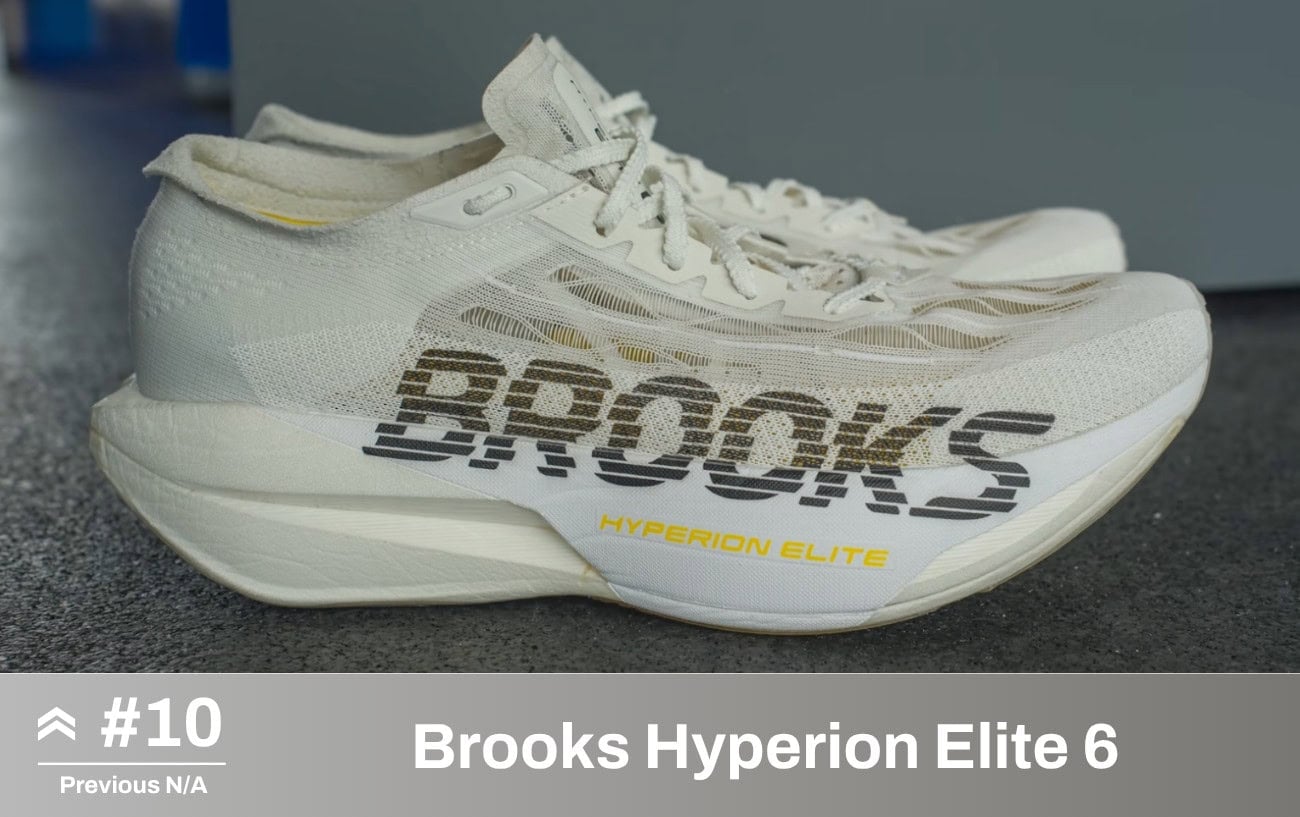
The Deets: Tech Specs For The Brooks Hyperion Elite 6
- MSRP: TBD
- Stack height: Heel: 40mm; Forefoot: 33mm
- Weight: 6.98oz (198g)
- Heel-to-toe drop: 7mm
- Release date: August 1, 2026
The Brooks Hyperion Elite 6 might be the best product a brand can achieve with regular super-shoe-making means. No incredible TPU foams, no weird gimmicks. If they’d made it five years ago, it would look like something from the future. These days, it just doesn’t quite have the wow factor.
But it’s the fastest thing Brooks has ever produced. Brooks had nailed easy running shoes — their Glycerins, their Ghosts. Terrific shoes. They just didn’t have a great super shoe, because their Hyperion Elite line lacked teeth. No real rock-forward profile. The Hyperion Elite 6 has more.
Quick background: Brooks released the Hyperion Elite 4. Underwhelming. Then the Hyperion Elite 4 PB, which almost looked like an emergency measure. Didn’t work. Then the Hyperion Elite 5, with little orbs around the midsole to try to increase pop. Didn’t make much difference. The magic was always going to come from a better rock-forward profile, and the Hyperion Elite 6 has it.
It’s battle-tested. Clayton Young and Jess McClain killed Boston wearing it. Both ran personal bests. McClain’s time was the fastest by an American woman on the Boston course, and Young ran 2:05. That’s a big green check mark.
I have a bit of insider knowledge from a certain athlete technical meeting where I was racing but also lurking in my journalist hat. I saw a picture of the next Hyperion Elite, presumably the seven, and the big jump will happen between six and seven. Six is an improvement, but expect big things from Brooks in the next year or two.
The last Hyperion I meaningfully wore was the Elite 4. I thought it was a workout shoe, not a racing shoe. I wore it into the ground, but I didn’t reach for it for a goal race. The Elite 6 is getting closer. If I’m Clayton Young, who just signed presumably for big bucks to move from ASICS to Brooks, or Jess McClain, who’s their pillar athlete right now, I’m feeling more and more confident with their R&D. The midsole is starting to get it right.
It’s not the bleeding-edge innovation we’re seeing from the Big Three — Nike, ASICS, Adidas — when it comes to midsole foam. The Elite 6 lacks a bit in the foam department, but they’re getting the geometry right. I also think it might be the best-looking super shoe of 2026. Pretty slick silhouette, nice design principles. Overall, really comfortable.
9. On Cloudboom Dev 5 (LS)
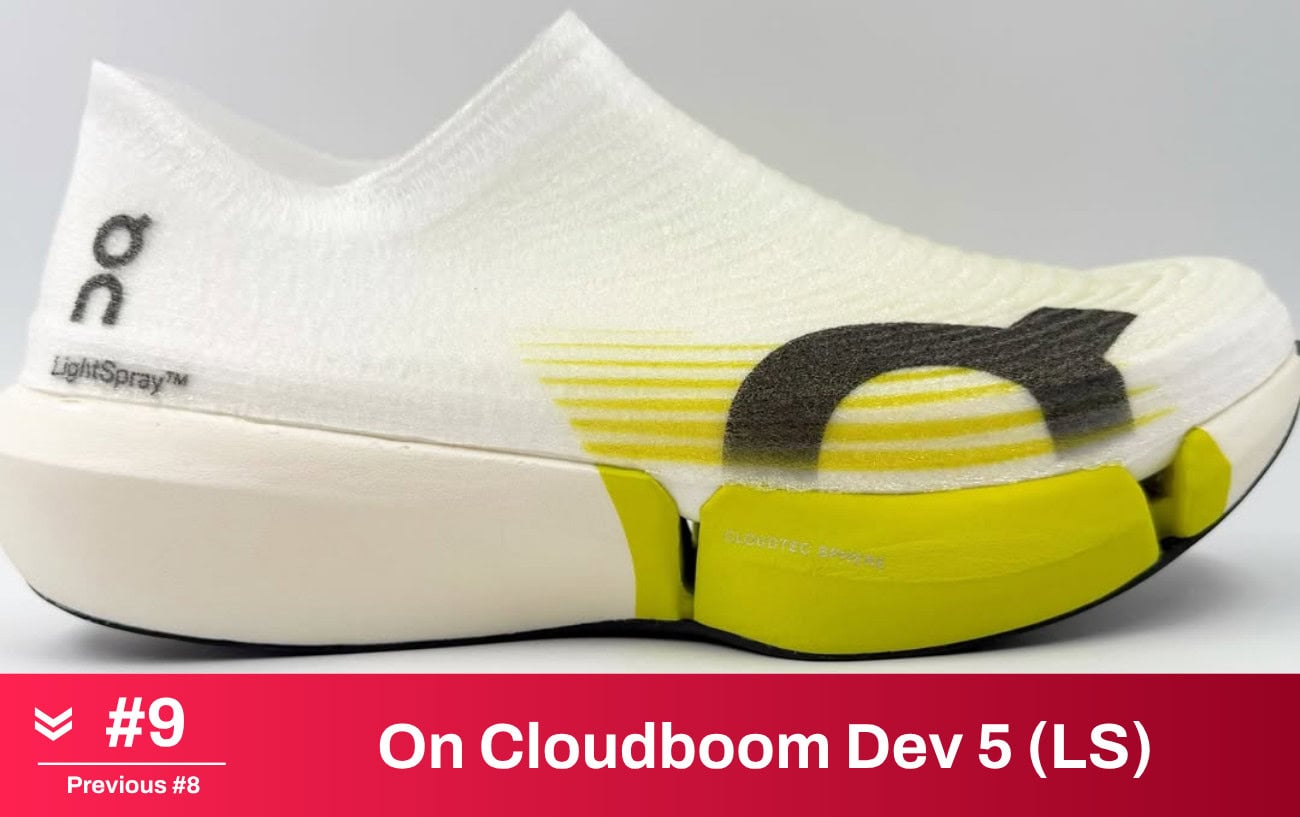
The Deets: Tech Specs For The On Cloudboom Dev 5
- MSRP: TBD
- Stack height: TBD
- Weight: TBD
- Heel-to-toe drop: TBD
- Release date: TBD
For massive nerds, there’s a site (cert.worldathletics.org) where you can track shoes as they get accepted onto the roads and the track. On that list, this one is still called the On Development Shoe 5. We can assume the LS will be added when it’s formalized. LS stands for Light Spray — because this is the shoe made by a robot. The upper is spun by a robot, almost like it has Spider-Man-esque powers. We’ve seen the robot in action in Boston and New York. It’s pretty cool, but a little bit of a gimmick — it just removes the need for shoelaces.
A version of this shoe has been used mostly at the bleeding edge by Hellen Obiri of Kenya, who’s won both Boston and New York multiple times in it. The Dev 5 is the latest iteration. The midsole has been modified — it now comes in two parts, with what looks like a bit more flexibility in the forefoot. We still don’t know much about the foam.
Hopefully now that we’re into the second iteration, we’ll see this shoe in some retail capacity. As it stands, it mostly only exists in our minds. They drop a handful of pairs at a World Marathon Major, and if you happen to be the right size, you might get one. Otherwise, you’re seeing this on the feet of Obiri, Joe Klecker, and Ryan Ford — top Americans who blew the doors off the place in Boston. Clearly very fast. We just don’t know much yet.
On is one of those brands dealing with a big lag between what’s available to their elites and what’s available to everybody else. Hopefully that changes in the next year.
8. ASICS Metaspeed Ray
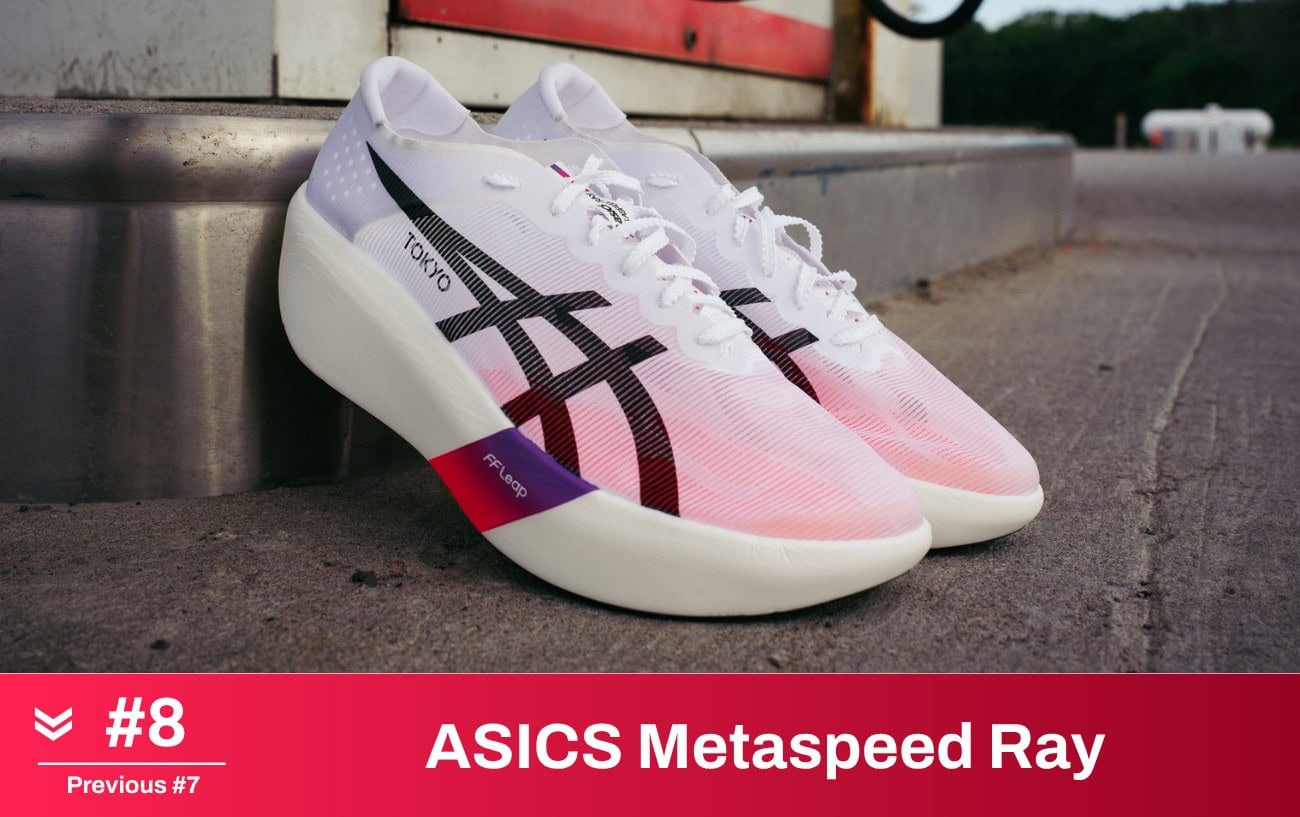
The Deets: Tech Specs For The ASICS Metaspeed Ray
- MSRP: $300 USD
- Stack height: Heel: 39.5mm; Forefoot: 34.5mm
- Weight: 4.6oz (129g)
- Heel-to-toe drop: 5mm
I’m not ready to say the Ray is a failed shoe. It’s actually quite innovative. When it was released, it broke the record for the lightest super shoe in the world. It has a relatively simple midsole — one big slab of ASICS’s FF Leap foam, super light, not all that durable, and not much structure. That’s why we mentioned previously it’s made for runners with a quite efficient stride who don’t waddle too much left and right. It’s for 2:15 marathoners and faster.
When I heard that at the New York City Marathon last year — we got to talk with one of ASICS’s main shoe engineers — I thought, “Okay, this is the divide. The elites will wear the Ray, everyone else will wear the Metaspeed Sky and Edge.” And then in the following months, I noticed many elites chose the Edge and the Sky over the Ray.
That suggested the Ray wasn’t necessarily better — it was a bit of an experimental shoe. And what’s coming down the pipeline (more on this later) seems to be updated models of the Metaspeed Sky and Edge. Phil Sesemann in London wore one of the new versions. He told us it was a little different but not so much. It makes me wonder if the Ray ends up being a one-off that didn’t have enough structure.
When you think of structure, you think of anti-pronation, the big Gel-Kayanos. But you also need a bit of rock-forward profile, and the Ray, for all its lightness, doesn’t really have much of a rock-forward mechanism.
This year, the Ray appeared on one podium — second place at Boston wore it. So it’s still in the conversation. But for now, it ranks at number eight.
The Ray might go down in super shoe history as a one-off or two-off — an experiment in lightness. They took this super-light, powerful, squishy foam and built a midsole entirely from it, added a bit of stability with the plate and rods, and saw what happened. Ultimately, it’s too much of one thing. ASICS will probably take a step back and lean on their other approach — the Edge and Sky tune two different foams together for the right stiffness and responsiveness. That’s probably the smarter way to go, even for elite athletes.
But credit to ASICS. It’s cool what they’re doing, and they’re not all that secretive about it. They’re taking these super-advanced foams, building shoes entirely out of them, and then trickling that foam into some of their easy-running shoes. It’s a very F1-like approach: bleeding-edge tech in the F1 vehicle, then trickling down to the consumer market where it makes sense. Lighter, more powerful daily trainers and super trainers. Everyone benefits.
7. Adidas Adios Pro Evo 1
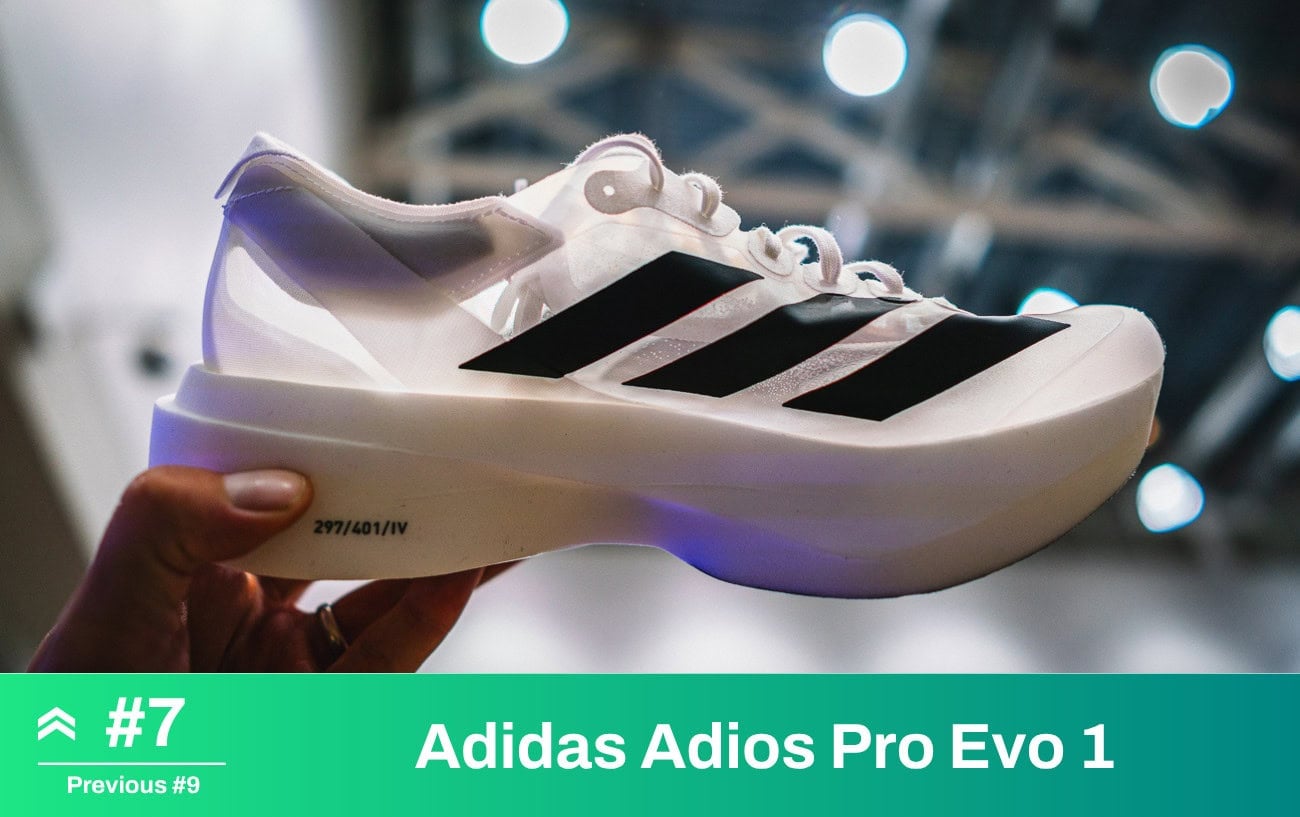
The Deets: Tech Specs For The Adidas Adios Pro Evo 1
- MSRP: $500 USD
- Stack height: Heel: 39mm; Forefoot: 33mm
- Weight: 4.87 oz (138 g)
- Heel-to-toe drop: 6mm
Technically, the Pro Evo 1 V2 at this stage. Let’s sort out the confusion: Adidas dropped the original Pro Evo back in 2023, when Tigist Assefa wore it as a development shoe. It felt like a sea change in the super shoe movement — a game-changer along the lines of the very first Vaporfly 4% from Nike. It really pushed the envelope, changed the design approach, packed a lot of innovation into one shoe.
It has lingered. They did a slight tweak called the V2, which is what we’re referring to now. Some pro athletes still wear it. We’ve subsequently seen the Pro Evo 2, which we’ll talk about, and as of London, the Pro Evo 3, which we’ll get to. But the Pro Evo 1 is still hanging in there.
Alex: Too good to forget. Fotyen Tesfay wore it in Barcelona for what we’ll call the women’s marathon world record — if we don’t count Ruth Chepngetich’s time, which I think we shouldn’t. So, there’s been a 2:10 run in those shoes recently, and Tadese Takele wore them to win Tokyo this year.
It’s two shoes down the timeline, but still very much in the conversation.
6. Nike Alphafly 4 (Michael was strong-armed)
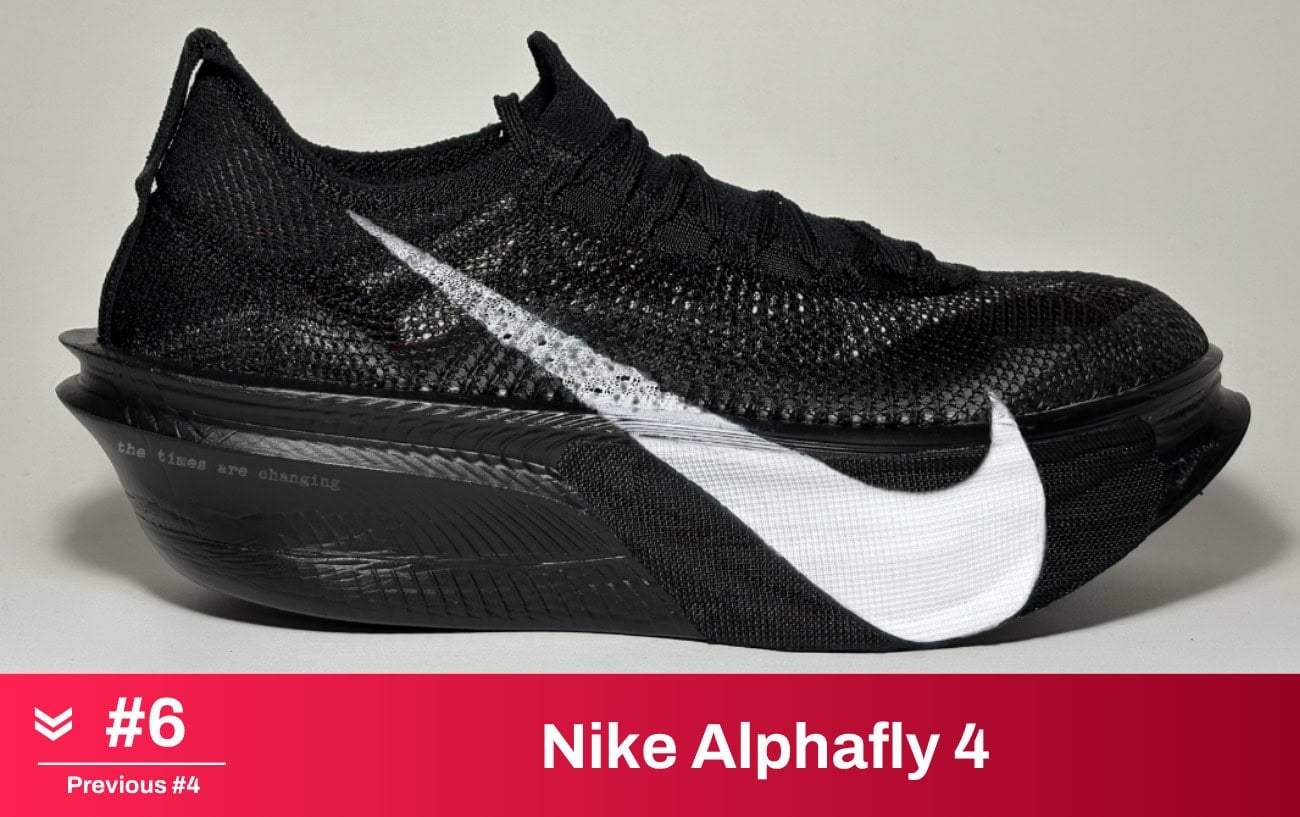
The Deets: Tech Specs For The Nike Alphafly 4
- MSRP: TBD
- Stack height: TBD
- Weight: TBD
- Heel-to-toe drop: TBD
- Release date: TBD
This is where I anticipate some pushback. I kind of strong-armed Michael into ranking the Nike Alphafly 4 no higher than six.
We’re getting into the part of the rankings where we’re mostly operating on professional results. I just thought people would run faster. I thought the Alphafly 4 would dominate early races more than it has.
A couple of flashpoints: yes, Jacob Kiplimo was wearing the Alphafly 4 when he ran a “measly” 2:00 flat at the London Marathon. Poor guy, finishing third. That was faster than the old world record. The Alphafly 4 is capable of going fast. But at this point, I wonder if it’s just not keeping pace with Adidas’s pace of innovation.
We talked to Conner Mantz last fall before his American-record-setting attempt at the Chicago Marathon, and he was about to trial what we now know as the Alphafly 4. He told us the shoes were a little lighter, a little different, but not all that different. I’m still waiting to find out the exact weight, but they risk being twice the weight of a Pro Evo 3.
I came into this year hoping Nike would release not only a better super shoe but a hyper shoe — something that completely changes what the Alphafly looks like. That’s not the case. They’re certainly not ahead of Adidas, and they’re not really keeping pace with ASICS in early marathon rankings either. Shout-out to Mary Ngugi-Cooper, who made the podium in the Alphafly 4 in Boston. But other than that, there are five shoes that deserve a higher ranking.
We should note there have been strong performances in the Alphafly 4 (or the Alphafly Prototype, as it was called for a while), including Mantz’s North American marathon record in Chicago and his half marathon in Houston earlier in the year.
But when you think of Nike coming out with a new shoe — especially the heir apparent to the great Alphafly 3, which have previously set both the men’s and the women’s world records (the women’s now with a big asterisk) — it just felt like the bleeding edge when it came out a million years ago now.
It’s surprising the Alphafly 4, which has taken a long time to get to release, doesn’t feel like the big leap they need to take. We have it on good authority it’s coming out in the fall — wouldn’t be surprised if it’s released ahead of the Chicago Marathon, a Nike event, with a special Chicago colorway.
If this is going to be Nike’s flagship shoe, they’re going for volume sales numbers, not best shoe in the world. That’s surprising for Nike. You need both. Adidas does both — a lot of people buy the Pro 4, and then they have their ultra-high-performance shoe next to it. Nike doesn’t quite have that yet.
We do have it on pretty good authority, from a source, that there’s another shoe coming from Nike — maybe even as early as the end of 2026. Maybe that’s the shoe. They have to respond to what Adidas is doing. Fully anticipate Nike are in absolute chaos mode right now. All in on innovation.
What we know about the Alphafly 4: it’s wider, by design, to make it more accessible to athletes across the board — middle and back of the pack included. Previous criticism of Nike super shoes was that they were too narrow. Music to many ears.
5. ASICS Metaspeed Sky / Edge (Tokyo)
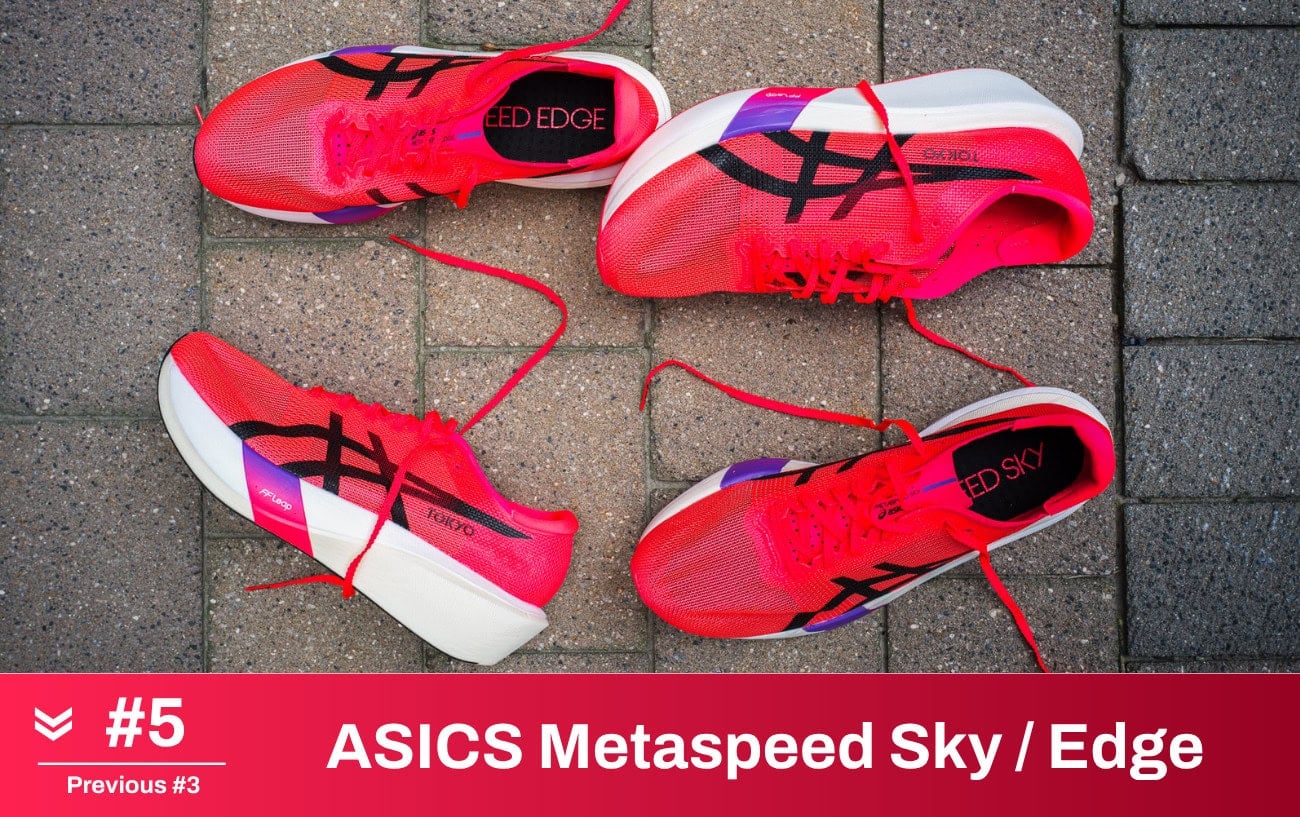
The Deets: Tech Specs For The ASICS Metaspeed Sky / Edge
- MSRP: $270 USD
- Stack height: Heel: 39.5mm; Forefoot: 34.5mm
- Weight: 6.0oz (170g)
- Heel-to-toe drop: 5mm
Speaking of the shoe for the people. We bundled the Sky and Edge together — they’re very similar.
This is Michael’s shoe of preference when running a goal marathon. Came out last summer to great fanfare and a great deal of success. When I’m in the starting corral of a big race and I look around, I see the orange-red colorway of the Sky everywhere. (Lightning Red? Scarlet? Speed Scarlet? I’m sure they have a specific name — probably a Tokyo-something.)
A total home run by ASICS. Very stable, feels light, feels fast. Foam feels great. You don’t really feel the plate, but you do feel an adequate kick. Just the perfect all-rounder for a super shoe — and very much available. You can go buy it right now. I’m sure it’ll crack our accessible top 10. Got a couple of colorways out now.
I have no issue ranking that even above the Alphafly 4, which is maybe a testament to where ASICS is and where Nike seems to be.
4. Adidas Adios Pro Evo 2
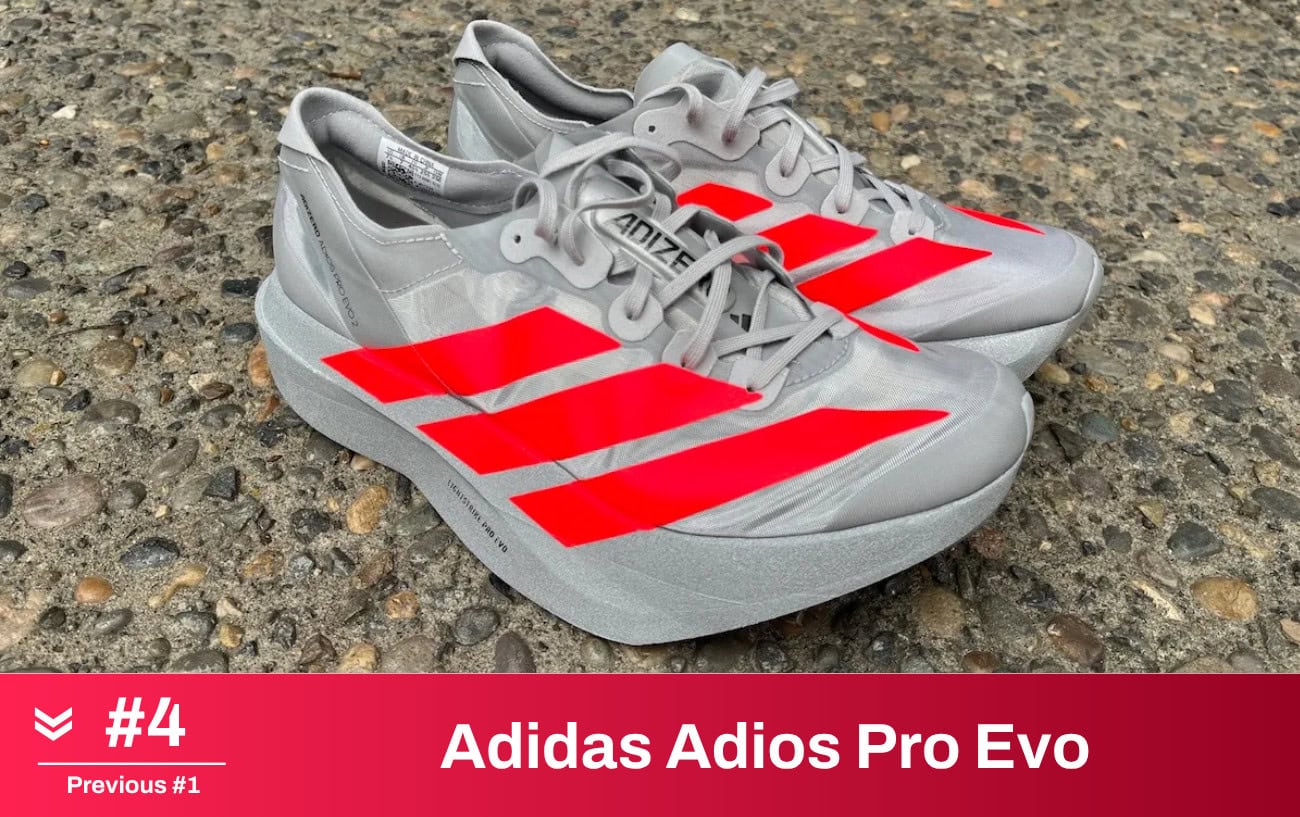
The Deets: Tech Specs For The Adidas Adios Pro Evo 2
- MSRP: $500 USD
- Stack height: Heel: 39mm; Forefoot: 36mm
- Weight: 4.9oz (138g)
- Heel-to-toe drop: 3mm
I can’t believe this shoe fell off the podium. Just five months ago, I was doing everything I could to find a pair so I could review them and maybe race in them.
The big two differences between the Evo 2 and the Evo 1: the heel-to-toe drop was reduced (extra foam under the toe of the Pro Evo 2, creating a different feeling — that’s why some athletes stuck with the one and others went to the two, depending on whether you’re a high-drop or low-drop person), and the Evo 2 lasts more than a marathon. That makes it better for non-elites or for runners not sponsored by Adidas.
Problem is, they’re still really hard to find.
The Evos were the story of 2025. Adidas dominated the podiums. We did a point system across the World Marathon Majors and World Championships — basically any big marathon of consequence — and Adidas scored the most points by far. They beat ASICS and Nike (second and third) even if you combined those two scores. The big reason was the Pro Evo 2.
The big day for the Evo 2 was the New York City Marathon, when the men, all wearing the same shoes, swept the podium. Almost as much as London, New York was a touchpoint for Adidas — it signaled they were on top of the running world.
A lot has happened since. Three shoes are now better than the Pro Evo 2, but it’s still in the conversation. Benson Kipruto wore it again this year in Boston — odd that he didn’t wear the updated version. We heard that the Pro Evo 3 wasn’t yet ready for him, even though they were ready for Kejelcha and Sawe six days later. Either way, the Evo 2 did fine — Kipruto finished third.
At the time, it tied with the Ray for the title of lightest super shoe in the world. That’s since been eclipsed, but it’s still a super-high-tech, fast, high-performing, more durable shoe than its predecessor.
If you’re a shoe nerd looking for a goal-race shoe and you happen upon a pair in your size, I’d be very tempted — they’re still really expensive, $500. The big innovation is a basic concept that points to where the super shoe game is right now: Adidas looked at the Pro Evo 1 and said, “What if we just stuff more foam into the forefoot?”
They kept the same weight (135 grams for a US 8.5 test size) by making the midsole overall lighter, and dropped to roughly a 3 mm drop — almost zero drop. Basically, they’re shoving as much of that powerful supercritical Lightstrike Pro foam as they can into the forefoot, so you get even more power on toe-off.
It worked for their elite athletes. Very cool shoe — but $500 is a lot of money, and you don’t get much more durability than the first iteration. I’d wonder if you can get more than a marathon out of them.
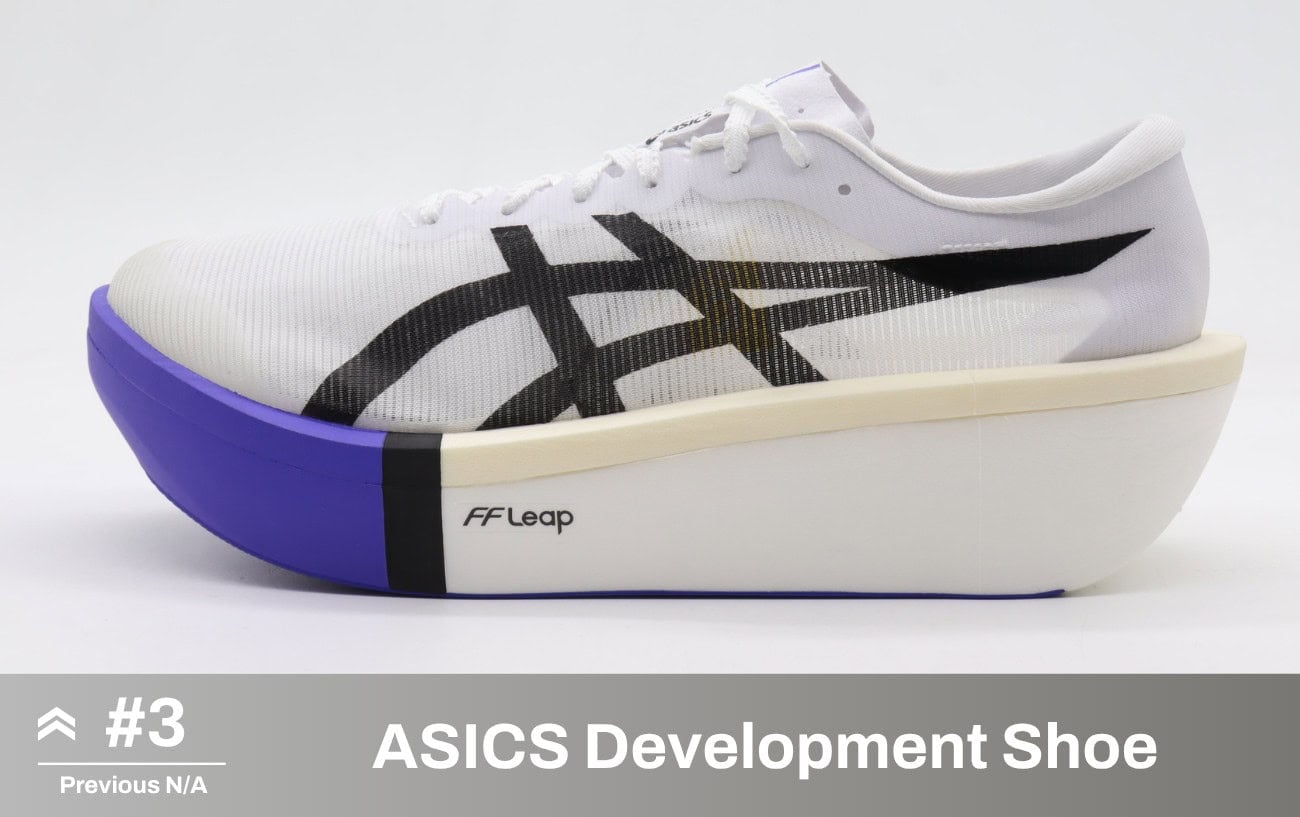
3. ASICS Development Shoe (ME5 Type One / Type P)
The Deets: Tech Specs For The ASICS Development Shoe
- MSRP: TBD
- Stack height: TBD
- Weight: TBD
- Heel-to-toe drop: TBD
- Release Date: TBD
Onto our podium — the bronze medalist. The third-place shoe in the Spring 2026 Marathon Handbook Super Shoe Power Rankings is the ASICS Development Shoe.
We don’t know exactly what this Frankenstein version of the Metaspeed something-something is, but we’ve now eyeballed it on the feet of a few of their top athletes. Top of the list, obviously: John Korir, who won the Boston Marathon in 2:01:52, setting a course record by a country mile — until six days later in London, when history was changed forever.
We thought Korir had the gigantic performance of the spring, and the ASICS Development Shoe was the toast of the running shoe nerd world. Wild.
Things have changed, but Joscelyn Jepkosgei finished third in London in this shoe. Phil Sesemann had a really good day in London in it as well, and told us he’s wearing it. We don’t know a ton yet. Definitely haven’t tested it. We hope to see it more available throughout the summer.
For total nerds: it’s also called the ME5 Type One and ME5 Type P. Sounds like it’ll follow the same logic as the Sky and Edge — two nearly identical versions. To the eye, it looks a bit chunkier in the front. Could be the colorway or an illusion. We’ll report back.
I wonder if the Adidas Pro Evo 2 influenced ASICS’s approach. World Athletics has limited stack height to 40 mm at any point in the midsole, so Adidas figured out: minimize the drop, shove as much foam into the forefoot as possible.
Maybe this new development shoe is doing something similar — lower profile, less drop, more foam in the forefoot. We do know it has more FF Leap foam than the Sky did, though probably not a full wedge like the Ray. The plate geometry is apparently a little different. Pretty cool.
2. Puma Fast-R Nitro Elite 3
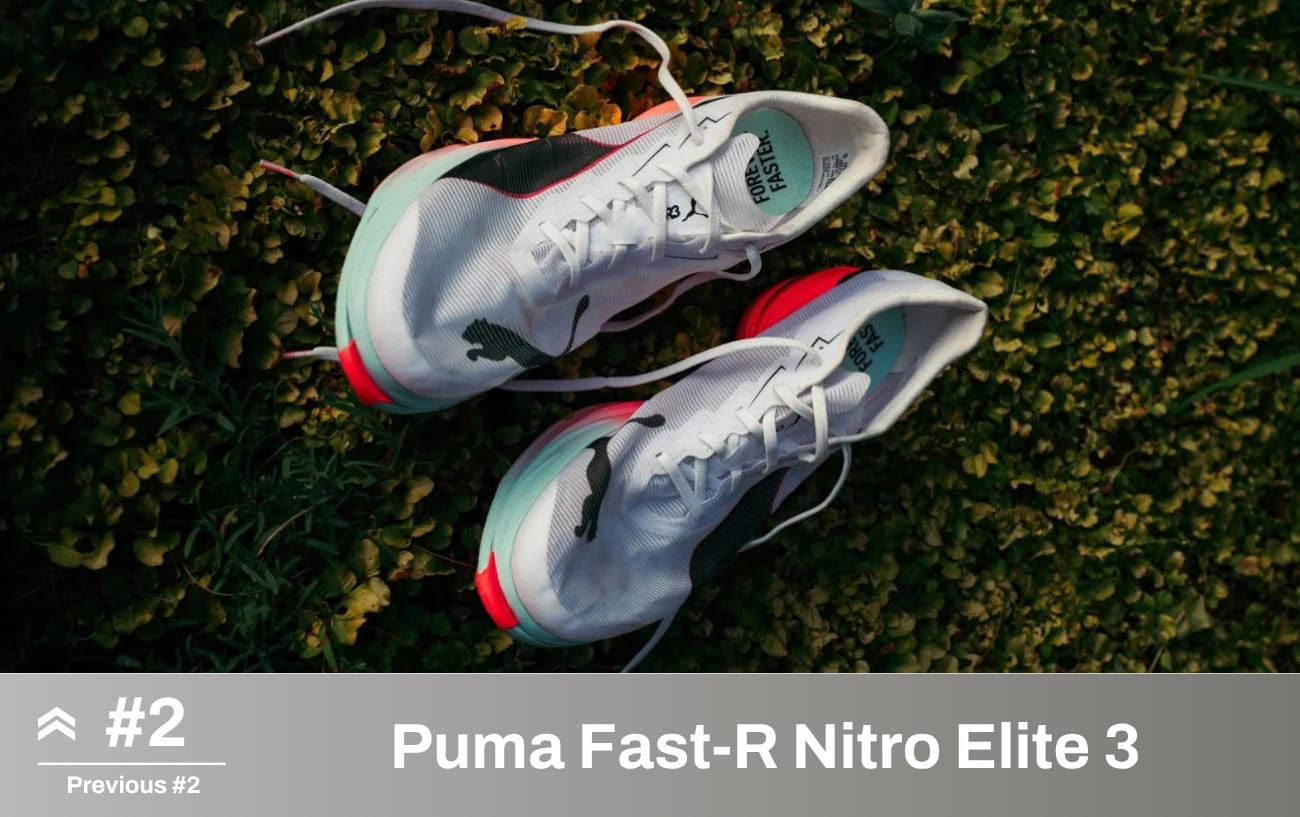
The Deets: Tech Specs For The Puma Fast-R Nitro Elite 3
- MSRP: $300 USD
- Stack height: Heel: 40mm; Forefoot: 32mm
- Weight: 6.0oz (170g)
- Heel-to-toe drop: 8mm
Here’s a shoe that didn’t jam nearly as much foam as it probably could have. But who am I to criticize my current racing shoe of choice?
Quick background. Burst onto the scene at Boston 2025. Puma had released a study — they tapped the sport science folks at UMass, a really great department — for a blind study of super shoes, including this shoe. The supposedly unbiased results showed the Fast-R was 3% more efficient than other leading competitors. A massive statement to make nine years into the super shoe wars.
Soon after, athletes started doing the walking, and the shoe became one of the most sought-after pairs of sneakers in the world. Puma’s slate of athletes — let’s not hide it — aren’t the very top elites. Nike, Adidas, and to a lesser extent ASICS have sponsorship rights on most of those athletes, especially the East Africans. So your Puma marathoners were the 2:08–2:09 men and 2:22–2:23 women. Those athletes quickly became 2:06 marathoners and 2:20 marathoners.
Look closer and the shoe is probably responsible for the most marked improvements in elite running. It just doesn’t happen at the 2:02 level or the 2:13–2:14 level for women. American, Canadian, British, German elites who were on the cusp — totally.
After elite athletes got to test the shoes, then shoe reviewers and generally fast runners got their hands on them, and most people raved. I kept raving. (It’s a wonder I don’t get paid by Puma — I promise I do not.) One of the lightest shoes. Led me to my personal bests. Puts you onto your toes. A great 5K, 10K, half marathon shoe. Lots of marathon PBs. A bit of a cheat code for many.
Since then, more people have gotten to test the shoe, and it’s finally become more available. Props to Puma for getting their best product into the public’s hands — you’re more likely to find a Fast-R 3 than an Evo 2 in the wild.
Now that everyone — well, runners trying to break three, runners trying to break four — has tested it, opinions are evolving and a little mixed. Some people don’t like the minimalist build. It still has the 40 mm stack height, but there are a lot of cutouts in the midsole, so it’s not necessarily supportive.
Not that it isn’t durable — but if you don’t have a forefoot strike and aren’t comfortable with the rock-forward profile, you might struggle over longer distances. For the right person, it totally works. I see a real difference, at least in my own running, between this shoe and a lot of other super shoes.
This shoe is 1just over a year old. It was the talk of Boston 2025. It’s also among the most accessible shoes on our overall list — a big compliment to Puma. They introduced bleeding-edge technology, premiered it at a World Marathon Major out of nowhere last spring, and have continued. There’s even a prototype Fast-R 4 now — Amanal Petros wore it in London. He had a tough day at the office, but you don’t knock the shoe for that.
In the days leading up to the 2026 Boston Marathon, I went into a local indie shoe store, and the Fast-R 3 was on the wall in my size, in a new colorway. That’s a big testament to what Puma is doing. They’ve figured out something other brands aren’t bothering with: get your shoe into people’s hands. Mass-manufacture without losing the bleeding-edge technology. Thousands of runners can use it.
The Fast-R 3 is a huge success story. It’s one of the factors in why we have it at number two. Cool that a shoe you can actually buy is the second-best shoe in the world, prototypes included.
1. Adidas Adios Pro Evo 3 (the sub-2 shoe)
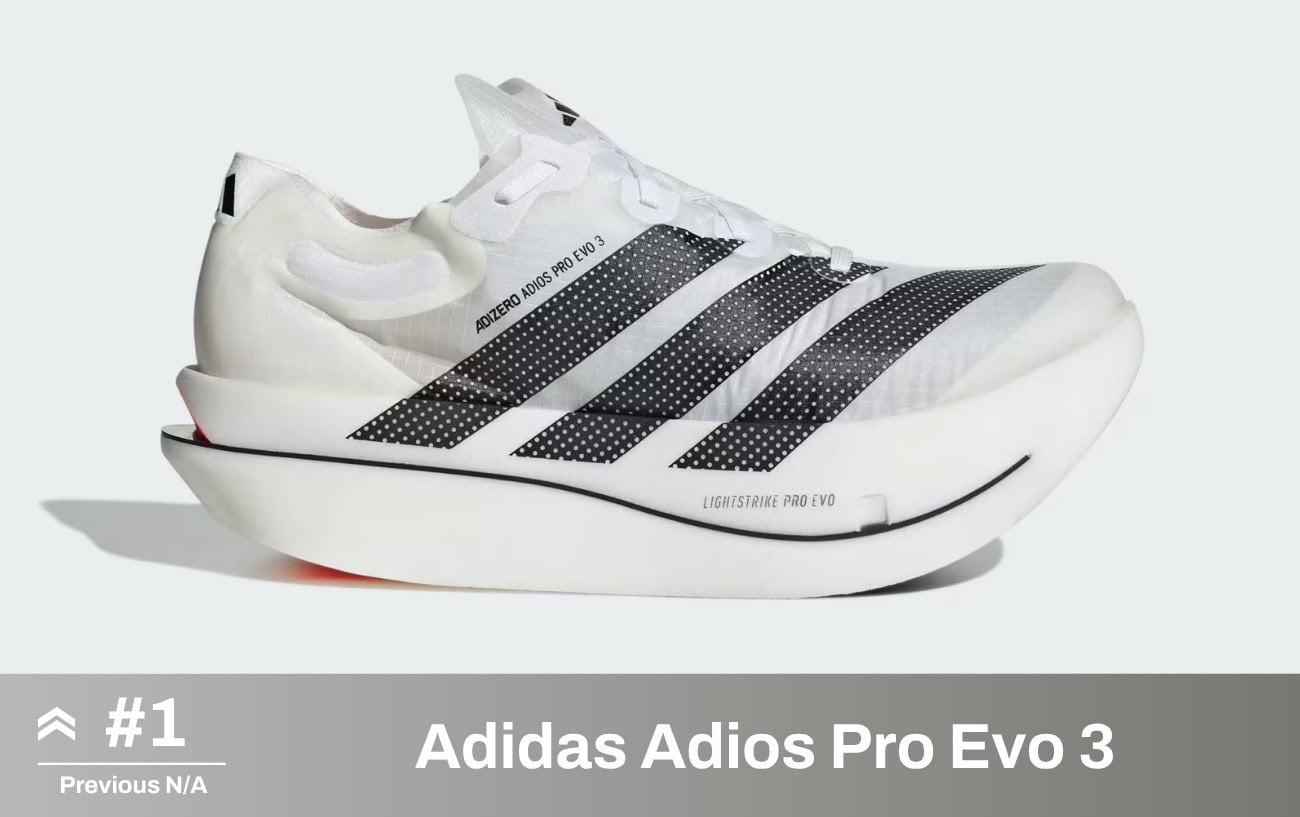
The Deets: Tech Specs For The Adidas Adios Pro Evo 3
- MSRP: $500 USD
- Stack height: Heel: 39mm; Forefoot: 36mm
- Weight: 3.5oz (98g)
- Heel-to-toe drop: 3mm
The number one shoe right now in the Spring 2026 Super Shoe Power Rankings has to be the Adidas Adios Pro Evo 3.
We knew it was coming as of Tokyo. There was a very awkward, clunky soft launch — it was rumored to be there, with some suggestion Adidas athletes might wear it. It didn’t come to pass. We saw a photo or two on Instagram, and even those were unclear.
Then in Boston — Boston is an Adidas event. We thought: the Pro Evo 3 has to drop this weekend. It has to be on Benson Kipruto’s feet going toe-to-toe with John Korir for the win. Come on, Adidas — this is your event. Your moment to launch your big shoe of the year.
Instead, they had a single shoe — not even a pair — at the Expo, in a glass box on a lectern, so you could kind of look at it. A little podium. It was brutal. We got confirmation in the days leading up to Boston that none of the Adidas athletes would wear the shoe in Boston, but it would debut six days later in London.
And my god, did it debut.
I’d say this is the single biggest debut ever by a shoe known to exist in advance of its existing. The biggest debut of any shoe might have been the original super shoe Nike was sneaking onto the feet of Eliud Kipchoge, Galen Rupp, and Shalane Flanagan for Rio — before anyone knew super shoes existed. But in terms of shoe hype, the 2026 London Marathon and the Adios Pro Evo 3 are inextricably bound in history: the first sub-two-hour marathon on a sanctioned course by Sebastian Sawe. Yomif Kejelcha was wearing them. Tigist Assefa was wearing them for the women’s-only world record. This is the most hyped shoe in the world right now.
Alex Hutchinson — running journalist, tracker of these things for more than a decade, who was at Breaking2 back in 2017 — was on the podcast. We asked him what’s the one big thing inside Sebastian Sawe’s sub-two run, and Yomif Kejelcha’s sub-two as well, and he pointed to the shoes. On paper, the Pro Evo 3 is 3.2–3.4 ounces, or about 97 grams. Less than half the weight of an Alphafly. A whole ounce less than the previous lightest super shoe. It’s paradigm-shifting.
It’s almost as if Adidas knew this shoe would produce something amazing. I refuse to believe Adidas couldn’t have put them on Benson Kipruto’s feet for Boston. They chose not to. Maybe they didn’t believe in his ability to win outright, so they waited for Sawe and Kejelcha to “properly” debut it in London, plus Tigist Assefa. Within six days, we went from “Wow, did Adidas drop the ball?” to: Adidas just hurdled all of us into a new era of super shoes.
Some people think the shoe is ruining the sport. Others, like me, are fired up to try them. There’s no other shoe we could have picked at number one.
What we do know: 97 grams, the first sub-100 g super shoe in existence. Do the math — at 180 strides per minute, Sawe’s stride is somewhere between 160 and 200 over the course of a marathon. Thousands and thousands of times of lifting each foot up and powering it back into the ground. We started to take for granted a couple of years ago that making a really light shoe still makes a hell of a lot of sense.
We got away from that early in the super shoe era because we realized that pairing a powerful supercritical foam with a carbon plate creates an incredible amount of energy return — which dwarfed the obsession with making the lightest slipper possible. Pre-super-shoe era, it was all about shedding weight. Then we got into the power game. Now we’re into power and shedding weight, which is wild.
We don’t know how resilient this shoe is. My guess: not at all. This is innovation territory — not durability territory. This is a shoe for running under two hours, or under 2:10 on the women’s side. Not a shoe to run a second marathon in.
It’s going to be $500, like the last iteration. Sounds like a deal. Even if it’s a one-use shoe, I’d probably buy it. It’s going to be next to impossible to get your hands on — Adidas has already done a raffle for the privilege of paying $500. They had to do this to make it World Athletics eligible. (World Athletics says you have to make the shoe somewhat available; this is how Adidas has chosen to do that.)
I can’t foresee many pairs being available in the near future. There might be a couple of pairs at expos at fall World Marathon Majors, immediately snatched up.
What We’re Watching for the Summer Update
That’s it. Geez. It makes me wonder where we’ll be in six months when we do this again.
- Will we have firsthand experience in the Pro Evo 3?
- Will we have tried the Alphafly 4? Will more people have it on their feet?
- Will we finally know more about the ASICS Development Shoe? Will it be much better than the Metaspeeds?
- What’s up with the On shoe?
That’s not to mention the storylines we don’t even know exist yet. The winter 2026 power rankings are going to be fascinating — we’ll have a lot of answers.
Carbon Plate Running Shoes FAQ
Do carbon plate shoes really make you faster?
Yes. Research published in Sports Medicine found that carbon-plated super shoes improve running economy by 4-6% on average, which translates to roughly 2-3 minutes faster over a marathon distance. The combination of curved carbon fiber plates and energy-returning foam creates a “rocker” effect that reduces the work your calf muscles need to do at toe-off.
How long do carbon plate running shoes last?
Most carbon plate shoes last 150-250 miles before the foam degrades enough to lose their performance advantage. This is significantly less than daily trainers (400-500 miles), which is why most serious runners reserve their super shoes for races and key workouts only. At current prices, that works out to roughly $1-2 per mile of racing.
Are carbon plate shoes worth the price?
For competitive runners targeting a PR, carbon plate shoes offer the single biggest legal performance gain available. A 4% improvement in economy is worth roughly 8 minutes in a 4-hour marathon. For casual runners or those not racing, the high price and limited lifespan make daily trainers a more practical choice. Check our full running shoe rankings for alternatives at every price point.
Can beginners wear carbon plate shoes?
Beginners can wear super shoes, but the benefits are less pronounced at slower paces. The carbon plate’s energy return mechanism works best at paces faster than approximately 8:00/mile. Beginners may also find the aggressive rocker geometry destabilizing. We’d recommend building a solid running form foundation first, then trying super shoes for your first goal race.
What’s the difference between the Nike Vaporfly and Alphafly?
The Vaporfly is lighter and more versatile across distances (5K to marathon), while the Alphafly offers more cushioning and stability for longer races thanks to its additional Air Zoom pods. Most elite marathoners choose the Vaporfly for its lighter weight, but heavier or less efficient runners often prefer the Alphafly’s extra cushion for marathon distance.
More shoe guides: Find the right shoes for every run with our guides to the best marathon running shoes, best daily running shoes for training, and best running shoes for workouts.
Want to get the most out of your new shoes? Learn how to run faster and check out our guide to training for a marathon.
Head-to-Head Shoe Comparisons
Can’t decide between two popular shoes? Our detailed comparison guides break down the differences:
- Hoka Clifton vs Bondi
- Nike Vomero vs Pegasus
- Nike Vaporfly vs Alphafly Comparison
- ASICS Metaspeed Sky vs Edge
- Brooks Glycerin vs Ghost
- ASICS Gel Nimbus vs Kayano
- Hoka Bondi vs Brooks Ghost
- Nike Pegasus vs ASICS Nimbus
More Shoe Roundups From Marathon Handbook
- Best Running Shoes For Beginners
- Best Hoka Running Shoes
- Best Half Marathon Shoes
- Best Trail Running Shoes
RunClub — Free
Join 300,000+ runners in RunClub
Free training plans for every distance, a daily running game, exclusive coaching content, and a real community of runners. Create your free account in 20 seconds — no card.
Already a member? Log in →



Join the conversation
I would warn anyone who has ankle or knee stability issues to reconsider the Endorphin Elite 2. I ran in mine a total of three times before I decided to put it on the curb because it hurt my ankle and knee so bad. Just cautioned!