


Just days after being banned for two years for testing positive for a prohibited corticosteroid, Kenyan trail runner Joyline Chepngeno has issued a personal statement explaining how she came to take the substance, and apologizing to the sport.
Chepngeno, 26, was informed by the Athletics Integrity Unit (AIU) on September 1 that her sample from Sierre-Zinal on August 9 contained triamcinolone acetonide, a corticosteroid commonly used to treat inflammation but banned in competition without clearance.
The AIU handed down its sanction on September 8, annulling her victories at both Sierre-Zinal and the UTMB Mont-Blanc OCC 50 km three weeks later.
In her letter, signed on September 12 in Nakuru, Kenya, Chepngeno said the substance came from an injection she received in Nairobi after her long-standing knee injury flared up in the weeks leading into Sierre-Zinal. She described feeling desperate, with limited access to medical treatment in Kenya, and turned to a local pharmacy.
“The practitioner recommended an injected painkiller, assured me it was not doping, and said it would help me recover in time. I accepted the injection because I feared I would not be able to participate otherwise,” she wrote.
Chepngeno admitted she did not inform her coach, Swiss athlete Julien Lyon, because she believed he would not let her compete if he knew the extent of her pain. “But I had to run, as it is my only means of feeding my two children and my widowed mother,” she said.
The runner, who only last month became the first Kenyan to win a UTMB event, accepted full responsibility: “I wish I had been better educated about substances and procedures. The rules apply equally to every athlete, and I accept the AIU’s decision and all the consequences that come with it.”
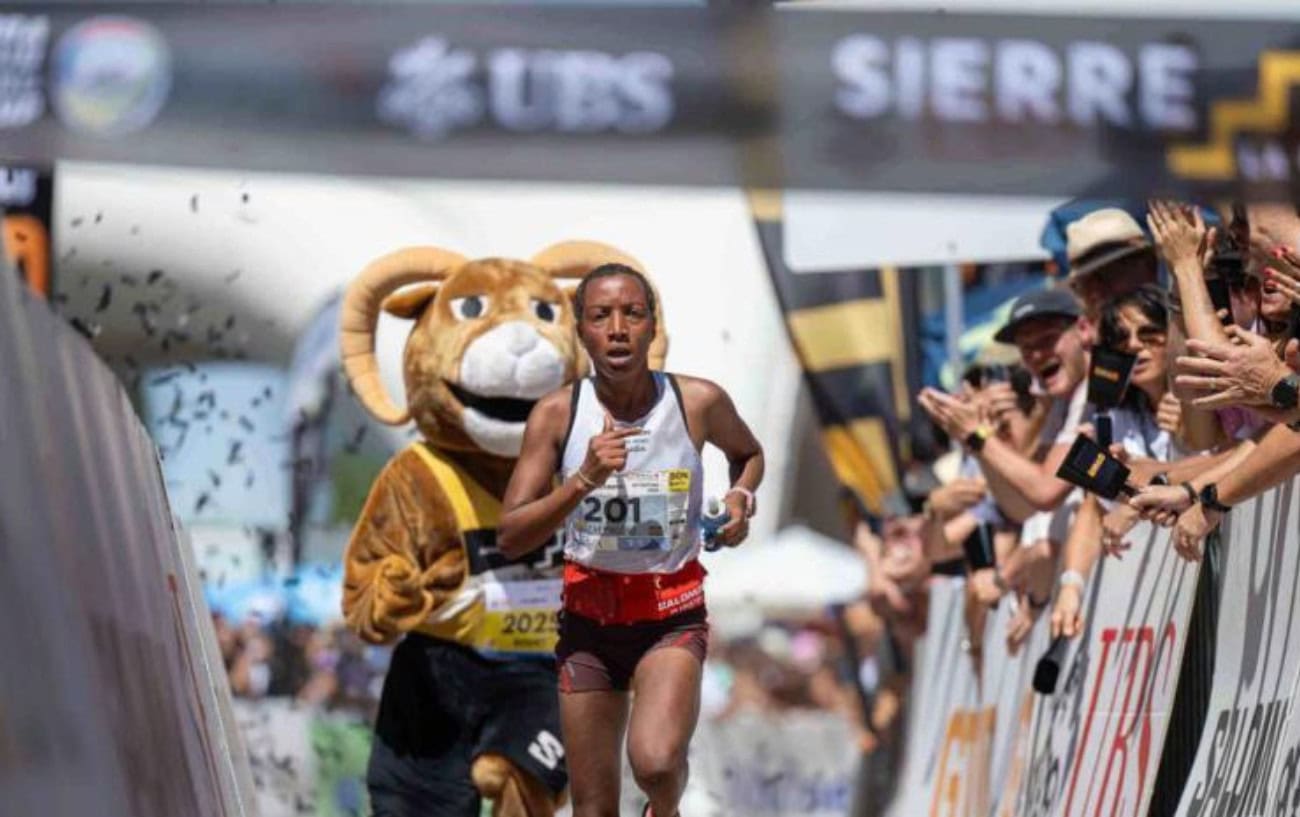
Chepngeno also apologized directly to Sierre-Zinal organizers, her coach and teammates at Milimani Runners, and the wider community that had supported her rise. “I have learned a painful lesson, and I commit to racing in a healthy, clean, and responsible way in the future,” she said, while stressing it was never her intention to cheat.
The consequences remain severe. Salomon terminated its sponsorship contract immediately after the AIU’s ruling, and Sierre-Zinal organizers sanctioned Lyon and suspended his team from future editions. Chepngeno herself cannot return to the Swiss race until at least 2027.
Her case has also fueled broader scrutiny of doping in Kenyan distance running. The country has been under WADA’s highest-risk classification since 2022 after a string of violations. While most cases have been in road running, Chepngeno’s ban is the second at Sierre-Zinal for the same substance in three years, following Esther Chesang’s disqualification in 2022.
For a sport that has long prided itself on its clean image, trail running is now facing uncomfortable parallels with road and track. And for Chepngeno, once poised to be a trailblazing figure for Kenyan athletes on the mountain circuit, the road back is uncertain. “I hope that the world will give me another chance to return after this period,” she wrote.
RunClub
Get more running stories — join RunClub
Daily running news, a community of 300,000+ runners, free training plans for every distance, and a daily running game. Free to join — no card.
Already a member? Log in →




Start the conversation