

A Marathoner’s Next
Congratulations! You just finished a marathon, the one you’ve been diligently training for over the past many months. So how did you feel after crossing the finish line? Like going another five or 50 miles? Probably not. If you’re like most people, after the initial exhilaration of finishing wears off, you just want to get your medal and sit down for a good, long rest. After all, you just ran 26.2 miles! Isn’t that enough?
For some people, the answer is a resounding no. More and more people are taking that next giant step into ultrarunning. For the uninitiated, ultras are anything longer than 26.2 miles—but ultras really start at a distance of 50K (31.1 miles).
That said, many hard-core ultrarunners say an ultra has to be at least 50 miles. While races vary, other common ultraruns are 100K and 100 miles—and beyond. Rather than set a specific distance, other ultras set a specific time. There are 8-, 12-, 24-, and even 48-hour races. Beyond these there are six-day races. Marty Malin is race director of the Badgerland 12- and 24-hour runs in Greendale, Wisconsin. Over the past 21 years, Badgerland has had anywhere from a dozen to two dozen people a year trying to see just how far they can run in a 12- or 24hour period. Most of the time the race is held on a track. You got it: round and round and round, switching direction every three hours to balance the stress on the ankles and knees. Just how many times around? Well, the most anyone has done at Badgerland in 24 hours is Roy Pirrung. He ran 555 laps—137.99 miles.
ISN’T 26.2 ENOUGH? People generally turn to ultras after they’ve done a few marathons or more and want a new challenge. But there’s more to it than just seeing how far they can push their bodies. It’s a different kind of race atmosphere.
Ultraraces tend to be more low key with far fewer people. There are no ultraraces with tens of thousands of participants like a Boston or New York City Marathon. It’s more like tens of people or, in the largest ultraraces, hundreds of people.
What may be the biggest attraction of ultras is that they are mostly off road. Atlanta runner Sandy Geisel says that’s why she started running ultras. “I just love trails and couldn’t find many trail runs at shorter distances. The extra miles just add to the challenge,” she says.
Janice Anderson, who has finished in the top three in the Western States 100mile endurance run more than once, is the president of GUTS, the Georgia Ultra Trail Society. She founded the club to get more people involved and to help get people acquainted with trails. She says ultras are the natural next step for that person looking for a new challenge after conquering the 26.2-mile distance, but it’s the atmosphere that keeps them in the sport. “Once people do one ultra and see how much fun it is to get out there on the trails and enjoy the countryside, they’re usually hooked,” says Anderson.
Living in Boulder, Colorado, ultrarunner Danny Abshire says it’s all about the surroundings. “Being outdoors, in the woods, there’s always a new challenge in the mountains. Sometimes you have to jump over logs, waddle through creeks, or
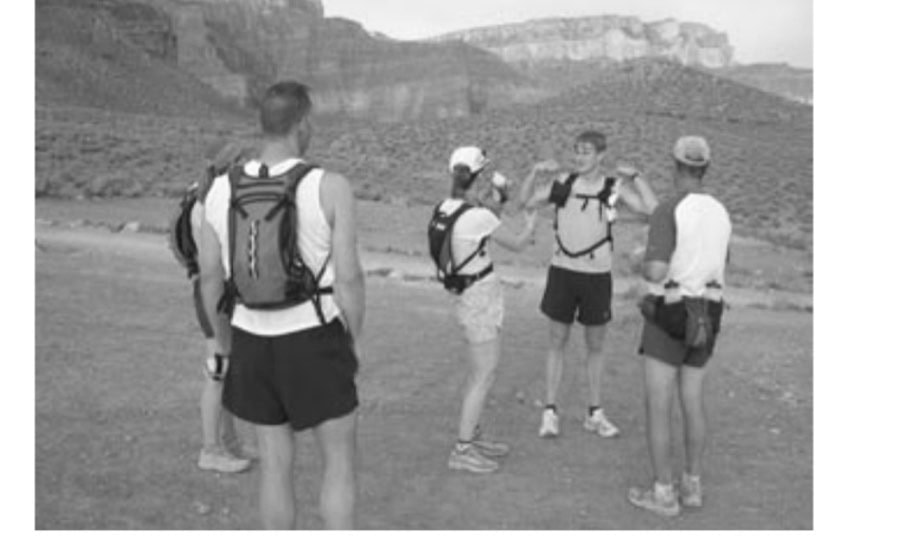
Members of the Georgia Ultra Trail Society (GUTS) at the Grand Canyon in May 2004.
power hike instead of run. It’s a whole different world of running. It’s about running, hiking, listening to your body. It’s much more of a mental game,” he says.
TRAINING If you do long runs at 20 miles to train for a marathon, does that mean you have to run 40 miles to train for a 50-miler? Not necessarily. Coaches say your weekly training runs won’t change that much, but of course you will have to build the duration of your long runs. It might be a combination of running and hiking, but you physically and mentally have to get used to being out there for a long period of time.
As always, training theories abound, and what works for one person may not work for someone else. One of the most common training strategies is to run for time instead of miles and do two back-to-back long runs, for example, a long run of five or six hours on Saturday followed by a two- to three-hour run on Sunday.
Other ultra coaches recommend going out for one very long run of six to eight hours, with walking breaks of 15 minutes each hour. With either plan, mix in some walking so your body gets used to it. It’s a chance to refuel as well as give your muscles a break from the steady pounding of a run.
Whether it’s a marathon or ultra, it’s always wise to mimic the conditions of your race as closely as possible during training. Since most ultraraces are on trails, train on trails or in the mountains if that is where your race will take place.
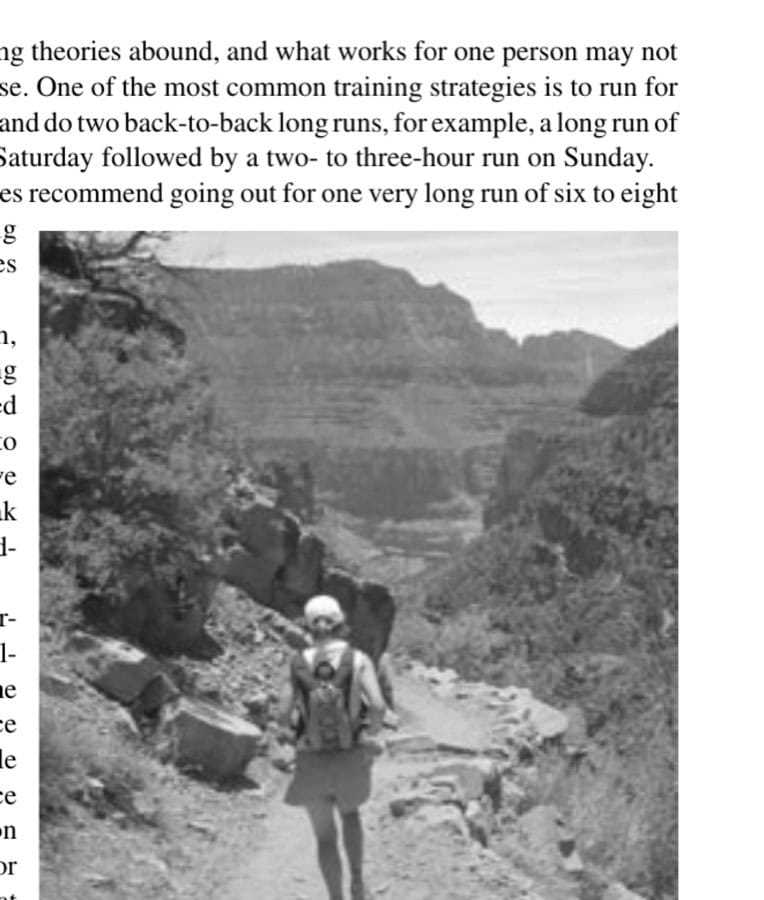
GUTS member Sally Brooking at the Grand Canyon in May 2004.
Plus, depending on the length of the race and your pace, keep in mind that you may be running in the dark and the early-morning hours of the next day. Abshire says he will start some of his training runs at midnight. “After a long day at work, when I’m already exhausted, I’ll start a long run. Yes, it’s dark, but if I have a 26-hour race at some point, I’ll be running in the dark and already be tired. The early-morning hours are when it’s toughest for everyone. It’s dark and it’s lonely. For people who haven’t experienced this, this is the time they’re most apt to quit.” He says being out when it’s pitch dark makes you mentally tougher. He advises others that if they haven’t been up for 24 hours since their college midterm exams, to give it a try.
If you’re going for one of the 12- or 24-hour races held on a track, you should do most of your long training runs on a track or similar short circle. Mentally, you have to get used to doing the same thing over and over again. Physically, you have to get used to using the same muscle groups with few, if any, ups and downs over the same pattern. “Many people tend to get into a rhythm during the race such as running three to seven laps then walking a lap. This should be practiced during training runs as well,” advises Malin.
SLOW(ER) AND STEADY If you’ve ever raced a 10K and sprinted at the start only to slow to a crawl at mile five—and who hasn’t gone out too fast?—then you should start changing the way you think about racing before you send in your application for an ultra. It doesn’t matter how fast you are, sprinting the first mile or two of a 100-miler will do nothing good for you. In a distance this far, too many things can go wrong, from twisting an ankle to not being properly hydrated. There are too many miles and too many hours for everything to go exactly right.
HURTS SO GOOD What may be most surprising is that ultrarunners say after completing a longdistance race that they often feel better than after running a marathon. Abshire says: “I’m definitely less beat up after an ultra than when I run a fast road marathon. For one, I’m on a softer surface; also, there’s a lot of walking involved. It’s a slower pace in general, so my body doesn’t build up as much lactic acid.”
REFUELING AND REHYDRATING You may be able to get through a marathon with a packet or two of gel, but when you’re running 50 miles or longer, it’s crucial to pay attention to nutrition and hydration.
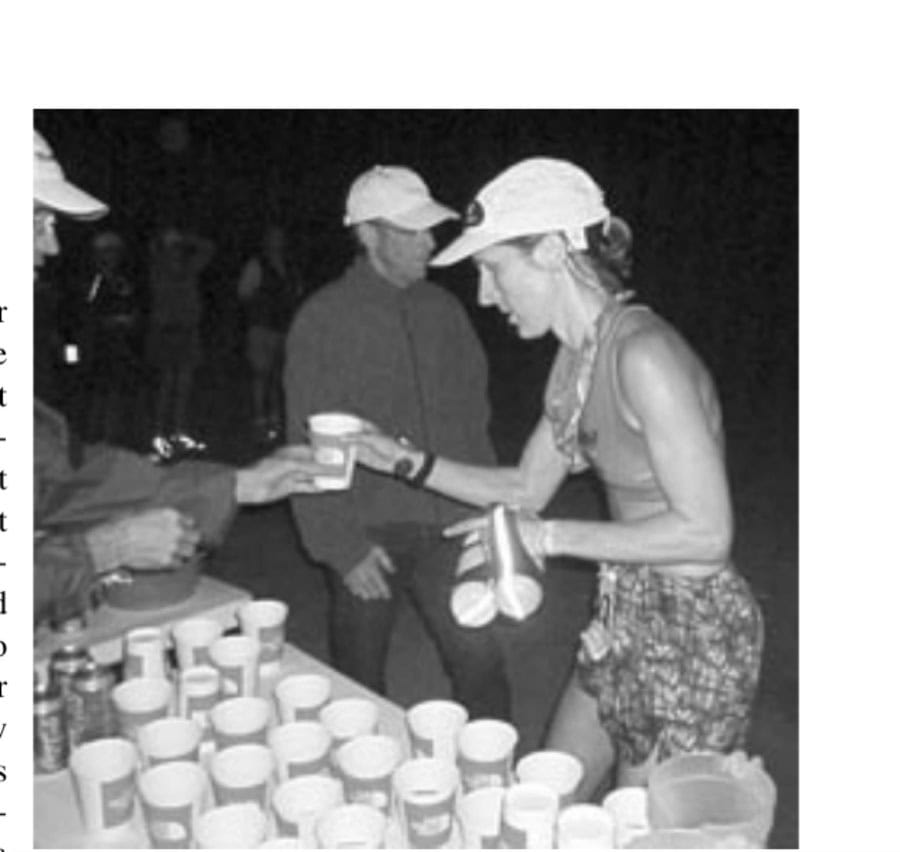
Janice Anderson at an aid station during the Western States 100.
Running six or seven hours, you’re going to have to eat something. It’s recommended you try to eat small amounts at least once an hour. Depending on your body and the conditions, 200 to 300 calories per hour is a good goal. Many times the aid stations have foods you probably don’t see in a 10K race, like boiled potatoes, soup, and flat soda pop. Some aid stations can be quite extravagant. The Arkansas Traveler 100 is known for having tables with everything you can imagine. How does a fajita or a hamburger sound? Or maybe even a margarita?
Wear a fanny pack during training runs and stock it with various foods—OK, you might want to leave the margarita mix at home—but include foods that are salty and some that are sweet to respond to your cravings and see what your stomach can handle.
Of course, regular drinking goes without saying. In the Badgerland 12- and 24-hour run, Malin puts a scale next to the aid station. People are encouraged to weigh in every three or four hours. If they’re losing weight, they know to replenish. If they’re losing too much weight, Malin will pull them out of the race. “That gives them more incentive to properly hydrate and race smarter,” says Malin. Just as in running a marathon, don’t wait until you’re thirsty. Have a plan, decide before the race how much and when you will drink, and stick to the plan.
GEAR TO GO Long runs take a lot of planning. You’ll also have to consider the terrain, weather, and possibly darkness. That means you’ll have to pack some extra gear. Read the race guidelines ahead of time to see what you’ll need. If aid stations will be more than an hour apart, you’ll want to wear a fanny pack with food or gels and wear a hydration pack.
Depending on the length of the race, think about bringing an extra pair of shoes and socks. Anderson, who has done more than 80 ultras, says it’s best to be prepared for anything. Her fanny pack has the absolute necessities. “I have Advil, electrolyte tablets, gels, ChapStick, sunscreen, sometimes a Clif Bar, or even sandwiches,” she reports. In her car she keeps a gearbox stocked with bug spray, Body Glide, blister kits, sunglasses, and a hat.
You also have to consider what to wear. It’s always best to dress in layers. If you’re running a mountain ultra, you may need long sleeves and gloves for the higher elevations. Sometimes gloves can be useful during the whole race for climbing over stumps or to protect your hands in case you fall.
If you’re running through the night, think about a light. Even Anderson, who has a PR of 16:03 for a 100-miler, is running in the dark at some point. Several types of lights are on the market. Headlights, handheld lights, and lights you can wear around your waist or arm are available. If you haven’t run with a light, it’s another thing you want to try out during training runs. Sometimes the lights can be mesmerizing because of the bobbing of the light and your body, especially if you’re tired. Of course, wear all of these gadgets in training just to make sure the packs and accessories are comfortable and don’t rub you the wrong way, and so that you can learn to adjust and service the gadgets on the run and in the dark.
A LITTLE HELP FROM YOUR FRIENDS Most races allow you to have a crew. If this is possible, your crew can help in more ways than one. While there are rules, such as the crew can meet you only at certain points in the race or at specific aid stations, the crew can do wonders for your mind, body, and spirit.
The crew can have available an extra pair of shoes and socks or that special treat you know you’ll be craving halfway through the race. Sometimes, if you’ve been on the course for a while and you let your blood sugar drop, the crew can pick up on that just by looking at you. They’ll be able to remind you to eat and drink. And it goes without saying that just seeing the smiling, familiar face of a special buddy or spouse along the course can be a great morale booster.
RUNNING WILD There’s a lot you have to think about when running an ultra that you wouldn’t even consider when running an event like the Los Angeles Marathon. You have to put some of your commonsense skills into play. Running in the mountains, you have to know what to do to avoid being struck by lightning when one of the many thunderstorms pops up. It’s recommended you crouch down in a ball, roll up on the balls of your feet, and cover your ears. Also, be aware of what type of wildlife you might encounter on long training runs or even during races. In 1994, 40-year-old Barbara Schoener was running on
the American River Canyon Trail near Auburn, California. She was training for the Western States 100 when she was attacked and killed by a mountain lion. This is rare, but bears, mountain lions, and snakes are out there. These are circumstances that may not even cross your mind if you live in New York City or Washington, D.C., where you are more likely to be concerned about being mugged for your running shoes; but they’re definitely something to think about if you plan to do a 100-mile trail race through the woods or in the mountains.
You need to be alert and aware of your surroundings while at the same time watching your footing on the trails. You have to be extra diligent, especially during dawn and dusk, the most precarious times, because that’s when the wildlife is more active and when it is more difficult to see well.
HEAD GAMES Ultrarunning engages the mind more than shorter races do. And you need a solid mind/body connection. The most successful ultrarunners tend to be more in tune with their bodies. They tend to listen to their bodies and know what they need and when it’s time to fuel up. They are able to recognize pain and determine whether it’s the kind of pain that will pass or that will lead to injury. Abshire says he dropped out of a 100-miler
Printer: Insert Reebok dealer listing ad
at mile 86.5. “I knew I could come back next year. I didn’t want to injure myself just for the goal. There’s always another race,” he concludes. There is no doubt that hours and hours of running can take a mental toll. Abshire says you have to stay in the moment. “You can’t think too far ahead; you have to be happy with where you are, whether it’s mile 10, 20, or 99, and be able to relax your body and your mind.”
Running that many hours, you’re likely going to have a number of small setbacks, from losing your food pack to forgetting your sunscreen or missing your crew at a designated spot. It can be frustrating and you can get angry, but there’s nothing you can do about it. It’s just a life experience. You have to stay calm and not dwell on it. If you do, it will cause emotional and physical stress and lead to a downward spiral in your running.
THE LONELY ROAD Ultras can get lonely. Even if you’re doing one of the larger races, with several hundred people, the runners spread out, and you may go for three or four hours without seeing anyone else. There is a section of the Leadville Trail 100 nicknamed the Big Lonesome. It’s a section where you can see the 12,000-foot mountain you have to go over in front of you, but it’s 40 miles away. Depending on your pace, you might be out there alone. It’s very quiet, just you and nobody else. If you’re OK with that, it can be comforting. If you’re not, it can be stressful.
On the flip side, during the 12- and 24-hour races, people are always available to run with and talk to. At any time, you can be talking to the lead runner or the slowest runner out there. On every lap, you see your friends and family near the aid station.
Malin says, “It’s like one big happy family. You get to see everyone, and you’re always less than a quarter of a mile from the aid stations.”
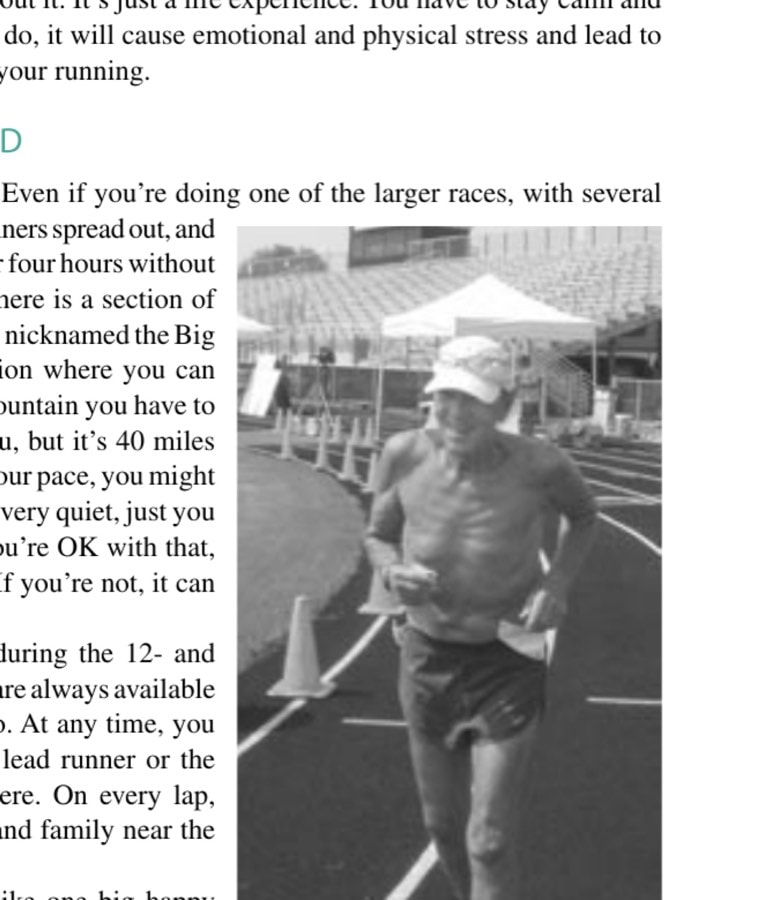
Gene Turnipseed, 72, at the Badgerland 12 & 24 Hour Run.
A KINDER, GENTLER RUNNER When you’re out on the trails, you really get to know your fellow runners. “There’s a bonding that is just impossible to experience in a 10K or even a marathon. In general, the people who do ultras are quite helpful,” says Anderson.
It’s not that there’s no competitiveness, but runners tend to help each other more than competitors in other events. It could be the fact that everyone is trying to conquer a huge distance, the “we’re all in this together” mentality, and racers are more apt to assist a fellow runner along the trail. “
Everyone is in pain and suffering on some level; if you see someone who is worse off than you feel at the moment, you’re likely to see whether they need help. Stopping for a minute or two to help someone is minuscule in the course of a nine- or 10-hour race,” says Abshire.
BELIEVERS So, can it be done? Of course it can. People have been doing it for years. But how long would it take to run a 50-miler? If you really need a rule of thumb, double your marathon time and add a couple of hours. So if you run a 3 1/2-hour marathon, your 50-miler would be about nine hours.
Printer: Insert Spenco ad
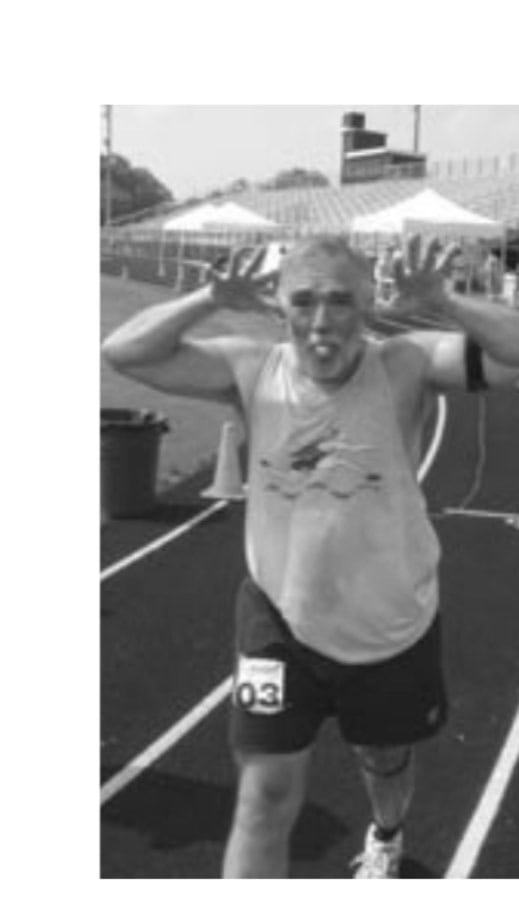
Dan Roberdeau, 60, at the Badgerland 12 & 24 Hour Run.
Others say that’s completely out of the question because there are too many extenuating circumstances. Of course, running on trails, hiking over mountains, and climbing over logs will definitely slow you down. The experts say that for your first ultra, your goal should be merely to finish. Enjoy the time you’re out there and forget about the clock. Anderson says the biggest secret to ultras is “people need to believe they can do it.” So, if you’re looking for that next big race, give an ultra a try. After all, what’s another five miles on top of a marathon? Or, for that matter, another 73.8 miles? It’s a new goal, a new adventure, and one more running challenge to be conquered.
Find answers to all your marathon questions! Let Marathon Runner’s Handbook lead you to
$19.95 • ISBN 0-7360-4420-5
race day with confidence. Nine-time Comrades Marathon winner Bruce Fordyce translates years of distance running experience into this all-in-one resource, complete with awe-inspiring full-color photos. You’ll find: • detailed training programs for the 10k, half marathon, marathon, and ultramarathon, • how to treat and prevent injuries, plus exercises to stretch and strengthen, • advice on finding comfortable shoes and running gear that will last.
HUMAN KINETICS
The Premier Publisher for Sports & Fitness P.O. Box 5076 • Champaign, IL 61825-5076
X002
To order call toll-free
1-800-747-4457 or visit our Web site at www.humankinetics.com
This article originally appeared in Marathon & Beyond, Vol. 8, No. 6 (2004).
← Browse the full M&B ArchiveMore like this
1,000+ stories from 19 years of Marathon & Beyond
The complete archive of the legendary long-distance journal — digitized and free to read.
