

Trail Marathons
To get the most out of your marathon training and money, consider a trail marathon, an entirely different experience and culture than the traditional road marathon. Although aspects of trail courses such as rugged surfaces, elevation variation, and water crossings typically produce slower times than the same distance on a flat road course, racers are both challenged and invigorated by these running-with-nature elements.
Trail marathoners are frequently rewarded with top-of-the-world views and a sense of achievement that gives the word “demanding” a whole new meaning. On top of this, there’s the draw of the far-from-the-maddening-crowds aspect: smaller fields, out-of-the-way venues, camaraderie, and a psychological and physical high.
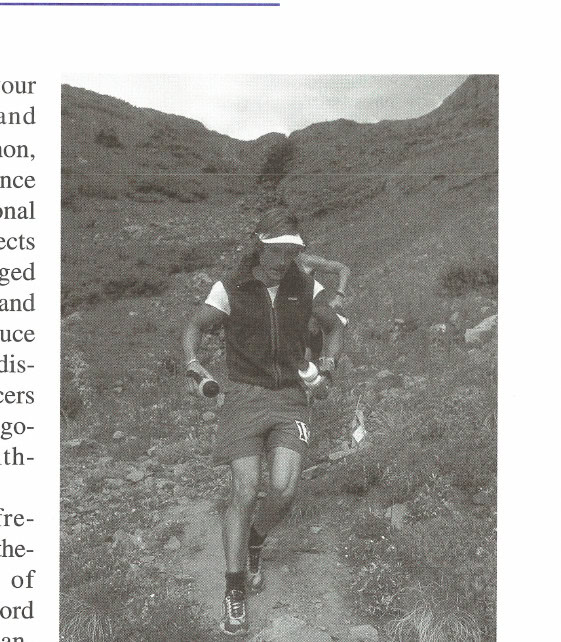
And drawn they are. The largest trail marathon in the United States is the Pikes Peak Marathon, established in 1954. With a field limited to 800, the mid-August race’s registration closes early in the spring. Trail marathoners with lofty goals race 7,815 feet to the top of Colorado’s most famous peak (14,110 feet), then turn around and run back down to the start/finish line. To participate in this popular trail marathon, runners must first qualify via one of three options: (1) run a sub-5:00 ascent of the Pikes Peak course, (2) be a prior Pikes Peak Marathon finisher, or (3) complete an ultramarathon within the ultra race’s cutoff.
But in case newcomers to trail marathoning think these races are a haven for slower-paced runners or declining talent, be aware that runners competing in trail marathons are capable of clocking very fast marathon times. Russell Bollig of Boulder, Colorado, won the 2000 Snow Mountain Trail Marathon, contended at an altitude above 9,000 feet, in 3:07:16. As demonstrated by the final finisher in this trail marathon, who crossed the finish line in 6:32:30, trail marathons can also provide an opportunity for recreational runners to enjoy the trail environment while achieving their marathon-distance goals.
Could a trail marathon be your next marathon challenge? If you’re thinking about it, look at what follows as your essential guide to trail marathons. We’ll identify the character and attitude of trail marathoners and give information on how to get started in this exciting and incredibly varied sport. We’ll also suggest gear we consider essential for trail running and provide trail training tips and trail marathoning opportunities and resources.
TRAIL CHARACTER AND ATTITUDE
Trail marathons often have radical geographical features absent from road marathons. Trail marathons are usually held in remote locations difficult to access other than by foot, and they attract fewer competitors than road marathons.
And then there’s attitude. Who knows if the trail develops the runner’s attitude or the runner with attitude is drawn to the trail, but trail runners are easy to identify. Primarily, trail runners are independent, self-sufficient, at ease being alone, and adept at focusing on the demands that trail running throws at them. In other words, they are rugged individualists.
Since trail marathon courses are generally remote and do not have aid stations with paper cups of water every few miles, an independent, self-sufficient attitude is essential. Because there can be long stretches of time or distance between aid stations, trail marathoners take self-support in stride, carrying their own fluids and fuel. And since part of the challenge of trail racing can be finding the course and staying on it—a challenge absent from most road marathons—trail runners have to be comfortable relying on their own outdoor skills. This characteristic can have a downside when the independent trail runner
encounters potentially life-threatening wildlife in the form of snakes, mountain lions, and bears. Injuries are also a concern. No one who runs trails regularly escapes injury. If you run a lot of miles on trails you are going to eventually fall and suffer trail rash, or strain or sprain an ankle, or sustain some other sort of trail-related injury. Everyone who runs trails falls at some point. Many become skilled at the art of learning how to fall to minimize the bad effects.
Another characteristic of trail marathoners is their ability to focus. As trail marathoners are scurrying over scree and snowfields while struggling for oxygen at 11,000 feet at the Leadville (Colorado) Marathon, they are pretty serious and focused. There are not many trail marathon competitors dressed in Mickey Mouse costumes or hula skirts, outfitting not uncommon at thematic road marathons. Trails require serious attention for safety to sustain any kind of a pace over the radically varying surface.
Perhaps, overall, trail runners are interested in and able to connect with nature in a special and intimate way. They want to use their running ability in a natural environment without being reminded of civilization through asphalt, portalets, and other man-made conveniences—without belly dancers as race entertainment, without throngs of cheering crowds. They don’t need the approval of the crowds to validate their existence. Their existence is validated by the sweep of nature through which they are privileged to move under their own power.
In our modern society dependent on immediate ego gratification, a surprising attitude of trail marathoners is how remarkably understated they are about their trail-marathoning accomplishments. They modestly rack up numerous trail marathon finishes in a single season; afterward, they are understated about their accomplishments.
Trail marathoning seems to be much more about personal accomplishment than the traditional social, if not party-like, celebration that characterizes road marathons. Trail marathons are not as commercialized or sponsored or highly attended as the more visible established road marathons. This makes for both good news and bad news for the emerging sport. Trail marathons struggle with the balance of preserving their character and attracting participants, sponsors, and visibility, but growth and popularity can directly change the character that caused the race to exist in the first place.
KISS PREDICTABLE GOOD-BYE
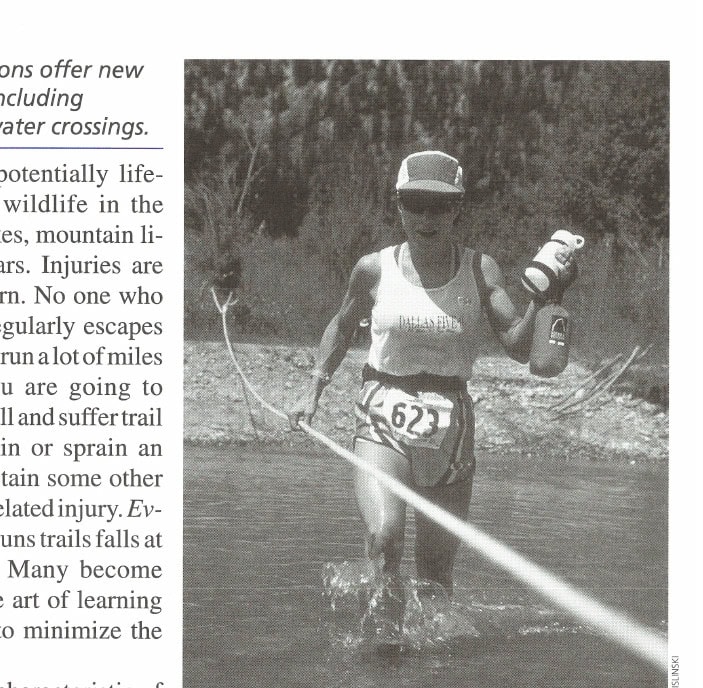
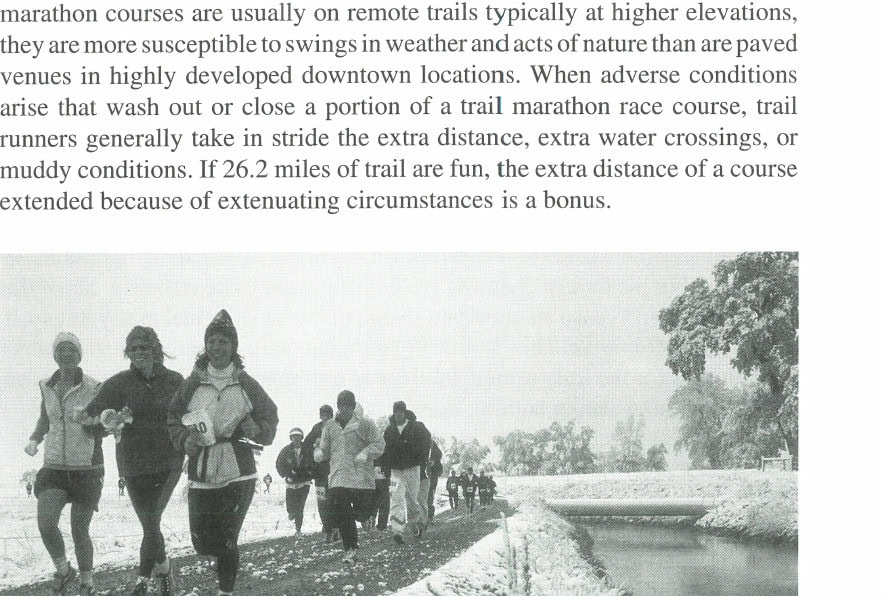
Another important characteristic of trail marathoners is flexibility. Since trail marathon courses are usually on remote trails typically at higher elevations, they are more susceptible to swings in weather and acts of nature than are paved venues in highly developed downtown locations. When adverse conditions arise that wash out or close a portion of a trail marathon race course, trail runners generally take in stride the extra distance, extra water crossings, or muddy conditions. If 26.2 miles of trail are fun, the extra distance of a course extended because of extenuating circumstances is a bonus.
GETTING STARTED
You can get an idea of what trail marathoning is like by participating in a shorter-distance trail race. Many trail marathons offer half-marathon events along with the marathon. The trail marathon itself may also be offered on the same course as ultra trail races. The Snow Mountain Ranch Trail Challenge near Winter Park, Colorado, offers a half-marathon, marathon, 1-1/2 marathon, and double-marathon on a 13.1-mile trail loop. Race director Scott Weber offers this range of distances in a single venue to allow trail runners of all abilities to experience the spectacular race course in the shadow of the Continental Divide. “The race has grown in popularity, primarily the half-marathon event,” he reports. “I think when the half-marathoners realize that they can complete a trail race and they see the double-marathoners running on the same course they are inspired to try a trail marathon.”
Another introductory approach to experiencing trail marathons is to run an “in-between” marathon, such as the two-year-old Boulder Backroads Marathon, which meanders through beautiful countryside on mostly soft-packed dirt roads and quiet rural lanes. Not the true definition of trails, certainly, but the country venue approaches the traditional trail marathon’s more remote character.
Also, trail races on paved trails or “rails-to-trails” can offer a transition from road marathon venues to mountain/trail marathons for novice trail marathoners. Such venues offer a transition from traditional urban landscaped marathons on pavement, but the lack of cheering crowds along the more remote areas of the race course could cause an unprepared road marathoner to feel pretty lonely, if not lost and off-course. This “solitary” factor can help prepare new trail marathon runners for the truly remote traditional trail marathons where a racer can go miles without seeing another human being.
GEAR
Depending on the characteristics of the course, expect to be out much longer when you run a trail marathon than you would be for a road marathon. To enjoy successful trail marathoning experiences, runners rely on gear not traditionally part of road marathons. Most trail marathons are in locations meant to showcase a particular attraction, such as rugged mountain trails, desert environments, or remote coastal areas. Although each of these environments has unique considerations when it comes to choosing running gear, the overriding concern is to be prepared for running in the environment for an extended time.
Gear common to trail marathons in remote locations starts with good hydration systems. Because an independent, flexible character is not enough, trail marathoners need to support their independence with a hydration system that can take them from one distant aid station to the next. Of course “distance” in
these events is relative—time between aid stations is what you’ll need to prepare for. As a road marathoner, you might cover six miles in 50 minutes, but six miles on a mountain marathon course could take 90 minutes or more. With this in mind, you’ll want to carry fluid and extra calories. If the time between aid stations is within the 60-minute range, most trail marathoners are comfortable carrying a 20-ounce water bottle (with a hand bottle strap) and refilling it as the time between aid stations dictates. Bottle straps prevent fatigued hand and arm muscles that come with clenching a nearly 2-1/2-pound full water bottle. The strap may also keep the water bottle attached to your hand instead of tumbling down a 1,000-foot dropoff. When approaching a course new to you, research the course profile and description or run the course in advance of the race for training if possible and determine your hydration requirements between aid stations. Then prepare accordingly. For really long stretches between aid stations or to allow a fast runner to minimize rehydrating time at an aid station, consider a backpack-style hydration system (such as Camelback). These systems, made by several manufacturers, are available in running, cycling, and sporting goods stores. Remember, though, that although you can go much longer between fill-ups than you can with handheld bottles, when the time comes to fill the backpack-style hydration container, it’s more complicated and may take longer than filling a bottle.
Fueling, always an important aspect of a successful marathon, is even more of a consideration in trail marathons because of extended time on the course. Fortunately, the same fueling products used in road marathons apply to trail marathons; the main difference is that you use more.
Sport gels are easy to use and carry and are readily available. The biggest consideration when using sport gels during a trail marathon is to make provisions to pack out the empty packets to the next aid station to avoid littering. Littering on a pristine mountain trail is not only uncouth but can be a violation of permits issued by the United States Forest Service, the authority over the nation’s national forests.
You can pour gel into a plastic flask that attaches to your waterbottle belt or slides into the pocket of your running shorts. But remember that gel flasks, like water bottles and backpack hydration systems, can leak. Sticky, gooey running shorts are not uncommon in trail marathon training and racing. Rely on your flexible trail marathoner personality to get you through these inevitable annoyances.
Because of the gravelly conditions of some trails, trail marathoners should consider gaiters to prevent a collection of stones, gravel, and grit accumulating in their shoes. Trail shoes designed with a higher profile may reduce the effects of this condition. When you run on trails, you’re going to get trail stuff in your shoes. It’s not a big deal, and you generally get used to it.
Trail running shoes may be the most important piece of gear for successful trail marathoning. Look for a pair that is truly functional. When trail running shoes first hit the market in the early 1990s, the emphasis was on hiking shoe lookalikes. The more substance to the shoe, the more the manufacturer charged. The danger to a runner of dragging an inflexible, overbuilt, high-profile shoe across rocky trails and slick water crossings was not a consideration. Over the years, trail running shoes have become lighter, more flexible, and safer. And, depending on the surface of the trail, trail running shoes may be a liability and not a help. If the trail marathon course is relatively smooth, not very steep, does not include water crossings or scree, road shoes may work just fine. Don’t compromise your marathon time by carrying the extra weight of a trail shoe you don’t really need. But also don’t compromise your trail marathon safety by running in road shoes when something more substantial is called for.
TRAINING
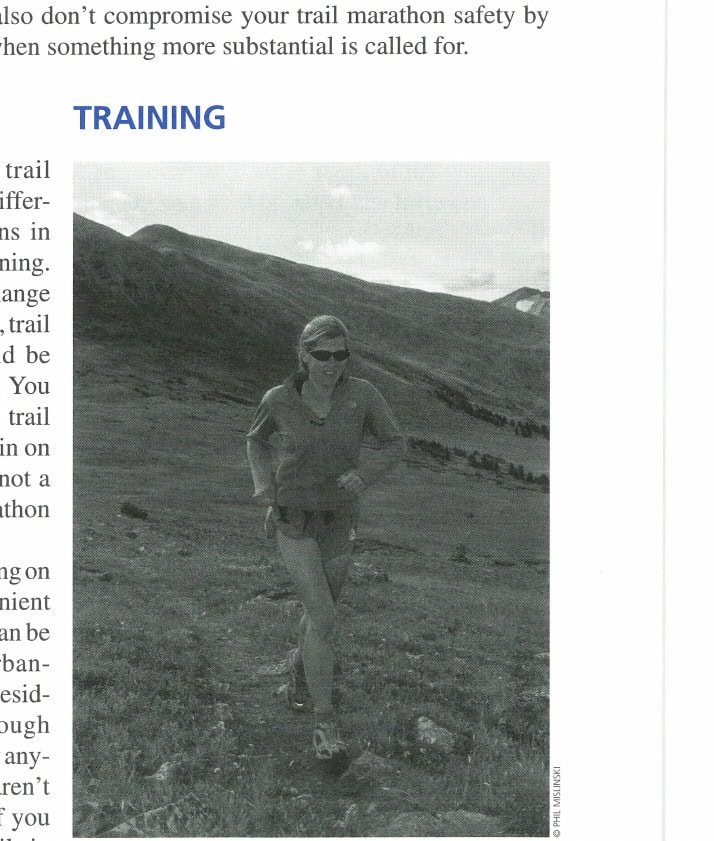
Part of the appeal of trail marathoning is that it’s different from road marathons in both character and in training. If you’re looking for a change in your training program, trail marathon training could be just the spark you need. You cannot run a successful trail marathon unless you train on trails, which is usually not a component of road marathon training.
The first step to training on trails is locating convenient trails in your area. This can be a challenge for the urbanlocked runner or those residing on flatlands. Although trails can be found nearly anywhere, mountain trails aren’t always as convenient. If you don’t have mountain trails in your area and are interested in training for a mountain trail marathon, crank up the grade on your treadmill. Even without the experience of weather, wildlife, trail surface, and descents, an inclined treadmill produces a demanding uphill workout.
GOING UP
As you begin your uphill training for mountain/trail marathons or as your fitness increases and you progress to steeper hills, use the “baby step” technique. That is, use a shortened stride that looks like baby steps, or imagine that you’re using a granny gear in a motor vehicle or bicycle to continue moving upward in a jogging motion. Balance this technique with power-hiking walks when the energy-exerted-to-distance-gained ratio does not produce a fast enough pace.
Another technique when running uphill is to focus your eyes uphill and keep your head up to allow oxygen better access to your lungs. This is easier said than done because when you’re fatigued from climbing a trail, your head drops and your eyes fall to the trail surface. With practice you’ll become stronger and more powerful and better able to execute a more effective style.
GOING DOWN
The same trail descents that can be a great thrill for the veteran trail runner can be downright dangerous for the inexperienced. Experienced trail runners use one technique to distribute weight efficiently for a steep descent and another technique to travel over uneven, steep terrain. As with most things involving physics, it’s easier to experience these techniques than to explain or understand their written specifications. The goal of successful trail descents is to be light on your feet, which allows you to quickly adjust a misplaced foot before your body’s full weight compresses it toward an injury as it impacts a rock or root. Speed, aggressiveness, and confidence help you to become light on your feet. Sitting back and “holding on the brakes” harms your lower back and buttocks more than an aggressive forward approach and makes you heavier and slower to react to quick adjustments you need to accommodate the trail.
Use your arms to distribute your weight more horizontally than vertically. Think of chicken wings: elbows bent and out away from your body to add balance, much like a tightrope walker with a balancing pole. This technique lowers your center of gravity, keeping you closer to the ground. Also, anticipate your foot plants in advance. When descending, keep your eyes on the terrain ahead of you.
Trail descents demand fitness and experience. You have to run a lot of trail miles, both up and down. The more time you spend descending trails, especially trails with obstacles like roots, quick turns, and rocks, the better trail runner you’ll become.
ADVANTAGES
Along with the advantage of running through beautiful, natural outdoor locations, a special feeling of achievement comes with the trail marathon experience. The challenging marathon distance covered in a really tough environment offers a satisfaction running on smoothly paved roads does not.
Another advantage is quicker recovery times. Because trails are typically softer surfaces and cause less impact stress to a runner’s body, recovery comes quicker. Additionally, the diversity of the geography over which you’re running distributes the stress over the muscles from a number of angles, as opposed to stressing the same muscles from the same angles over 26.2 straight miles.
OPPORTUNITIES
In addition to a wide variety of trail-racing opportunities, from short races to full marathons, a number of “related” sports lend themselves to making you a better trail racer, including snowshoeing, cross-country skiing, and orienteering
(also called “rogaining”). It’s to your advantage to engage in some winter sports, such as cross-country skiing, as even though trail marathons are held in summer, you’ll likely run in patches of snow, depending on the elevation of the course.
RESOURCES
As trail marathoning grows, so do the resources available to the sport. The All American Trail Running Association (AATRA), whose mission is to represent and promote trail and mountain running, posts a Web site that is the Internet’s most comprehensive source for trail running, focused at both the seasoned trail runner and the road runner considering a break from the pavement. AATRA offers memberships that include a newsletter as well as their Web site www.trailrunner.com that lists mountain/trail marathon events by state and country and race results.
Pikes Peak Central (www.skyrunner.com) includes detailed information on training at altitude, frequently asked questions about Pikes Peak and high-altitude trails, course photos, and a Pikes Peak racing history.
In response to the growth in the niche market of mountain/trail marathoning, Trail Runner was launched in December of 1999. A bimonthly, full-color magazine, Trail Runner includes short articles and information about trail runners, ultrarunning in trail venues, and adventure racing with profiles of races, runners, and equipment. The photography is inspirational and the list of trail-running events comprehensive. Visit the magazine at www.trailrunnermag.com.
The move to trail running is on the rise, which makes many road runners curious about what the attraction is. Well, why not give your adventurous side a chance? Get out there and run in the great outdoors—find out if trail running is part of your nature.
This article originally appeared in Marathon & Beyond, Vol. 5, No. 2 (2001).
← Browse the full M&B ArchiveMore like this
1,000+ stories from 19 years of Marathon & Beyond
The complete archive of the legendary long-distance journal — digitized and free to read.
