

After The Elephant Screamed
Editor’s note: Although Marathon & Beyond focuses on marathoning and ultrarunning, we occasionally carry a piece that is only tangentially in one or the other of those camps. This is one of those stories: a true tale of courage told remarkably well.
In November 2003, when an elephant gored and crushed Rory Mackie in Zimbabwe, no one thought that he would survive. His extensive injuries—a seven-inch hole ripped through his back mere millimeters from his spine, one punctured lung, one bruised lung, several broken ribs, a broken collarbone, and the loss of nearly a third of his body’s supply of blood—went untreated for nine hours because of the remoteness of his location. Nevertheless, Rory managed to survive injuries that experts agree should have killed him, and his survival was based on his courage and mental strength as well as his superb physical condition. Not one moment passed during his ordeal in which he thought that he might die. The thought simply didn’t enter his mind. But how could this be possible?
Rory Mackie is an amazing person, but most important, he is an elite triathlete who was slated to represent Zimbabwe in the 2004 Olympic Games. Rory’s prowess at triathlon is shown by his statistics. In 2003 alone, Rory placed within the top six in the Plover Cove International Triathlon in Hong Kong, the Shanghai International Triathlon, the Mazatlan International Triathlon in Mexico, and the St. Kitts International Triathlon, and he placed seventh in the African Regional Championships in Namibia. But the brightest feathers in Rory’s cap were his win in the 2002 Alpharetta U23 Duathlon Championships in the United States and his fourth-place junior finish in the 2001 Edmonton World Triathlon Championships.
The sport of triathlon requires years of intense training. Unlike other athletes, triathletes peak in their late 20s and early 30s. To reach that peak, though, the
best triathletes begin competing around age 18 or 19. Dr. Lynn Voss, an orthopedic surgeon and triathlete from Boulder, Colorado, explained the physiological makeup of triathletes. “The endurance athlete needs to have that efficiency of transporting oxygen to tissues,” Dr. Voss said. “Yes, you have to have a genetic predisposition to that type of sport, but you also have to teach the body how to be efficient at doing those things. And that takes time. Lots of time. The endurance athletes aren’t looking for muscle mass—they’re looking for efficiency, and then they’ll have a long career.”
The Olympic Triathlon An Olympic triathlon begins with an open-water swim covering nine-tenths of a mile. After completing the swim, the competitors run out of the water to the transition area where they pull on their cycling shoes, helmet, and sunglasses. Next, they grab their road bikes and take off for a 24.9-mile ride. Once this is over, the athletes head for another transition area where they leave their bikes, helmets, and cycling shoes, throw on their running shoes, and compete in the final leg of the race by running 6.2 miles. Not only is Rory’s body built for greatness in this sport, he is also one of those lucky individuals who knows precisely what he wants to do with his life—at least for as long as he can.
Rory thrives on physically taxing situations. As an elite triathlete, Rory is conditioned to push his body to all sorts of outrageous limits brought on by the grueling endurance requirements of his sport. With tightly muscled legs and arms and a thin frame, his slim and compact build allows him to swim, bike, and run for miles without dragging along extra weight.
This is the story of how Rory’s well-conditioned body combined with his dogged determination saved his life. * * * Zimbabwean natives Rory Mackie and Shayne Gush have a friendship dating back to adolescence, largely rooted in arguing, teasing, and one-upmanship, but most of all, their friendship is firmly rooted in respect and loyalty. In celebration of their friendship, they began an annual tradition of taking hiking and camping trips together a few years earlier, and for these young men, the greater the challenge and thrill of a trip, the better. In 2003, Rory and Shayne chose Chizarira National Park on the northwestern edge of Zimbabwe—a place that most Zimbabweans, black and white alike, consider to be one of the deepest and darkest parts of Africa.
Despite the scorching heat on that blistering November morning in Harare, Rory and Shayne had big plans for their trip. It was nearly 10:00 a.m. when the men started their journey. Since they lived on the eastern side of the country in Harare, the capital of Zimbabwe, their trip required them to drive clear across the country.
Rory Mackie
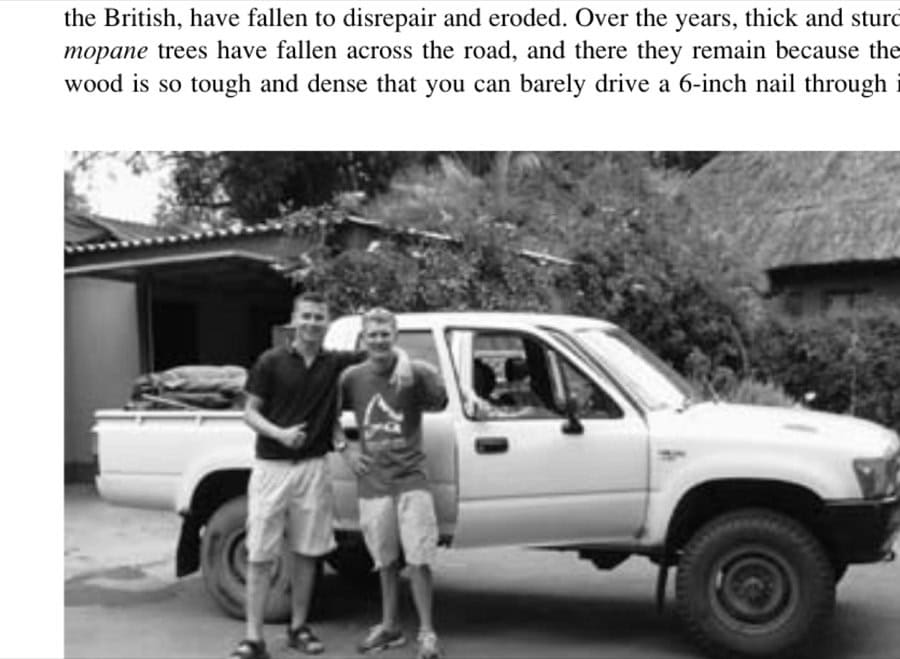
Both of them were nursing hangovers from too many Bohlinger beers and screwdrivers at a club the night before, but their excitement over the adventure ahead returned them to harsh sobriety better than a strong cup of coffee. Together they transferred Rory’s gear to Shayne’s parents’ 4×4 Toyota Hilux. Shayne’s mother, Trish, took a picture of the boys posing side by side by the truck. Rory’s coarse and wavy blond hair was cut short, framed his light blueberry eyes, and blended in with his fair skin that was perpetually sunburned. His shorts and Tshirt looked loose on his 5’8″ frame, as most of his clothes did, because of his triathlete’s build. Shayne’s short brown hair and brown eyes seemed to be only a few shades lighter than his skin tone. Shayne is nearly 6’2″ and his shorts and shirt weren’t nearly as loose on him as Rory’s. Other than their physical builds, these young men wore large, slightly impudent grins, and each stood with an air of nonchalance, an arm bent, hand on hip. There was a certain hubris in their eyes, a look that is fairly typical of young men ready to test their limits and tempt fate. Like children excitedly running away from home, both men jumped into their truck, the raw blue sky gleaming above them as they began their drive.
Chizarira is a remote area of Africa where most roads, originally built by the British, have fallen to disrepair and eroded. Over the years, thick and sturdy mopane trees have fallen across the road, and there they remain because their wood is so tough and dense that you can barely drive a 6-inch nail through it.
Rory (right) and Shayne on their departure day.
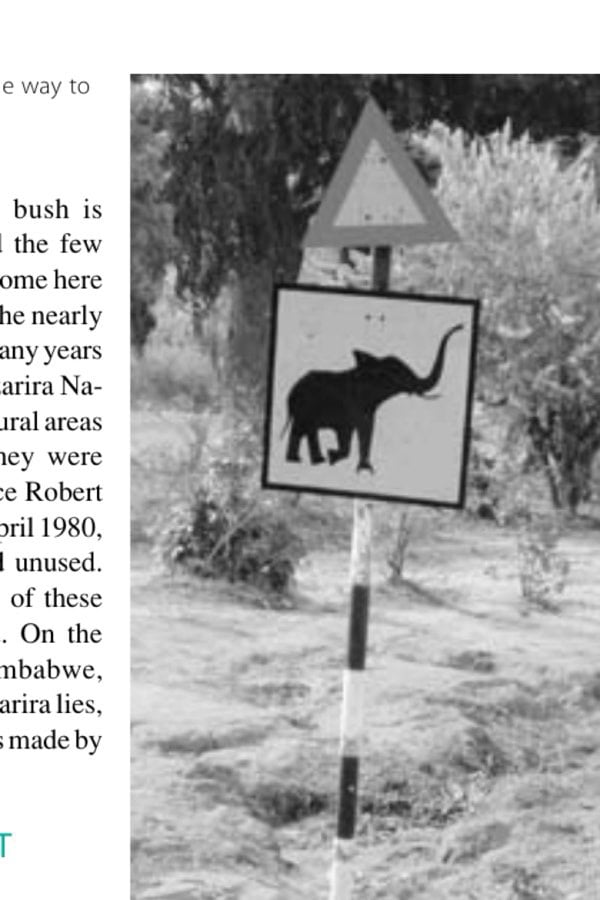
A common road sign on the way to Chizarira National Park.
A Map That Doesn’t Yield Information Rory drove the car and Shayne read the map while dust flew up from the ground in soft, dirty puffs. Their map was topographical, and Shayne quickly realized that there weren’t enough contour lines to figure out where they were. All of the streams and rivers on the map that could have quickly yielded their location had long since dried up; it was November and the end of the drought season. It hadn’t rained for months, and the earth was starved for water. Trees were brown and leafless. Every animal in the bush, from elephants to buffalo, was covered in fine brown dust, acting as camouflage within a monochromatic brown landscape choked with thorny jesse bush and tough mopane trees.
After spending three days camping and hiking in Chizarira, Rory and Shayne began to run out of water. Knowing that their trip would be over without this precious resource, they decided that they would spend Tuesday, their fourth day in the park, in search of water. The day passed quickly but with no luck. By now, it was nearing 5:00 p.m., and the only way to get back to the truck and the road was by walking through a dried-out and sandy-bottomed riverbed. As they trudged on through the thick layer of sand, Shayne and Rory wondered whether they would
Rory Mackie
The sub-Saharan African bush is riddled with mopanes, and the few visitors and poachers who come here end up just driving around the nearly impenetrable roadblocks. Many years ago, roads ran through Chizarira National Park and other more rural areas of Zimbabwe. Although they were simple and basic roads, once Robert Mugabe came to power in April 1980, they became neglected and unused. As the years passed, many of these roads slowly disintegrated. On the far western border of Zimbabwe, close to Zambia where Chizarira lies, travelers must now use paths made by elephant herds.
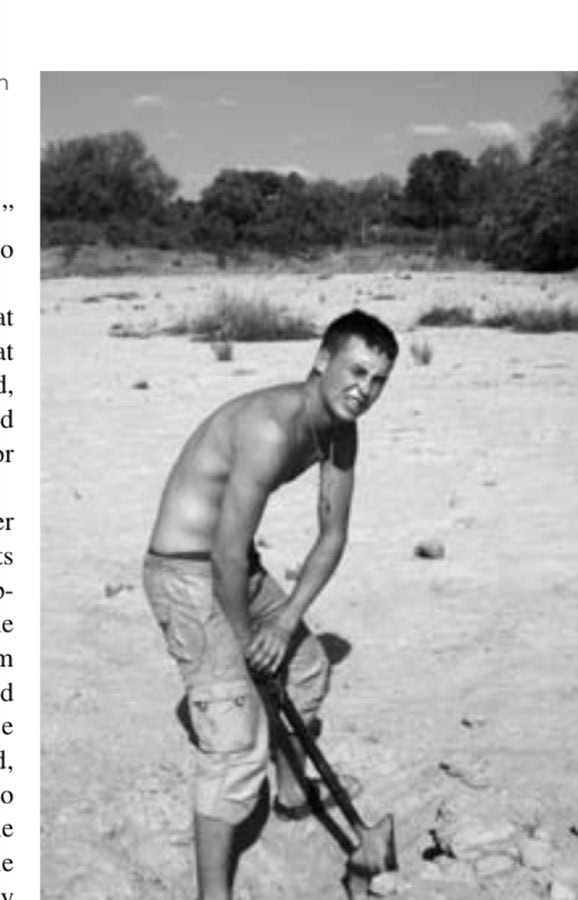
ever find water. So far, the Busi riverbed was turning out to be just like all the other nonexistent water that had vanished in the searing summer heat. And then they had some luck. Rory noticed a place where elephants had been digging—he could tell from the scrape marks and deep holes in the riverbed. Additionally, there was a little puddle of dirty water, and around it he could see more little holes that the elephants had made with their tusks in search of water. Rory and Shayne now knew that water was there, so they broke out their pangas (machetes) from their hiking packs and started digging. After about 15 minutes, they found damp sand. After another 15 minutes, a trickle of water emerged. But by now, it was close to 6:00 p.m., and the sun was setting. Although they had found water, they had only their water bottles to collect it. They also realized that the water was brown and dirty and would need to settle overnight. Ecstatic that they had actually found water, they filled up the containers with as much as they could and headed back to camp.
It was nearly 7:00 p.m. by the time they finally arrived. Then their evening really started going. Rory and Shayne proceeded to get rip-roaring drunk off their beer and wine and gorged themselves on all of the food that wouldn’t keep any longer. It was an unforgettable night. It would also be their last night in the park. * * * “Shayne, you shit! It’s your turn to carry the pack! You bloody chain-smoking bastard!” Rory yelled. “
Rory, it’s stinking hot! It’s your turn to carry it—you keep the pack!” Shayne snapped. Shayne loved badgering Rory whenever he could, particularly since Shayne made such an easy target of himself with his chain-smoking, beer chugging, and lack of triathlete-level fitness. Nevertheless, Shayne could hold his own. He was the one who had formally trained as an outdoor endurance-school counselor and guide two years earlier. He gained this expertise working in the cool and drizzly conditions of Scotland, where his dark and tanned skin quickly faded, and he began to blend in with the Scottish locals with his dark hair and eyes.
That Wednesday morning, it was Rory’s turn to carry the pack, and Shayne was going to take full advantage of the situation—particularly since Rory was far better suited for enduring the brutal heat and hiking. They had gotten up late that morning, and both of them were suffering from a bit of a hangover. First thing that day, Rory and Shayne returned to the pit they had dug to see how much water had appeared. Sure enough, their plan had worked: the hole was filled with water. But this water was brown and dirty—it would need to sit for a few hours in order for the dirt to settle to the bottom of the hole. In the meantime, they decided to hike in the area around the riverbed. “
Hey, Ror! Don’t you think it’d be great to hike up there to that hill?” Shayne asked.
“Jah, great, Shayne,” Rory answered. “You want to carry the pack for it?” “Ah, come on. I’ll bet that tree up there has some great stories to tell,” Shayne said, looking for any way he could to make the hike difficult for Rory.
The blistering November heat encapsulated them in its pulsating and relentless throbbing. It billowed out of the ground, beat down on them from above, and enveloped them from all sides. The ground was hard, cracked, and dusty brown with no relief of life anywhere. The entire landscape—from the ground to the thick and thorny jesse bush to the strangling closeness of the mopane trees—was scorched. But Rory and Shayne were unconcerned by the raging heat and the claustrophobic landscape. They hiked deeper and deeper into the bleak and untamed corners of Chizarira, hoping to see some wildlife.
As they eased their way through the thick African bush, they suddenly heard loud crashing sounds coming from 40 or 50 meters ahead. For those unbaptized in the ways of the dark wilds, it might sound like a large party of tourists munching on their safari-prepared meals. But Rory and Shayne knew instantly that it was a herd of elephants breaking large, heavy branches off the sturdy mopane trees. To them, it sounded as if bones were being broken.
Tempted by the thought of finding elephants, Rory, who was in the lead, started moving quickly. “Maybe Shayne’s not going to be happy with how fast I’m moving,” Rory mumbled to himself. He was so excited, though, that it didn’t matter to him. Rory continued to hurry ahead so that he could get pictures of the elephants with the new camera he had brought back with him from the States.
Rory Mackie
Shayne digging for water in the Busi Riverbed.
“Shayne, we can get right in close here,” Rory said. “We’re going to get some great shots, and then we’ll carry on.” As they approached the source of the munching, the noise got louder and louder. Rory stopped and turned to look at Shayne. “
Shayne? Do you want to take the lead? Do you want me to slow down?” Rory asked, knowing that his frantic pace might annoy Shayne. But Rory didn’t wait to hear Shayne’s answer as he kept on jogging into a clearing nearly 10 meters by 10 meters in size. Shayne, though, quickly caught up. “
Shayne! Get down, get down!” Rory hissed in an intense whisper, as the scaly trunk of an elephant snaked along the jesse bush searching for food. The last thing he wanted to do was to upset these gigantic creatures.
Both men quickly dropped to their knees. Shayne grabbed the camera out of Rory’s daypack and handed it to him. They stared hard at the trunk, fascinated with their find. All of a sudden, the bush got quiet—dead quiet. The trunk stopped looking for food and began sniffing the air. That sound of the elephant searching for invaders was all that Rory and Shayne could hear. We’ve gotten too close—they know we’re here, Rory thought to himself. We must be upwind of them—that’s how they know we’re here. I’m so stupid—how did I let this happen? And then the sniffing suddenly stopped. “Oh shit!” Shayne whispered. “This isn’t going to be good.”
The Trumpet of Elephants The forest exploded with the entire herd trumpeting in unison. The roaring was above them, beneath them—completely surrounding them, much like the heat that sucked the moisture out of their bodies. During the midst of the uproar, the elephant that Rory and Shayne had first spotted sauntered into the clearing. Just as shark watchers eagerly drop bucketfuls of chum in shark-infested waters to draw them close, the blistering winds announced Rory and Shayne to the grazing herd.
Believing that if they remained perfectly still nothing bad would happen, Rory began taking photos using the tiniest of flicks of his finger to depress the shutter. Figuring that Shayne was right behind him taking photos and being as still as possible, Rory snapped away. But Shayne had heard an elephant off to the right—something that Rory in his photographic bliss did not pay attention to. Shayne stood up behind Rory to get a better look and saw that another elephant was flanking them with its sights set on Shayne. In a state of panic, Shayne said nothing to Rory and instead took off running.
As the ground shook from the thuds of the elephant’s legs, Shayne ran. He ran and he ran and he ran, moving left and then right, hoping to lose the elephant that continued to chase him down. But none of his maneuvers worked. The elephant just plowed straight through the thorny and tangled brush, not even bothering to
Rory Mackie
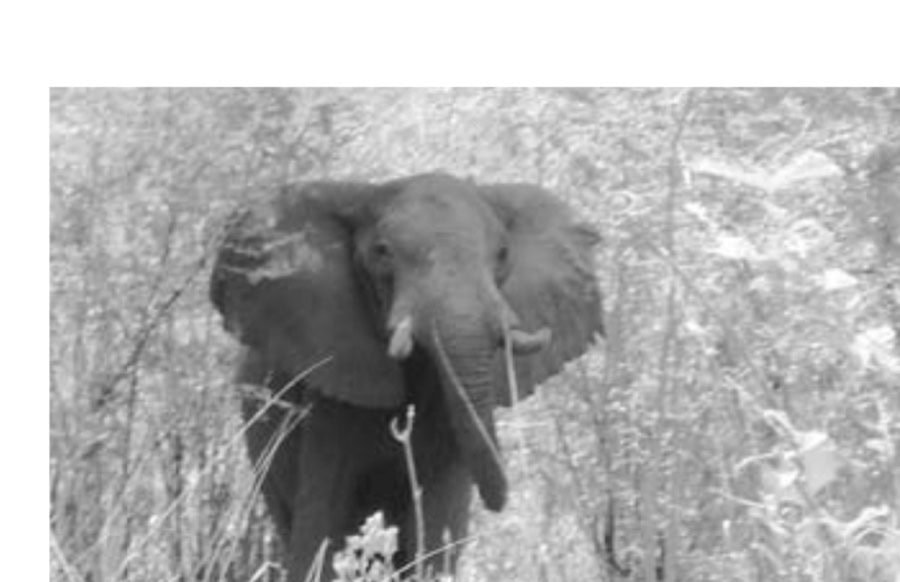
An African bull elephant that Rory and Shayne encountered on their trip.
turn. Shayne leapt over a large jesse bush and fell onto its other side, rolling over onto his stomach. Just as a child might think, he hoped that if he couldn’t see the elephant, then it couldn’t see him.
Confused as to where its prey had gone—particularly since the elephant could still smell Shayne but not see him—the elephant looked around for a bit and then turned and headed back to the clearing where Rory was still taking pictures. * * * During Shayne’s mad race for safety, Rory had continued photographing the elephant in front of him. For some reason, he had neither seen nor heard the second elephant that frightened Shayne away. When he finally turned around to check on Shayne, he saw his friend running away. This made him laugh since he thought that Shayne was running away because he was frightened of the elephants. Somehow, though, Rory remained blissfully unaware that an elephant had been flanking them from the right.
But it wasn’t long before Rory wore out his welcome with his photography subject. Although the elephant was nearly 25 meters away, Rory could tell that the elephant felt threatened when he saw it lift its trunk into the air to sniff for telltale foreign scents. It would be merely seconds before it honed in on Rory’s location and began to charge him, gaining speed and momentum as the ground trembled beneath the weight of its enormous legs. Rory instantly realized that
he was directly within the elephant’s line of sight. He needed to get out of the way quickly. Rory turned around and ran from the elephant in the same direction that Shayne had taken. He certainly didn’t lack speed as he sprinted away, fueled by the desire to avoid being trampled by a 4-ton animal. Chances are that Rory’s breathing rate was nearing the maximum for efficient breathing—close to 35 breaths a minute. According to Peter Stark, author of Last Breath: Cautionary Tales From the Limits of Human Endurance, Rory would have been “taking in 130 liters of air—about 35 gallons—each minute. His heart beat at 190 beats per minute and pumped nearly 30 liters of blood, or over 7 gallons each minute, enough to fill a bathtub up to the overflow in four minutes. This river of blood is the amount a trained athlete’s heart puts out near maximum performance.”
Taking a second to look over his shoulder to gauge his pursuer’s distance, Rory stopped running when he realized that the elephant had disappeared back into the bush with the rest of the herd. He breathed a sigh of relief and then froze, his eyes opened wide when he found himself staring into another pair of eyes.
Standing about three meters in front of him was the same cow elephant that had chased Shayne. It had returned to the clearing after being unable to catch him. Only now did Rory realize why Shayne had bolted, and now he had to figure out what to do. His adrenaline levels spiked, and his body automatically began to shunt its blood supply to his arms and legs and away from his organs—his body was preparing itself to run. Both his heart and respiratory rate were moving at a higher rate, and his body’s “fight or flight” mechanism had kicked in. The body’s autonomic nervous system works much like the accelerator and brakes in a car. The sympathetic nervous system works as the accelerator and releases adrenaline into the human body during stressful times, controlling what Robert Sapolsky, a professor of Neurology and Neurological Sciences at Stanford University, calls the “four Fs of behavior—flight, fight, fright, and [sex].” During these times, the sympathetic nervous system diverts blood into the muscles, just where Rory needed it. The parasympathetic nervous system, on the other hand, works as the brakes. It controls the calm and quiet activities of the human body—everything except the “four Fs.”
At that moment, Rory’s sympathetic nervous system was in full gear and ready to get out of there. He was too close to the animal to try to make a run for it because the elephant could easily catch him in this enclosed area. Still, as the elephant stared him down, Rory believed that he would still somehow be able to get out of this mess.
When people’s bodies are in the midst of a fight or flight situation, they have either a sense of panic or a sense of calm, and their perceptions of their surroundings can become distorted or even surreal. In Rory’s case, he was calm. Time feels like it slows to a crawl in these situations because the body is processing
information and events so quickly that you’re not necessarily thinking about what you’re doing; rather, you’re acting. You’re making very fast decisions without analyzing them. From the brain’s perspective, information is being processed in the midbrain and not in the cerebral cortex where sophisticated thought processes take place. Instead, the decision making is coming from the midbrain, where more primal thought processes occur. In Rory’s case, his midbrain was telling him just to run—fast. And although his brain couldn’t handle solving complex calculus equations at that very moment, it could help him to make good decisions in terms of what direction to run, where to hide, and whether to yell out for help.
Glancing to the side, Rory noticed a slight opening in the vegetation. It wasn’t large at all, perhaps only 6 feet wide, but it could provide him with the immediate cover he needed. “Shit, if I could just get under that bush there, then I’ll be all right,” he said to himself. “If I could just scrape under there.”
No more time for weighing options. The elephant began its charge, the seismic boom of its enormous legs striking the ground causing the earth to shake and rumble beneath its weight. Rory turned quickly to his left, trying to make a dash for the opening. Just as he went to leap for the shelter, his feet slid out from under him, victims of the gravelly and dusty terrain. He could hear the thundering beast closing in on him from behind. He was stuck on the ground, face down. With his palms and fingers extended forward, he attempted to push his torso up and off the ground, arching his spine, and lifting his head up. The last thing he remembered was blackness falling over him, and once he was unconscious, the elephant let out a blood-curdling scream. * * * The first blow caught Rory from behind. The tusk ripped its way through Rory’s daypack and through the left side of his back, within a few millimeters of his spine, and worked its way about seven inches high, nearly up to his left shoulder blade. The tusk came so close to his spine that it actually glanced off a couple of vertebrae. The elephant’s tusk, monstrous in size, doesn’t have the razor sharpness necessary to do more damage. But the tusk had so much pressure from the mass of the elephant behind it that it tore into his back, cracking ribs and bruising his left lung.
The next wound came from one of the elephant’s tusks shearing off the top few centimeters of Rory’s right shoulder. As the tusk forced its way into Rory’s shoulder, it crushed his clavicle, and because the lung sits directly below the collarbone and is easily punctured if anything injures the clavicle, it punctured his right lung.
And still, this wasn’t the end of the attack: the elephant stood over Rory, contemplating how to make sure he was dead. It knelt down by him and began rubbing and shoving at him with its tree-bark-textured legs and face that were covered by thousands of tiny coarse and bristly hairs—the coup de grace. The
elephant ground down on all of Rory’s exposed flesh with the full force of its 8,000 pounds, leaving Rory with brush burns on his face, arms, and legs. When it was satisfied with its work, it left Rory for dead.
Because his adrenaline was running high just before the attack, Rory’s body had shunted blood away from his intestines, liver, kidneys, and other organs and delivered the blood to his heart, lungs, and brain—the three organs that would need the blood the most in order to survive. Although unconscious, his body was trying to work at a higher efficiency, and so it was shuttling blood well. He wouldn’t be able to perform the way that he did initially with one lung compromised, but even with just one, he could still survive. But if his left lung had also been punctured instead of just bruised, he would be dead. * * * When he regained consciousness, Rory felt as though a heavy veil of milky blackness had enveloped him. He knew that something was wrong—horribly wrong. He was lying facedown in the hot dirt under the blazing African sun, struggling to breathe, and his mind fought to figure out what had just happened. He felt as though an entire rugby team was lying on top of him, crushing all the air out of his lungs. Each breath was a fight as he sucked oxygen in through constricted and damaged bronchial matter, yet no breath was enough to satisfy the frantic pleas of his body. Because he was also an asthmatic, Rory tried to calm his battered lungs. He knew that his survival depended on every ounce of his physical and mental strength. “
Shit!” Rory said to himself between gasps for air. “Now we’re going to have to cut our trip short!” He pulled himself into a seated position, shoving himself through the dusty ground with his legs so that he could rest with his back propped up against a tree. Despite the extent of his injuries, he had no idea what had happened to him, nor did he seem to notice the blood that had begun soaking his shirt. Instead, for some reason, his instincts told him to jump up quickly to look around and make sure that no one had seen him, and if someone had, just to pretend that nothing had happened. “
I’m such a fucking idiot! I never know when to stop!” Rory murmured to himself. * * * Lying flat on his stomach in his hiding place, Shayne wondered where Rory was. It had been nearly five minutes since he had heard the elephant cry out. “Maybe he’s in trouble, but no . . . he must be back at the riverbed,” he muttered. “He’s the bloody world-champion triathlete, after all. I’m sure he escaped somehow.”
Shayne stood up slowly and instinctively lifted his hand to adjust his hat. “Ah, shit!” he said, realizing that his hat had fallen off as he ran for cover. “Now I’m gonna have to look for my hat.”
And then, out of the depths of the bush, a strained and wailing cry shattered the stillness. “Shaaaaayyyyynne! Shaaaaaaaayyyyyynnnne!” He had never heard anyone call his name like that. It was then that he knew that something had happened to Rory, but his brain wouldn’t permit him to believe that Rory had been attacked.
I don’t want to move—I don’t want to go back toward where the elephants are, Shayne said to himself, initially paralyzed by shock. But after hearing Rory’s pleas, Shayne began to push his way through the bush in the direction of the call. He walked toward the clearing where he had last seen his best friend, and there, sitting against a massive mopane tree, holding his knees up to his chest with his arms wrapped around them, was Rory. Blood pooled out beneath him, and his eyes were barely open. “
Ror, what’s happened?” Shayne asked. Dumbfounded, he surveyed the area. The daypack was flung at least four meters away from Rory, the camera was out of reach, and a water bottle lay toppled over in the dust. “
Shit!” Shayne whispered. “Well, that’s a silly thing to say,” Rory said, trying to joke. But Shayne wasn’t laughing. “So, how bad is it?” Rory asked. “No, it’s fine . . . it’s fine,” Shayne murmured as he stared at the back of Rory’s brown shirt. Now the shirt was black, completely saturated from blood.
A Bloody Assessment Inspecting Rory’s back, Shayne gently removed the blood-soaked shirt. Nothing prepared him for what he saw. The wounds were so extensive that he could see all the way down to Rory’s rib cage while muscle dangled out of the gaping hole. It was as though someone had jammed a scythe into Rory’s back and pulled hard, ripping out huge masses of muscle with it, and left the bloody tissue to hang against Rory’s fair and freckled flesh. Even though Shayne had no idea what was going on with Rory’s body, he knew that this was no time for panic. Concentrating on the task at hand, he continued assessing Rory’s wounds, despite the fact that he could hear elephants milling around nearby. “
How’s it look, Shayne?” Rory asked again. “Ah, fine, Ror. Not that bad,” Shayne replied. There was blood everywhere: caked into the dirt, soaked into Rory’s clothing, dripping out of his wounds, and splattered onto his backpack. Rory’s shirt had two jagged tears in it from the elephant plunging its tusks into his body. His shorts also had several holes in them from the sandpaper effect of the elephant’s skin. “
Ror, what the hell happened?” Shayne asked, trying to make sense out of the situation.
“Ah, Shayne,” Rory said, wheezing and desperately trying to catch his breath, “I’ll tell you one day over a beer.” Rory’s attitude may have seemed cavalier, but medical experts agree that it actually made sense under these extreme conditions. He didn’t have a lot of pain because of the adrenaline surging through his body and blunting his pain response. In fact, Rory never felt any pain because in a matter of seconds, his world had gone from being well ordered to chaotic. In order to survive, his brain prioritized survival over pain, and pain wouldn’t become a priority until some semblance of normality and order returned.
According to Dr. Voss, “People get up and walk away from collarbone injuries all the time. Some people continue playing football, rugby, those kinds of things, and that’s in a much less intense experience than what [Rory] had just gone through.” Even broken ribs can be managed because people can still walk and breathe.
Somehow, despite the severity of the circumstances, Shayne knew what had to be done, and this sense of calm proved to be a powerful resource. The most important task was getting Rory back to the park headquarters to arrange for medical assistance. After collecting the camera and water bottle and shouldering the remnants of the mutilated backpack, he gently helped Rory to his feet, sliding his right arm around Rory’s waist. Entwining his fingers into the bloody fabric of Rory’s shorts, he helped anchor Rory’s hips so that he could hobble along. All the while, Shayne spoke quiet words of encouragement to Rory.
Shayne remembered the lone mopane tree on the top of the hill that he had pointed out to Rory when they had begun their hike into the bush earlier that morning and began to look for it. Once he pinpointed that tree, he knew the direction he had to go. As the minutes multiplied exponentially, Shayne knew that they were going to have to blaze through the bush. Although he felt awful forcing Rory to move, it couldn’t be helped. Blood steadily dripped onto the ground beneath them, forming mosaics in the dusty soil. “
Ah, please Shayne. I’ve got to rest. I’m so tired. Please, man!” Rory begged. “You’re a triathlete, Ror! You guys don’t need rest—stop complaining.” The complaining and muttering lasted for the entire kilometer’s walk back to the dried-out riverbed where Shayne had left his backpack. “
Don’t worry, man,” Rory pleaded. “Nothing hurts. I promise. I’m just unbelievably tired. Just let me rest under that tree there.” “No, Ror, quit it already. We’re almost there. Just hang on, now.” Shayne knew he had to keep his voice calm and steady, and from his first aid training, he also knew that physiological shock could set in quickly, particularly if Rory were allowed to rest.
Instead of listening to his body’s pleas for sleep, Rory set small goals for himself: the first was to make it down some cliffs that edged the riverbed, but climbing was definitely out of the question. He needed Shayne to push him down the nearly 60 meters of those sandy cliffs. As Shayne held onto the belt loop of Rory’s pants, they slid down the cliff. Now Rory’s wounds were covered in sand, and Shayne’s first thought was that they would become infected. * * * According to Dr. Jonathan Metzler, a sports psychologist at Georgia Southern University who also works for the Olympic Committee, the fact that Rory immediately began setting small goals for himself in order to survive his ordeal syncs perfectly with research done on elite endurance athletes when they compete. “Endurance athletes will tend to look ahead,” Metzler said. “They’ll pick a spot ahead, and that becomes a goal; and then once they get up near that spot, they’ll adjust and pick a new spot ahead and they’ll look at that—continually looking ahead at something that’s out there in the distance. That’s their goal.” And this was precisely what Rory, the elite of elite triathletes, was doing, since athletes at his level tend to be optimistic and future oriented. “
It’s an odd paradox,” Dr. Metzler explained. “They’re in the moment, but they’re always focused on the mission, the outcome. Elite athletes don’t tend to think in terms of wins and losses; rather, they think in terms of achieving specific goals that put them into a position to reaching the outcome they want.” * * * Shayne dragged Rory to the middle of the riverbed and began tending to his wounds. But before he could begin, he had to get Rory to stay conscious. By now, Rory’s eyes were rolling back in their sockets, and his head swayed from side to side. Acting on his instincts, Shayne squeezed some of the water remaining in their bottle into Rory’s face and then panicked: he had just wasted some precious water. But it worked. Now Rory was conscious, and to Shayne, this was paramount because Rory had to remain conscious in order to tell him how he was feeling and what was happening to his body.
Shayne continued surveying Rory’s wounds and focused his attention on the largest one in his back. The elephant’s tusk had come frighteningly close to Rory’s spine, and Shayne’s first concern was whether Rory had suffered any spinal cord damage because the tusk could easily have snapped Rory’s spine in half. But because Rory could walk, Shayne assumed that his spine was probably uninjured. Shayne carefully dribbled the remaining water over Rory’s wounds, trying to clean them from their thick sandy coating. The wound in his back, located a mere two or three millimeters from his spine just below his left shoulder blade and stretching nearly seven inches down near the middle, continued to bleed profusely even after Shayne inserted an entire roll of thick cotton bandage fabric into the gaping crevasse. The injury to Rory’s collarbone was on the right side. Although it looked
as though a knife had sheared off his shoulder, the cut was clean, and by this time, it wasn’t bleeding very much. Now it was a matter of covering the terrible hole in Rory’s back and getting him back to their vehicle. Shayne knew that he couldn’t let Rory rest for long. They had to make it to their truck quickly—even though it was about a two-kilometer hike through the sandy riverbed—so that he could get Rory to the park headquarters as soon as possible.
In Rory’s case, the only thing he wanted was to get back to the truck, and in order to do that, he needed to set and achieve small goals that he would attain with Shayne’s help. “OK, Ror. Just about one more K to go,” Shayne said encouragingly, as Rory dragged his feet through the sand. By now, the temperature had blasted into the 100s, and it felt as though they were trudging through a furnace. “
Jah, man; jah, man,” Rory said, almost whispering. By now, he focused on his second goal: I just have to make it to the truck, he thought to himself. Something deep inside of him knew that he could do it as long as he focused on putting one foot in front of the other, ignoring his exhaustion. Nothing was going to get in the way of getting to the truck.
Dr. Metzler also notes a phenomenon in endurance athletes in which they train in order to disassociate themselves from their bodies since triathlon is such a grueling and painful sport. “Endurance athletes tend to think outside of themselves and focus away from the actual pain part toward other things,” said Metzler. “That doesn’t necessarily mean that their attention is all over the place, but it’s definitely away from the body and the potential pain mechanisms. It’s hard for the gears to churn when you’re thinking about them grinding.” Rory turned this focus inward, making his very survival into completing a different kind of triathlon.
For Want of Water Finally, they arrived at the campsite and the truck. Shayne surveyed the supplies and was dismayed to see how little water they had left. Before leaving camp that morning, Shayne and Rory had mistakenly left the lid to the cooler open, and by now ants were swimming in the dirty, melted ice water along with a warm glass bottle of Coke. That meant that Shayne had squirted the only clean water they had onto Rory’s back to clean off the sand. He had counted on the water at the camp to hydrate Rory, clean the dried blood off his face, and moisten his chapped lips.
As Rory waited for Shayne to pack the truck, he began preparing himself for his next goal: climbing into the truck and sitting down. I can do this, Rory thought to himself. I know I can. Shayne walked over to Rory, gingerly picked him up, and helped him sit down in the passenger seat of the truck. Even though every movement was an effort and he tried to catch his breath as he leaned back into his seat, Rory had an idea.
“Shayne,” he said quietly. “Get the camera. Take pictures.” I know I’ll want this later, he thought to himself. He’s just got to take the damn pictures, and then we can go. “You’re crazy, man—I’ve got to get you back to headquarters!” What’s wrong with him? Shayne thought to himself. Why in the world would he want pictures? Maybe he’s acting this way because of the blood loss. “
Jah, I know. Just take pictures.” Rory was adamant. The pictures had to be taken no matter what. He didn’t know what was compelling him to do this, but he wouldn’t be deterred. By now, Rory was panting between each word. Not wanting to debate with Rory, Shayne grabbed the camera out of the pack and took pictures. Blood covered both the front and back of Rory’s shirt, dripped down onto his shorts, and slowly pooled up in the passenger seat. His face—by now a bluish-red and serrated mess—was raw and oozing from the elephant’s rubbing. His head hung down to his chest, and his light-blond, wavy hair had a pinkish cast to it from the blood that had stained him from head to toe. His eyelids drooped heavily as though he were in a drunken stupor.
Shayne gently shut the door, ran around to the driver’s seat, and started the car. He slid it into first gear, and the truck lurched forward. “Oh my God!” Rory begged. “Hold on, Shayne . . . please! Don’t drive so fast— please!”
Shayne looked over at his friend and listened as Rory’s wheezy and haggard breathing changed. Now he was struggling to clear his lungs of the blood that had begun to fill them. He began coughing up wet and blobby masses of blood. Shayne was filled with a frightening mix of helplessness and gutwrenching sadness. They faced a three-hour drive back
Shayne Gush
Bleeding profusely and struggling to breathe, Rory summons all his remaining strength for the perilous and uncertain journey to find medical care.
to park headquarters, but he didn’t know whether Rory would live that long. For the first time in years, Shayne began to cry, but he was careful to look out the driver’s-side window so that Rory wouldn’t see his tears. * * * Rory knew that his next goal required that he do everything in his power to stay awake, so he let his mind wander back to his father and the stories his dad, Charles, used to tell him when he was a little boy. Charles Mackie, a game warden for the national parks in Zimbabwe (then named Rhodesia), frequently had to drive around the perimeters of the parks to check on the status of the wildlife and protect the animals from poachers. Twenty-three years earlier, he had brought Rory, a newborn infant, along to check the perimeters of Chizarira. Driving along in his roofless 4×4 jeep on that warm and sunny day, Charles careened around on the stony and unstable paths, checking the nooks and crannies of the park. Dust rose all around the vehicle, and as he made a hard and fast turn, infant Rory, who had been lying on the passenger seat swaddled in blankets, tumbled out of the vehicle, and rolled out of sight into a cloud of dust. Frantic, Charles slammed on the brakes and jumped out. He ran to the side of the path where he thought he had seen his baby son fall, and there was Rory lying in a tiny heap, his bright blue eyes brimming with tears and burning with irritation from the dust, staring up at his father and wailing in protest.
Rory laughed softly to himself as he sat slumped over in the passenger seat of the 4×4. The deep wounds covering his chest, back, face, and shoulder refused to stop bleeding. His hair, smeared with blood and sweat, clung to his forehead, ears, and neck. “
Isn’t life ironic?” he asked Shayne. “I come here as a baby and get hurt, and now I’m here again as an adult and I really get hurt.” Shayne knew this story well; after all, it was the reason that he and Rory had chosen to come here. The fact that Rory was still talking was a good sign—he needed Rory to stay conscious. But Shayne needed to concentrate on his driving. Considering that Shayne had never bothered getting a driver’s license and very rarely drove on the paved and straight roads back home in Harare, let alone in rugged conditions such as these, he needed to figure out how to use all the steadiness he could muster to navigate the truck through Chizarira’s twisted paths and keep Rory talking at the same time. “
Ah, Ror. Don’t worry about that now. You want to hear a joke?” Shayne asked. “Jah, sure.” “OK, Ror, there were three tomatoes: Mama Tomato, Daddy Tomato, and Baby Tomato. And they were walking down the street, and Baby Tomato started to fall behind. So what did Daddy Tomato say to Baby Tomato?” “I dunno man.”
“Catchup! Isn’t that funny?” “Ah, Shayne, my breathing,” Rory said, wheezing. His inhalation sounded as though he was having a severe asthma attack. But this was no asthma attack: these were punctured and bruised lungs. Rory, the champion triathlete, the young man who was supposed to represent Zimbabwe in the 2004 summer Olympics and who had been the 2002 World Champion Duathlete, was now struggling to breathe, and his energy drained away as effortlessly as his blood flowed onto the floor of the vehicle. In fact, he was losing nearly a third of his body’s supply of blood, and this blood loss was causing his exhaustion.
By now, Rory was probably functioning at a quarter of his body’s natural efficiency. The puncture in his right lung had cut off half of his body’s ability to get oxygen. Compounded with losing so much of his body’s supply of blood, he had lost another half of what his body needed to get enough oxygen to his blood cells and tissues to keep him alive. Functioning at a mere 25 percent of normal efficiency made him lethargic and unable to think clearly. It was a struggle to move any part of his body, and at this point, his brain was shutting down different parts of his body. His intestines and kidneys had shut down: his body was neither producing urine nor processing food. His brain stem, that primal part of the human brain, was focused only on conserving as much energy as possible, keeping his heart beating and his respiratory system breathing.
Shayne struggled to push out of his mind the thought that Rory might die, because he had to concentrate on driving on the unstable terrain; otherwise, he ran the risk of flipping the truck. To steady his nerves, he chain-smoked for the entire three hours it took him to maneuver the manual transmission truck over the park’s tangled and unforgiving paths.
As the truck bumped and jerked along the rocky path, Rory’s only goal was to focus on breathing. Inhale, exhale, inhale, exhale, he told himself as he closed his eyes while his limp body bounced in the truck. These words became his mantra for the rest of the day.
Shayne’s fear only intensified as Rory continued coughing up blood. The blood seemed to be everywhere inside the truck: on the seats, dashboard, windows, stick shift, and steering wheel. In fact, it seemed to splatter randomly as Rory swayed and rocked with every bump and turn. * * * When a cow elephant gored photographer Peter Beard, model Cheryl Tiegs’s former husband, in 1996, he remained conscious during the attack. As he recalled in an interview with People magazine, the elephant seemed to come out of nowhere, and before Beard knew it, he was on the ground. As he remembered, “I don’t really know what happened, but I think she pinned me against the anthill. Her tusk went right through my left thigh; there’s a hole as big as my hand where it went in, but the hole on the other side is only about 4 inches. So I think the tusk
went into the anthill, which is very hard, and that stopped it. Then she crushed me with her head. “It was just a steady crunching. “Crrrr! Crrrr! Broke my ribs. I was totally conscious. I could feel the whole pelvis going. It’s like an elevator or a freight train coming down on you. Huge pressure, incredible pressure. “
And then I lost my eyesight. “The rest of the herd came around, and I lay there like a lump of flesh. She gave me this squish for maybe three to five seconds. I could hear all their feet. They usually trample you and make a grease spot out of you. But they totally left me alone—maybe because we had run so far away that they sensed we weren’t their enemy.”
Craig Van Zyl, a local Zimbabwean who works with his wife, Calla, running guided camping and safari trips throughout much of the country, is familiar with the type of attack that Peter Beard endured. “A lot of the bull elephants, it’s a big show of size: the ears come out, they make themselves tall, they run. Typically, those types of charges don’t scare us very much. A lot of times it’s a show, but things could change. Oftentimes they’ll kick dust at you, and even with those shows, they can come all the way. But they can change their mind, which they sometimes do.”
According to Van Zyl, attacks by cows are different. “Now and again what happens, especially with the female elephants, they’ll just charge. They won’t even warn you that they’re coming. They’ll just pick up the smell of you, and they’ll come quietly at full speed. And those are the worst and most scary charges because they don’t want you to know. They want to get you.”
Johnny Uys, a Zimbabwean naturalist who was the former head of the Zambian game department and a confidant of the Zambian president, was killed by a charging bull while leading a group of tourists in Hwange National Park in Zimbabwe. According to Van Zyl, “[Uys] spent a lot of time with these elephants. He would see how they were doing at the water holes, and he would spend hours and hours watching them, and he spent so much time with them that eventually he could get out of his car and feed them the pods from the trees, and they would take them. He would walk amongst them—they trusted him. And one day, there was a young elephant that he smacked on the bum with his hat, and then the elephant gave a distress call, and then the elephant turned around and killed him. There were actually people videoing, and he was squashed. It’s like I said: there’s no typical way that elephants kill people. They use their head, they use their foot, they kick people. You can get hit by their tusks and killed.” * * * By noon, they had been driving for over two hours. Once Shayne knew that the headquarters was no more than one hour away, he decided that it was time to stop
and give Rory the only liquid they had left: the warm bottle of Coke. As Shayne tried to pop the lid off, the neck of the bottle shattered and shards of glass fell into the liquid. Not wanting to waste it, Shayne lifted up Rory’s bloodied shirt, placed the bottle under a layer of fabric, and then held it up to Rory’s lips. Drinking the mixture of blood and hot Coke tasted terrible to Rory, but his extreme thirst overcame his disgust. After Rory finished the drink, Shayne drove for the remaining hour straight to the front entrance of headquarters in Manzituba.
The truck lurched to a stop as he parked under the shade of a nearby tree. “OK, Ror, I need you to take it easy,” Shayne said. “I’ll just be a minute.” “Jah man, jah man,” Rory said quietly. Shayne left Rory in the truck and ran to the desk. Tasham Nyakashaya, a man of medium and compact build with dark black skin and closely cropped hair, was the only park official working that day. He remembered Rory and Shayne from when they had registered at the park, but when he saw the way Shayne was running toward the office, he knew there was a problem. “
Tasham,” Shayne said, panting. “There’s been an accident, and my friend’s been attacked by an elephant. We need help. Can you radio up for anyone?” No medical personnel worked at headquarters, and the closest medical facility was in Binga, a small and remote village nearly an hour away. The best hospital in the country was back in Harare—a 45-minute plane ride away. Because Tasham only had a radio to use to find some help, the likelihood of his raising an airlift all the way back in Harare was doubtful. The best chance was to radio to the nearby safari lodge in Bulawayo to see whether someone could contact the small hospital in Binga for an ambulance. Trying to cover all of his bases, Tasham also asked the lodge to call the Medical Air Rescue Service (MARS) in Harare to see whether a plane could be sent.
After a few radio transmissions back and forth with the lodge, MARS announced that it would have a plane in Chizarira within 45 minutes. Shayne, who had been pacing anxiously back and forth between Tasham’s office and Rory, ran to the truck. “
Ror! Great news, man. A plane will be here in 45 minutes. Everything will be fine; you just have to hold on a little longer, OK?” “Jah, man. OK. If I can just make it until the plane comes, then everything will be all right,” he said, more to himself. Shayne sat next to the truck in the shade keeping a close eye on his watch. The 45 minutes dragged by, and there was no word on the plane. By now, Tasham had his doubts that the plane would arrive any time soon. “
Where’s the plane?” Rory asked weakly. “I’ll go check and see, Ror.” Shayne walked over to Tasham. “Tasham, any word on the plane, hey?”
“Well, I am very worried about that plane,” he said. “Sometimes it takes almost four hours to come to this park.” Returning to Rory, Shayne tried to mask his concern over the situation.
There Are Other Priorities “There’s a slight problem with the plane, but don’t worry,” Shayne said. “The hospital in Binga has an ambulance on the way.” In fact, MARS had decided that it had to make a more desperate rescue in the eastern part of Zimbabwe, meaning that Rory’s rescue was pushed further down the list of priorities. The plane would come to Chizarira when it could get there—no promises. “
So I’ll have to hang on a little longer,” Rory said. I can do this, he thought to himself. I know I can do this. I will do this. An hour passed. It was now close to 2:30 in the afternoon, and nearly five hours had passed since the attack. But the ambulance still hadn’t arrived. Again, Shayne went to get an update from Tasham. Although the news was disheartening, Shayne knew that for Rory’s sake, he would have to mask it in humor in order to keep Rory’s attitude positive. “
Well, Ror,” he reported. “The ambulance can’t find diesel at the moment, so it’s going to come in about 30 minutes.” Shayne was careful never to use the words “hour,” “half an hour,” or any combination because he thought that if he could give Rory the time estimates in minutes, then psychologically, Rory would be able to handle the news better.
Thirty minutes passed, and still no sign of the ambulance. Again, he went to Tasham for an update. This time, however, Shayne had to struggle to hide his frustration with the inadequate medical system. “
Ah, Ror? Hmm, there’s a problem with the ambulance. It seems that the doctors and nurses are on tea break, so it hasn’t left yet.” “Are you serious, man?” Rory asked. “Jah, it appears so. I’m sorry. But it should be here in 30 minutes.”
In the meantime, fat, black flies kept landing in Rory’s gaping collarbone, exposing his punctured lung to even more infection. These flies had taken advantage of the ideal conditions to lay eggs in Rory’s wounds during the drive to the park headquarters. Although Shayne thought he could see maggots, whatever it was that he saw, he kept to himself. Despite these setbacks, Rory tried to find something positive he could focus on, and after a few minutes, he found it: his bleeding had slowed down. This is what he would focus his energy on for as long as he could.
I just have to make it for another 30 minutes, just another 30 minutes, he told himself. After that, the ambulance surely would arrive. As Rory and Shayne sat waiting, local Batonka men and women gathered by the truck, pointing and wagging their fingers. Hearing that an elephant had
attacked a makuwa (meaning a white person in the local dialect), the locals had come to catch a glimpse before Rory was taken away to the hospital. “Shame, shame, shame,” they muttered, shaking their heads in worry. * * * By 3:30 p.m., the ambulance from Binga had finally set out, but it had other stops to make and wasn’t scheduled to arrive for two and a half more hours. In light of this update, Rory made a new goal for himself: to sit calmly, focus on his breathing, and rest in order to conserve the little strength he had left. Once the ambulance arrived, everything would be fine. As he waited, he wondered about what type of ambulance would arrive. After all, what sort of ambulance from Binga could possibly handle these roads?
As he sat slumped over in the truck, he tried to joke with Shayne. “Hey man, what kind of ambulance do you think they’ll send?” “I dunno, man,” Shayne said. “I’ll bet I’ll get to have a two-hour drive in the back of an old 1970 Peugeot 504 station wagon, lying in the back with a few other sweaty people needing lifts to Binga, hey?”
Shayne laughed, knowing that Rory was probably correct. More than anything, though, he was glad that Rory hadn’t lost his sense of humor. None of the delays seemed to be causing him to panic or despair. To Shayne, this was remarkable. What neither of them could have known was that if Rory got on that ambulance from Binga, he probably would not survive.
According to Dr. Amos Rumhizha, a cardiothoracic surgeon in Harare, no doctor in Binga would have treated Rory because none of them had any training to deal with any type of extensive injury. Coupled with the fact that their inadequacies would be exposed and their fear of ridicule from the Harare medical professionals, the Binga doctors wouldn’t have treated Rory. If he had arrived at their hospital, the doctors simply would have instructed the ambulance to keep driving until it reached a hospital in Harare.
After all of the waiting, Tasham was becoming impatient, not only with the Binga ambulance but also with the MARS airlift, even though he knew from previous experience that the plane could take almost three or four hours to reach Chizarira despite the fact that it was only a 45-minute flight from the park to Harare. With no lighting system on the makeshift runway, Tasham was concerned that even if the plane showed up, it wouldn’t land if there wasn’t enough daylight. In addition, Rory’s condition had worsened as Tasham watched him sit for the entire day inside of the car. Even in Rory’s weakened state, he could tell that Tasham was incredibly worried about him. “
Oh, Tasham chap,” Rory said. “Now don’t you start worrying, too. I’ll be back in December to pay you a special visit.”
Two more hours passed, and still no sign of the ambulance. Frustrated and furious with the incompetence that seemed to surround him, Shayne decided that he and Tasham needed to press harder for Harare to send a MARS plane. At this point, Shayne didn’t care what the priority of emergencies was. His only concern was getting Rory the hell out of Chizarira, and that meant pleading with Tasham to locate a radio frequency that enabled him to connect directly with MARS, not just with the general dispatch. After lots of static, lost transmissions, and yelling into the radio, Tasham was finally able to convey the basic details to the radio operator. Once Tasham mentioned that the victim was a white boy named Rory Mackie, the MARS pilot, who had overheard the conversation, instantly perked up: he had met Rory just weeks before, flying him to a triathlon in Namibia. The pilot told the radio operator that he would go to Chizarira immediately. Ecstatic, Shayne raced back to the truck to tell Rory the good news.
A Special Talent for Survival By now, it had been 8 1/2 hours since the attack, and fatigue wrapped Rory in a warm blanket, calling to him to just close his eyes and sleep. Experts such as Dr. Voss doubt that anyone other than an elite endurance athlete could have survived this long without proper medical treatment. Nevertheless, Rory knew he couldn’t succumb. He had to stay awake to make it to the ambulance; he had come too far to permit himself to give up now, even though neither the plane nor the ambulance from Binga had arrived. “
OK, Ror. A plane is on its way from Harare. Forty-five minutes. Hang on,” Shayne said. Music to my ears, Rory thought. “Just 45 minutes. OK, Shayne. Everything will be all right,” he said. As Tasham got into the back seat of the truck, Shayne readjusted Rory back into his seat and began to drive to the nearby airstrip. As they drove, Rory’s wounds began to bleed again. By this time, Rory had lost nearly 3 liters of blood and had very little of his strength left. Blood seeped through his clothes and began wetting the passenger seat again. “
Shayne,” Rory whispered once the car pulled to a stop. “That was the longest five-minute drive I’ve ever made.” Shayne surveyed the airstrip and wondered how in the world a plane could possibly land there. There was no air traffic tower, no runway lights—and no runway, for that matter. The only thing for the plane to land on was a flattened, golden-brown swath of elephant grass nearly 300 meters long that stretched down the only treeless area Shayne had seen around the park. The only indicator a plane would have for where to land would be if it could locate the dirt and gravel path that led from the headquarters to the airstrip. Other than that, the coordinates were
unclear. In addition, the runway was littered with large rocks, which Tasham told Shayne would have to be moved; otherwise, the plane wouldn’t land for fear of popping a tire. Leaving Rory in the car, Shayne and Tasham began hauling rocks of all sizes and shapes to the sides of the strip: nothing was going to interfere with this rescue, and Shayne would move every boulder, stone, and pebble if necessary to ensure that the plane would land. Finally, after nearly 30 minutes, they heard the dull hum of a plane in the distance. “
There, Ror—up there!” Shayne said jubilantly, pointing up at the sky. “Do you see it? It’s the most beautiful sight of all!” It was a small plane flying just barely above the treetops. “I’ll only believe it, Shayne,” Rory said, panting, “when I can reach out and touch it.” Just as the plane was landing, though, Rory asked Shayne to help him out of the truck. As Shayne stood next to Rory, propping him up, their backs turned away from the plane, three people exited the plane: Michelle, a stunning blonde bombshell of a copilot; John, a hardened white male bush pilot; and Dr. Rudo, a beautiful and fine-featured female black doctor. Together, they jogged toward Rory and Shayne. By this point, Rory’s face was turning from chalk white to gray, so they loaded Rory onto a stretcher and carried him to the back of the truck where Shayne dropped the lift gate, making for a makeshift medical table. While Dr. Rudo hooked an IV up to Rory and began to pump his body with fluids, the copilot, Michelle, approached Shayne.
Michelle was like a beautiful mirage to Shayne. She made it her job to comfort Shayne, saying, “Oh Shayne, you poor boy, you poor, poor boy. What you must have been going through all today.” She plied him with Cokes and packs of cigarettes, all the while talking with him and trying to ease some of the burden that Shayne had borne through the seemingly endless day.
Noticing that Rory seemed to be fading while the medics worked on him, Shayne leaned in close so that only Rory could hear and whispered, “Hey Ror, check out that pilot, hey? She’s got a great rack!” Rory smiled faintly, and Shayne felt that he had done his part to help perk Rory up a bit.
Testing for Alertness By now, Dr. Rudo had arranged her medical equipment, all the while talking with Rory. “Can you see this?” she asked. “How many fingers can you see?” Shayne listened as Rory answered her questions. “What about this?” she asked. “Can you see this light?” And then, speaking loudly enough for all to hear, she said, “My God! It’s a miracle he’s still alive.” Her voice was electric with shock from what she was witnessing with Rory’s bodily responses. “You realize,” Dr. Rudo said to Shayne, “that he’d be dead in another half an hour?” Shayne stood still, not saying a word.
After taking a quick look at his back, Dr. Rudo said, “OK, it’s definitely a punctured lung. Let’s put two incisions in the sides of his chest and clear the way for chest drains.” For Rory, the insertion of the chest tubes was the most pain he had experienced all day, and according to Shayne, Rory’s face looked like that of a scared rabbit.
To do this, Dr. Rudo made incisions through his intercostal muscles—the muscles that contract and expand with inhaling and exhaling—all the way down to Rory’s lungs. These incisions were made on each side of his chest, underneath his armpits and just below his nipples, where the doctor fit two tubes, each approximately the width of a man’s thumb. Dr. Rudo spread, jammed, pulled, and stretched the ribs in order to insert the tube. The seal between the tube and the muscle needed to be tight enough to hold suction so that Rory’s punctured lung could reinflate and pressurize over the course of the flight from Chizarira to Harare. Once the chest tubes were in, Dr. Rudo began to sedate him. Blood that had filled Rory’s lungs began to drain out.
During the entire procedure, Shayne held tight onto Rory’s hand while Rory kept his eyes focused on Shayne. “Oh, Shayne, thank you. Thank you for everything. I know I’ll see you back in Harare. Thank you so much, mate. Thank you, thank you, thank you.” As his pain level increased, so did his grip on Shayne’s hand, but once the sedatives began working, Rory’s body eventually began to relax. Shayne continued holding Rory’s hand as Dr. Rudo and the rest of the crew worked quickly to get Rory onto the plane so that they could get him back to Harare.
As luck would have it, the ambulance from Binga, which had been due to arrive four hours earlier, drove up just after the chest tubes were inserted. The ambulance driver apologized for his tardiness, saying that they had gotten a flat tire, and he attempted to lend assistance to the MARS team. Grabbing his medical kit, which looked more like a rusty old toolbox, this questionable-looking mechanic/doctor trotted over to Dr. Rudo. But by now, the immediate work was already finished.
By this time, a large group of Batonka onlookers had gathered, watching wide eyed at the team of medical personnel working frantically on Rory. Trying to make himself useful, Tasham focused on keeping them back from the truck and airplane. The plane had been on the ground for less than an hour, but by now, the sun was setting, and the pilots were anxious to be on their way back to Harare. “
Shayne, I promise I’ll see you in Harare,” Rory said. Shayne said that Rory’s voice sounded as though they would never see each other again. “I’m just so sorry about messing the whole trip up for you.”
By now, the sedatives were pumping through Rory’s body, and he began to repeat himself, forgetting what he had already said. “Ror, please. Don’t think like that—it’s no problem at all,” Shayne said.
“But, oh Shayne, I’m just so sorry. Am I gonna have to leave? Where am I going?” he asked. “You’re off to Harare, mate, where they’re gonna fix you right up. No worries, OK?” “I’m so sorry, Shayne, now I’m gonna miss the whole trip. I’ve stuffed it up for the both of us.” The medical team loaded him onto the plane, closed the door, and headed down the runway just as the sun was setting in an astonishing combination of oranges and blood reds that seemed to stain the entire sky. * * * Once airborne, Dr. Rudo began detailing the extent of Rory’s injuries. By now, Rory was becoming more comfortable with the medications flowing through his veins through an IV. Dr. Rudo was pleased and surprised that Rory was able to carry on a conversation with her about mundane things as well as his responsiveness and ability to cooperate with her treatments. Perhaps this young man has a chance after all, she thought to herself.
Once the plane arrived at St. Anne’s Hospital in Harare, the doctors immediately wheeled Rory into a surgical theater where they assessed his wounds. It didn’t take them long to realize that they weren’t going to be able to close either of his wounds. The sand and bugs had caused such great infection that the doctors could only remove the infected tissue and give Rory pain medication. The morphine they put Rory on made him feel great. A day or so after Rory entered the hospital, one of the many phone calls he received was from Giovanna White, one of his closest friends from the Olympic Training Center in Colorado Springs, Colorado. “
Ror! Oh, my God! How are you feeling?” she said. “Oh, I’m just great. Did you know that I’m getting ready for my next triathlon?” he asked. Thinking that perhaps she hadn’t been given correct information about the extent of his injuries, Giovanna assumed that he was much better than he actually was. “
That’s great, Ror!” she said. “Jah, it is. You know, my mum’s getting my bike ready for me while I’m in here,” he said. “That’s really, really great, Ror. I’m so glad to hear that you’re feeling better,” she said. She didn’t know until a day or so later that Rory was taking massive doses of morphine and that it had been the drugs talking to her that day, not Rory.
The doctors checked Rory’s open wounds several times a day, each day taking him to the surgical theater to clean out the infection and remove any dead tissue they found. This continued for nearly four days before the doctors were confident that they could close him up.
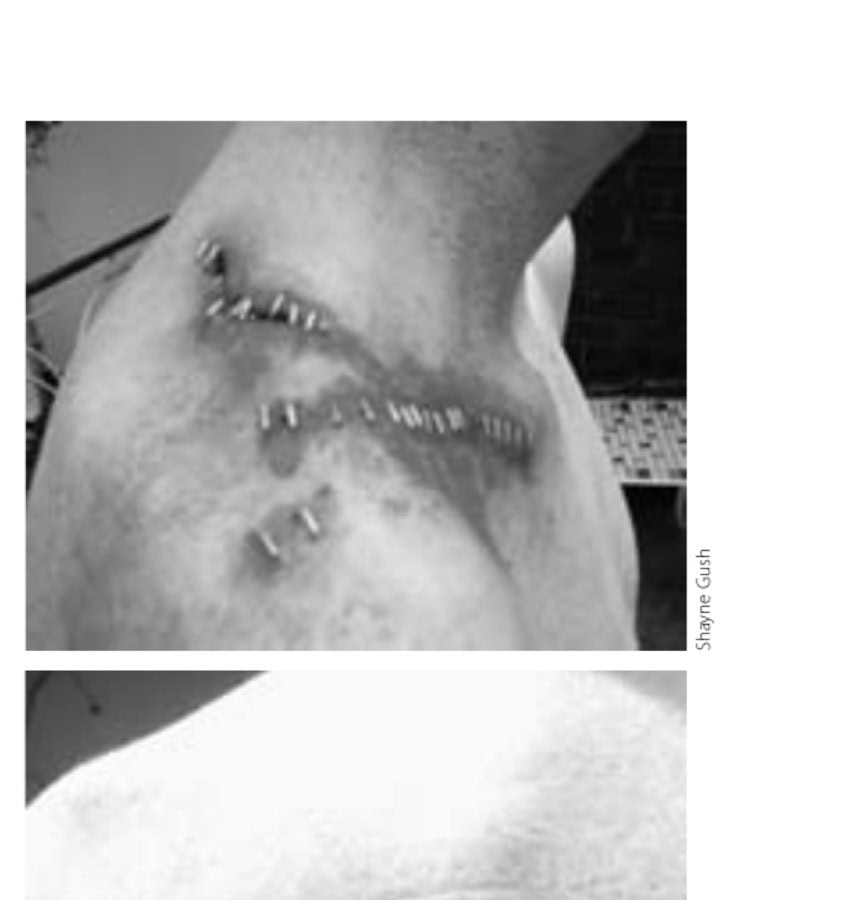
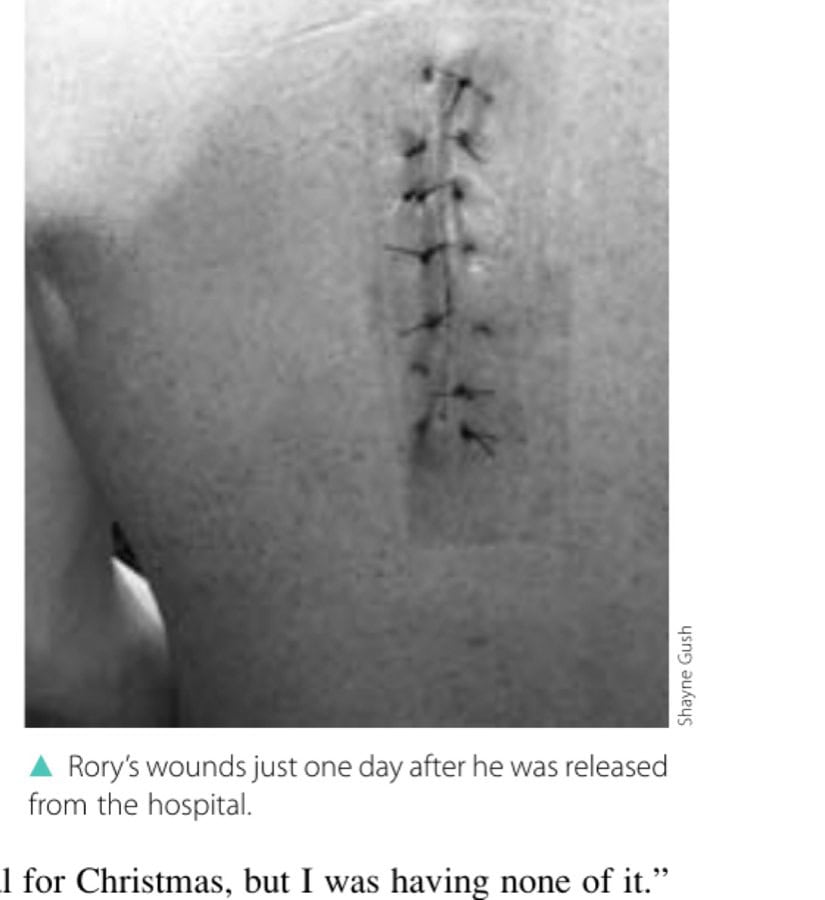
The shoulder required sutures and large staples to close. The injury to his back was easier—the doctors could use regular sutures. However, within a day,
Shayne Gush Shayne Gush
infection began to leak through the stitches, and the doctors had to reopen Rory’s back. From there, they went back to the procedure they had been following for the last several days: clean the infection and remove the dead tissue. Finally, the surgeons closed him up. * * * During Rory’s third week in the hospital, he started to become bored and decided that he needed to get back to his training for triathlon—walking around the gardens wasn’t cutting it anymore. He began running up stairs in the mornings and in the afternoons doing short 50-meter sprints. That was, however, until he bumped into his orthopedic surgeon one morning on the stairs. Needless to say, the surgeon wasn’t happy. “
I could see him boiling up inside,” Rory said. “He could not shit on me as I was not quite a kid, and since he was not quite sure what to say, he just walked off in a huff.” Rory wasn’t having much better luck with his cardiothoracic surgeon, Dr. Rumhizha. Every day they had the same argument: Rory wanted to leave the next day, and Dr. Rumhizha wanted him to stay
Rory’s wounds just one day after he was released for another week. from the hospital. “The big joke,” Rory said, “was that I would still be in the hospital for Christmas, but I was having none of it.” Suffice it to say that Rory was not St. Anne’s dream patient. This viewpoint was validated during Rory’s final operation during that third week in the hospital. That operation was to remove any remaining infected tissue and finally sew up all of his wounds. Rory had been given sedatives early in the morning and had
fallen asleep, but unexpectedly, he had woken up and hadn’t been taken to the operating room yet. Rory decided to take matters into his own hands. “I went to see what was going on and see what the holdup was and tell them to get a move on,” he said. “I had to get home in time for Christmas. So I hung around the operating theatre checking to see what was going on, and I chatted to a few people. The expression on the face of the young nurse was priceless when they saw me waiting at the door, and so I asked them, “What’s taking so long? Let’s get this show on the road!” Determined to be difficult, Rory insisted on sitting upright on the gurney as he was wheeled into the operating room.
Once he was in the operating room, the doctors administered the anesthesia. From his prior surgeries, Rory remembered that the doctors would tell him that he would start feeling sleepy, that they would count to five, and presumably by then, he would be asleep. This time, however, Rory was determined to make it to five. But for this operation, he didn’t make it past two.
Finally, Out and About Finally, Rory was discharged from the hospital. To celebrate his recovery, he and Shayne took a fishing trip to Chirundu, a border town in western Zimbabwe. In the weeks he spent in the hospital, he had lost a great deal of weight—nearly 15 pounds—and that was weight that Rory simply couldn’t spare. According to Rory, he looked like “a Somalian on Weight Watchers.” As a result of this weight loss, as well as the loss of his upper-body strength, when Rory caught a large tiger fish, he nearly fell into the river trying to pull in his catch. Nevertheless, over the next few months, Rory managed to gain the weight he needed in order to train and compete again.
In January 2004, he completed his first run in the middle of the month and his first bike ride and even started swimming at the end of the month. But for Rory, his speedy recovery was a double-edged sword: he became arrogant in his belief that he could begin competing so soon after his accident. Despite his efforts, he wasn’t able to compete at the National Champions triathlon in February or in the All-Africa Triathlon at the end of April. These setbacks devastated the young man who had set his sights on competing in the upcoming Olympic Games.
But the Zimbabwean Olympic Committee had not forgotten about Rory and his amazing achievements prior to his accident. In March 2004, Rory found out that the committee had awarded him an Olympic wild card, which meant that he would be able to attend the 2004 Olympics despite his lackluster training after the accident. “
I remember the phone call,” Rory said. “I thought that it would not mean too much to me, but I was wrong. I cried again. The happy kind of crying, the kind
that hits you totally out of the blue—suddenly, you cannot breathe properly and you are crying, only you are smiling ear to ear.” The wild card had its price, though. In order to compete at the 2004 Olympic Games, Rory would need to move up in his world ranking from 130th to 125th. If he spent the months leading up to the Games accruing points from a variety of races, he might be able to move up in his ranking. But that never happened, particularly since he hadn’t raced in the early months of the year.
For Rory, this was devastating. Triathlon had been his life, and suddenly, the one thing that he did best in his life was no longer possible. All of a sudden, the man who had always believed in himself and in his abilities as an athlete felt fear and doubt. Despite the fact that his friends and family had all the confidence in the world that he could do it, Rory didn’t. Perhaps one of the lowest points at this time was a training swim during which a 13-year-old kept whizzing by him. Prior to the accident, the swim would have been a breeze. “
Here I was a world-class triathlete hoping to get to the Olympics,” Rory said. “And I could not even finish a training session. I was being beaten by youngsters— and not even ones that were that good, either.”
After long hours agonizing over his inability to perform at his usual level, Rory decided to quit pursuing a professional career in triathlon. Even though he was dejected and feeling depressed, he was guided by his own set of principles. Accepting the Zimbabwean Olympic Committee’s offer would be an insult to the other athletes who, in Rory’s words, “had to work so hard and get there the hard way.” He wrote a letter to the Zimbabwean Olympic Committee explaining his decision and delivered it personally. It was one of the hardest things he had ever done, but he knew that his heart was no longer in triathlon.
And so, a few months later, Rory watched the 2004 Olympic Games from his living room chair and, according to him, without regrets.
Postscript: Rory and Shayne—Where Are They Now? Although Rory Mackie decided not to participate in the 2004 Olympics, he did continue to train. During his 2004–2005 season, Rory was named Zimbabwe Triathlon Champion and, once again, was asked to join the Zimbabwean Olympic Triathlon Team for the 2008 Games. In 2006, Rory took second place in the All-Africa Triathlon Championships. However, despite this tremendous achievement, Rory chose to leave the Zimbabwean Olympic Team and, ultimately, the sport of triathlon. His reasons were complex and focus largely on the permanent damage he suffered from the injuries sustained in November 2003 in Chizarira National Park. Rory believes that he will never overcome the physical limitations that his injuries inflicted on him. Rory currently works as an apprentice safari guide under his longtime friend, Craig Van Zyl.
After saving Rory’s life, Shayne Gush continued with his adventurous pursuits. “Shayne spends his life chasing adventure every chance he gets,” Rory says. Shayne currently resides in Harare, Zimbabwe, where he and Rory love to get together and share the occasional beer or two. Shayne will undoubtedly find a new adventure to pursue in no time.
This article originally appeared in Marathon & Beyond, Vol. 12, No. 4 (2008).
← Browse the full M&B ArchiveMore like this
1,000+ stories from 19 years of Marathon & Beyond
The complete archive of the legendary long-distance journal — digitized and free to read.
