

“Aj.” Twietmeyer
In November 2006, I snagged an invitation to the Runner’s World Heroes of Running ceremony in New York City. Nine running legends, including Frank Shorter, were in attendance to receive awards in honor of their contributions to the sport.
But it gets better. Within half an hour, I found myself seated next to a familiar, mustached fellow decked out in an unfamiliar shirt and tie. Accustomed to seeing pictures of him in running gear, sunglasses, and a fuel belt, I hesitated in asking, “Are you Tim Twietmeyer?”
He seemed surprised by my question but nodded and smiled in the affirmative. Within minutes we were chatting like old friends. Twietmeyer seemed more in awe of his surroundings than by his inclusion in them. When Paul Tergat walked in, regal and resplendent in a dark suit, the ultrarunning legend to my left murmured, “Man, I can’t believe I’m in the same room as him.”
Courtesy of Monica Hunsberger
▲
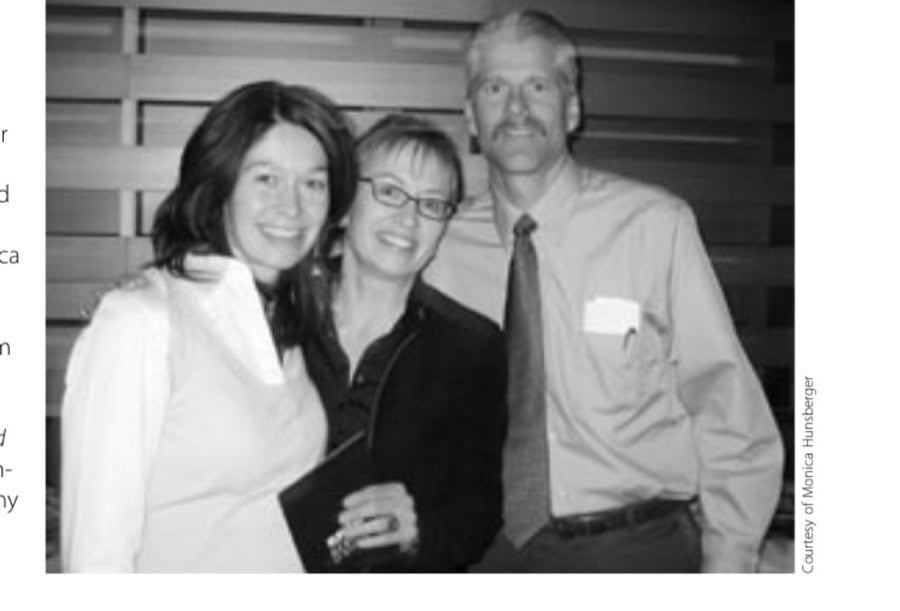
The author (middle) and her best friend and training partner, Monica Hunsberger, enjoy a moment with Tim Twietmeyer at the 2006 Runner’s World Heroes of Running Ceremony in New York City.
I began to understand why his nickname in the ultrarunning community is “A.J.” for “Average Joe.” * * * It is a nickname that makes little sense at first. Over the past 26 years, Tim Twietmeyer has racked up an impressive dossier of ultrarunning awards. A five-time champion of the 100-mile Western States Endurance Run, he is also the only person to have run it more than 20 times in under 24 hours. He also has finished in the top five 15 times and holds the masters course record of 17:17.
And those are just the stats for one ultra. The list of awards covers races such as the Eagle 100 Mile Run, the Jed Smith 50K, the Pueblo Nuevo 50-Miler, and the American River 50. Twietmeyer, 49, has completed the latter race 27 times. Shortly after the 2007 American River 50, he was characteristically enthusiastic and low key about the experience. “
I was pleasantly surprised with my time.” (He came in seventh out of 479 finishers, in seven hours.) “But the one thing that really got me was the pavement running the first 27 miles.” All that pounding is part of the reason Twietmeyer is changing focus. “I’ve got a left knee that’s probably not as happy as it would like to be, plus arthritis in my left big toe.”
While his love for the sport is unabated, this running icon admits that lately his body has been sending out distress signals. “It’s only recently where I’ve had wear ’n’ tear injuries. I didn’t have as much fun training this year.”
Talking to Twietmeyer is always a conversation punctuated with humor, even when he’s discussing negative aspects of aging. He laughs and continues, “Yeah, my brain is still 25 and my body’s closer to 45. So now I’m kind of starting to move in the direction of, ‘Well, how can I preserve this?’ There’s a mental shifting.” So in May 2007, for the first time since 1981, he didn’t run Western States. Instead, he spent time “seeing the race from the other side” as he worked alongside Greg Soderlund, the race director. “
It’s going to be weird not being all wound up on Friday afternoon,” he said before the 2007 WS100. “Plus I’ve never had to go to race stations in my car. . . . I’ll be seeing the other side of the event.” * * * The first time Twietmeyer got a taste for endurance running was in 1978, when as a college student at Chico State he caught wind of a strange event at a local track. It was a 24-hour run, so the curious 19-year-old just had to stop by for a peek.
What hooked him? “You know, to watch the people, how they competed . . . nothing seemed to faze them. Dick Collins, Ruth Anderson—these were not household names. And they just seemed like regular, simple guys.”
The future champion had played golf in high school and college, but he was just beginning to “run for fun.” In 1979, he competed in that same, crazy all-day track run. Then again, in 1980. “And the next year I did Western States.” Twietmeyer not only did the run. His first time out of the chute, he finished in under 24 hours. So the next year he went back with high hopes only to endure “the worst race of my life.” “You know, the first year there’s all this mystery. You’re wondering, can I do it, can I break 24 hours? But, man, that second year I got sick, lost like 20 pounds. I ate something bad, and once you start getting sick, it’s hard to stop. “
But I still broke 24 hours.” Looking back over a quarter of a century, Twietmeyer has definitely seen changes in the event itself. “Twenty-five years ago there was no GU, Cytomax, things that can really help you perform. Back then an aid station was a bag of potato chips and some water.”
He acknowledges that participants have come a long way in understanding how to handle the rigors of the race itself. “Scientifically, what we’ve learned about how to bounce back and perform, I think, is pretty valuable.”
Speaking about the course itself, Twietmeyer admits that these days “it’s a lot harder, longer, and more difficult than it was in ’81.” He attributes this to the addition of California Street, the section of trail that comes after Foresthill. “
But the spirit of the race is the same. There’s the personal exploration of trying to do something for the first time. To me, each time is still just as challenging.” It was 2001 when Twietmeyer broke the masters record, which he still holds today. But his sweetest WS memory dates back to 1992 when he won the race for the first time.
In the previous three years, Twietmeyer felt “like I was going backwards. I came in second, then third overall, and then fourth in ’91.” Nineteen ninety-two turned out to be “a really emotional year.” Twietmeyer and his wife, Kathy, had welcomed their second son, Trevor, in January and learned he had Down syndrome. “So we were focused on getting all the medical stuff handled. I really didn’t train like I had in the past. “
Maybe that was a blessing because when it came time, I just popped it out and said, ‘Let’s go.’” * * * Getting this modest, laid-back runner to discuss his attributes is like asking Scott Jurek to recommend a burger joint. There is a long pause after he is asked what makes him so successful. “
For me, it’s always been hard work. I’ve also made a point of getting away from it, so I’ve always enjoyed it. Late summer and fall, I get away. So that keeps me fresh.
© Joe McCladdie
“Also, when I came into the sport I was just an average guy.” (There’s that word again.) “I learned the sport, was in the middle of the pack, and I worked my way up. I always appreciated the people I met—role models like Dick Collins or Ruth Anderson or Doug Latimer who’ve run races and contributed back to the sport in a big way. “
A lot of guys come in for a year or two and then they flame, probably because they got overwhelmed. That balance around my family, my job . . . well, my running keeps me balanced.” Twietmeyer has been married to his wife, Kathy, for over 20 years. They have three sons: Matthew, 17, Trevor, 16, and Austin, 13. The boys aren’t as impressed with their father’s accomplishments as his fans are. “They just kind of tolerate me. They’re at the age now where they’re busy doing other things.”
The family man does admit that living with teenage boys influences one area of training: his dietary habits. “With three boys it’s pretty hard to get into broccoli and tofu dishes. We love pizza, spaghetti, and tacos. Plus, I’m a big ice cream guy.”
At Hewlett-Packard in Roseville, California, where Twietmeyer has worked for 26 years, coworkers and bosses often rib the engineering manager, especially whenever his picture appears in the local paper. “Yeah, they’ll be like, ‘Hey, you’ll never guess who’s on the front page of the sports section.’”
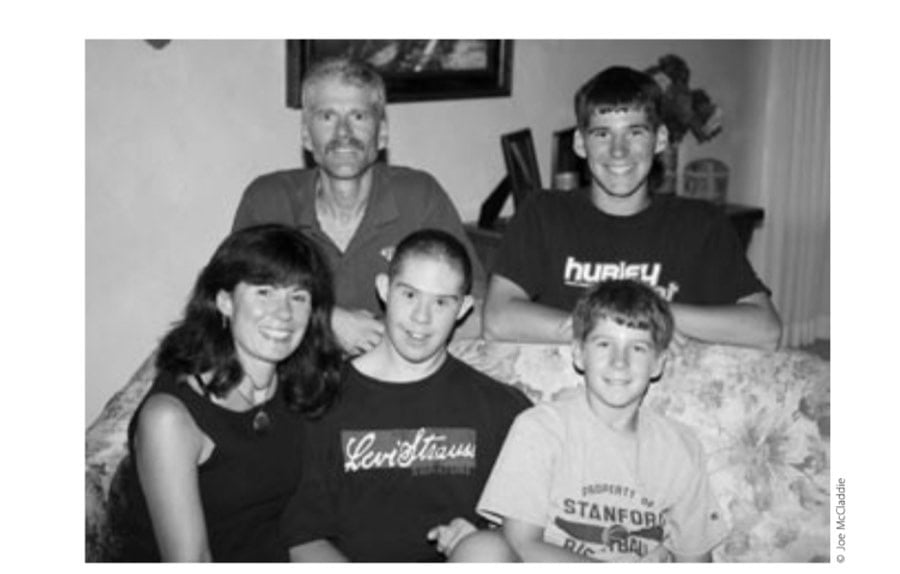
▲ Tim and his wife, Kathy, pose with their sons (left to right), Trevor, Matthew, and Austin.
It is hard to imagine that Twietmeyer won’t be gracing as many photo shoots as he has in the past. But is he really retiring or just shifting focus? “I’m still going to ultrarun. But I’d like to do some cycling events, maybe some century rides. “
I don’t really want to get into competitive cycling. I just enjoy riding with friends, like to Tahoe and back. Personal rides that are important to me are more intriguing than trying to do some race.”
Most weeks, Twietmeyer incorporates anywhere from 100 to 150 miles of cycling in his training. Whereas 15 years ago he would run 30 to 40 miles during the workweek and an additional “30 to 40 miles on Saturday with another five to 10 miles on Sunday,” these days he has cut his running distance by almost half. “
Now I do about 15 to 20 miles during the week and a longer run on the weekends of two to three hours, plus the time on the bike. Without a 100-miler on the horizon, I’ve tried to balance my mileage between running and cycling. So far, it’s working well.” * * * Greg Soderlund, for one, is doubtful that Twietmeyer has given up on the 100mile race that made him a legend. “I suspect he hasn’t finished with Western States,” notes the race director. “He’s always said that just once he’d like to run the race from the middle of the pack.”
Soderlund and Twietmeyer have known each other for close to 15 years. These days Twietmeyer is president of the Western States board, in the second year of
© Glenn Tachiyama
▲
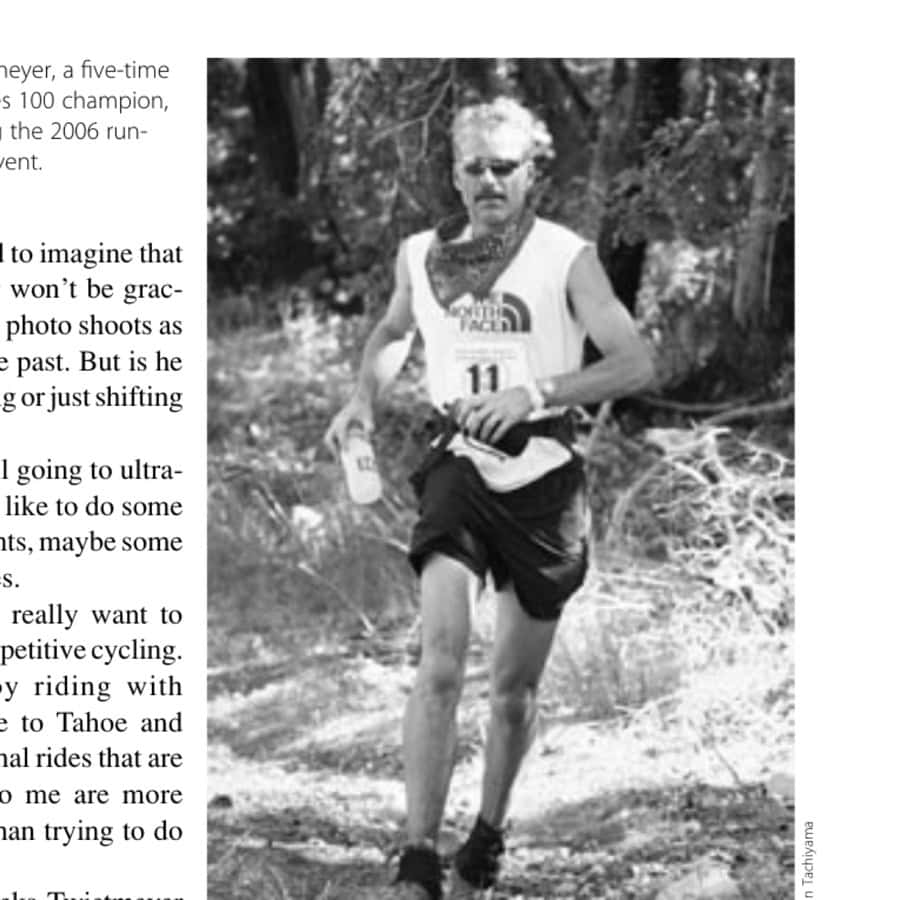
Tim Twietmeyer, a five-time Western States 100 champion, cruises during the 2006 running of the event.
a five-year term. So he and Soderlund speak on an almost daily basis, something the race director appreciates for a number of reasons. “I have to bounce a lot of things off him. You know, he just seems like this average guy.” (There it is again.) “
But I really got to know him sitting at these board meetings, listening to him give recommendations. We’d be trying to work out some issue, and he’d give us the simplest solution. He’s great at thinking outside the box.”
Having seen the cream of the crop at Western States, Soderlund also appreciates Twietmeyer as a competitor. “He’s somebody who goes out and runs his own race. If it’s fast enough to win, that’s fine. If not, that’s OK, too. The number one thing is he’s positive. “
Tim’s pretty laid back. You’ll see him at the beginning of the race, having a good time with everybody.” So how does Soderlund think Twiet will fare on the Western States sidelines? “He’s really looking forward to it. And I’m sure his wife—she’s a saint—is looking forward to it! This will all be new to him. He’s always wanted to see it from the other side because he’s not self-centered.
Four Zany Questions for “Twiet” 1. If you had to listen to one song over and over again on your MP3 player, what would it be? “Badlands” by Bruce Springsteen 2. If you had to spend your next life as a female ultrarunner, who would it be and why? (
After a lot of hemming and hawing: “Oh, I’ve got to be careful with this one!”) “Suzie Lister. Just because she’s a really funny person who has the same outlook on the sport as I do. She’s a fun person to be around.”
3. If you could be paced by any person in history, who would it be and why? “Someone like Sir Edmund Hillary or (George) Mallory, just because those guys were really fascinating, possessed by what they did. I’d want to hear what drove
them to such challenging feats when they had no real technology to fall back on.” 4. If you knew you could run only one more race, which race would it be? “Definitely Western States because that’s the pinnacle of the sport.”
▲
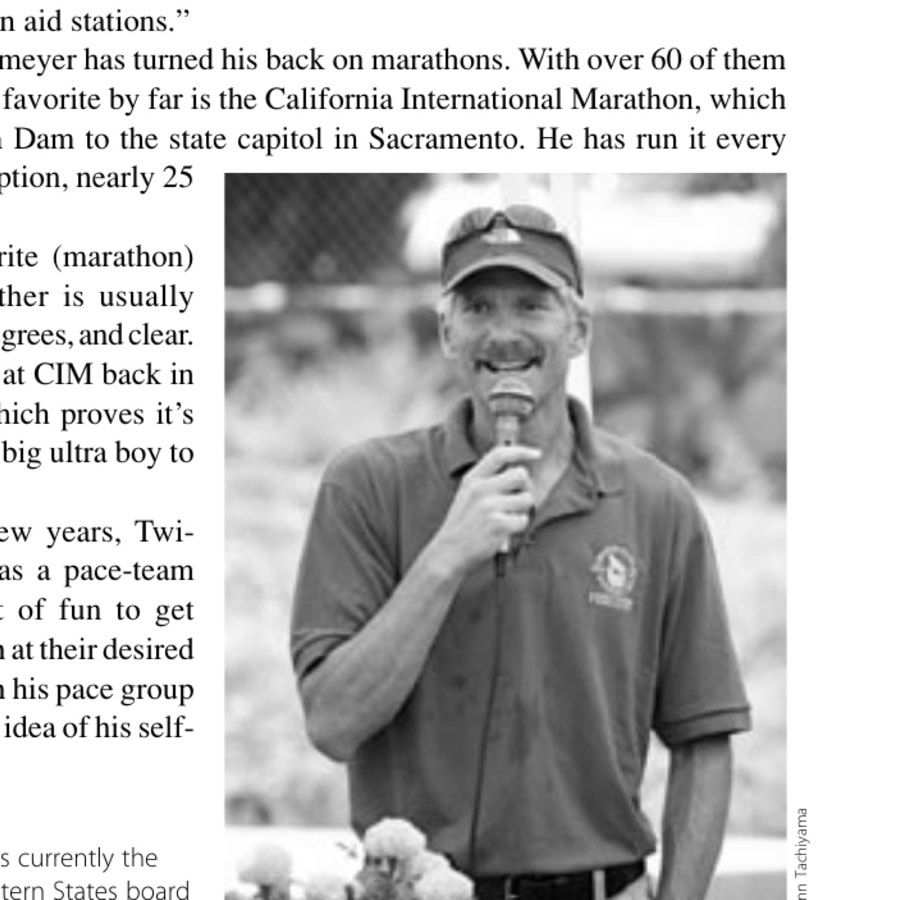
Tim Twietmeyer is currently the president of the Western States board of directors.
© Glenn Tachiyama
“What’s remarkable is the balance Tim keeps in his life with work, family, volunteer service to the community, and his competitive running. He’s had his challenges in life, and still he’s a rock-solid guy.”
Soderlund notes that whenever he and his friend are out in public, “I’ll introduce him to someone and Tim won’t talk about his accomplishments. I have to mention them.” * * * One thing Twietmeyer isn’t shy about is giving advice to the hordes of baby boomers who are making the transition from marathoning to ultramarathoning. “
I think that’s great. It [ultrarunning] can sometimes be less punishing than marathoning because the pace is slower plus the terrain tends to be more forgiving. I tell them, take it like they did their first marathon. Enjoy it so you have a positive experience and want to do it again. “
I’ve got some friends who are cyclists, and they’re thinking of doing an ultra. I tell them, ultrarunners never seem to be much in a hurry to get anywhere. It’s more about the experience than your time. “
People are so much more low key compared to, say, marathoners. You’re not elbowing people in aid stations.” Not that Twietmeyer has turned his back on marathons. With over 60 of them under his belt, his favorite by far is the California International Marathon, which runs from Folsom Dam to the state capitol in Sacramento. He has run it every year since its inception, nearly 25 years ago. “
It’s my favorite (marathon) because the weather is usually perfect: cold, 50 degrees, and clear. Plus I had my PR at CIM back in ’89 at 2:36:45, which proves it’s a fast course for a big ultra boy to run under 2:40!”
For the last few years, Twietmeyer has run as a pace-team leader. “It’s a lot of fun to get people to the finish at their desired time.” The folks in his pace group can get a firsthand idea of his self-
deprecating humor when they read his online pacer profile: “I’m tall, so if it’s windy and rainy, everyone can just tuck-in [sic] behind me and save their energy.” * * * On the whole, interviewing Tim Twietmeyer is a painless and smooth process. But he turns quiet and serious when asked to sum up what the last quarter of a century of ultrarunning has meant to him. After a full minute of silence he whispers, “Wow,” then continues. “
I’ve always said that my ultrarunning friends are the best friends I’ve had. I’ve just really enjoyed the people and the camaraderie. It’s almost like a second family.” Once again, Twietmeyer finds it easy to praise others while deflecting attention from his own accomplishments. “
Categorically, all the people are just really good people. I think maybe it’s just a sport that draws a different type of person who’s looking for a different challenge. “There are very few people out there just looking to win the event or be cool. Most of them are out there to run and enjoy other people.”
But the gregarious Twietmeyer didn’t take much time to chat with fellow runners after his top 10 showing in the American River 50 in April 2007. “I pretty much just toweled off a bit, grabbed something to drink, and hopped in my car.”
Home to jump in an ice bath? Nope. He drove 25 miles straight from the finish line to see his oldest son, Matthew, compete in a track meet. Gee, maybe he is just your Average Joe after all.
This article originally appeared in Marathon & Beyond, Vol. 12, No. 2 (2008).
← Browse the full M&B ArchiveMore like this
1,000+ stories from 19 years of Marathon & Beyond
The complete archive of the legendary long-distance journal — digitized and free to read.
